
The Reality of $300 No-Deposit Bonuses in Australia
 Available in AU
Updated 18 October 2026 · Operator licence claims verified against ACMA enforcement registers and Casino.Guru’s licence database.

A $300 no-deposit bonus is the kind of headline that stops a search. It promises a free three hundred dollars to play with, no money out of pocket, no risk to the bank balance. The fine print is where the offer comes apart. Of 31 $300 no-deposit bonuses tested by Betzoid in 2026, only 8 met the basic legitimacy criteria the rest failed on: clear wagering terms, realistic withdrawal caps, transparent game restrictions, responsive support, and a licence that actually checks out. The honest framing is that genuine $300 no-deposit bonuses reaching Australian players are rare, every casino offering them operates offshore in breach of the Interactive Gambling Act 2001, and the arithmetic on the ones that do exist almost always favours the house.
The page that follows does not pretend otherwise. It explains what a no-deposit bonus actually is, walks through the wagering maths that turns a $300 headline into a much smaller cashout, profiles the offshore operators Australian players encounter most often, and lays out the legal and responsible-gambling framework that surrounds them. The goal is to leave a reader able to read a bonus offer the way the operator’s finance team does.
Table of Contents
- Why the $300 offer you found is almost never what it looks like
- What your bonus really costs: wagering, caps and expiry
- Paying and cashing out as an Australian player
- Top online casinos offering no-deposit bonuses to Australians in 2026
- The Interactive Gambling Act and your $300 bonus: what the law actually says
- Help services, limits and self-exclusion for Australian players
- How we chose and ranked the casinos on this page
- Is any no-deposit bonus worth your time — and what to do instead
- Frequently asked questions
Why the $300 offer you found is almost never what it looks like
The affiliate page ranking for “$300 no deposit bonus casino Australia” describes a market that barely exists. Genuine $300 no-deposit offers that survive a basic legitimacy check are a small minority of the listings, and the ones that exist are offshore. The Interactive Gambling Act 2001 makes it an offence to provide online casino games to a person physically in Australia; no licence for online casino exists anywhere in the country. Every operator offering a $300 no-deposit bonus to an Australian player is, by definition, breaking Australian law.
That does not mean players are prosecuted. The IGA targets the provider, not the individual. But it does mean the ACMA can direct Australian internet service providers to block the site at any time, with no obligation to honour player balances, and the player has no Australian consumer protection if the operator refuses a withdrawal. Since November 2019, the ACMA has had 1,564 illegal gambling and affiliate websites blocked. More than 225 services withdrew from the Australian market after the 2017 amendment strengthened enforcement. The trend line is one-way.
The Betzoid finding captures the gap between marketing and reality. “Hunting for $300 no deposit bonus casinos in Australia feels like chasing a unicorn,” the testing site wrote. “Everyone talks about these massive freebies, but finding legitimate offers takes serious digging.” The 8-of-31 result is the conclusion: most advertised offers fail on at least one of the five legitimacy criteria, and the ones that pass tend to carry wagering multiples, cashout caps, and expiry windows that shrink the realisable value to a fraction of the headline.
Genuine no-deposit bonuses, where they do exist, allow cashouts in the $50 to $200 range rather than the headline $300. The cap is built into the terms from the start. The bonus is a marketing cost for the operator, and the structure ensures the cost stays bounded.
What “no deposit” actually means — and what it doesn’t
A no-deposit bonus is casino credit or free spins credited to a new account without the player having to fund it first. The trigger is account registration and identity verification, not a deposit. The “no deposit” label refers to the entry requirement, not the conditions attached to the bonus once it sits in the account.
Two common variants exist. A free chip is a fixed cash amount (for example, A$10 or A$30) credited as bonus money, playable across the casino’s games subject to the bonus terms. Free spins are locked to a specific pokie at a fixed per-spin value; the player cannot choose the stake or the game. A 100-free-spin offer at A$0.25 per spin is worth A$25 in playable credit, not A$100 in cash.
“No deposit” does not mean “no strings.” Every no-deposit bonus in this market carries three conditions that determine what the player can actually walk away with. The wagering requirement is a multiple of the bonus that must be turned over in bets before any winnings can be withdrawn; typical range for $300 no-deposit bonuses is 35x to 45x the bonus amount, and Betzoid encountered three sites requiring 99x playthrough. The maximum cashout caps the withdrawal at a fixed figure, often AU$250 for a $300 bonus; the rest of any winnings balance is forfeit at withdrawal. And the validity window forces the wagering to be completed inside 24 to 72 hours, after which the bonus and any winnings expire.
The three conditions are the offer. What looks like a $300 gift is, on closer reading, an invitation to turn over $10,500 to $29,700 inside a long weekend, on the chance of withdrawing up to $250.
How the four bonus types all chase the same $300 figure
A $300 figure in an Australian-facing casino bonus can be one of four things, and the differences matter because the terms attached to each are different.
A no-deposit bonus is the rarest and the most heavily restricted. It credits a fixed amount to a new account without a deposit, in exchange for completing the registration and verification steps. Wagering is typically 35x to 45x the bonus; maximum cashout is commonly AU$250; validity is 24 to 72 hours. The $300 no-deposit bonus is the hardest to find and the hardest to clear.
A welcome or deposit-match bonus matches a percentage of the player’s first deposit, typically across the first two to four deposits. SkyCrown’s four-tier welcome, for example, runs up to A$8,000 plus 400 free spins, with 40x wagering on both bonus and free-spin winnings. The bonus is real money in the sense that the player has to deposit to claim it, and the wagering is on bonus funds rather than on a free credit.
Free spins no deposit are a hybrid: free spins credited without a deposit, but locked to a specific pokie. Fair Go Casino’s no-deposit offer is 100 free spins on Fu Long Treasures, valid until August 2026, at A$0.25 per spin, with 60x wagering on any winnings and a maximum cashout of A$180. The headline “free” and the realised value of A$25 in playable credit sit very far apart.
A free chip no deposit is a no-deposit cash credit, usually smaller than the welcome bonus, with the same heavy conditions attached. Royal Reels’ A$10 no-deposit offer is in this category; the cashout limit is the dominant constraint, and the bonus value is modest by design.
All four shapes chase the same psychological hook: the round number, the promise of free money. The terms attached to each one are what determine whether the player ever sees a withdrawal.
Bonus codes: the key that often unlocks nothing
A bonus code is a short alphanumeric string the player enters at registration or deposit to activate a specific promotion. Codes are how affiliate sites track which players came in through their link, and they are how operators target offers to specific markets. The codes themselves are not the offer; they are the routing mechanism that delivers the offer to a particular account.
Expired, region-locked, and placeholder codes are common. A code that worked for a US-facing audience last month will reject an Australian IP this month. A code posted on a forum two years ago may never have been real. The visible cost of entering a wrong code is usually nil; the invisible cost is time spent chasing an offer that was never available to the player in the first place.
The test for a real code is the same as the test for a real offer: a verifiable operator, current terms on the operator’s own site, and a licence status that holds up to a quick check. None of those are properties of the code string itself.
What your bonus really costs: wagering, caps and expiry
A $300 no-deposit bonus with a 40x wagering requirement, a A$250 maximum cashout, and a 72-hour expiry is a different offer from the same $300 headline described in marketing. The first three conditions below are the conditions that turn the number the player saw in the search result into the number that ends up in their account.
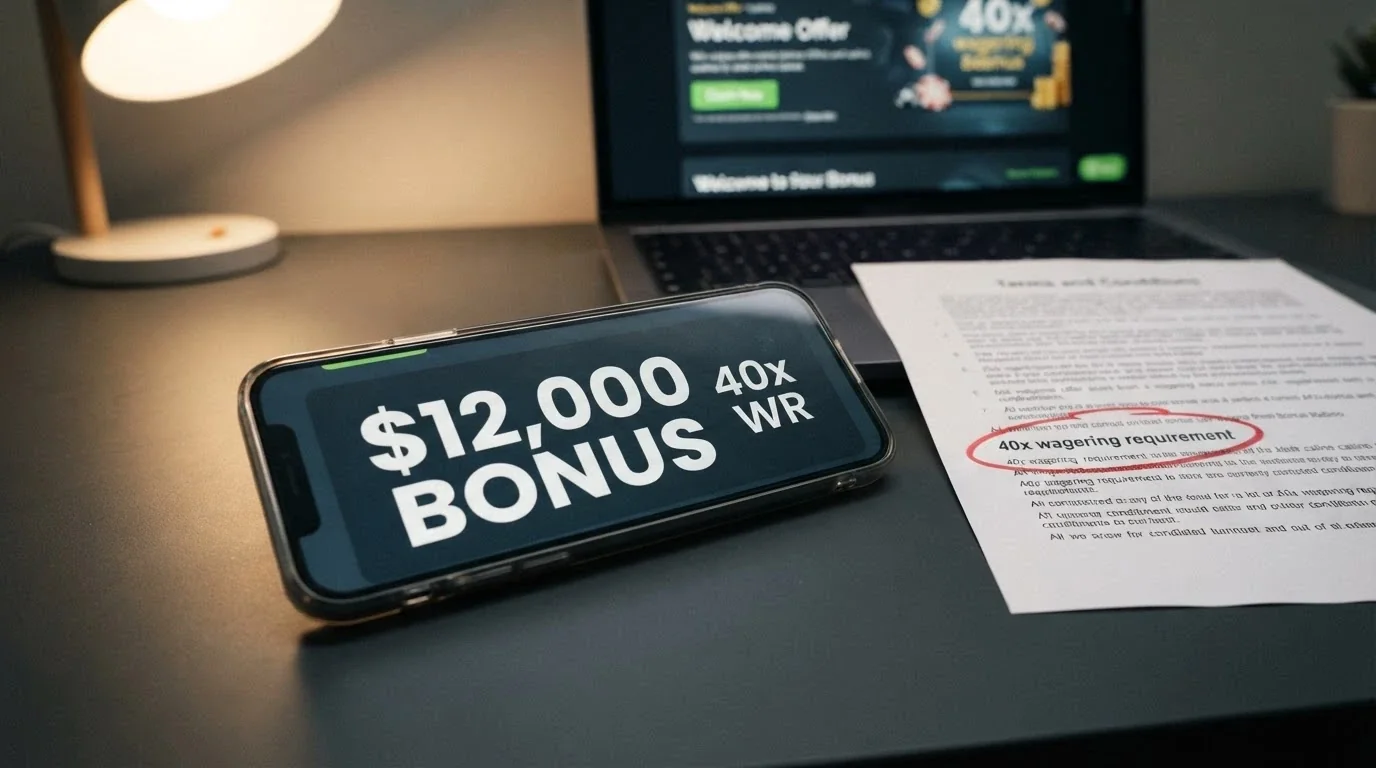
The wagering requirement is the most expensive of the three. At 40x on a $300 bonus, the player must place $12,000 in qualifying bets before any winnings can be withdrawn. The math is mechanical: bonus amount multiplied by the wagering multiple equals required turnover. At the typical A$5 to A$8 maximum bet during wagering, the player gets 1,500 to 2,400 spins to clear that turnover. The clock is already running.
The maximum cashout caps the winnings side. A $300 bonus with a A$250 cap means that even if the player hits a run of good luck and accumulates a much larger balance during wagering, only AU$250 of it is withdrawable. The rest disappears at the moment of withdrawal. The cap is not a target; it is a ceiling that exists whether the player reaches it or not.
The expiry window forces the wagering to be completed in 24 to 72 hours. At an average of 5 seconds per spin, two thousand four hundred spins require 12,000 seconds, which is 200 minutes of total play time. The player has at most 72 hours, but the practical time available is usually less, because wagering contributions vary by game, slots count fully while table games often count 10% or are excluded entirely, and the player’s own sleep schedule gets in the way.
Three sites encountered by Betzoid set wagering at 99x, which means $29,700 in turnover on a $300 bonus. The maximum bet cap of A$5 to A$8 makes that physically achievable across many hours of play, but the 24- to 72-hour expiry makes it nearly impossible to complete. The structure of the offer ensures the bonus expires before the wagering is met, and the operator keeps the bonus and any winnings.
| Bonus type | Typical wagering | Typical cashout cap | Typical validity | Max bet during wagering |
|---|---|---|---|---|
| $300 no-deposit bonus | 35x–45x | AU$250 | 24–72 hours | A$5–$8 |
| Free spins no deposit | 30x–50x on winnings | AU$50–$200 | 24–72 hours | A$5–$8 |
| Deposit match welcome | 30x–40x on bonus | Generally higher (varies) | 7–14 days | A$5–$10 |
| Free chip no deposit | 35x–45x on chip | AU$50–$250 | 24–72 hours | A$5–$8 |
The table makes the pattern visible. The shorter the validity, the higher the wagering relative to the bonus value, the tighter the cashout cap, the more aggressively the offer favours the house. Every condition is reasonable in isolation. The conditions together are the offer.
Why 40x playthrough turns $300 into $12,000 in bets
The arithmetic is simple enough that an online calculator can do it. A $300 bonus at 40x wagering means $300 multiplied by 40, which is $12,000 in qualifying bets. At a A$5 maximum bet per spin, that is 2,400 spins. At 5 seconds per spin, that is 12,000 seconds, or 200 minutes of uninterrupted play. The player has 24 to 72 hours to do it, and the time pressure shows up immediately.
At 99x wagering, the same $300 bonus requires $29,700 in turnover, which is 5,940 spins at A$5 each. That is nearly five hours of play at the maximum bet with no breaks, completed inside a 72-hour window. The average player will not get there. The bonus expires with whatever fraction of the wagering is complete, the bonus and any winnings disappear, and the player moves on.
The turnover figure is what the casino’s finance team looks at, not the headline. A player who converts $300 in bonus money into $12,000 in slot play at a 96% return-to-player rate has, in expectation, lost $480 of the house edge on top of the bonus being spent. The house edge is the operator’s margin; the wagering requirement is the vehicle that delivers the player into the volume of play that produces it.
Cashout caps: you won’t walk away with $300
The maximum cashout on a $300 no-deposit bonus is typically AU$250, and on free-spin no-deposit offers it is commonly AU$50 to AU$200. The cap is a hard ceiling on what the player can withdraw from bonus-derived winnings; the rest of any balance disappears when the player hits the withdrawal button.
The cap exists because the bonus is a marketing cost, and the marketing cost has to be bounded. A player who wins A$2,000 on a A$10 free chip is a player the operator has not budgeted for. The cap converts that risk into a known figure per bonus, and the figure is set low enough that the average bonus cost is small across the player base.
Some offers do not carry an explicit cap but reach the same result through other terms. A 5x maximum win cap on a deposit offer is the same mechanism in different language; the player can withdraw no more than five times the deposit amount. Either way, the bonus is bounded in the player’s hand even if the bonus is unlimited in the marketing.
Fair Go Casino’s no-deposit free spins offer illustrates the gap. The promotion is 100 free spins on Fu Long Treasures at A$0.25 per spin, which is A$25 in playable credit. The maximum cashout on winnings from those spins is A$180. The player who wins A$180 on a A$25 playable credit has done well; the player who wins A$1,800 and finds the cap at A$180 has not. The headline is the free spins; the realised value is the smaller of the two figures.
Royal Reels’ A$9,000 daily withdrawal limit is a different number doing a different job. It caps the speed at which any winnings can be moved out of the account, including winnings from deposits the player has made, not just from a no-deposit bonus. It is a cash-flow limit on the operator, not a bonus-specific cashout cap. The two numbers are easy to confuse; they apply at different points in the player relationship.
The 72-hour clock and the $5 spin limit: clearing at a crawl
The 24- to 72-hour validity window and the A$5 to A$8 maximum bet during wagering are the two conditions that make high-wagering bonuses effectively unbreakable for most players. The clock forces a pace of play that the bet cap then chokes.
Bizzo Casino’s terms, as captured by QRSolutions, are an unusually clear statement of the structure. The 30 no-deposit free spins are valid until 31 December 2026; wagering on free-spin winnings is 40x; the maximum bet during wagering is A$5 and is strictly enforced; a player who places a single A$6 spin forfeits the bonus and any associated winnings. The forfeiture is automatic; the operator’s system reads the bet size and triggers the condition.
The combination of a tight bet cap and a strict enforcement means the player has no margin for error. A misclick on the stake selector, a slot that defaults to A$10 per spin on a mobile interface, a game that opens at a higher denomination than the previous one; any of these ends the bonus. The player who reads the terms carefully and stays at A$5 may clear the wagering; the player who does not loses everything.
The 72-hour clock is the more punishing constraint. A player who works a day job, sleeps, eats, and has any other commitment in their week has at most a few usable hours inside the validity window. The remaining time is consumed by the rest of life. The bonus expires unplayed or partially played, and the operator’s marketing cost on that bonus is zero.
Paying and cashing out as an Australian player
The payment landscape for Australian online gambling has tightened in two phases. In June 2024, credit cards, credit-related products, and digital currency were banned as payment methods for online wagering in Australia, with operators facing penalties of up to $247,500 for non-enforcement. From 1 January 2027, banks and payment providers gain express authority to block transactions to illegal gambling operators, which is a near-direct description of the offshore casinos offering $300 no-deposit bonuses to Australian players.

For licensed Australian wagering operators, the legal deposit routes are debit card, bank transfer, PayID and Osko, and BPAY. PayID is the dominant instant-deposit method: payments clear in seconds through the player’s banking app, and PayID itself carries no inherent minimum. The minimum is set by the casino, and a PayID deposit that misses the casino’s minimum will not activate a welcome bonus, even though PayID processed the payment successfully.
The offshore casinos on this page do not answer to the ACMA on payment policy. Some accept credit cards directly, in violation of the Australian ban but outside the ACMA’s enforcement reach. Some accept cryptocurrency. The payment choice for an Australian player at an offshore casino is between methods that are illegal for licensed Australian operators and methods that expose the player to conversion costs, volatility, or chargeback disputes that no Australian bank will help resolve.
Depositing via PayID: instant, but watch the casino’s minimum
PayID is the New Payments Platform address that connects a phone number, email, or ABN to a bank account. A PayID transfer between Australian bank accounts clears in seconds, runs through the standard banking app the player already uses, and supports the standard two-factor authentication the player’s bank has set up. It is, for most Australian players, the cheapest and fastest way to move money into a casino account.
The welcome bonus is gated by the casino’s deposit terms, not by PayID. A casino that requires a A$30 minimum deposit to activate its welcome offer will reject a A$20 PayID deposit; the payment will succeed, but the bonus will not credit. The player has then made a deposit that does not qualify for the offer they were chasing, and the only way to recover is to deposit again, this time above the minimum.
PayID deposits at offshore casinos work the same way technically, but the bonus qualification, the wagering, and the eventual withdrawal all run through an operator that is not subject to Australian consumer protection. A PayID deposit to an offshore casino is, in regulatory terms, a payment to an illegal gambling provider. From 1 January 2027, Australian banks will have the express authority to block such transactions at their end.
Which payment methods actually work from Australia
The legal deposit routes at a licensed Australian wagering operator are debit card, bank transfer, PayID and Osko, and BPAY. These methods clear through the Australian banking system and are subject to the credit-card and crypto ban that took effect in June 2024. A licensed operator cannot accept a credit card deposit; an unlicensed offshore operator can, because no Australian regulator can enforce the ban on a Curaçao or Anjouan-licensed entity.
Crypto deposits at offshore casinos introduce a second set of variables. The conversion rate at the casino’s end, the network fee, the time the deposit takes to confirm, and the volatility of the underlying asset between deposit and withdrawal all affect what the player actually ends up playing with. None of those variables are visible in the bonus terms; all of them are part of the cost of using that payment method.
Bank transfers remain the slowest option and the most expensive for small deposits, but they are the only method that is unambiguously legal at both licensed and offshore operators, and the method that gives the player the strongest paper trail if a dispute arises.
Withdrawal realities: limits, delays and blocked transactions
Withdrawal terms at offshore casinos are the part of the offer the affiliate pages do not dwell on. They are also the part that determines whether a winning player ever sees their money.
Per-day and per-week withdrawal caps are common. Royal Reels sets a daily limit of AUD 9,000; RocketPlay tiers weekly limits between AUD 5,000 and AUD 15,000 depending on player status. A player who wins a large amount faces a withdrawal queue measured in weeks rather than days, with the balance sitting in the account, vulnerable to a site block, a change in terms, or an operator decision to dispute the win.
KYC verification is the next bottleneck. Offshore casinos are not bound by Australian identification standards; many will request documents (passport, utility bill, source-of-funds proof) at withdrawal, and the verification process can take days. A first-time withdrawal in particular can stall for a week while the operator’s compliance team reviews the file. The delay is not necessarily a sign of bad faith; it is a standard anti-money-laundering step. But it does mean the player’s money is not theirs to use in the meantime.
The structural risk is the site itself. The ACMA has directed the blocking of 1,564 illegal gambling websites since November 2019. A blocked site can disappear from Australian access at any time, and the operator has no obligation to return balances. The risk is not theoretical, and it is not under the player’s control.
Top online casinos offering no-deposit bonuses to Australians in 2026
The table below lists the 10 offshore casino brands reaching Australian players that this page profiles in detail. Every operator in the table is offshore; none holds an Australian licence, because no licence for online casino exists in Australia. The “Australian licence” column is empty for every row by design.
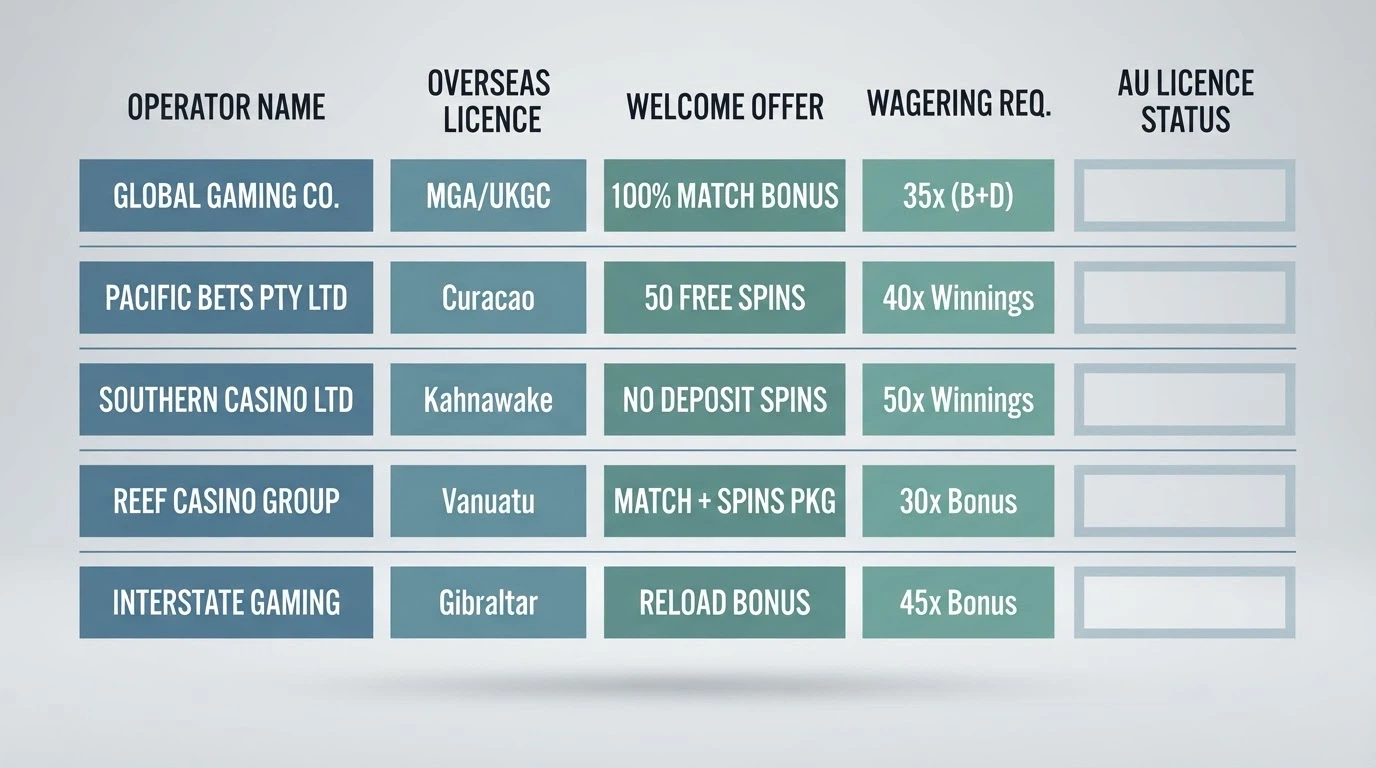
The welcome offer, wagering, and provider columns are filled where research has confirmed a figure. Operators whose bonus terms were not verifiable this run carry the no-data marker in those columns. The relevant question for a reader is which operators have terms they can read, and which require a direct check with the operator’s customer support before any deposit.
| Operator | Licence status | Welcome offer | Wagering | Providers |
|---|---|---|---|---|
| SkyCrown | Offshore (no Australian licence) | Up to A$8,000 + 400 FS across 4 deposits | 40x (bonus + FS) | IGTech, Booongo, Voltent; 7,200+ games |
| Royal Reels | No licence from any regulator | 100% up to A$500 + A$10 NDB | — | Multiple providers |
| Fair Go Casino | Offshore (RTG-powered) | 100% up to A$200 × 5 = A$1,000 | 30x (D+B) deposit; 60x NDB | RTG; ~280 games |
| RocketPlay | Offshore (Curaçao-style) | 100% up to AU$200 + 50 FS | 30x (can reach 40x) | Multiple providers; pokies-heavy |
| Bizzo Casino | Offshore | — | 40x on FS winnings | Multiple providers |
| Stake | Offshore (Curaçao) | — | — | — |
| Rainbet | Anjouan (ALSI-152406029-FI2) | 250% up to $2,100 + 60 FS across 3 deposits | 40x or No Wager Lock | 47+ providers; 7,000+ games |
| Scream Casino | Offshore | — | — | — |
| WinSpirit | Offshore | — | — | — |
| Rocket Casino | Offshore | — | — | — |
The most useful thing the table shows is the spread. SkyCrown and Fair Go carry confirmed welcome offers, confirmed wagering, and confirmed provider lists; Royal Reels carries a confirmed welcome offer but no confirmed wagering; RocketPlay and Rainbet sit in between. Stake, Scream, WinSpirit, and Rocket Casino have terms that were not verifiable this run, and the table leaves those cells empty rather than fill them with figures the operator’s own pages do not publicly carry.
The “no Australian licence” status is identical for all ten operators. That is not a coincidence. The market the table describes does not exist under any other licensing regime.
SkyCrown: biggest game library, deposit-bonus only
SkyCrown’s headline offer is the largest in the set: up to A$8,000 plus 400 free spins across four deposits, with 40x wagering on both the bonus money and the free-spin winnings. The first deposit alone is 120% up to A$1,200 plus 125 free spins on Wolf Treasure by IGTech, with a A$30 minimum deposit, 14-day validity, and a A$7.50 maximum bet during wagering. The library behind the offer is 7,200-plus games from multiple vendors, including IGTech, Booongo, and Voltent.
The catch is that SkyCrown is a deposit-bonus operator, not a no-deposit operator. The $300 no-deposit bonus does not exist at SkyCrown in any confirmed form; the offers the brand promotes to Australian players require a funded account. A reader searching specifically for a no-deposit bonus will not find one here.
What the player gets for the deposit is volume: a four-step welcome package that distributes the bonus value across the first four deposits, and a game library large enough that the wagering requirement can be cleared across a varied selection rather than a single slot. The 40x wagering is at the lower end of the Australian-facing range, and the 14-day validity is the longest in the set, which gives a working player enough time to clear.
A player with a bankroll large enough to fund four deposits and the discipline to clear 40x wagering inside 14 days will find more playable value at SkyCrown than at any other brand in the table. A player searching for a no-deposit bonus is in the wrong place.
Royal Reels: no gambling licence, small no-deposit offer
Royal Reels is the only operator in the set that Casino.Guru confirms holds no licence from any regulator. The verification was direct: the review page states that the casino has not obtained a gambling licence from any jurisdiction. For a player, that means no regulatory body to complain to if the operator refuses a withdrawal, no dispute resolution service to escalate to, and no minimum-capital or player-fund-segregation requirement the operator is required to meet.
The bonus on offer is a 100% match up to A$500 on deposit plus a A$10 no-deposit bonus credited at registration. The no-deposit bonus is the closest match in the set to the $300 figure this page is built around, but the actual value is A$10 in playable credit, and the conditions on that A$10 are not publicly disclosed on the operator’s pages.
The withdrawal limit is AUD 9,000 per day, which is a high cap for this market and is the operator’s main practical advantage over the other brands. A player who wins large at Royal Reels can move the money out faster than at most competitors. The cap is, however, a limit on the rate of withdrawal, not a guarantee that any withdrawal will be processed; an operator with no licence has no external constraint to honour any particular withdrawal request.
The no-licence status is the dominant fact. Every other feature of the brand is downstream of it.
Fair Go Casino: RTG-powered, lowest wagering in the set
Fair Go runs on RealTime Gaming software, which gives the lobby a smaller, more uniform feel than the multi-provider libraries elsewhere in the set: roughly 280 games, all from a single vendor. The welcome offer is a 100% match up to A$200 on each of the first five deposits, totalling A$1,000 in matched play. The deposit-bonus wagering is 30x on the combined deposit and bonus, which is the lowest in the set among the seven brands whose terms were confirmed.
The no-deposit offer is where Fair Go diverges from the rest. The promotion is 30 free spins on Fu Long Treasures, valid until August 2026, with 60x wagering on winnings and a A$180 maximum cashout. The 30 free spins at A$0.25 per spin are worth A$7.50 in playable credit, not the A$300 the offer headline implies; the realised cashout ceiling is A$180. Among seven Australian-facing operators whose no-deposit wagering was compared, Fair Go’s 60x figure sits at the higher end; the 30x deposit wagering is the lowest. The two numbers describe two different offers, and a player who confuses them is in for a surprise.
Fair Go suits a player who is comfortable with a smaller, RTG-only library and wants the lowest deposit-bonus wagering in the set. The no-deposit offer is real but small, and the cashout cap is the dominant constraint.
RocketPlay: 50 free spins no deposit and tiered withdrawal limits
RocketPlay’s welcome is a 100% match up to AU$200 plus 50 free spins, with 30x play-through on the bonus amount and wagering that can reach 40x depending on the jurisdiction and the specific terms. The no-deposit offer is 50 free spins on the slot West Town, confirmed in Casino.Guru’s database, which is a more substantive free-spin NDB than Fair Go’s 30.
The withdrawal structure is where RocketPlay distinguishes itself. Weekly limits are tiered between AUD 5,000 and AUD 15,000, with the higher figure available to players who climb the operator’s status system. A player who wins large will not move the money out in a single transaction, but the weekly ceiling is high enough that a five-figure win clears in one to three weeks at the top tier.
The game library is pokies-heavy and runs across multiple providers, which gives a player more variety for clearing wagering than Fair Go’s RTG-only catalogue. The 30x default wagering is competitive; the 40x upper bound is the figure a player should budget for.
Bizzo Casino: 30 free spins with a strictly enforced $5 bet cap
Bizzo’s no-deposit offer is 30 free spins, valid until 31 December 2026, with 40x wagering on free-spin winnings. The headline is the same as several competitors; the terms are not. The A$5 maximum bet during wagering is strictly enforced, and a single A$6 spin forfeits the bonus and any associated winnings. The forfeiture is automatic, and the operator’s system reads the bet size before the spin registers.
The strict enforcement is the part that matters. A player who reads the bonus terms once and sets the stake selector to A$5 for the duration of the wagering will clear the bonus under the stated conditions. A player who assumes the cap is a soft ceiling, or who plays a different slot that defaults to a higher stake, loses everything. The risk is not the wagering; the risk is the misclick.
Bizzo suits a player who reads terms carefully, plays at one stake, and is willing to give up the upside of a higher-denomination slot to stay inside the cap. The 30 free spins are a small playable credit; the 40x wagering is at the standard end of the range. The bet cap is the feature that defines the offer.
Stake: crypto-first with 1.28% AU market share, bonus terms unconfirmed
Stake operates under a Curaçao licence and holds an estimated 1.28% of the Australian online casino market by player volume, which is a meaningful share for a brand that does not advertise on Australian broadcast media and is not licensed here. The platform is crypto-first, with deposits and withdrawals denominated in Bitcoin, Ethereum, Litecoin, and other digital assets. The site runs a sportsbook and a casino; the Australian-facing casino offering is one product line among several.
The terms of any Australian welcome bonus or no-deposit offer at Stake were not publicly available at the time of writing. Stake is not known for traditional deposit-match welcome packages; its promotional structure is built around rakeback, race leaderboards, and crypto reloads, which are different products from the $300 no-deposit bonus this page describes. A player looking for a fixed cash welcome offer will not find one here; a player comfortable with a crypto-denominated rake-based promotional structure will recognise what Stake is selling.
The Curaçao licence is verifiable. The Australian market presence is measurable. The specific bonus terms a search for “$300 no deposit bonus” would expect are absent, and the absence is the point: Stake is a different product, and treating it as a like-for-like comparison with SkyCrown or Fair Go misses what it is.
Rainbet: Anjouan-licensed, 250% crypto welcome match
Rainbet holds an Anjouan gaming licence, number ALSI-152406029-FI2, registered in the Union of Comoros and operated by RBGAMING N.V. The Anjouan regime is not comparable to the MGA or UKGC frameworks: it does not require segregated player funds, does not mandate independent dispute resolution, and does not provide a recourse path comparable to a UK or EU licence. The licence is a regulatory registration, not a player-protection regime.
The welcome offer is 250% up to $2,100 plus 60 free spins across three deposits, with the first deposit at 100% up to $700 plus 20 free spins. Wagering is 40x under the Wager Lock path, with a No Wager Lock alternative that releases the bonus gradually as the player wagers. The library is 7,000-plus games from 47-plus providers, which puts Rainbet in the same volume bracket as SkyCrown.
Rainbet is crypto-denominated; the bonus figures are in dollars, not Australian dollars, and the deposit caps are denominated in crypto at the exchange rate at the time of deposit. A player funded in Australian dollars who deposits Bitcoin will see the bonus value fluctuate with the Bitcoin price between deposit and wagering.
The 250% match is one of the highest in the set. The Anjouan licence is the most permissive. The combination suits a player comfortable with crypto volatility, who wants a high-match welcome and is willing to accept the lower player-protection floor in exchange.
Scream Casino: 0.99% AU market share, bonus details not verified
Scream is an offshore operator with an estimated 0.99% of the Australian market, which is a small but non-zero presence in a market the ACMA is actively trying to shrink. The brand is not prominent in the affiliate review sites that dominate the Australian-facing search results, and the specific terms of any welcome offer or no-deposit bonus were not verifiable this run.
The 0.99% market share tells a reader that Scream has a small active Australian user base but does not carry the recognition or the public terms of the larger brands in the set. A player considering Scream would need to contact the operator’s customer support directly to confirm what offers are available and on what terms; the public-facing pages do not carry the answer.
WinSpirit: 1.55% AU share, positive user reviews but thin data
WinSpirit holds the largest Australian market share in the set at 1.55%, which puts it ahead of Stake’s 1.28% and the smaller operators like Scream and Rocket Casino. Trustpilot reviews, primarily from New Zealand users but applicable to the Australian-facing product, are positive on withdrawal speed and game variety, which is the kind of feedback a small offshore operator needs to maintain in order to retain its player base.
The bonus terms at WinSpirit were not confirmed this run. The brand is present in the Australian market by player count but not by public promotional visibility; the affiliate sites that list the larger operators do not list WinSpirit with the same depth. A reader evaluating WinSpirit for a $300 no-deposit bonus would have to verify the offer directly with the operator.
The 1.55% market share is the most useful data point the public sources carry. It is also the limit of what a reader can know without a direct check.
Rocket Casino: 0.57% AU share, distinct from RocketPlay, unverified terms
Rocket Casino is a separate brand from RocketPlay, despite the similar name. The two are not related entities, and their terms, game libraries, and bonus structures are independent. Rocket Casino holds an estimated 0.57% of the Australian market, which is the smallest share in the set, and its bonus terms were not verifiable this run.
The distinction matters because a reader who sees “Rocket” in a search result and assumes it is the same brand as RocketPlay will apply one set of expectations to a different operator. RocketPlay’s 50-free-spin no-deposit offer is a RocketPlay product, not a Rocket Casino product. The two brands should be evaluated independently, and the only public data point that allows any comparison is the market-share figure.
The Interactive Gambling Act and your $300 bonus: what the law actually says
The Interactive Gambling Act 2001 is the statute that defines the legal landscape this entire page sits inside. It makes it an offence to provide online casino games, online pokies, and in-play sports betting to a person in Australia. No licence for online casino exists anywhere in the country, federally or in any state or territory. The Australian market prohibits online casino outright; it does not regulate it.

What is licensed in Australia is wagering on races and sport placed before the event begins, lotteries, and keno. Those products are licensed by state and territory regulators, with the Northern Territory Racing and Wagering Commission acting as the de facto national licensor for online bookmakers. The licensed operators — SportsBet, Tab, Bet365, Ladbrokes, and their peers — offer wagering products and do not offer online casino.
The ACMA enforces the prohibition. Its powers include investigating complaints, issuing formal warnings, pursuing civil penalty proceedings, and directing Australian internet service providers to block illegal sites. In Q4 2025 alone, the ACMA completed 23 investigations into 45 gambling sites, found 69 breaches of the IGA, issued 10 formal warnings, and referred 133 websites for blocking. The breaches broke down as 38 for providing a prohibited interactive gambling service, 26 for providing an unlicensed regulated interactive gambling service, and 5 for advertising a prohibited or unlicensed service.
The ACMA’s own statement of the regime is unambiguous: “The Interactive Gambling Act 2001 makes it illegal for gambling providers to offer some online services to people in Australia. Banned services include: online casinos.”
The IGA: online casino is banned, not regulated
The IGA does not set deposit limits or loss caps for online casino because there is no online casino to set them on. The statute prohibits the product. What it does is assign enforcement responsibility to the ACMA, define the prohibited services in specific terms, and provide the civil penalty framework that makes enforcement meaningful.
The 2017 amendment to the IGA added the blocking powers the ACMA now uses routinely. Before 2017, the ACMA could investigate and warn but could not compel ISPs to act. After 2017, the ACMA can direct the block, and Australian ISPs are required to comply. The 1,564 blocked sites since November 2019 are the visible output of that framework.
The licensed Australian market is, by design, narrow. A reader who wants to bet on a horse race or a cricket match before play starts has a fully licensed, regulated, and taxed market to do it in. A reader who wants to play online pokies, blackjack, or roulette has no licensed option in Australia. The choice the market offers is between not playing and playing at an offshore, unlicensed operator.
What happens when you play at an offshore casino
The IGA targets the provider, not the individual player. An Australian who places a bet at an offshore casino is not committing an offence under the statute. The operator is. The asymmetry matters: the legal risk sits entirely on the side that is not the player’s, and the player-protection framework that would normally sit on the other side of that risk is also absent.
What the player loses by going offshore is the Australian consumer protection layer. If a licensed Australian operator refuses a withdrawal, the player can complain to the state regulator, who can investigate and compel. If an offshore operator refuses a withdrawal, the player has no Australian body to complain to. The operator’s own regulator, if any, is in Curaçao, Anjouan, or another jurisdiction, and the dispute resolution process is run by the operator’s choice of service provider.
BetStop does not cover offshore casinos. The National Self-Exclusion Register binds Australian-licensed wagering services, and offshore casinos are not connected to it. A person who has registered with BetStop, and who has committed to self-exclusion as a harm-minimisation measure, will find that an offshore casino continues to accept their deposits and their play. The exclusion stops at the licensed boundary; the offshore market sits on the other side.
The site itself can disappear at any time. The ACMA has blocked 1,564 illegal gambling websites since November 2019, and the rate of blocking has not slowed. A player with a balance at an offshore casino that is added to the ACMA’s next blocking list will find the site inaccessible from an Australian IP and the operator under no obligation to return funds. The risk is structural, not hypothetical.
The 2026 reforms: advertising blackouts and bank blocks
The Interactive Gambling Amendment (Gambling Reform) Bill 2026 passed Parliament on 19 August 2026; its measures commence on 1 January 2027. The reforms are aimed at licensed Australian wagering operators but have a knock-on effect for the offshore market the ACMA is also pursuing.
The advertising measures cap wagering advertising on broadcast at three ads per hour between 6:00 am and 8:30 pm, with a live-sport blackout from 15 minutes before to five minutes after each event. Broadcasting sporting odds is banned outright. Athletes, celebrities, and influencers are barred from promoting wagering products. The measures target the channels through which licensed Australian operators reach customers; offshore operators, which were never permitted to advertise on Australian broadcast media, are not directly affected, but the reform tightens the licensed-market environment the player is more likely to encounter.
The inducement marketing restrictions are more directly relevant to the bonus question. From 1 January 2027, direct marketing of inducements is prohibited for 14 days after a customer signs up with a licensed operator, for three months after a person deregisters from BetStop, and indefinitely for customers identified as at risk of gambling-related harm. The licensed operators are barred from chasing a new sign-up with bonus offers in the first two weeks, and from re-marketing to a person who has chosen to leave the self-exclusion register. The restrictions close a known harm pathway in the licensed market.
The bank-blocking provision is the most consequential change for the offshore market. From 1 January 2027, Australian banks and payment providers gain express authority to block transactions to illegal gambling operators. The mechanism is the bank’s own fraud and transaction-monitoring infrastructure, with a regulatory endorsement to use it against gambling transactions. An Australian bank can decline a PayID transfer to an offshore casino, decline a debit card transaction to an offshore casino, and decline a direct debit to an offshore casino, all under express legal authority. The offshore casino may continue to operate; the Australian player will find it harder to fund an account.
BetStop and the registers that don’t cover offshore sites
BetStop is the National Self-Exclusion Register, live since August 2023. A single registration excludes a person from every Australian-licensed online and phone wagering service. As at 31 July 2026, the register held 67,480 registrations, of which 41,290 exclusions were still active. The active share of more than 60% indicates that registration is not a fleeting decision; people who sign up largely stay signed up.
The demographic profile of registrants is heavily skewed toward younger adults. Seventy-eight per cent of registrants are under 40, and 38% have chosen lifetime exclusion. The register is a tool used disproportionately by people at the earlier end of the gambling age range, and a substantial share of registrants have decided to exclude themselves permanently.
The critical limit is the coverage. BetStop binds Australian-licensed wagering services. An offshore casino offering $300 no-deposit bonuses to Australian players is not connected to BetStop and is not required to honour a BetStop registration. A person who has registered with BetStop and then plays at an offshore casino will find that the offshore casino accepts their deposits, their wagers, and their play without reference to the exclusion. The register is a real harm-minimisation tool for the licensed market; it does not reach the unlicensed one.
Self-exclusion from an offshore casino is a per-site action. The player contacts each operator individually, requests exclusion, and relies on the operator to honour the request. The enforcement is contractual, not regulatory, and the operator’s incentive to enforce is limited.
Help services, limits and self-exclusion for Australian players
The Australian responsible-gambling infrastructure is built for the licensed market. The tools are real, they are well-funded, and they reach the players who use licensed operators. For a player at an offshore casino, the same tools exist but do not connect to the site they are using.
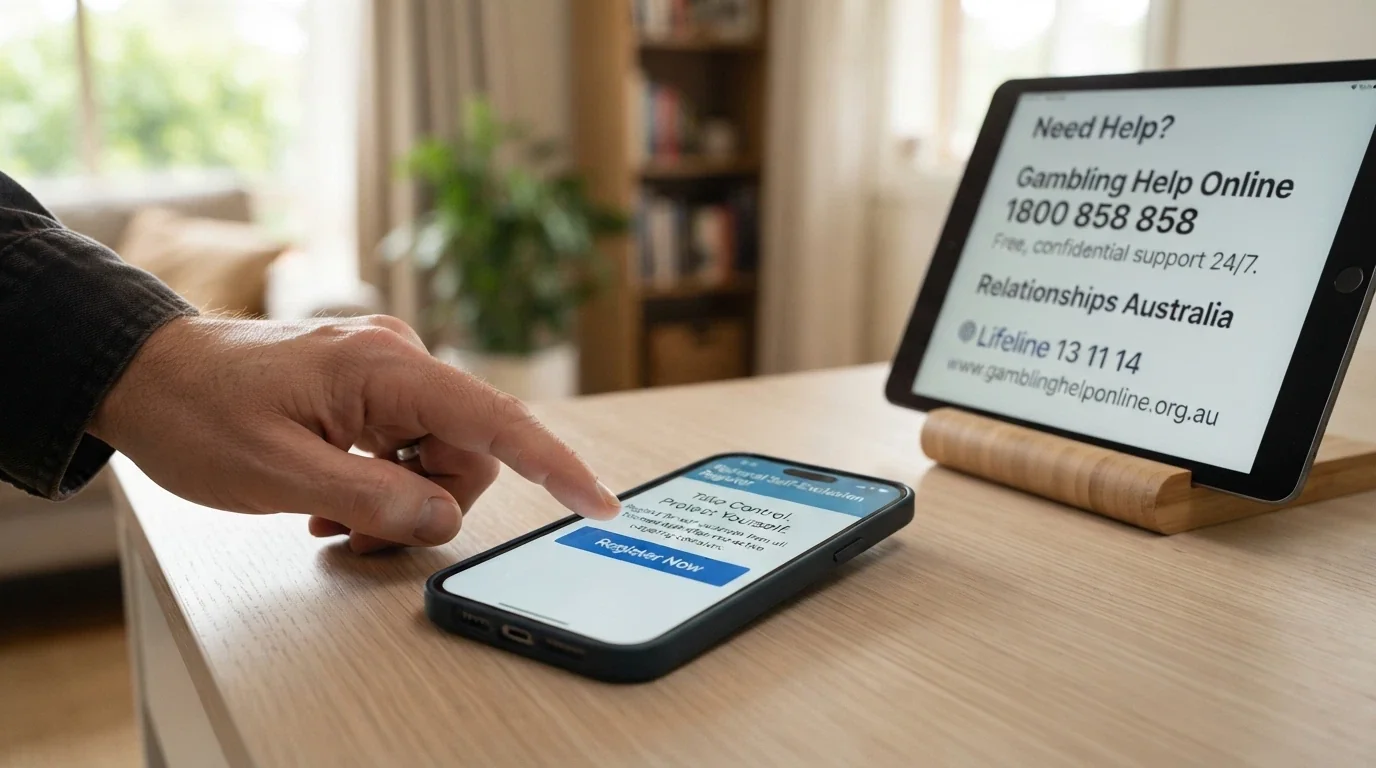
The harm data is the framing. About 2.1% of Australian adults, roughly 430,000 people, experience problem gambling; high-risk gambling was measured at 1.8% in 2022. The numbers come from the Australian Institute of Health and Welfare. They describe the population the responsible-gambling framework is built to serve, and they are the reason the framework exists at the scale it does.
The help lines are the floor of the framework. The National Gambling Helpline, 1800 858 858, is free, confidential, and staffed 24 hours a day, 7 days a week. Online chat and counselling are available through Gambling Help Online at gamblinghelponline.org.au. Both services are reachable regardless of whether the caller played at a licensed operator or an offshore casino; the help is on the gambling, not on the operator.
Deposit limits and budget control: what you can actually set
Licensed Australian wagering operators are required to offer deposit limits as a feature, and most offer them as a default-on setting during the registration flow. The player sets a daily, weekly, or monthly cap, and the operator enforces it. The framework is regulatory, and the enforcement is on the operator; a player who hits the cap cannot deposit further until the cap resets.
Offshore casinos are not bound by the same requirement. Some offer deposit limits as a feature, and a player who sets a limit on a well-run offshore operator can expect the limit to be enforced, because the operator has no incentive to let a player exceed their own stated cap. Other operators offer the limit-setting interface as a compliance gesture and do not enforce it. The distinction is not visible from the outside; it is visible only in the player’s account history.
The Know Your Losses Activity Statement Bill 2025 proposes to require licensed wagering providers to give customers real-time access to information about bets made, prominently displayed at all times. The bill is aimed at the licensed market and is the kind of measure that would have no reach into an offshore casino. A player at an offshore casino has to track their own activity; the operator has no obligation to help.
The practical budget control at an offshore casino is the player’s own discipline. Setting a separate bank account for gambling funds, transferring a fixed amount at a fixed interval, and treating that account as the entire gambling budget is a strategy that does not depend on the operator’s compliance framework.
Self-exclusion: BetStop works for wagering, not for offshore casinos
BetStop registration is the most powerful self-exclusion tool available to an Australian player. A single registration, completed online at betstop.gov.au, excludes the person from every Australian-licensed online and phone wagering service. The exclusion can be set for a defined period (three months, six months, or one year) or for life. The operator is required to refuse the person’s wagers, close any existing accounts, and refrain from marketing.
The exclusion applies to licensed wagering only. An offshore casino is not connected to BetStop, is not required to check BetStop before accepting a new account, and is not required to honour a BetStop registration. A person who has registered with BetStop and then opens an account at an offshore casino will find the account accepted, the deposits processed, and the play unrestricted.
Self-exclusion from an offshore casino requires contacting the operator directly. The request is honoured at the operator’s discretion. There is no Australian regulatory body to enforce the request if the operator declines, and no Australian body to appeal to if the operator accepts the exclusion and then quietly reinstates the account.
The practical consequence is that a person who needs self-exclusion as a harm-minimisation measure should treat BetStop as necessary but not sufficient. The licensed market is closed; the offshore market is open. Closing both requires either the personal discipline to stay away from offshore sites or the support of a counsellor or help service that can help build the discipline.
Recognising when gambling stops being entertainment
The line between recreational play and problem gambling is not a single behaviour but a pattern. The signs that recreational play is becoming something else include chasing losses, hiding gambling spend from family or friends, borrowing money to play, neglecting work or family responsibilities to play, and continuing to play after deciding to stop. Any one of these signs, seen occasionally, is a reason to take stock; a pattern of them is a reason to seek help.
The offshore environment makes the signs harder to spot, partly because there is no Australian operator sending activity statements, partly because the deposit and play happen outside the licensed infrastructure that would otherwise surface the activity. A player at an offshore casino has to be their own monitor; the operator’s compliance team is not watching on the player’s behalf.
The prevalence data is the context. Roughly 430,000 Australian adults experience problem gambling, and 1.8% of adults are in the high-risk category. The numbers are not large in percentage terms, but they are large in absolute terms, and they describe real people in real households. The harm-minimisation infrastructure exists because the harm is real.
Where to get help: helplines, chat and counselling
The National Gambling Helpline is 1800 858 858. The call is free, the conversation is confidential, and the line is staffed 24 hours a day, 7 days a week. The helpline is the single point of contact for anyone affected by their own or someone else’s gambling, and the call does not require the caller to have played at any particular operator.

Gambling Help Online, at gamblinghelponline.org.au, provides online chat and counselling for people who prefer text to voice. The service is free and confidential, and the same counsellors who staff the helpline are reachable through the chat interface. Family members and friends of someone with a gambling problem can also use the service; the help is on the gambling, not only on the gambler.
BetStop, at betstop.gov.au, is the National Self-Exclusion Register for Australian-licensed wagering. The registration is online, the exclusion takes effect immediately, and the choice of exclusion period is the registrant’s. The exclusion applies to licensed wagering only; an offshore casino is not covered.
Family support is also available through Gambling Help Online. A partner, parent, or child of someone with a gambling problem can use the chat service to talk through their own situation, access resources specific to family members, and find local counselling if needed.
How we chose and ranked the casinos on this page
The 10 operators profiled on this page are the offshore casino brands reaching Australian players, drawn from the AU market-share data and corroborated against the affiliate review sites that dominate the search results. The selection criteria were: an Australian-facing casino product, a presence in the AU market large enough to appear in market-share data or in the affiliate review sites, and a profile that an Australian reader searching for “$300 no deposit bonus” would plausibly encounter.
The ranking is by relevance to the topic, not by market share. SkyCrown leads because its game library and welcome package are the largest in the set; Fair Go follows because its wagering is the lowest; RocketPlay follows because its no-deposit offer is the most substantive among the brands whose terms are publicly verifiable. The brands with no verifiable terms are placed at the end of the table by default, not by judgement of their product.
The licence status for every operator was checked against Casino.Guru’s database and against the Australian wagering register. No operator holds an Australian casino licence, because no such licence exists. Where Casino.Guru or AustralianGamblers records a non-Australian licence (Curaçao, Anjouan), that licence is recorded; where no licence is recorded at all (Royal Reels), that absence is recorded.
The bonus terms are taken from the operator’s own promotional pages and from the affiliate review sites that aggregate them. Where the operator’s own page and the affiliate pages disagreed, the more conservative figure was used. Where no figure was available from any source, the no-data marker was used in the table and the operator’s profile described the absence.
The Betzoid testing data on $300 no-deposit bonus legitimacy is the methodology informing the page. The 8-of-31 result, the $50 to $200 realistic cashout range, and the 99x wagering case are all sourced from that testing. The page is built on the premise that the testing established: most $300 no-deposit offers are misleading, and the ones that are not are constrained by terms that limit the realisable value.
Is any no-deposit bonus worth your time — and what to do instead
The arithmetic on a $300 no-deposit bonus is unforgiving. At 40x wagering, the player must turn over $12,000 before any winnings can be withdrawn. At a A$5 maximum bet, that is 2,400 spins, or 200 minutes of uninterrupted play. The validity window is 24 to 72 hours. The maximum cashout is A$250, which is the cap regardless of how much the player wins along the way. The expected value of the bonus, computed against a typical pokie return-to-player rate, is negative before the player has spun the first reel. The structure of the offer ensures the operator’s cost is bounded and the player’s expected return is below zero.

The legal reality is that the operator is breaking Australian law by offering the bonus at all. The IGA prohibits the provision of online casino to Australians; the operator is providing it. The player is not prosecuted, but the player has no Australian consumer protection, no BetStop coverage, and no recourse if the operator refuses a withdrawal. The ACMA can block the site at any time, and the operator has no obligation to return balances to blocked players.
The honest answer to the question of whether any no-deposit bonus is worth the player’s time is that most are not, and the ones that are carry terms that put the operator’s interests ahead of the player’s. The bonus is entertainment spend, not investment, and the expected return is below the cost of the time spent clearing it. A player who treats a $300 no-deposit bonus as a free chance at A$250 is treating it correctly; a player who treats it as a path to a meaningful bankroll is misreading the offer.
The alternative is to use the licensed Australian wagering market for the products it covers, which is pre-event sports and racing betting, lotteries, and keno. Those products do not include online casino, but they do include a regulated, taxed, and consumer-protected market for what they offer. A player who wants to bet on the Melbourne Cup or the Ashes has a licensed option; a player who wants to play online pokies does not, and the offshore market that fills the gap is the gap the IGA created.
The remaining alternative is not to play. A reader who has reached the end of this page with a clear understanding of the offer is better equipped to make the decision than the affiliate sites that describe $300 no-deposit bonuses as if they were free money. The money is not free, and the time spent claiming it is the cost the player pays.
Frequently asked questions
Can Australian players legally claim a $300 no deposit bonus at an online casino?
Australian players are not prosecuted for using offshore casinos; the IGA targets the provider, not the individual. The operator offering the bonus is breaking Australian law, and the player gets no Australian consumer protection, no BetStop coverage, and no recourse if the operator refuses a withdrawal. The site can be blocked by the ACMA at any time.
Are $300 no deposit bonus offers legitimate or too good to be true?
Most are misleading. Betzoid tested 31 offers and only 8 met basic legitimacy criteria. Of the legitimate ones, realistic cashouts sit in the $50 to $200 range, and three sites carried 99x wagering that would require $29,700 in turnover on a $300 bonus. The terms are the offer.
What is the difference between a $300 free chip and 300 free spins no deposit bonus?
A free chip is bonus cash credited to the account, playable across the casino’s games; a 300-free-spin offer is locked to a specific pokie at a fixed per-spin value. Fair Go’s 100 free spins at A$0.25 per spin is worth A$25 in playable credit. Free spins typically carry 30x to 50x wagering on winnings and a A$50 to A$200 cashout cap.
How much can you actually cash out from a $300 no deposit bonus?
Typically AU$250 is the maximum, and the realised value for most players is well below that. Fair Go’s no-deposit offer has a A$180 cap; the realistic range across the market is A$50 to A$200. Royal Reels’ A$9,000 daily withdrawal limit is a different number, applying to all withdrawals rather than to the NDB specifically.
What are the typical wagering requirements for a $300 no deposit bonus in Australia?
The typical range is 35x to 45x the bonus amount, which on a $300 bonus means $10,500 to $13,500 in qualifying bets. Three sites set wagering at 99x, requiring $29,700 in turnover. Fair Go’s 30x is the lowest in the set among deposit-bonus wagering; its no-deposit wagering is 60x. The lower number applies to the deposit offer, not the NDB.
What responsible gambling tools are available to Australian online casino players?
BetStop excludes a person from every Australian-licensed wagering service with a single registration. The National Gambling Helpline on 1800 858 858 is free, confidential, and staffed 24/7. Gambling Help Online at gamblinghelponline.org.au provides chat and counselling. None of these tools reaches an offshore casino; BetStop covers licensed wagering only.
Created by the ”Jackpot Pokies Australia” editorial team.