
Online Casino Reload Bonus Australia: What the Terms Cost and Why Every Operator Is Offshore
A reload bonus looks like free money. The casino matches a slice of your next deposit and hands you a balance to play with — generous on the surface, friction-laden underneath. For Australian players, the picture is harder than for almost any other market: there is no licensed online casino in Australia, no domestic regulator writing terms for reload offers, and no BetStop coverage when the casino sits in another jurisdiction. Every reload bonus an Australian player can claim in 2026 comes from an offshore operator, on that operator’s terms, with that operator’s house rules.

This page works through what a reload bonus actually is, why offshore casinos offer them, and what the wagering terms underneath the headline match really cost the player. It compares ten offshore brands that reach Australian players, lays out the legal landscape under the Interactive Gambling Act 2001, and ends on the harm context that makes the topic more than a bonus-comparison exercise.
Current as of 18 October 2026, with the regulatory framework checked against the Australian Communications and Media Authority register and the Interactive Gambling Act 2001 as enforced through 2026.
Table of Contents
- What a Reload Bonus Actually Is (and Why It Exists)
- The Offshore Casinos Offering Reload Bonuses to Australians in 2026
- Rocket Play
- Skycrown
- Royal Reels
- WinSpirit
- Stake
- Rainbet
- Scream Casino
- FairGO
- Bizzo Casino
- Rocket Casino
- How Reload Bonuses Really Work Behind the Terms
- The Legal Reality: Offshore Reload Bonuses and Australian Law
- Staying in Control: Responsible Gambling When Using Offshore Casinos
- How We Evaluate and Rank Reload Bonus Casinos
- What Australian Players Should Actually Do About Reload Bonuses
- Frequently Asked Questions
What a Reload Bonus Actually Is (and Why It Exists)
A reload bonus is a deposit-match offer aimed at players who have already made at least one deposit. The casino picks a percentage — commonly 25%, 50% or 100% — and applies it to a returning deposit up to a stated cap. The headline is the match: deposit $200 and a 50% reload gives $100 in bonus funds. What sits underneath is a turnover requirement, a list of games that count toward clearing it, a maximum-cashout ceiling, and an expiry window. The bonus exists because the casino wants to keep a depositor active; the terms decide how much of the headline the player ever sees back.
What a reload bonus actually is
The deposit-match mechanic is the same one used in welcome offers, scaled down. A welcome bonus might match 100% of a first deposit up to several thousand dollars with hundreds of free spins attached. A reload trims both the percentage and the cap — typically half the welcome headline or less — because the player is already in the door and the casino does not need to pay acquisition costs. The cap is the lever: the casino decides how much bonus money it is willing to put on the table for any single reload event, and most reloads sit well below welcome-offer ceilings. A 50% reload capped at $200 is a common shape; a 100% reload capped at $500 is the upper end most operators publish.
Reload offers also tend to come with shorter validity windows than welcome packages. A welcome bonus might give the player 30 days to clear the requirements; a reload commonly gives 7, sometimes 14. The shorter window pushes the player to deposit again within a defined period rather than walking away with the bonus balance sitting untouched.
How a reload bonus differs from a welcome offer
A welcome offer is a one-shot acquisition tool. The casino pays a premium to convert a new sign-up into a depositing player, knowing that many of those new players will not return. A reload is a retention tool. The player has already demonstrated they will deposit, so the match rate drops, the cap shrinks, and the operator concentrates on keeping the depositor in the cycle rather than buying a new one.
Wagering tells a similar story. Welcome offers frequently carry higher multipliers — sometimes 40× or more on bonus-plus-deposit — because the casino is paying for the privilege of acquisition. Reload offers often sit lower, in the 25× to 35× band on bonus or bonus-plus-deposit, though the spread varies widely across brands. The eligibility window tightens at the same time: a welcome offer usually runs across the first one or two deposits within a stated period; a reload is tied to a specific deposit event with a defined window for opt-in and a defined window for clearing.
The structural point is that the welcome offer and the reload are the same kind of bonus priced differently for different jobs. The welcome pays to bring a player in; the reload pays to keep them from leaving.
The reload bonus calendar: weekly, weekend and loyalty reloads
Offshore casinos that target Australian players schedule reloads on predictable cycles. The three shapes most commonly seen are weekly reloads, weekend reloads, and loyalty-tier reloads.
A weekly reload runs on a fixed day — often a Monday or Friday — and resets every cycle. The player who deposits on the right day gets the match; the player who misses it waits for the next week. A weekend reload is the same shape with a tighter window, typically Friday through Sunday, and is often paired with free spins on a featured pokie. Loyalty-tier reloads are reserved for players the casino has flagged as high-volume: tier-based percentages, higher caps, sometimes personal offers negotiated by a VIP manager. Event-triggered reloads are rarer in the offshore-AU market but appear around major sporting events or seasonal promotions.
The calendar shape matters because it sets the rhythm the casino wants. A weekly reload trains the depositor to deposit weekly. A weekend reload concentrates play in a defined window. Loyalty reloads keep high-volume players inside the casino’s tracking rather than drifting to a competitor. Each is a retention mechanism dressed as a promotion.
The Offshore Casinos Offering Reload Bonuses to Australians in 2026
Australia does not issue online casino licences. Every operator below is offshore; none holds a permit from the Northern Territory Racing and Wagering Commission, from Licensing NT, or from any state or territory wagering regulator, because no such permit exists for the product these casinos sell. The ranking reflects reach to Australian players and platform accessibility; live offer terms were not confirmed for any operator in this research cycle, and the table states that openly.

| Casino | Licensed in Australia | Connected to BetStop |
|---|---|---|
| Rocket Play | No | No |
| Skycrown | No | No |
| Royal Reels | No | No |
| WinSpirit | No | No |
| Stake | No | No |
| Rainbet | No | No |
| Scream Casino | No | No |
| FairGO | No | No |
| Bizzo Casino | No | No |
| Rocket Casino | No | No |
The two columns carry every casino the same answer for the same reason: the Interactive Gambling Act 2001 prohibits online casino games to people in Australia, so the licence column has no positive value to put in any row, and BetStop binds only Australian-licensed wagering services. An Australian player signing up with any brand on this list sits outside the local licence framework and outside the national self-exclusion register.
What we looked for in a reload bonus casino
The ranking criteria were Australian-player accessibility, reload-offer structure, transparency of published terms, and platform reputation. Each operator was checked against the ACMA register of blocked and approved services; each was reviewed for published bonus terms; each was assessed for whether the platform accepts Australian registrations, the deposit rails on offer, and the level of term disclosure visible before sign-up.
The honest constraint on this ranking is that live offer data was not confirmed in this research cycle. Reload bonus percentages, caps, wagering multiples, game-weighting tables, max-cashout ceilings, and expiry windows were not verified for any of the ten operators listed. The ranking is therefore qualitative — the ordering reflects reach, platform maturity, and term transparency as observed, not a head-to-head comparison of matched percentages or turnover figures that research did not confirm.
Rocket Play
Rocket Play operates offshore and accepts Australian registrations. The casino’s reload-bonus terms were not verified in this research cycle: the headline match percentage, cap, wagering multiple, game-weighting table, max-cashout ceiling, and validity window are not on the record here. What is on the record is that the platform reaches Australian players, sits outside any Australian licence framework, and is not connected to BetStop.
For a reader comparing reload offers, Rocket Play is a known name in the offshore-AU market with a standard deposit-match structure. Without verified terms, the practical read is the same as for any offshore brand on this list: the offer is governed by the operator’s own published rules, and the player carries the gap between local protections and what the casino chooses to provide.
Skycrown
Skycrown is an offshore operator reaching Australian players. Like every brand on this page, it does not hold an Australian licence and is not connected to BetStop. The reload-bonus structure was not verified this run — match percentage, cap, wagering multiple, eligible games, max cashout, and validity were not confirmed against the operator’s published terms.
Skycrown has a presence in the Australian-facing offshore market and a published bonus section on its platform. What a reader needs to know going in is that the terms are the operator’s, that no Australian regulator will arbitrate a dispute, and that the safety net a licensed wagering account carries does not extend to a Skycrown account.
Royal Reels
Royal Reels operates offshore and accepts Australian registrations. Reload-bonus terms were not verified in this cycle: the headline match, cap, wagering multiplier, game weighting, max cashout, and validity were not confirmed against published terms. The operator’s Australian licence status is the same as the rest of this list — none is possible — and BetStop does not apply to an offshore casino.
Royal Reels is one of several offshore brands that have built a presence among Australian players. The reader-facing point is unchanged: the offer sits outside the Australian regulatory framework, the terms are the operator’s, and the protections a licensed wagering account provides are absent.
WinSpirit
WinSpirit is an offshore operator serving Australian players. Reload-bonus terms — match percentage, cap, wagering multiple, game-weighting contributions, max cashout, validity — were not verified in this research cycle. The operator is not licensed in Australia because no such licence exists for an online casino, and is not connected to BetStop.
WinSpit’s profile for an Australian reader is the standard offshore shape: a deposit-match offer with terms set by the operator, no ACMA complaint pathway, and no Australian consumer-law recourse if a withdrawal dispute arises.
Stake
Stake is an offshore operator with a substantial Australian-facing presence. The casino’s reload-bonus terms were not verified in this research cycle; the wagering multiple, eligible games, max cashout, and validity window were not confirmed against Stake’s published terms. The operator is not licensed in Australia, because no Australian online-casino licence exists, and is not connected to BetStop.
Stake is the largest and best-known brand on this list by reach. For a reader comparing reload offers, the same caveat applies: the offer is governed by Stake’s own rules, and any friction in clearing or withdrawing is a matter for Stake’s dispute process, not an Australian regulator.
Rainbet
Rainbet is an offshore operator accepting Australian registrations. Reload-bonus terms were not verified in this research cycle: the match percentage, cap, wagering multiple, game-weighting table, max cashout, and validity window were not confirmed. The operator holds no Australian licence and is not connected to BetStop.
Rainbet sits in the same offshore-AU shape as the rest of this list. The reader-facing read is unchanged: the offer’s terms are the operator’s, the safety net is absent, and any dispute resolution is internal to the platform.
Scream Casino
Scream Casino operates offshore and accepts Australian players. Reload-bonus terms were not verified this run: the headline match, cap, wagering multiple, eligible games, max cashout, and validity window were not confirmed against the operator’s published terms. The casino holds no Australian licence and is not connected to BetStop.
For a reader comparing reload offers, Scream Casino is one more offshore brand in a market where every brand sits outside Australian law. The terms that govern the offer are the operator’s, and the protections a licensed Australian wagering account provides do not extend to a Scream Casino account.
FairGO
FairGO is an offshore operator that has built a presence specifically among Australian players, with AUD banking and Australian-facing marketing. Despite that focus, the casino is not licensed in Australia and has no connection to the national self-exclusion register. Reload-bonus terms were not checked for accuracy in our research: match percentage, cap, wagering multiple, game-weighting contributions, max cashout, and validity were not confirmed against published terms.
FairGO is the most Australia-branded name on this list, but the brand presentation does not change the legal position. The reader-facing caveat is the same as for every offshore operator: the offer is governed by the casino’s rules, no Australian regulator arbitrates disputes, and BetStop does not cover the account.
Bizzo Casino
Bizzo Casino is an offshore operator accepting Australian registrations. Reload-bonus terms — match percentage, cap, wagering multiple, game-weighting table, max cashout, and validity — were not verified in this research cycle. The operator is not licensed in Australia and is not connected to BetStop.
Bizzo Casino sits in the standard offshore-AU shape: deposit-match offers with terms set by the operator, no Australian regulatory floor, no ACMA complaint pathway, no BetStop coverage.
Rocket Casino
Rocket Casino operates offshore and accepts Australian players. Reload-bonus terms were not verified this run: the match percentage, cap, wagering multiple, eligible games, max cashout, and validity window were not confirmed. The operator holds no Australian licence and is not connected to BetStop.
Rocket Casino closes out the ranking. The reader-facing read is unchanged from the rest of the list: the offer is governed by the operator’s rules, no Australian regulator arbitrates disputes, and the safety net a licensed wagering account carries does not extend to a Rocket Casino account.
How Reload Bonuses Really Work Behind the Terms
| Mechanic | Player Impact |
|---|---|
| Wagering requirement | Forces turnover targets before withdrawal |
| Game weighting | Reduces contribution of table games |
| Max-cashout ceiling | Bounds potential winnings |
| Expiry window | Forces faster deposit activity |
The headline match percentage is the marketing surface. The mechanics underneath decide whether any of the bonus money is ever withdrawable. Four mechanics matter: the wagering multiple, the game-weighting table, the maximum-cashout cap, and the validity window.
How wagering requirements eat into your reload value
A 50% match on a $100 deposit looks like $50 free. A 35× wagering requirement on bonus-plus-deposit turns that $50 into $5,250 of turnover before a dollar is withdrawable — the player has to put $5,250 through eligible games before the bonus balance converts to withdrawable cash. A 35× requirement on bonus-only is roughly half that figure, but the math still produces thousands of dollars of turnover.

The typical reload wagering multiple in the offshore-AU market sits in the 25× to 40× range on either bonus-only or bonus-plus-deposit. The exact multiple for any operator on this page was not verified in this research cycle, so the example above is a hypothetical illustration of how the mechanic works, not a confirmed reload term from any featured brand. The point holds regardless: a reload bonus is not free money, it is turnover that must be cleared before the bonus balance is yours. The higher the multiple, the more of the bonus the house edge eats before the player is allowed to withdraw.
Aussie reload casino offers: what the market actually looks like
Australian players searching for reload bonuses find offshore casinos only. No licensed online casino in Australia means no standardised reload terms, no common wagering multiple, no shared definition of eligible games, and no common maximum-cashout cap. The market the reader sees is ten or more offshore brands, each with its own published terms, each competing on headline match percentages and caps without a domestic regulator writing a floor under any of it.
The offshore casino advertising a welcome bonus to Australians is breaking the prohibition itself. The Interactive Gambling Act 2001 prohibits online casino games to people in Australia, and the Interactive Gambling Amendment Act 2017 strengthened the framework. The provider carries the legal exposure; the individual player is not prosecuted, but the offer itself sits outside Australian law.
Pokies reload bonuses versus table-game reloads
Reload bonuses favour pokies players. The game-weighting table at most offshore casinos assigns 100% contribution to slots and pokies — every dollar wagered counts a full dollar toward clearing the requirement. Table games like blackjack and roulette typically contribute between 5% and 20%, and live-dealer games are often excluded entirely or weighted at the low end.
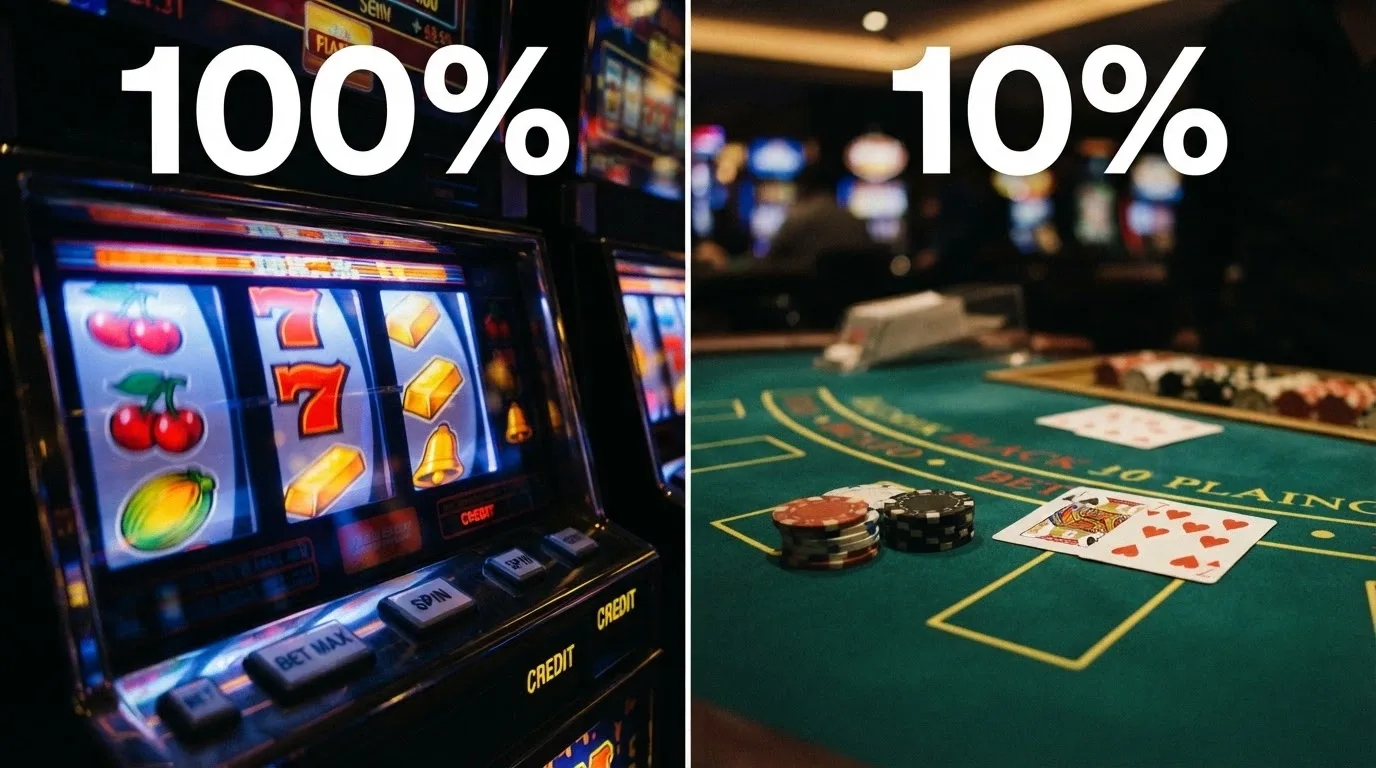
The mechanic means that a blackjack player clearing a reload bonus effectively faces a wagering multiple five to twenty times higher than the headline. A $50 bonus at 35× on bonus-only requires $1,750 of slot turnover; the same bonus cleared on blackjack at 10% weighting requires $17,500 of blackjack turnover. The game the player picks changes the real cost of clearing the bonus by an order of magnitude. Per-operator game-weighting tables were not verified in this research cycle, so the figures above are illustrative of the typical market range, not confirmed terms from any featured brand.
No-deposit reload bonuses: free spins with strings attached
A no-deposit reload asks for no deposit. The casino credits free spins or a small bonus balance to the player’s account, usually to re-activate a dormant depositor or to win back a player who has stopped logging in. The mechanics underneath are heavier than a standard deposit reload: wagering on winnings from the free spins is typically 40× or higher, the maximum cashout from the offer is capped at a low figure (often $50 to $100), and the eligible games are restricted to a short list of pokies the casino has selected.
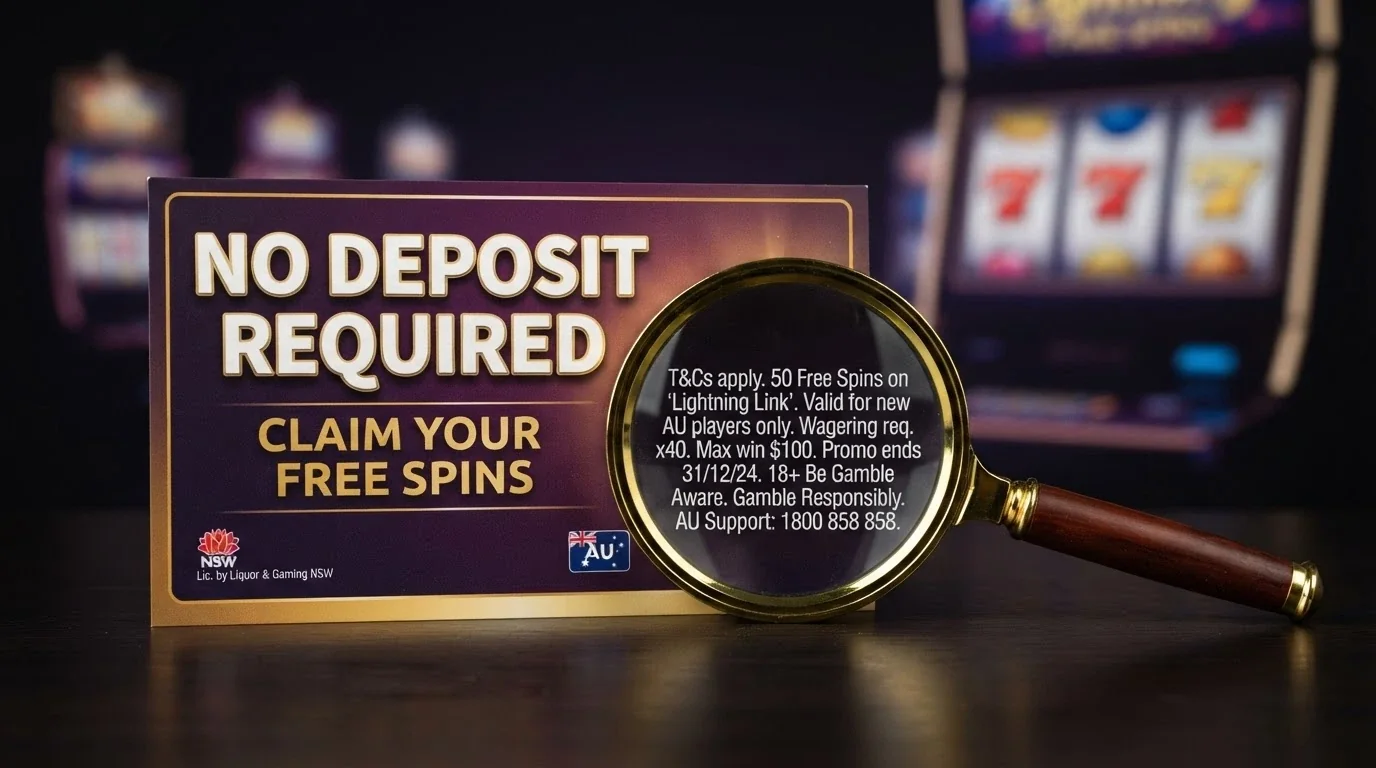
The trap is that the free spins cost nothing to claim but can be nearly impossible to clear. A player who wins $20 from free spins at 50× wagering on winnings has to put $1,000 through eligible pokies before the $20 converts to withdrawable cash, and the max-cashout cap means the upside is bounded even if the wagering is cleared. No verified no-deposit reload terms exist for the featured operators in this research cycle; the structure above is the typical shape across the offshore market.
Bitcoin and crypto reload bonuses: faster deposits, same wagering trap
Crypto reload bonuses are pitched on speed and anonymity. Deposits settle faster than card or bank transfers, and the casino can advertise privacy as a feature. The wagering terms are the same as any other reload — the bonus is still subject to turnover requirements, game-weighting tables, max-cashout caps, and validity windows.
The Australian layer is that credit cards, credit-related products and crypto are banned as payment for online wagering in Australia from 11 June 2024. The ban applies to licensed Australian wagering operators; an offshore casino is not bound by it. An Australian player using crypto at an offshore casino is using a payment rail the Australian framework has explicitly tried to close. Operator penalties for failing to enforce the ban can reach A$247,500, which is why licensed Australian wagering platforms do not accept crypto. The offshore casino that does accept it is operating outside that perimeter. Crypto volatility adds a second risk layer: the value of the deposit can move between deposit and withdrawal independent of the wagering outcome.
PayID reload bonuses: why the deposit rail doesn’t change the terms
PayID is a legal deposit route for licensed Australian wagering. Debit card, bank transfer, PayID and Osko, and BPAY are the methods licensed operators accept. A reload bonus claimed via PayID at a licensed bookmaker sits inside the Australian framework.
A reload bonus claimed via PayID at an offshore casino does not. The deposit rail is legal; the casino is not. PayID makes the deposit fast and familiar, but the bonus terms are still the offshore operator’s, the dispute resolution is still internal to the platform, and BetStop still does not apply. The rail is not the deal.
The Legal Reality: Offshore Reload Bonuses and Australian Law
The Interactive Gambling Act 2001 prohibits online casino games, online pokies and in-play sports betting to people in Australia. The Interactive Gambling Amendment Act 2017 strengthened the prohibition and gave the Australian Communications and Media Authority enforcement powers. The ACMA is the federal regulator that investigates complaints, issues formal warnings, runs civil penalty proceedings, and directs ISPs to block illegal sites.
Licensable online products in Australia are limited to wagering on races and sport placed before the event begins, lotteries, and keno. Minimum gambling age is 18. There is no federal deposit, loss or stake ceiling for online gambling because the product those limits would govern is banned outright. Australia caps the payment method rather than the deposit itself. The IGA targets the provider; the individual player is not prosecuted.
Why no online casino can be licensed in Australia
Australia’s gambling-licence framework covers wagering, not online casino. Online wagering licensing is state and territory business, with the Northern Territory Racing and Wagering Commission / Licensing NT acting as the de facto national licensor for major online bookmakers. NT licences for wagering operators can run for terms of up to 20 years; the NT regime was reformed in 2026 after criticism of the regulator’s structure.

Land-based casinos such as Crown and The Star are state-licensed and operate inside Australian venues under state casino control acts. Those state licences do not extend to an online casino product. The Interactive Gambling Act 2001 makes these games illegal across the country, and no state or territory can issue a licence for a product the federal Act bans. There is no online casino licence to apply for in Australia.
What Australian players lose when they claim an offshore reload bonus
An Australian player signing up with an offshore casino loses the framework that licensed wagering provides. BetStop, Australia’s National Self-Exclusion Register, binds only Australian-licensed wagering services; an offshore casino is not connected to it and can continue accepting money from a self-excluded person. There is no ACMA complaint pathway for an offshore casino dispute. Australian consumer-law recourse does not extend to a transaction with an operator outside Australia. Identity-verification standards are not guaranteed offshore; a licensed Australian wagering operator is required to verify identity at account opening, but an offshore casino sets its own standard.
Payment protections are also absent. From 11 June 2024, credit cards, credit-related products and crypto are banned as payment for online wagering in Australia. Operator penalties for failing to enforce the ban can reach A$247,500. From 1 January 2027, banks and payment providers gain express authority to block transactions to illegal gambling operators. The licensed system closes the rails; the offshore casino relies on rails the Australian system has explicitly moved to shut down.
ACMA enforcement: 1,788 blocked sites and counting
Since its first blocking request in November 2019, the ACMA has blocked 1,788 illegal gambling and affiliate websites. More than 230 illegal services have pulled out of the Australian market since the ACMA started enforcing new illegal online gambling rules in 2017. The ACMA’s October to December 2025 report recorded 23 investigations into 45 gambling sites and 69 breaches of the Interactive Gambling Act 2001: 38 breaches for providing a prohibited interactive gambling service to Australian customers, 26 for providing an unlicensed regulated interactive gambling service, and 5 for advertising a prohibited or unlicensed gambling service.

Enforcement is real but the market is whack-a-mole. New offshore brands appear as older ones are blocked, and the ACMA blocks new domains as they surface. For a reader, the practical effect is that an offshore casino URL they used last month may be blocked this month; the operator usually re-appears at a new address within days.
Staying in Control: Responsible Gambling When Using Offshore Casinos
The responsible-gambling infrastructure that licensed Australian wagering provides does not extend to an offshore casino. Deposit limits, session timers, reality-check pop-ups, take-a-break pauses, and activity statements are standard on Australian-licensed wagering platforms. An offshore casino is not obliged to offer any of them.

The tools offshore casinos won’t give you
Deposit-limit tools let a player set a maximum daily, weekly, or monthly deposit. Session-time limits cut the account after a defined play window. Reality-check pop-ups interrupt play at intervals to display elapsed time and net position. Take-a-break and cool-off periods lock the account for a defined span — days, weeks, or months — at the player’s request. Activity statements give the player a downloadable record of deposits, withdrawals, and net outcome over a chosen period.
All five are mandatory or standard on Australian-licensed wagering. None is guaranteed offshore. Some offshore casinos offer one or two of them as a competitive feature; many offer none. A player who signs up with an offshore casino and wants a deposit limit has to impose one on themselves, manually, outside the platform.
BetStop, self-exclusion and why offshore casinos ignore them
BetStop went live in August 2023. As at 31 July 2026, the register had 67,480 registrations, with 41,290 exclusions still active. 78% of registrants were under 40; 38% chose lifetime exclusion. The register works for licensed wagering: a self-excluded person cannot open an account with an Australian-licensed bookmaker and existing accounts are closed.
The gap is that BetStop binds only Australian-licensed wagering services. An offshore casino is not connected to the register. A person who has registered with BetStop can still open an account with an offshore casino, deposit, and play. The exclusion the person requested does not travel with them offshore.
The real harm numbers behind Australia’s gambling landscape
Between March 2025 and March 2026, Australians lost A$36.0 billion to gambling. As of March 2026, an estimated 2,857,000 Australians were experiencing some form of gambling harm from their own gambling behaviours. Risky gambling in Australia increased from 13.7% in 2024 to 19.4% in 2025 — a sharp rise in the share of the population whose gambling has tipped from recreational into harmful.
The figures frame why a page about offshore reload bonuses cannot treat the topic as harmless entertainment. The bonuses are marketed as rewards; the market they sit in is the same market those harm numbers describe. The National Gambling Helpline — 1800 858 858 — is free, confidential and staffed 24 hours a day, 7 days a week, with online chat and counselling through Gambling Help Online. The line cannot recover money lost to an offshore casino, but it can help a player who is reading this page and recognises themselves in the harm data.
How We Evaluate and Rank Reload Bonus Casinos
The ranking was built by checking each operator against ACMA-published registers, reviewing publicly available bonus terms on the operator’s own platform, and assessing platform accessibility for Australian players. Each operator was checked against the federal regulator’s record of blocked and approved services; each was reviewed for the visibility and clarity of its published bonus terms; each was assessed for whether the platform accepts Australian registrations, what deposit rails are available, and how the operator presents its bonus structure.
The honest constraint on the ranking is that live offer data was not confirmed in this research cycle. Reload bonus match percentages, caps, wagering multiples, game-weighting contributions, max-cashout ceilings, and validity windows were not verified for any of the ten operators. The ranking is qualitative — the ordering reflects reach to Australian players, platform maturity, and term transparency as observed, not a head-to-head comparison of confirmed bonus figures.
What Australian Players Should Actually Do About Reload Bonuses
The individual player is not prosecuted under the Interactive Gambling Act 2001; the Act targets the provider. That fact does not change what the player loses when they sign up with an offshore casino. No BetStop coverage, no ACMA complaint pathway, no Australian consumer-law recourse, no payment-method safeguards — and, from 1 January 2027, banks and payment providers gain express authority to block transactions to illegal gambling operators, tightening the rails that an offshore casino relies on.
Australian betting and gambling winnings are not assessable income under section 6-5 of the ITAA 1997, and gambling losses are not deductible under section 8-1 unless the person is carrying on a business of betting or gambling. The tax position is one of the few clean answers on the page.
The practical verdict is that reload bonuses at offshore casinos cost more than the headline match is worth. The terms underneath — turnover requirements in the thousands of dollars, game-weighting tables that penalise table-game players, max-cashout caps that bound the upside, expiry windows that push the player back to the deposit screen — combine to deliver a retention mechanism to the casino, not a windfall to the player. The licensed Australian wagering system does not offer online casino products at all, because the product is prohibited; a player who wants to stay inside the local framework is choosing between wagering, lotteries, and keno. A player who chooses offshore is choosing to play without the safety net those products sit inside.
The forward-looking note is that the Australian framework is tightening rather than loosening. From 1 January 2027, the reform adds federal restrictions including a cap of no more than three wagering ads per hour between 6:00 am and 8:30 pm, a live-sport blackout from 15 minutes before an event until 5 minutes after it ends, a ban on athletes, celebrities and influencers promoting wagering products, and prohibitions on direct marketing of inducements for 14 days after signup, for three months after BetStop deregistration, and indefinitely for customers identified as at risk of gambling-related harm. Banks and payment providers gain express authority to block transactions to illegal operators from the same date. The environment around the offshore casino is closing.
For a reader who wants to proceed informed, the steps are simple: check the operator’s published bonus terms before depositing, calculate the turnover the wagering multiple implies against the bonus amount, check the game-weighting table against the games the player actually plays, confirm the validity window, and confirm the max-cashout cap. Then weigh those numbers against the fact that no Australian regulator will arbitrate a dispute and that BetStop does not cover the account.
Frequently Asked Questions
How much of a reload bonus can I realistically walk away with after meeting wagering requirements?
The bonus balance becomes withdrawable only after the wagering multiple has been cleared, and even then a maximum-cashout cap often limits how much of the bonus converts to real money. Per-operator figures were not verified in this research cycle, so the practical answer is to check the operator’s own terms page for the wagering multiple, the game-weighting table, and the max-cashout cap before depositing.
Can I claim reload bonuses from more than one casino at the same time?
Nothing in the offshore casino model prevents a player from holding accounts at multiple brands. Each operator’s bonus terms apply independently — a 50% reload at one casino does not affect a separate reload at another. The risk layer is that the wagering obligations stack across accounts and no single operator sees the full picture, so the player has to track turnover themselves.
What happens if I try to withdraw my deposit before finishing the wagering on a reload bonus?
Standard offshore casino terms treat the bonus balance and the deposit as tied during the wagering window. Withdrawing the deposit before the wagering is cleared typically forfeits the bonus balance or any winnings derived from it. The exact treatment is operator-specific, so the published terms page is the only reliable source — and dispute resolution, if a withdrawal is refused, is internal to the platform, not via ACMA.
How long do reload casino bonuses usually last before they expire?
Reload bonuses commonly carry shorter validity windows than welcome offers, often 7 to 14 days from the qualifying deposit. The exact window is operator-specific and was not verified for the featured brands in this cycle, so the published terms are the source. A bonus that expires with unfulfilled wagering is forfeited, along with any associated winnings.
Are reload bonuses available on mobile casino apps for Australian players?
The ten operators on this page run browser-based platforms; the availability of a dedicated mobile app varies. The reload offer itself is platform-agnostic — it applies to deposits made through the same account regardless of device. The legal position is unchanged on mobile: the offshore casino is not licensed in Australia, and mobile access does not import Australian regulatory protections.
Why do offshore casinos keep targeting Australian players with reload offers in 2026?
The Interactive Gambling Act 2001 prohibits the supply of online casino games to Australian players, but it does not prosecute the player. Offshore operators operate outside Australian jurisdiction and continue to reach Australian players through affiliate marketing, search advertising, and direct email. The market is large enough — A$36.0 billion in gambling losses between March 2025 and March 2026 — to keep drawing offers despite ACMA enforcement and the 1,788 sites blocked since November 2019.