
Casino VIP Programs in Australia — What the Ladder Really Costs
A “VIP program” at an Australian-facing online casino is a tiered loyalty scheme that swaps your weekly play into status, and status into benefits the standard player never sees: higher withdrawal caps, a personal host, cashback on net losses, exclusive bonuses, the occasional holiday. The framing sounds generous. The mechanics are not. Every dollar an operator gives back is a dollar it has already taken from the player in house edge, and the tier you climb into is calibrated to extract more of that edge, not less of it.

That gap — between what a VIP program promises and what it actually delivers in dollars — is the subject of this page. The other subject is the geography. Online casino is prohibited in Australia under the Interactive Gambling Act 2001, and no operator holds an Australian online casino licence because no such licence exists. Every VIP program named below runs from offshore, under licences that are not recognised here, and every one of them is illegal to provide to a person in Australia. The player is not criminalised. The player is also, in practical terms, unprotected — no Australian complaints body has jurisdiction, no BetStop self-exclusion binds, and the site can be blocked by ISPs with a balance still on it.
The set below ranks ten operators that Australian players actually use. Some publish their VIP terms in detail; others do not. Where the operator hasn’t published, the page says so, because a comparison whose reader cannot tell which numbers come from the operator and which are guesswork is one they cannot use.
Data current as of 18 October 2026, verified against ACMA’s register of licensed wagering services and the operators’ own published VIP terms pages.
Table of Contents
- What an Online Casino VIP Program Actually Delivers (and What It Doesn’t)
- How VIP Casino Tiers Work — the Real Value of Climbing the Ladder
- VIP Casino Bonuses in 2026 — Why the Biggest Number Isn’t Always the Best Deal
- Australia’s Best VIP Casino Programs — 2026 Edition
- The Legal Reality — Playing at VIP Online Casinos from Australia
- Accessing Your VIP Casino Account — Login, App and Mobile Reality
- Inside the VIP Room — What Casino Clubs and Lounges Actually Offer
- VIP Pokies and Tables — Where the High-Stakes Action Lives
- Crypto VIP Casinos — Faster, Cheaper, but Not Without Risk
- Reading VIP Casino Reviews — Separating Promotion from Honest Assessment
- How We Evaluated These VIP Casino Programs
- What Your VIP Casino Strategy Should Look Like in 2026
- Frequently Asked Questions
What an Online Casino VIP Program Actually Delivers (and What It Doesn’t)
A VIP program is the loyalty scheme that sits on top of the games. The player wagers real money; the program credits points, experience, or “comp” currency; the points accumulate until they cross a threshold, and at the threshold a new tier unlocks. Each tier brings more benefits than the last — the canonical list runs cashback percentages up, withdrawal ceilings up, personal host access in, response times down.
The mechanics are a copy of airline frequent-flyer programs, and they are designed with the same intent: keep the high-value customer inside the ecosystem, and reward them in ways that cost the operator less than giving the equivalent in cash. A 15% cashback on net losses is generous in marketing. Against an average pokie house edge north of 4%, it is roughly a quarter of what the player has already paid to play.
The basics every Australian player should know before joining
The Australian context shapes everything that follows. Online casino is prohibited here, so the term “VIP casino Australia” describes two things at once: the marketing category the operators use, and the legal situation they operate in. No VIP program available to an Australian player runs from a domestically licensed operator. Every one is offshore, and every offshore licence — Anjouan, Curaçao, Malta (MGA) — is not recognised by the Australian regulator, the Australian Communications and Media Authority.
The player is not committing an offence by joining. The Interactive Gambling Act 2001, section 8AA, targets providers, not players. What the player is giving up is every domestic protection that would attach to a licensed relationship: no access to BetStop self-exclusion, no ACMA complaints pathway, no Australian Financial Complaints Authority, and no guarantee that a balance will be reachable if the site is blocked. These are not small concessions. They are the difference between a regulated product and a contract with an entity the reader’s home government cannot help them enforce against.
The “VIP” label, meanwhile, is the loosest word in the category. Some operators mean a transparent, multi-tier scheme with published thresholds and rewards. Others mean a manually curated list of high-spending customers, contacted by a host when the analytics flag the account. The promotional surface is similar; the underlying mechanism can be very different.
How VIP Casino Tiers Work — the Real Value of Climbing the Ladder
Tiered loyalty is the structure almost every operator in the comparison has adopted, and it is the structure the page will dig into first. The terms vary, but the architecture is consistent: a defined number of levels, a point-earn rate, a threshold to advance, a benefit schedule that improves with the level, and — at the top — a tier that is not earned by play at all, but by an invitation from the operator’s VIP team.

Tier structures explained — from entry level to invitation-only
The count runs from 4 to 10 tiers across the operators with published terms. Mr Green is the most compressed: four named tiers (Green, Silver, Gold, Platinum) and the top tier is invite-only. Caswino sits in the middle with five (Bronze through Diamond). Jackpot Jill runs six (Bronze through Royal) and reserves Diamond and Royal for invitation. Royal Reels is the deepest at ten (Opal through Diamond).
The earn rate is where the math gets interesting. Royal Reels credits 50 XP for every AU$1 wagered, so the climb is mechanical and visible to the player. At Jackpot Jill, Silver unlocks at roughly A$1,000 in lifetime wagers, which is fast for a casual player and trivial for a serious one. The published thresholds sit at the low end of “what you would play through in a month” for the entry tiers, and at the high end of “what you would play through in a year” for the upper tiers. The most generous perks are reserved for the bands the average player will never touch, which is the standard loyalty-program architecture, and worth naming plainly.
“Invitation-only” deserves a sentence of its own. The label means the operator has decided not to publish a wagering threshold for the top tier, and the player is not told what they need to wager to qualify. In practice the operator’s VIP team monitors high-volume accounts and extends invites by direct contact. The benefit to the operator is flexibility — they can promote a high-spending player with modest tenure past a slower but longer-tenured account. The cost to the player is that the goalpost moves.
The benefits that actually matter — cashback, personal hosts and priority withdrawals
The promotional list is long. The benefits that translate into dollars are shorter. Cashback on net losses is the first one: a percentage of what the player lost in a period returned as cash or bonus credit, with no further wagering. Caswino publishes a 5% rate at Bronze scaling to 15% at Diamond, paid monthly. Rakeback — a percentage of the theoretical house edge on every bet, regardless of whether the player won or lost that bet — is rarer and more valuable, and Caswino includes it from the entry tier. Where a program offers both, the player is being compensated from two angles, which is the closest thing in the category to a structural edge.
Personal account managers arrive at the upper tiers. Joe Fortune publishes a manager at Platinum and above. Jackpot Jill publishes one at Gold, after roughly A$5,000 in lifetime wagering. The value of a host is not the small exclusive bonus they will email; it is the speed at which a withdrawal issue, a verification request or a game dispute is resolved. The standard player waits in a queue. The VIP player waits on a person.
Withdrawal limits are the easiest benefit to compare in dollars. Mr Green publishes daily limits scaling from A$5,000 at Green, to A$7,500 at Silver, A$10,000 at Gold and A$20,000+ at Platinum, with withdrawal times compressing from 1–3 business days to same-day. The top of the broader market reaches A$50,000 per day, against a standard A$5,000 ceiling for unverified accounts — a tenfold lift. For a player winning in four or five figures at a time, the limit, not the marketing, is the gate.
The benefits that do not translate as cleanly are exclusive promotions, birthday bonuses, and the “VIP events” category. The marketing surface is loud; the dollar value is usually modest; the wagering attached to them often cancels the headline figure out. The reader is well served by treating the comparable benefits as cashback, host access, and withdrawal limits, and everything else as decoration.
Status progression and how your play volume determines your tier
The climb is wagered, not deposited. Most programs credit points on turnover, not on money in, which is a meaningful distinction: a player who deposits A$1,000 and wagers it through on a 96% RTP pokie has contributed A$1,000 to their tier status, while a player who deposits A$1,000 and withdraws after losing A$200 has contributed A$800. The latter has spent more; the former has climbed further. Every operator in this comparison is built that way.
Royal Reels makes the math explicit at 50 XP per AU$1 wagered. Jackpot Jill uses a lifetime wagered threshold (roughly A$1,000 to Silver). The other operators either do not publish or use opaque “comp point” currencies the player has to convert at a rate the program may change.
Maintenance and downgrade are the half of the ladder nobody talks about in the marketing. Most programs that publish a maintenance policy require a minimum monthly or quarterly wager to hold the tier; fall below, and the account reverts to the tier below, sometimes with the perks of the lost tier rescinded. Caswino publishes the most player-friendly policy: points never expire while the account is active, and the cashback structure does not require a maintenance threshold. For an operator whose cashback rates run 5–15%, that is a more durable promise than what most competitors publish. For the others, the reader should treat the tier label as a snapshot, not a permanent status, and the absence of a published maintenance policy is itself a piece of information.
VIP Casino Bonuses in 2026 — Why the Biggest Number Isn’t Always the Best Deal
A welcome package headline of “A$3,000 + 200 free spins” looks decisive on a banner. The wagering requirement on that bonus, the maximum bet allowed during wagering, the validity window, the list of games that contribute, and any cap on winnings from the bonus are the actual offer. They are also where the operator recovers the headline.
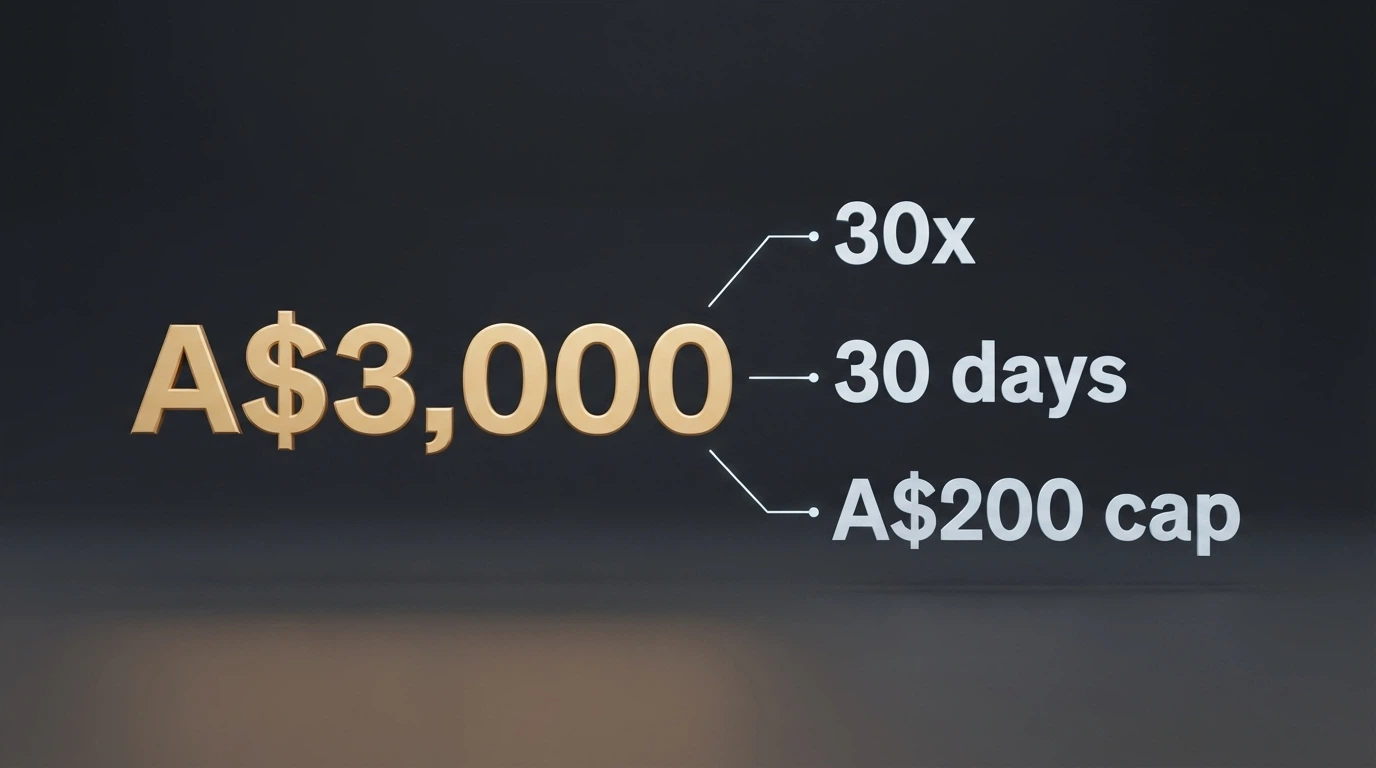
The category runs from deposit-matched welcome packages through reload bonuses (a percentage match on subsequent deposits) to no-deposit offers, free spins, and the rarer wager-free bonus. The wagering multiples run from “low” at 30x to “aggressive” at 50x, and the gap between the two is the difference between a bonus that pays for itself under sustained play and a bonus that returns a fraction of its face value to a typical player. Most fiat offers in this market sit in the A$1,000–A$3,000 range at 30x–50x wagering, with specific terms varying by operator.
A worked example: a AU$10 no-deposit bonus at 30x wagering requires A$300 of qualifying turnover before the bonus balance converts to withdrawable cash. At a typical pokie bet of AU$0.50 per spin, that is 600 spins, and at a 5-second spin interval that works out to roughly 50 minutes of continuous play. The reader can check the cost: 600 spins at AU$0.50 is AU$300 turned over, against a published no-deposit headline of AU$10, and the expected loss on those 600 spins at a 96% RTP pokie is 4% of the turnover, or A$12. In plain terms, the player is funding the playthrough with their own money while clearing the operator’s bonus, and the house edge on the playthrough is roughly 1.2 times the value of the bonus itself. The bonus is real. The arithmetic of clearing it is not generous.
Welcome bonuses, deposit matches and reload offers for VIP players
Welcome packages are the deposit-gated offers, and they are the ones with the largest headline numbers. Royal Reels’ welcome bonus carries 30x wagering, which is at the lower end of the published range and the most player-friendly wagering on the comparison set. JustCasino, for context, runs 40x with max-bet limits and winnings caps on certain bonus types — a steeper ask for the same headline.
Reload bonuses are the deposit-matched offers that arrive after the welcome package is consumed. They are typically smaller in percentage but recur, and they are the part of a VIP program the player will actually claim over a year of play, rather than the welcome offer they claim once. The cadence varies by operator, and where the cadence is not published, the reader should treat the welcome package as the visible part of the offer and the reload schedule as an unknown.
Validity windows are the quiet killer. A 30x wagering requirement on a A$1,000 bonus is A$30,000 of qualifying turnover, which a serious player clears in days and a casual player never clears at all. A 7-day window turns the same bonus into something only a heavy player can convert. A 30-day window is the more typical generous offer. Where research has not surfaced a specific validity window for an operator’s offer, the page notes that, because the absence of a published window is itself the kind of term a player should check before claiming.
No-deposit bonuses and free spins — what VIP members can actually claim
The no-deposit offer is the rarest bonus in the category, and Royal Reels is one of the few operators in the comparison to publish one: AU$10 credited after phone verification. The qualifying condition (the phone verification step) is itself a friction point that filters out players who want to remain fully anonymous, which the reader should weigh against the bonus value.
Free spins come in two forms. Wagering-attached spins require the winnings to be played through a multiple of times before they withdraw. Wager-free spins pay out as cash, but the operator compensates with a cap on winnings. Jackpot Jill is the clearest example: wager-free free spins with a A$200 maximum-win cap. The cap is the trade. A 50-spin package at A$1 per spin with a A$200 cap returns, on a strong outcome, A$200 — not A$50, not the screen value of the symbols. The player should read the cap as the upper limit of the offer, not the headline.
For operators where no no-deposit offer is published, the page does not imply one exists. A bonus the player cannot confirm is a bonus they cannot claim.
Cashback and reward points — the loyalty currency that stacks up
Cashback and rakeback are the most economically significant benefits in any VIP program, and they are the benefits that compound. A 10% monthly cashback on net losses returns, over a year of play, a meaningful share of what the house edge would otherwise have taken. Rakeback — a percentage of the theoretical house edge paid on every bet — compounds similarly, with the difference that rakeback is paid whether the player won or lost the session, which makes it a closer approximation to a structural rebate than cashback on net loss.
Caswino is the clearest published offer: 5% at Bronze, scaling to 15% at Diamond, with rakeback from the entry tier. Joe Fortune offers a dual-track conversion: loyalty points convert to locked bonus credit (subject to 30x wagering) or, at the higher tiers, to direct withdrawable cash. The dual track is the more valuable structure for a player who reaches the upper tiers, because cash is cash. Royal Reels’ 50 XP per AU$1 wagered is a points-currency the player would need to convert at a published rate to know the dollar value, and where that conversion rate is not published, the points are an IOU until the operator says otherwise.
Points-expiry policies vary. Caswino publishes the most durable promise: points do not expire while the account is active. Other operators do not publish an expiry, which is a different thing from “no expiry” and a different thing from “expiry of 12 months”. The reader should treat an unstated expiry as a risk, and check the operator’s terms before assuming the points are theirs forever.
Australia’s Best VIP Casino Programs — 2026 Edition
The comparison below ranks ten operators that Australian players use. The ranking is by how much of the VIP program each operator publishes in verifiable form; the higher the rank, the more the reader can check before signing up. Where the program is not published, the table says so.
| Operator | Licence | Key VIP feature |
|---|---|---|
| Royal Reels | Anjouan (offshore) | 10-tier VIP (Opal→Diamond), 50 XP per AU$1, AU$10 no-deposit, 30x wagering |
| Skycrown | Offshore (unverified) | 8.55% AU market share; VIP program not publicly documented |
| Rocket Play | Offshore (unverified) | A$632M revenue, 9.4% AU market share; VIP program not publicly documented |
| Jackpot Jill | Offshore (unverified) | 6 tiers (Bronze→Royal), personal manager at Gold, wager-free FS (A$200 cap) |
| Stake | Curaçao (offshore) | Crypto-first, TRC-20 USDT; VIP program not publicly documented |
| Caswino | Anjouan (offshore) | 5 tiers, 5%–15% monthly cashback, rakeback from Bronze, points never expire |
| Joe Fortune | Offshore (unverified) | Dual-track loyalty (bonus credit or cash at higher tiers), 30x on converted bonus |
| FairGO | Offshore (unverified) | RTG-focused pokies, 0.8% AU market share; VIP program not publicly documented |
| Bizzo Casino | Offshore (unverified) | 0.57% AU market share; VIP program not publicly documented |
| Mr Green | MGA/Malta (offshore for AU) | 4 tiers (Green→Platinum), A$5,000→A$20,000+ daily withdrawal, PayID all tiers |
Every operator in the table runs offshore, and none holds an Australian online casino licence, because no such licence exists. The licence column is what each operator has published about its own regulator; verification against ACMA’s register of licensed wagering services confirms none of them appear as an Australian wagering provider.
Royal Reels — The 10-tier giant with a low-entry no-deposit bonus
Royal Reels is the most tiered program in the comparison and the one with the clearest published mechanic. Ten tiers run from Opal at the base to Diamond at the top, with 50 XP credited for every AU$1 wagered. The rate is explicit, and a player who tracks their turnover can predict their tier trajectory to the dollar.
The game library is the second largest in the comparison: more than 5,400 pokies from 40+ providers, including Pragmatic Play and BGaming. The breadth matters because the cashback and tier thresholds are not bounded to a single provider’s RTP profile, and a player who picks higher-RTP games stretches the value of the same wager.
The bonus package is the most transparent in the set. A AU$10 no-deposit bonus is credited after phone verification — a small friction but a real one — and the welcome bonus carries 30x wagering, the lowest published multiple in the comparison. The top-tier package is published at A$300,000, which is the largest bonus figure in the set, although the terms that govern how a player actually reaches the top tier and what conditions attach to the withdrawal of that figure are not as visible as the headline.
The licence is Anjouan, which is one of the more commonly held offshore licences in the category and one of the less recognised by Western regulators. For an Australian player, the practical question is not the licence regime but the recourse available, and the answer there is the same as it is for every operator in the table: none in Australia.
Jackpot Jill — Wager-free spins and a personal manager at Gold tier
Jackpot Jill runs six tiers (Bronze through Royal) with the personal manager kicking in at Gold, after roughly A$5,000 in lifetime wagering. The threshold is published.
The free-spins package is the most distinctive part of the offer. Wager-free spins pay out as cash, which is the more player-friendly structure, and the A$200 maximum-win cap is the trade. The reader should weigh the two together: a 50-spin package on a high-variance pokie with a A$200 cap returns A$200 on a strong outcome, and the operator has priced the package to make the cap the binding constraint more often than the spin count.
The five-deposit welcome ladder extends the bonus across multiple deposits rather than concentrating it on the first, which is a structure that benefits the player who plans to deposit over a month rather than the player who wants the full headline on day one. The game library is pokies-focused, which the cashback calculation should be read against: a pokies-only library removes the table-game escape valve that a player with a strong bonus might otherwise use to grind the wagering.
Caswino — Cashback from day one and rakeback at every tier
Caswino is the clearest cashback-and-rakeback offer in the set, and the one that compounds most aggressively for a high-volume player. Monthly cashback runs from 5% at Bronze to 15% at Diamond, paid on net losses, and rakeback is included from the entry tier. The combination is closer to a structural rebate than a marketing perk, because rakeback is paid on the theoretical house edge regardless of session outcome.
The five tiers run Bronze through Diamond, and the published maintenance policy is the most player-friendly in the set: points do not expire while the account is active. For a player who plays intermittently over a year, the points are still there on the day they return. That is a more durable promise than what most competitors publish, and a real point of difference in the comparison.
The licence is Anjouan Gaming, which the operator publishes openly. The same caveat applies as elsewhere on the table: the licence is not recognised in Australia, the player has no domestic recourse, and the operator runs on its own house rules.
Mr Green — Tiered withdrawal limits and PayID at every level
Mr Green is the clearest withdrawal-focused program in the set. Four tiers (Green through Platinum) carry daily withdrawal limits that scale from A$5,000 at Green to A$7,500 at Silver, A$10,000 at Gold and A$20,000+ at Platinum, with processing times compressing from 1–3 business days at the entry tier to same-day and priority at Platinum.
For a player who values withdrawal speed and ceiling over cashback rate or host access, the trade is straightforward. Mr Green’s cashback and rakeback structure is not published in the same detail as Caswino’s, and the program is not as transparent on points earn rate. What is published is the limit ladder, and it is the most legible withdrawal story in the comparison.
PayID is supported at all tiers, which is a real advantage for Australian players. PayID is a near-instant domestic payment rail, and the combination of PayID deposits and tiered withdrawal limits means a player funding via PayID can move from a small bankroll to a large withdrawal faster than at an operator that relies on card or bank transfer. The MGA/Malta licence is the most recognised European licence regime in the set, and the one most likely to be tested in a dispute — but “more recognised in Europe” is not the same as “recognised in Australia”, and the same offshore-caveat applies.
Joe Fortune — Dual-track loyalty: bonus credit or withdrawable cash
Joe Fortune’s distinctive feature is the dual-track loyalty point conversion. Points can convert to locked bonus credit, which carries 30x wagering, or, at the higher tiers, to direct withdrawable cash. The cash option is the more valuable structure by a wide margin, and the fact that the operator publishes it is itself a signal of where the program is pitched: the higher tiers are designed for players who have already paid for the privilege of being there.
A personal account manager is available at Platinum and above, which is the most typical placement of the benefit in the comparison. The dual track is the more interesting feature, because it lets a player choose the structure that matches their play style: bonus credit for a player who wants the larger headline and accepts the wagering, direct cash for a player who values the withdrawal over the multiplier.
The wagering on converted bonus funds is 30x, which sits at the lower end of the published range. The combination of a published manager threshold, a published wagering multiple, and a published conversion structure is the most transparent set of terms in the upper-tier comparison, and the reason Joe Fortune is treated separately from the operators with no published VIP detail.
Stake — Crypto-first VIP play with TRC-20 USDT
Stake is the most distinctive operator in the set on the payment rail, and the one that should be evaluated differently from the fiat-friendly brands. The platform is crypto-first: TRC-20 USDT is the recommended payment, with deposits confirming in under 60 seconds and withdrawals clearing in under 5 minutes, against a 2–5 business day window for fiat-only competitors.
The AU market share is published at 1.28%, which is small in the comparison but not negligible, and the Curaçao licence is the standard offshore licence for crypto-first operators. What Stake does not publish — and what the page does not assume — is a detailed VIP program structure. The brand runs promotions and offers, but the tier-by-tier schedule that the other operators in this comparison publish is not in the same form on Stake’s terms page.
For a player who values payment speed and is comfortable with USDT on TRC-20, Stake is the operator the comparison was built to surface. For a player who wants the published-tier-and-cashback structure the other operators in the set publish, Stake is a different proposition and the reader should treat the absence of published terms as the absence of terms.
Skycrown — High market share, limited VIP transparency
Skycrown’s published market share sits at 8.55% of the Australian-facing offshore market, which is high enough to put the brand in the second tier of this comparison by player volume. What the brand does not publish — and what the page will not infer — is a VIP program structure, a tier count, a cashback rate, a wagering multiple, or a withdrawal ceiling. The reader knows the brand is large; the reader does not know what the brand offers a high-volume player.
The licence is offshore and the verification status is unverified: the operator has not published a regulator name the page can confirm against a register. The combination of a high published market share and a low published VIP terms surface is a common pattern in the offshore category, and the read is that the operator is acquiring players on the welcome offer rather than retaining them on a transparent program. The reader should weigh the market-share figure as a measure of how many Australians are playing there, not as a measure of how well the program serves them.
Rocket Play — The highest-revenue offshore casino in the AU market
Rocket Play is the highest-revenue operator in the comparison, at A$632 million against a 9.4% AU market share. The revenue figure implies significant player volume, and the market share is the largest in the set. What the page can also say, with the same precision, is that the operator does not publish a VIP program structure: no tiers, no cashback rate, no points currency, no maintenance policy, no published wagering terms on a bonus the reader could evaluate in advance.
The transparency gap is the single most important fact about Rocket Play for a player making a comparison. A revenue figure of A$632 million is not a benefit a player will receive. A non-published VIP program is the absence of a benefit a player would otherwise compare. The page covers the operator because the market share puts it in the comparison set, and the page is explicit that the comparison it offers is mostly the comparison of what the operator has chosen not to publish.
FairGO — RTG-focused offshore brand with 0.8% market share
FairGO sits at the smaller end of the comparison on volume, with 0.8% AU market share, and the game library is RTG-focused, which is a narrower provider mix than the multi-studio operators in the set. The narrower library is itself a piece of information: a player who values the breadth of a 5,400-pokie catalogue will read RTG-only as a constraint, and a player who values the consistency of a single provider’s RTP and volatility profile may read it as a feature.
The VIP program is not published in detail. The page notes the gap rather than infers a structure, and the reader who is comparing FairGO against a multi-studio operator with a published tier schedule is comparing two different categories of transparency.
Bizzo Casino — Smallest share among featured operators, no public VIP detail
Bizzo carries the smallest AU market share in the set, at 0.57%, and the operator has not published a VIP program structure, a tier count, or a bonus schedule the reader can evaluate in advance. The operator is in the comparison because it appears in the market, and the page notes the small share and the absence of published terms together: a low-volume brand with a low-detail program is a different proposition from a low-volume brand with a published program, and a different proposition again from a high-volume brand with a published program.
For a player who has decided to play at Bizzo regardless of the comparison, the practical advice is the same as for every other operator in the table: verify the licence directly, read the bonus terms before claiming, and confirm the withdrawal limit before depositing.
The Legal Reality — Playing at VIP Online Casinos from Australia
The legal position is the same for every operator above and for every player reading this page, and it has to be stated plainly at the start of this section rather than buried in a footer. The Interactive Gambling Act 2001 prohibits the provision of online casino games, online pokies and in-play sports betting to people in Australia. The Act is a provider-side law, not a player-side law — section 8AA targets operators, and the individual player is not criminalised for placing a bet. What the player is doing is transacting with an entity the Australian government has no power to regulate, and the consequences of that fact run through every protection a domestic licence would otherwise provide.

What the Interactive Gambling Act 2001 actually prohibits (and what it doesn’t)
The IGA makes it an offence to provide a “prohibited interactive gambling service” to a person in Australia. The category covers online casino games, online pokies, and in-play sports betting. It does not cover pre-event wagering on sport or racing, lotteries, or keno, which are licensable through state and territory regulators. The Northern Territory Racing and Wagering Commission, administered through Licensing NT, is the de facto national licensor for the major online bookmakers.
ACMA enforces the prohibition. Its tools include formal warnings, civil penalty proceedings, referral to law enforcement, and — most visibly — the power to direct Australian ISPs to block illegal sites. Since its first blocking request in November 2019, ACMA has had 1,788 illegal gambling and affiliate websites blocked. Over 230 illegal services have withdrawn from the Australian market entirely since ACMA started enforcing the new rules in 2017. The blocking and the withdrawals are not the same outcome — a withdrawn operator is one that has decided the Australian market is not worth the legal risk, while a blocked operator is one ACMA has caught in the act. Both reduce the supply the reader can reach.
The IGA was strengthened in 2017 with the Interactive Gambling Amendment Act, which closed the loopholes the early offshore operators had exploited and gave ACMA its blocking powers. The 2026 reform — the Interactive Gambling Amendment (Gambling Reform) Bill 2026 — passed Parliament on 19 August 2026 and takes effect from 1 January 2027. The reform introduces phased advertising restrictions, an AdStop opt-out register, inducement marketing bans for 14 days after sign-up and 90 days after BetStop deregistration, and the most consequential change for this page: from 1 January 2027, banks and payment providers gain express authority to block transactions to illegal gambling operators. A player funding an offshore casino account in 2027 will find their bank more willing to decline the transaction than it was in 2026.
Offshore casino risks — no consumer protection, no BetStop, no recourse
The licences held by the operators in this comparison — Anjouan, Curaçao, and MGA/Malta — are not recognised in Australia. The table below maps what each regime actually provides to a player sitting in Sydney or Melbourne.
| Licence regime | Example operators | Player protections | Recognised in Australia |
|---|---|---|---|
| Anjouan | Royal Reels, Caswino | Regulated under Anjouan Gaming rules; dispute resolution through Anjouan authority; no Australian enforcement | No |
| Curaçao | Stake | Regulated under Curaçao Gaming Control Board; dispute resolution through Curaçao authority; no Australian enforcement | No |
| MGA/Malta | Mr Green | Regulated under Malta Gaming Authority; established EU dispute pathways; no Australian enforcement | No |
| Unverified | Skycrown, Rocket Play, Jackpot Jill, Joe Fortune, FairGO, Bizzo | Operator’s own published terms; no independent regulator confirmed | No |
What “no Australian enforcement” means in practice: if an operator refuses a withdrawal, closes an account, or fails to credit a bonus the player believes they earned, the player has no Australian complaints body to approach. ACMA’s role is to enforce the prohibition on the operator, not to recover money for individual players. The Australian Financial Complaints Authority has no jurisdiction over an offshore gambling operator. The only recourse is the courts of the operator’s home jurisdiction, and the cost of pursuing a small-stakes dispute through an Anjouan or Curaçao court is almost always higher than the amount in dispute.
The credit and crypto payment ban is a separate but related pressure. Since 11 June 2024, credit cards, credit-related products, and digital currency have been banned as payment for online wagering in Australia. The penalty for operators that fail to enforce the ban is up to A$247,500. The ban is a tool the licensed market applies, not a tool that directly reaches offshore operators, but the licensed payment processors do, and the practical effect is that a player funding an offshore account has a narrower set of working payment methods than they did in 2023.
From 1 January 2027, the bank-blocking power takes effect, and the narrowing accelerates. Banks will gain express authority to decline transactions to illegal gambling operators, and the offshore operators in this comparison are the operators the banks are being empowered to block. A player who has been funding an offshore account via bank transfer will find the transfer more likely to be declined. Crypto-funded play is, in that respect, more resilient to the bank-blocking power, and the crypto section of this page addresses the trade-off in more detail.
Player protections every Australian VIP player should know about
The help infrastructure exists on the licensed side of the market, and the protections only reach there.
BetStop is the National Self-Exclusion Register, administered by ACMA and live since 21 August 2023. To 31 March 2026, 59,830 people had registered, and 37,247 had active exclusions. The register binds every Australian-licensed online and phone wagering provider. It does not bind offshore operators, which is the single most important fact about BetStop for the audience of this page. A self-excluded Australian who then opens an account at an offshore casino from this comparison is not stopped by BetStop, and the protection the register provides does not reach them.
The same gap applies to deposit limits, activity statements, take-a-break, and the full suite of harm-minimisation tools that the licensed operators are required to offer. None of it is enforceable against an offshore operator, and none of it is the offshore operator’s default. The harm-minimisation is opt-in, and the offshore operator’s incentive is to make it as frictionless as possible to keep playing.
The 24/7 support line is the National Gambling Helpline on 1800 858 858, free and confidential, with online chat through Gambling Help Online at gamblinghelponline.org.au. BetStop itself is at betstop.gov.au, with self-exclusion periods from a minimum of 3 months to a lifetime. The National Debt Helpline on 1800 007 007 is the right number for the financial damage gambling can do, separate from the gambling itself.
The scale of the issue is large. According to Roy Morgan data, 15.1% of the Australian adult population — an estimated 3.32 million people — are experiencing some level of gambling harm. 13.0% of the population, or roughly 2,857,000 people, are experiencing harm from their own gambling. 7.8% of Australian adults reported a reduction in available spending money as a result of their gambling. The Indigenous harm disparity is significant: 27.1% of Aboriginal and Torres Strait Islander peoples are at risk of gambling harm, compared to 14.6% of non-Indigenous Australians.
Awareness of the help on offer is low. Only one in three wagerers (33.5%) know BetStop exists, according to the Australian Gambling Research Centre. An estimated 400,000 high-risk gamblers exist in Australia, yet only about 30,000 individuals have active exclusions through BetStop — roughly 7.5% of the high-risk population. The Statutory Review of BetStop, published on 25 February 2026, examined the gap and is the most current public review of the register’s reach. The gap is the protection system’s most important number for the reader of this page.
Accessing Your VIP Casino Account — Login, App and Mobile Reality
The mechanics of getting into a VIP program are not exotic, but the AU-facing specifics are worth naming. A VIP program is not a separate product. It is a layer of the existing account, accessed through the same login, with the same balance, on the same games. The “VIP room” the marketing describes is a dashboard, a status badge, and a set of offers, not a separate portal or a separate app.
VIP login, dedicated portals and playing on mobile
The standard flow is straightforward: log in to the casino account, navigate to the loyalty or VIP section, and the tier status, points balance, and available offers are listed. Some operators expose a separate “VIP” tab in the main navigation; others promote VIP status via email once a tier has been reached. The dedicated VIP portal is a common piece of marketing language that overstates the technical reality. There is no second login to remember. The same username and password the player uses for the standard casino reach the VIP layer.
The Australian App Store is the practical constraint on mobile. Apple and Google do not allow real-money casino apps in their Australian stores, so there is no downloadable casino app from either platform for an Australian player. The mobile experience is a mobile browser, and the operator’s mobile site is what the player uses. The mobile browser is the access path for every operator in this comparison, and the experience is generally responsive — the same games, the same VIP dashboard, the same deposit and withdrawal flow, scaled to the phone screen. A dedicated VIP app the player can download does not exist for Australian-facing operators because the platform holders do not permit it.
The PlayID-and-mobile experience is the same on the VIP side as on the standard side, with one practical difference: a high-volume VIP player is more likely to want to manage their account from a phone (deposit, withdraw, contact host) than a casual player, and the responsiveness of the mobile site is the test. The reader who plays seriously should test the mobile deposit and withdrawal flow before committing volume, because the friction in that flow is the friction the tier benefits are supposed to remove.
Inside the VIP Room — What Casino Clubs and Lounges Actually Offer
The phrase “VIP room” sells exclusivity the technology cannot match. There is no physical room. There is a dashboard, a host, a tier label, and a set of offers the standard player does not see. The exclusivity is real, but it is a marketing exclusivity — the standard player is not shown the offers, not because they are barred from claiming them, but because the operator has decided not to surface them to the lower tiers.
VIP rooms, lounges and the membership experience
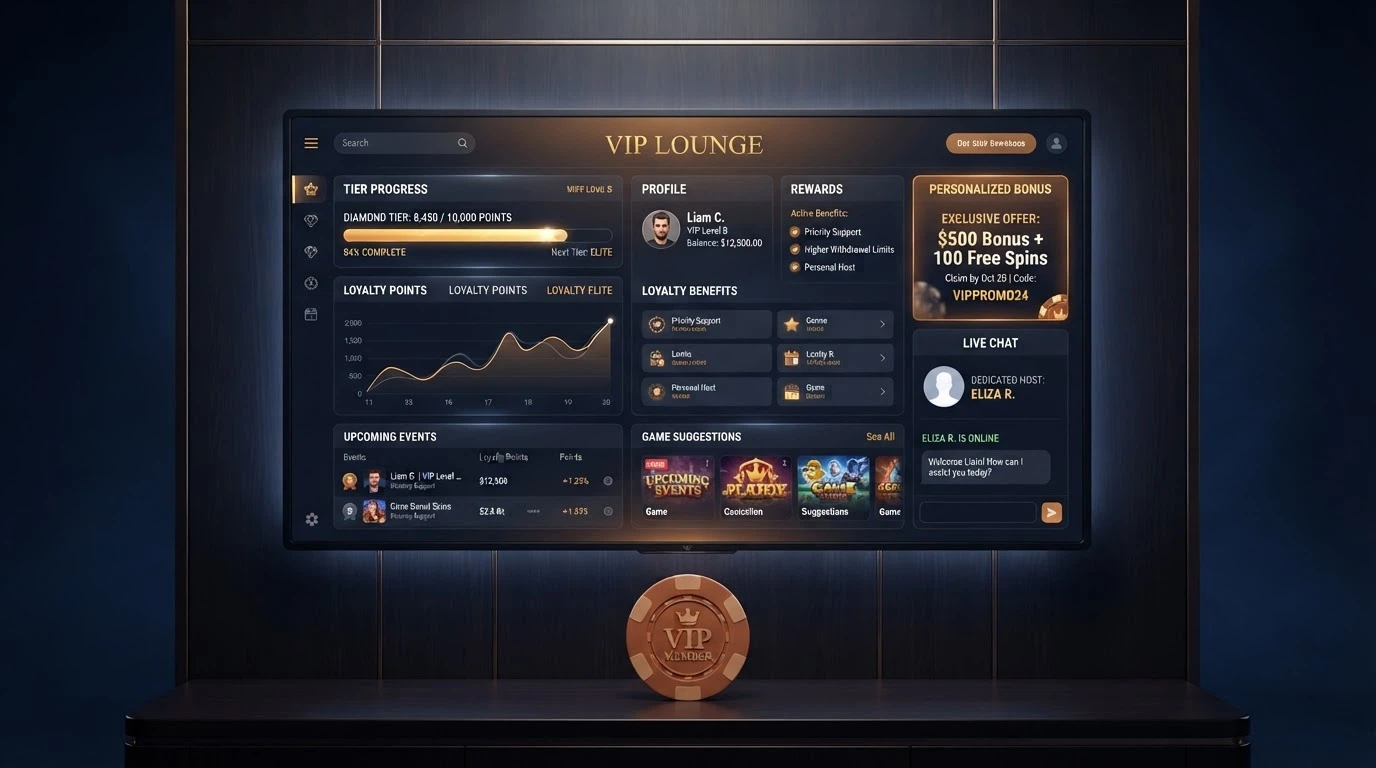
The “VIP room” is a digital interface. It is a tab in the navigation, a list of available bonuses the standard player does not see, a points balance and a tier progress bar, and — at the upper tiers — a direct line to a personal account manager via live chat or email. The host is the most human element of the program, and the most valuable. A host can resolve a withdrawal query in minutes that a generic support queue would take days to address; a host can offer a bonus the operator has not publicised; a host can flag a game issue before the player has to chase it.
Royal Reels’ VIP Club is the most published structural example in the set, with its 10 tiers and 50 XP per AU$1 the player wagers. The membership experience at Royal Reels is closer to a published programme than a curated list, which means a player can predict their tier trajectory from their turnover. Jackpot Jill’s Gold tier, at roughly A$5,000 wagered, is the lowest published host threshold in the set, and the threshold is the practical entry point to the host experience. Mr Green’s Platinum tier is invite-only, and the operator reserves the right to set the threshold on a per-account basis.
The lounge is a marketing word for the upper-tier experience. The features a player is buying into at the upper tiers — exclusive promotions, higher withdrawal limits, faster processing, a named host — are real and they are valuable, but they are also features the player has paid for in turnover. A A$20,000+ daily withdrawal limit at Mr Green Platinum is the same A$20,000 in real money as a A$20,000 withdrawal anywhere else; what the tier provides is the speed and the ceiling, not the dollars.
The access key is volume, and the volume is the price. A player who climbs to the upper tiers has paid the operator more in house edge than the upper-tier benefits return, by design. The tier is a margin-protection mechanism for the operator and a status reward for the player; the dollar value of the status is positive but smaller than the marketing suggests.
VIP Pokies and Tables — Where the High-Stakes Action Lives
The games do not change for VIPs. The same pokies, the same RTP profiles, the same volatility bands are available to the standard player and the VIP player. What changes are the bet limits and the access. A VIP player can place a larger bet per spin, on a single transaction, and the operator is more willing to clear the larger withdrawal that follows. The game math is identical; the betting envelope is wider.

VIP pokies and slot machines — higher limits, exclusive titles
Royal Reels’ catalogue of more than 5,400 pokies from 40+ providers is the broadest in the comparison, and the breadth matters at the upper tiers where the player has more game-selection discretion. FairGO’s RTG-focused library is narrower, which is a constraint on variety but a consistency of profile. The other operators in the comparison fall between those two poles, and the operator-specific mix is the variable a player should check before committing volume.
Higher bet limits are the most visible VIP differentiator. The standard AU-facing pokie carries a maximum bet somewhere between AU$5 and AU$20 per spin, and the upper tiers of the VIP programs in this comparison raise that ceiling, in some cases well above it. The higher ceiling lets a player with a larger bankroll move through turnover faster, which is what the tier thresholds implicitly require.
Exclusive or early-access titles are a marketing claim that operators make with varying degrees of substance. A true exclusive would be a title the operator has funded and which is not available at competing casinos; an early-access title is a title the operator is running ahead of a wider release. The reader should treat both as marketing, and judge the operator on whether the exclusive title carries a higher RTP than the standard catalogue, not on the exclusivity itself. House edge does not change for high rollers. The math is the math.
Live casino and table games for VIP players
Live dealer tables are where VIP status most visibly changes the experience. The standard live table at an AU-facing operator carries a maximum bet somewhere between A$500 and A$2,000 per hand, and the VIP or “Salon Privé” tables carry limits well above that, often into five figures. The higher limits are paired with a single-seat-per-table structure that gives the player the table to themselves, a dedicated dealer, and the discretion to bet at a pace the player sets.
Blackjack, roulette, and baccarat are the three games where VIP live play is most developed. Roulette at higher limits is the most accessible, because the bet structure is straightforward and the variance per spin is well-defined. Blackjack at higher limits is the most skill-dependent, and the RTP swing between a basic-strategy player and a casual player is significant. Baccarat at higher limits is the closest to a coin-flip in structure, and the tie bet — the highest-paying but the highest-house-edge option — is the bet a serious player learns to avoid.
The VIP live experience is largely a question of which operator runs Salon Privé tables and at what entry stake. The operators in this comparison do not all publish this detail, and the reader who values the live VIP experience should check the operator’s live casino page before signing up.
Crypto VIP Casinos — Faster, Cheaper, but Not Without Risk
Crypto changes two things about VIP play: the speed of deposits and withdrawals, and the size of the welcome package. The cost is a narrower set of payment options on the licensed side, where credit and crypto are banned for online wagering, and an AUSTRAC reporting threshold on the player’s side that makes “anonymous” crypto play less anonymous than the marketing suggests.

Bitcoin, USDT and crypto payments at VIP casinos
USDT on TRC-20 is the recommended crypto for an Australian-facing casino deposit. Deposits confirm in under 60 seconds. Withdrawals clear in under 5 minutes. Network fees run under AU$0.50 per transaction. The price is pegged to the US dollar, so the player is not exposed to the volatility of Bitcoin or Ethereum between deposit and play.
Bitcoin via the Lightning Network is the alternative for players who prefer to hold BTC. Of 12 AU-facing crypto casinos tested, 8 support Lightning, with instant confirmation on amounts under 0.05 BTC and fees under AU$0.01. For a player moving small balances, Lightning is the cheapest rail available; for a player moving balances above 0.05 BTC, an on-chain BTC transaction or a USDT alternative is the more practical option.
The on-ramp is the friction. CoinSpot and Swyftx are the two most-used crypto exchanges by Australian casino players, and both are AUSTRAC-registered and support PayID funding. PayID deposits clear in near-real time, and the exchange-to-wallet-to-casino flow takes minutes rather than days. The reader who has not set up a wallet before should expect the first deposit to take longer than the second, because the verification steps at the exchange and the wallet are the slowest part of the chain.
What crypto changes about VIP play — speed, limits and anonymity
Withdrawal speed is the headline. Fiat-only competitors take 2–5 business days to clear a withdrawal. Crypto casinos clear in 90 seconds to 10 minutes, and the practical difference for a high-volume player is the difference between playing one withdrawal per week and playing one per day. The cap is higher, too: crypto welcome offers can reach up to 30,000 USDT at 6x wagering, against A$1,000–A$3,000 at 30x–50x for fiat-only offers. The bonus size and the wagering multiple both favour the crypto player, and the combination is the largest single advantage the crypto rail offers.
The anonymity claim is overstated. AUSTRAC’s Travel Rule applies at AU$10,000 for crypto transactions, which means exchanges and operators collect and share sender and recipient information above the threshold. For a player moving more than A$10,000 per transaction, the transaction is reported, and the “anonymous crypto” framing breaks down. Below the threshold, the player is operating in a less-reported space, but the casino’s own KYC requirements at withdrawal typically still demand identity verification, and the on-chain record of every transaction is permanent.
The credit/crypto payment ban applies to licensed operators, not directly to offshore casinos. The offshore casino does not face the A$247,500 penalty for accepting crypto, because the offshore casino is not subject to Australian law in the same way a licensed operator is. The bank, however, may increasingly decline the deposit as the 2027 bank-blocking power takes effect, and the licensed on-ramp (the exchange) is the layer the AUSTRAC rules reach most directly. A player funding via crypto in 2027 will find the path to the offshore casino more frictioned than they did in 2026, even though the casino itself has not changed.
Reading VIP Casino Reviews — Separating Promotion from Honest Assessment
Six of the ten top-ranking pages for this category are affiliate listicles — pages that list casinos, rank them, and include a tracked link the affiliate gets paid on. The structure rewards a positive write-up and rewards a high rank, and the temptation to over-rate a partner brand is the same temptation the loyalty program itself is built on. The reader who can spot an affiliate page is the reader who can weigh the information it carries.
How to vet a VIP casino review and spot the bias
A credible review of a VIP casino for Australian players should hit a small set of points, and the absence of any of them is a signal. The reader is well served by treating the following as a checklist, and by being sceptical of any review that does not address them.
- Licence verification: the review should name the licence regime the operator holds, and the reader should be able to verify the regime independently. Anjouan, Curaçao, and MGA are the three regimes in this comparison; the review should say which one the operator holds and not stop at “licensed and regulated”.
- Bonus T&Cs quoted not summarised: a welcome package summary that does not quote the wagering multiple, the validity window, the max bet, and any winnings cap is a summary the affiliate has chosen to keep loose. The bonus T&Cs are the most decision-relevant part of the offer.
- Withdrawal experience tested: a review that has tested the actual withdrawal time, the KYC friction, and the limit at the player’s tier is worth more than one that has not. The “1–3 business days” line is a marketing line until a tester has put it on a clock.
- IGA reality stated plainly: a review that mentions “legal for Australians” without explaining that online casino is prohibited and that the operator is offshore is one the reader should discount. The IGA is the legal reality and the page should say so.
- BetStop and offshore gap: a credible AU review addresses that BetStop does not reach offshore sites, and that the player has no Australian complaints pathway. A review that does not is one that has chosen to leave the most important player-protection fact out.
- Harm data and help line: a review that does not name 1800 858 858 and gamblinghelponline.org.au is one that has chosen not to point the reader to the help that exists.
- Affiliate disclosure: the disclosure that the page earns a commission on sign-ups should be visible. The absence of a disclosure is not proof of a hidden commission, but the presence of one is a baseline standard.
The reader who is comparing two reviews of the same operator should weigh the one that hits the checklist against the one that does not. The gap is the difference between a review the affiliate wrote to rank the operator and a review the reader can act on.
How We Evaluated These VIP Casino Programs
The selection and ranking on this page draw on three sources: ACMA’s register of licensed wagering services, the operators’ own published VIP terms, and independent casino review databases. The cross-check against the ACMA register confirms what the IGA already establishes — no operator in the featured set holds an Australian online casino licence, because no such licence exists. The operator-specific facts are drawn from the operators’ own published pages and from independent reviewers who have tested the terms.
The ranking criterion is transparency. The operators are ranked by how much of the VIP program each has published in verifiable form, because a comparison the reader can check is more useful than a comparison the reader cannot. Royal Reels ranks first because the program is fully published: 10 tiers, 50 XP per AU$1, the welcome bonus terms, the no-deposit offer. Mr Green ranks in the comparison set because the withdrawal-limit ladder is published. Caswino ranks because the cashback and rakeback schedule is published. Joe Fortune ranks because the dual-track conversion is published. Jackpot Jill ranks because the tier count and the host threshold are published. The operators at the lower end of the ranking — Skycrown, Rocket Play, FairGO, Bizzo, Stake — are in the comparison set because of their AU market presence, and the page notes the absence of published VIP terms as the most important fact about each.
The ranking is qualitative, not weighted. No operator receives a numerical score, and the reader should treat the ranking as an ordering of transparency, not as a quality verdict. An operator with a published program is more evaluable, and therefore more comparable; an operator without a published program is less evaluable, and therefore harder to rank on the same terms. The page does not extend the comparison into a quality judgment it cannot defend.
What Your VIP Casino Strategy Should Look Like in 2026
The strategy the page’s own figures point to is straightforward, and it is the same strategy for every player the page is written for.
The first move is the licence check. ACMA’s register of licensed wagering services is the public record of who is licensed to take bets from Australians. No online casino appears on it, because no online casino licence exists. The operator the reader is considering is offshore, and the licence it holds is not recognised here. The reader who proceeds past that fact should proceed with their eyes open.
The second move is the wagering check. A bonus headline in the thousands means little without the wagering multiple beside it. The published range runs from 30x to 50x for fiat offers, and 30x is the more player-friendly end of that range. The reader who claims a A$1,000 bonus at 50x is committing to A$50,000 of qualifying turnover, and the house edge on that turnover is the price of the bonus. The arithmetic of clearing a bonus is the arithmetic the marketing copy does not show.
The third move is the withdrawal-limit check. The A$5,000 daily limit is the standard ceiling for a non-VIP account, and the upper tiers raise it. The reader should confirm the limit at their tier before depositing, because the limit is the gate on getting the winnings out. A player who wins A$20,000 at an operator with a A$5,000 daily limit is waiting four days; a player at an operator with a A$20,000 daily limit is waiting one.
The fourth move is the host check. A personal account manager is a real benefit at the upper tiers, and the threshold varies by operator. The reader who is climbing toward a tier should know the threshold before they climb, and should know whether the host they will be assigned is a person who has authority to resolve a withdrawal query, or a person who has authority to escalate one. The distinction is the difference between the benefit the marketing promises and the benefit the player actually receives.
The fifth move is the offshore-cost acknowledgement. No Australian consumer protection reaches the operator. No BetStop self-exclusion binds. No complaints body has jurisdiction. The site can be blocked at any time, and the balance on it can be unreachable. The 1,788 sites ACMA has already blocked, and the 230+ services that have withdrawn, are the practical evidence of how the prohibition is enforced. The reader who plays offshore is choosing speed and bonus size over protection, and the choice is a real one, not a technicality.
The page’s overall read is this: the operators with the most published VIP terms are the operators the reader can compare in dollars, and the operators with the least published detail are the operators the reader cannot. A comparison is most useful when it lets the reader act, and a comparison of unstated offers is not a comparison. The reader who values the ability to check what they are being offered before they claim it should weight the published-program operators more heavily than the brand-name operators with no published detail. The reader who values payment speed and crypto bonuses is making a different trade, and the crypto section of this page is where that trade is laid out. The reader who values player protection is making a third trade, and that trade points away from offshore VIP play altogether and toward the licensed wagering and lottery products that the IGA permits.
The strategy that the page’s figures support is the strategy the reader can defend with the page in their hand. Everything else is marketing.
Frequently Asked Questions
What playing volume do I need to reach VIP status at an online casino?
It depends entirely on the operator. Royal Reels publishes a 50 XP per AU$1 wagered rate, so a player who knows their target tier can compute the volume in dollars. Jackpot Jill publishes a roughly A$1,000 lifetime wagered threshold to Silver, which is fast for any player who plays regularly. The other operators in this comparison either do not publish a threshold or reserve the upper tiers for invitation. The volume question is therefore an operator-by-operator question, and the answer is: check the published terms at the specific brand you intend to play with.
Does using crypto at a VIP casino keep my identity hidden from Australian authorities?
No, not above the AUSTRAC Travel Rule threshold. AUSTRAC’s Travel Rule applies at AU$10,000 for crypto transactions, and exchanges and operators collect and share sender and recipient information above the threshold. Below the threshold the reporting is lighter, but the casino’s own KYC requirements at withdrawal typically still demand identity verification, and the on-chain record of every transaction is permanent. Crypto is faster and cheaper than fiat, and it is less private than the marketing claims.
Does self-exclusion through BetStop reach the offshore sites where I play?
No. BetStop binds every Australian-licensed online and phone wagering provider. It does not bind offshore operators, and the offshore casinos in this comparison are not connected to the register. A self-excluded Australian who opens an account at an offshore casino is not stopped by BetStop, and the protection the register provides does not reach them. To 31 March 2026, 37,247 Australians had active exclusions, which is roughly 7.5% of an estimated 400,000 high-risk gamblers.
What hidden terms should I check before claiming a VIP casino bonus?
The wagering multiple (the most decision-relevant number on the bonus), the validity window (the time the player has to clear the wagering), the maximum bet during wagering (a lower cap limits the strategies the player can use), the list of games that contribute (some games contribute 0% or 50%), and any winnings cap (a cap on what the player can withdraw from a winning bonus session). The terms the operator does not publish are themselves a signal, and the reader should treat an unstated term as a term the player cannot verify in advance.
What happens to my VIP casino balance if the site gets blocked by ACMA?
The site can be blocked at any time, and the player has no Australian complaints pathway to recover a balance held at a blocked offshore operator. Since November 2019, ACMA has had 1,788 illegal gambling and affiliate websites blocked, and the operators in this comparison are the category the regulator targets. A player who keeps a large balance at an offshore operator is accepting the risk that the balance becomes unreachable, and the offshore operator has no obligation to refund it.