
Anonymous Crypto Casinos in Australia — What the Term Actually Means in 2026
 Available in AU
Current as of 18 October 2026; licence claims cross-checked against the Curaçao Gaming Control Board register and the Anjouan eGaming licence directory.

Walk the phrase “anonymous crypto casino” past anyone who works in Australian iGaming and the eyebrow that goes up tells the story. The marketing has moved faster than the legal vocabulary, so the term now holds three things at once: a signup form that skips the document upload, a payment rail that leaves no bank statement, and a promise — sometimes met, sometimes not — that the operator will never ask for a driver’s licence. Each of those layers is a different technical reality, and a player choosing one over the other should see how they sit before any bonus number earns attention.
The reason the model exists is the same as the reason it is illegal here. The Interactive Gambling Act 2001 makes it an offence to provide an online casino to a person physically in Australia, and the credit-and-crypto ban that took effect on 11 June 2024 shuts the legal payment rails closed. An offshore crypto casino is, structurally, the workaround that survives those two closures: it licences outside Australia, accepts digital currency, and offers the casino product the IGA will not let an Australian operator run. The anonymity is a side effect of those structural choices, not the cause of them.
That is why this page treats anonymity not as a feature to chase but as a description to read. What you hand over, what stays between you and the operator, and what the regulator can still reach even offshore — those are the questions that decide whether the bonus headline and the licence stamp in the corner of the cashier page are pointing at the same operator.
Table of Contents
- Why an Anonymous Casino Is More Than Just a Casino Without ID
- How Crypto Casinos Deliver the Anonymity a Regular Site Cannot
- Australia’s Accessible Anonymous Crypto Casinos in 2026 — Ranked
- Why Your 2026 Anonymous Casino Bonus Is Smaller Than It Looks
- Where Australian Law Stands on Anonymous Crypto Casinos — and Where It Does Not Reach
- What You Give Up When You Wager Without an Identity
- How We Assessed and Ordered These Operators
- What an Australian Player Should Actually Do About Anonymous Crypto Casinos
- Frequently Asked Questions
Why an Anonymous Casino Is More Than Just a Casino Without ID
“Anonymous” in this market is a spectrum, not a setting. The competing pages that rank these casinos tend to use the word as if it were one value, and the result is a reader who cannot tell a $750 cashout test from a lifetime wallet-connect session. The actual practice runs from “email and a password, and we will ask for documents at some cashout” up to “no email, no password, no account at all, you connect a self-custodial wallet and we never learn a name.” Every tier on that axis is being sold as anonymous in 2026’s comparison tables, and the differences between them are larger than the differences between any two named casinos.
What drives a player to look for the upper tiers is straightforward, and not what the marketing assumes. The pitch to Australian players is rarely about evading the law at their own end — the Act targets the provider, and no Australian has been prosecuted for playing. The pitch is about the documents themselves: a driver’s licence uploaded to an offshore casino is a piece of identity data sitting on a server in another jurisdiction under another country’s breach-disclosure rules, with no Australian Privacy Principles cover and no OAIC to complain to. The “no document” model cuts that exposure to zero. The second motivation is speed: a withdrawal that needs no human review of a passport scan lands in minutes rather than days. The third is friction: signup that takes thirty seconds rather than ten minutes changes who bothers last.
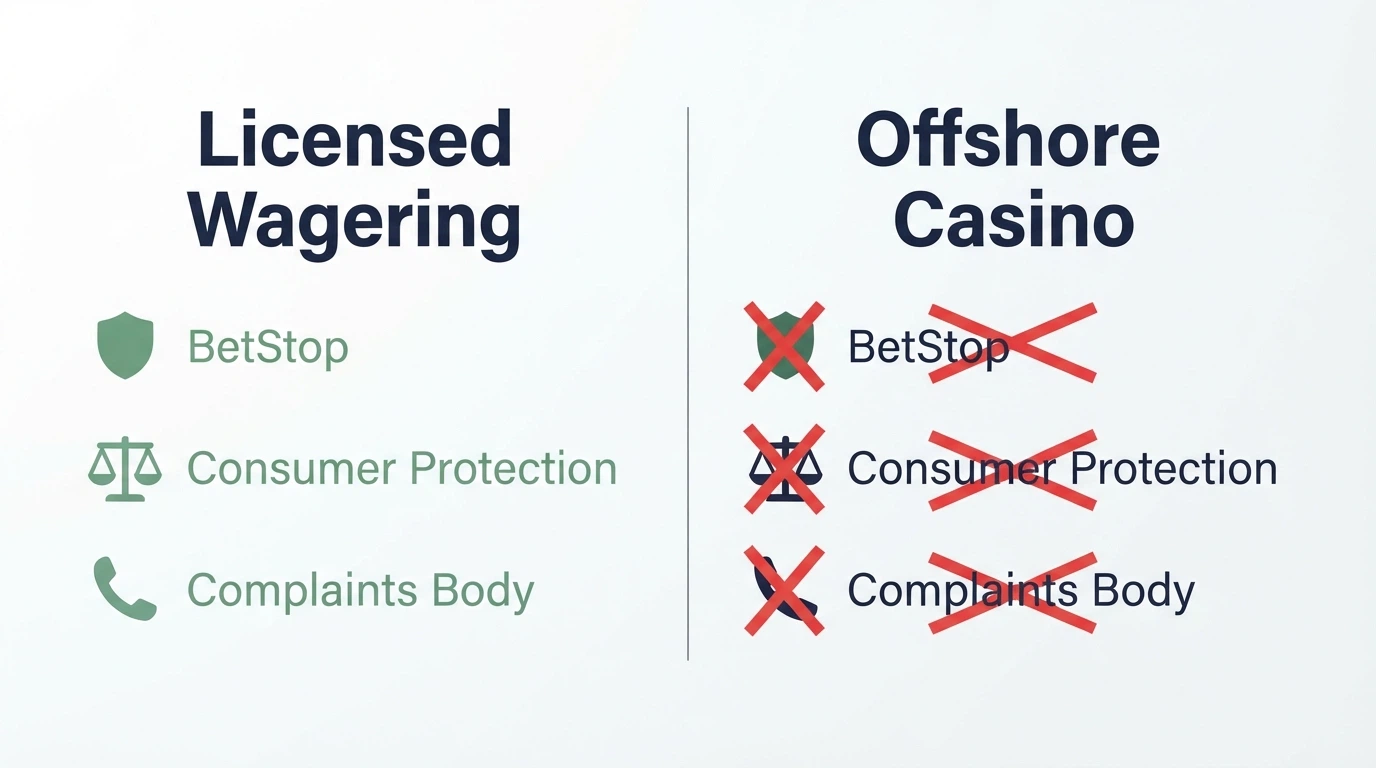
The trade-off the term hides is the same one the law was built to answer. Deposit limits do not exist at most offshore crypto sites because nothing obliges them to. Take-a-break tools do not exist because nothing obliges them to. A connection to Australia’s BetStop self-exclusion register does not exist because nothing obliges them to. The features that make an anonymous casino attractive are the features that strip out every harm-minimisation safeguard Australian regulation requires of the licensed operators. There is no version of the no-KYC casino where this is not so; what changes is whether the player walks in understanding it.
The KYC Wall — What You Hand Over at a Standard Casino vs an Anonymous One
A standard online casino — the kind that holds an Australian-licensed wagering product, or any operator running through the broader international regulatory net — runs a Know Your Customer routine at signup. That means an email, a password, and then at cashout the operator sends a request: a passport or driver’s licence scan, a recent utility bill or bank statement as proof of address, and increasingly a selfie-with-ID photograph to defeat the second-hand document trade. Each item is a piece of identity data the operator stores, often for the lifetime of the account plus a statutory retention period after closure. The Australian Privacy Principles do not reach an operator in Curaçao. If that operator is breached, the player’s data is part of the breach with no OAIC complaint and no Australian statutory compensation.
An anonymous casino cuts that process in two places, sometimes both. The lower tier is email-only: an address and a password, deposit crypto, play, and the operator reserves the right to ask for documents “at any time.” Most of the operators on this page sit here. Jackbit (now Jack) treats verification as a fraud-and-AML exception rather than a routine step — the casino reserves verification for genuinely flagged withdrawals, not for ordinary cashouts. The upper tier, and the only one the term approaches literally, is CryptoRoyal’s WalletConnect-only model: no email, no password, no account at all, just the wallet address that connected. The no-KYC policy at CryptoRoyal held firm through a $750 USDC cashout test, and the weekly withdrawal cap is 5,000 USDC.
The data collected is the surface, but the deeper difference is the data the Australian system cannot see. A bank transfer from an Australian account to an offshore operator leaves a PayID-style record that an Australian court can reach. A crypto deposit from a self-custodial wallet to the same operator does not. Every operator on this list accepts Australian signups via offshore domains, and all eight AU-facing operators in ChainBankroll’s test officially exclude Australia from their Terms under IGA enforcement risk — the exclusion exists for the operator’s protection, not the player’s.
Real-Money Stakes vs Free-Play Demos — What You Can Do Without an Account
Anonymous play splits into two quite different modes, and the distinction matters. Real-money wagering at most operators requires at least a wallet connection — you cannot risk funds you have not deposited — and so the anonymity on the cashier screen is the ceiling. Email-only registration still gives the operator a handle, even if no document has been uploaded. The WalletConnect-only tier goes further: the casino holds the wallet address, nothing else, and the wallet itself is a self-custodial software the player controls.
Demo or fun-mode play strips all of that back. Most operators in the featured set run demo slots and table games in the browser without an account at all — you click “Play for Fun” or its equivalent and the games load with a play-money balance. Demo mode is the right testing surface: it costs nothing, it does not collect a wallet address, and it lets a player sample a casino’s game library and platform feel before deciding whether to deposit. What demo mode does not simulate is the bonus fine print, the withdrawal queue, or what the cashier looks like under real KYC pressure: those only show up when money is on the screen, and anyone reviewing an operator should know that free-play is a useful but partial substitute for a real-money test.
Mobile Access and Pokies on Anonymous Platforms — No App Store, No Problem
Anonymous casinos deliver mobile play through the browser, not the App Store or Google Play. That is not a compromise — it is the architecture. Native app stores now require identity-linked developer accounts and run their own KYC on the apps they distribute, so a no-KYC casino cannot publish there without surrendering the model. The browser approach sidesteps the entire problem: the casino is a mobile website that runs on the player’s existing browser, with the wallet either inside that browser (a Web3 wallet like MetaMask) or external (WalletConnect on a phone). The result is instant-play mobile without an app trail in either direction.
Pokies — the slot machines on which Australians lose more than any other gambling product — are also the dominant category at anonymous crypto casinos, for the same reason they dominate Australian hotels and clubs. Pokies are responsible for roughly 51–57% of gambling problems in Australia, a substantially higher share of harm than race wagering, sports betting, casino table games or lottery products. The 2,700-plus game library Lucky Block advertises and the thousands of titles at BC.Game and Stake are made up disproportionately of exactly the games whose harm ratio research has been tracking for decades. An anonymous crypto casino is, in prevalence terms, the venue class where the harm ceiling sits highest.
How Crypto Casinos Deliver the Anonymity a Regular Site Cannot
The reason a fiat casino cannot match the no-KYC model is not regulatory reluctance — it is the plumbing. A bank transfer carries the account holder’s name permanently attached to it. A card payment carries the cardholder. PayID and Osko both carry the registered name behind the payment identifier. A licensed Australian wagering operator receiving a deposit through any of these rails is, by the rail itself, in possession of the customer’s verified identity. The only way to skip the KYC step is to skip the bank, and the only way to skip the bank is to use a rail that runs without one.
Cryptocurrency is that rail. A transfer from a self-custodial Bitcoin wallet carries no name, no address, no identifier that the receiving party can verify against any document. The receiving party sees a blockchain address and a transaction amount; the player’s identity is whatever can be reconstructed from the chain itself, which (depending on the currency) can be quite a lot or almost nothing. The licensed Australian wagering operators are not allowed to receive that payment — credit cards and digital currency were banned as online wagering payment methods on 11 June 2024, with penalties of up to A$247,500 for operators who fail to enforce. An offshore operator accepting crypto is, by virtue of accepting it, outside the Australian rules.
That fact — that the payment method itself tells the reader where an operator sits — is the loudest tell on the page and the one no comparison table displays. An Australian asked for a credit card or crypto deposit by a gambling site is being served by someone outside Australian rules. There is no licensed Australian online casino to deposit credit or crypto into.
How a Crypto Deposit Replaces Every Piece of ID
The full anonymous-crypto deposit looks like four steps, and only one of them touches identity.
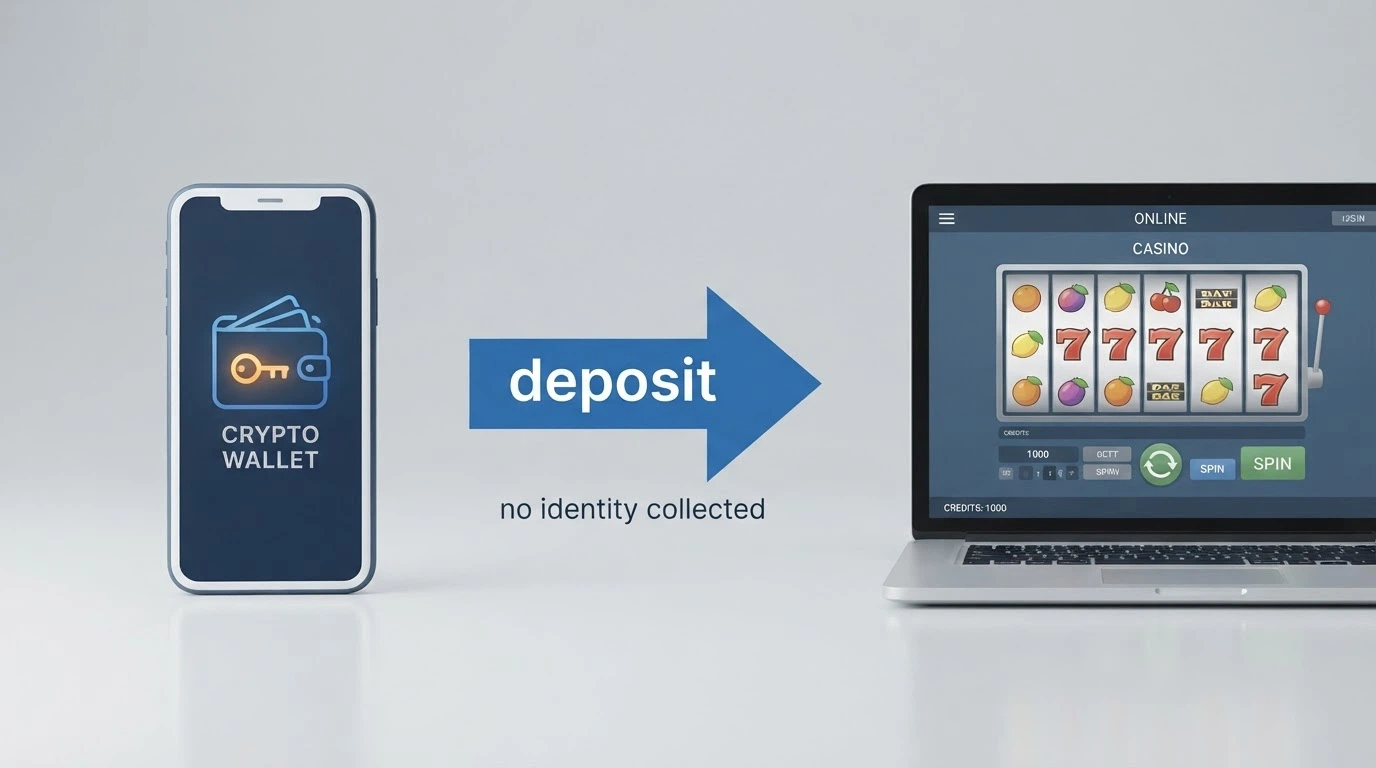
First, a wallet. A self-custodial software wallet (MetaMask, Trust Wallet, Phantom for solana, or a Bitcoin-native equivalent) is created by downloading an app and writing down a seed phrase. No document is requested. The wallet is a cryptographic key, not an account.
Second, the player buys crypto. This step — the only step that touches identity — typically happens on an Australian exchange such as CoinSpot, Swyftx, or Independent Reserve, all of which run under AUSTRAC’s reporting regime and verify the customer against a government ID at signup. The exchange is the identity event; it is also the chokepoint AUSTRAC monitors.
Third, the player moves the crypto into their self-custodial wallet. Once it arrives, the wallet is the jurisdiction: no Australian exchange has visibility from then on.
Fourth, the player deposits from the wallet to the casino with no further KYC in the standard no-KYC model. The casino sees a wallet address and a transaction; it does not see a name; it cannot, by itself, reconstruct one.
The full cycle from withdrawal request to AUD in a bank account runs anywhere from 30 minutes to 24 hours, depending on the currency and the exchange used. USDT on the TRC-20 network cleared fastest at under 10 minutes across the casinos tested by Casinoshub.com; Bitcoin averaged 10 to 60 minutes against the same benchmark.
Bitcoin, USDT, Ethereum — Which Currency Keeps You Most Anonymous
Not all cryptos carry the same privacy. The four currencies Australian players will actually see at an anonymous casino fall into two distinct privacy tiers, and the difference between pseudonymous and on-chain private is the difference between “we can probably find out who you are if someone subpoenas the right exchange” and “no one can ever find out who you are.”
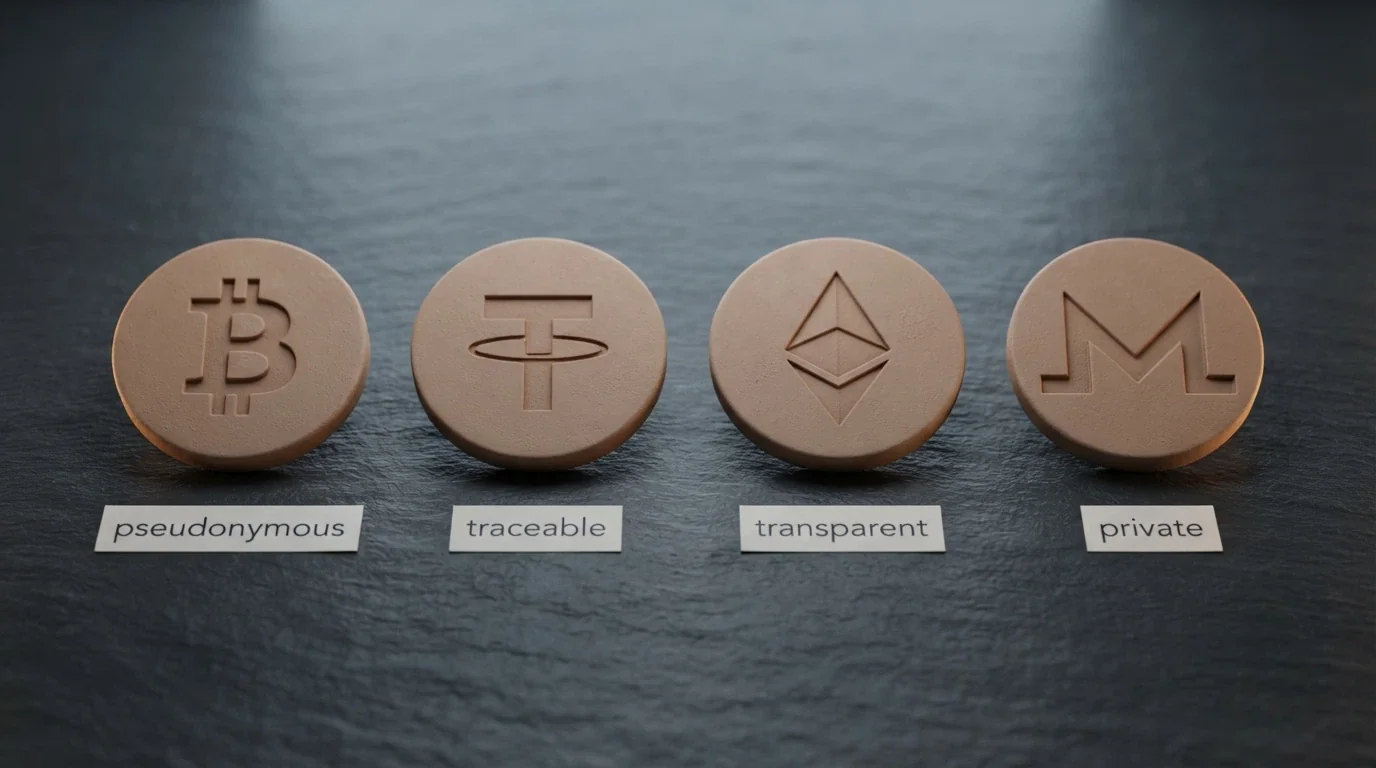
Bitcoin is pseudonymous. Every transaction sits on a public ledger forever, indexed by address. The chain does not carry a name, but chain-analysis firms (Elliptic, Chainalysis) cluster addresses and link them to exchanges where KYC has been completed. Once the link to a KYC’d exchange exists, the player’s real-world identity is one subpoena away. Bitcoin’s value at a casino is its universality, not its privacy.
Ethereum and the ERC-20 tokens that run on it (USDC, USDT on Ethereum) carry the same pseudonymous structure as Bitcoin, with all the same forensic exposure. USDT on the TRC-20 network (Tron) carries faster settlement — typically under 10 minutes — at a fraction of the fee, which is why the fast-withdrawal benchmarks reward TRC-20 over ERC-20 USDT. Lesser-known privacy coins shift the calculus. Monero (XMR) is the leading on-chain private currency: ring signatures, stealth addresses and confidential transactions obscure sender, receiver, and amount on the public ledger. Chain analysis cannot reconstruct Monero transactions beyond confirming they happened. Jackbit (Jack) supports a native Monero wallet, which is why the operator scores highest on the on-chain privacy axis in the featured set. Litecoin and Dogecoin round out the menu at most operators — low-fee alternatives to Bitcoin with the same pseudonymous profile.
The honest framing is that pseudonymity is enough for almost no one to care. The player’s name is one subpoenaed exchange away. On-chain privacy (Monero) is the only currency class where that link is not just expensive to pursue but technically unavailable. Most Australian players using BTC, ETH, USDT or LTC are, in anonymity terms, the same person whether they were on-chain or in a casino’s bank-transfer cashier.
The “Truly Anonymous” Threshold — No Email, No Name, Just a Wallet
The upper tier — the only tier where “anonymous” is not a stretch — is the WalletConnect-style pure-wallet model. CryptoRoyal sits there alone in the featured set: no email, no password, no account creation. A player connects a self-custodial wallet, deposits, and plays; if they disconnect, there is no account to return to. The operator’s database holds a wallet address and a transaction log, neither of which resolves to a name. The no-KYC policy held firm in a $750 USDC cashout test, and the weekly cap is 5,000 USDC.
Jackbit (Jack) sits one tier below. Registration requires an email address and a password, but verification — the step where documents would be uploaded — is reserved for genuinely flagged withdrawals rather than ordinary cashouts. Jackbit supports native Monero for the on-chain privacy layer, and the email it holds is not a document and not a national identifier. This is the tier where “anonymous” means what most readers expect: no driver’s licence, no passport, no proof of address, anywhere in the relationship.
Soft-KYC operators, including Goated, sit below that. A soft-KYC operator verifies identity at a triggered withdrawal — not on signup, not on small cashouts, but past a threshold. The threshold across the AU-accessible no-KYC market is approximately A$2,000 to A$5,000 in cumulative lifetime withdrawals, after which the casino typically sends a document request. Below the threshold, withdrawals process automatically.
What the blockchain itself records is the floor under whichever tier the operator occupies. Even at CryptoRoyal, an on-chain analyst can see a wallet has been funded to and withdrawn from a casino’s deposit address. They cannot, however, link that wallet to a person unless the player has reused an exchange-linked wallet or interacted with a KYC’d venue. A player using a fresh wallet funded from a non-custodial source sits closer to actually anonymous than any casino’s own KYC tier framing will admit.
Instant Payouts — How Crypto Cuts Withdrawal Times from Days to Minutes
The single biggest practical difference between crypto casinos and their fiat counterparts is the withdrawal clock. A fiat casino withdrawal typically moves through a payment processor, often via a card network that takes three to five business days to settle; a bank wire takes similar or longer depending on correspondent banks. A crypto casino that maintains a hot wallet processes withdrawals the moment it signs the on-chain transaction. The slot between “approval” and “funds in your wallet” is measured in minutes, not days.
The numbers from the live tests are striking. USDT on TRC-20 cleared fastest at under 10 minutes across all ten casinos tested by Casinoshub.com. Bitcoin averaged 10 to 60 minutes depending on network congestion. Jackbit (Jack) tested under 5 minutes. CoinCasino states 5 to 10 minutes and a June 2026 test cashout landed on-chain in seven minutes. Goated cleared a 0.03 ETH withdrawal instantly in an August 2026 live test. At the slower end, Wild Fortune averaged 5 hours 24 minutes from request to confirmation across five test cycles — fast for a fiat casino, slow for a crypto one — and the daily, weekly and monthly caps on Wild Fortune are USD$4,000, USD$10,000 and USD$40,000 respectively. BC.Game’s tested average sits at 3 hours 12 minutes, faster than Wild Fortune but slower than the TRC-20 clusters.
The full cycle from casino to AUD in an Australian bank account runs 30 minutes to 24 hours. No casino on the AU-accessible no-KYC list pays directly to an Australian bank account in AUD without a conversion step — the player withdraws crypto to a personal wallet, sells on a local exchange, then transfers to bank. Litecoin and USDT on TRC-20 are the fastest and cheapest options across the tested set.
Australia-Anchored — Accessing Offshore Crypto Casinos from Australia
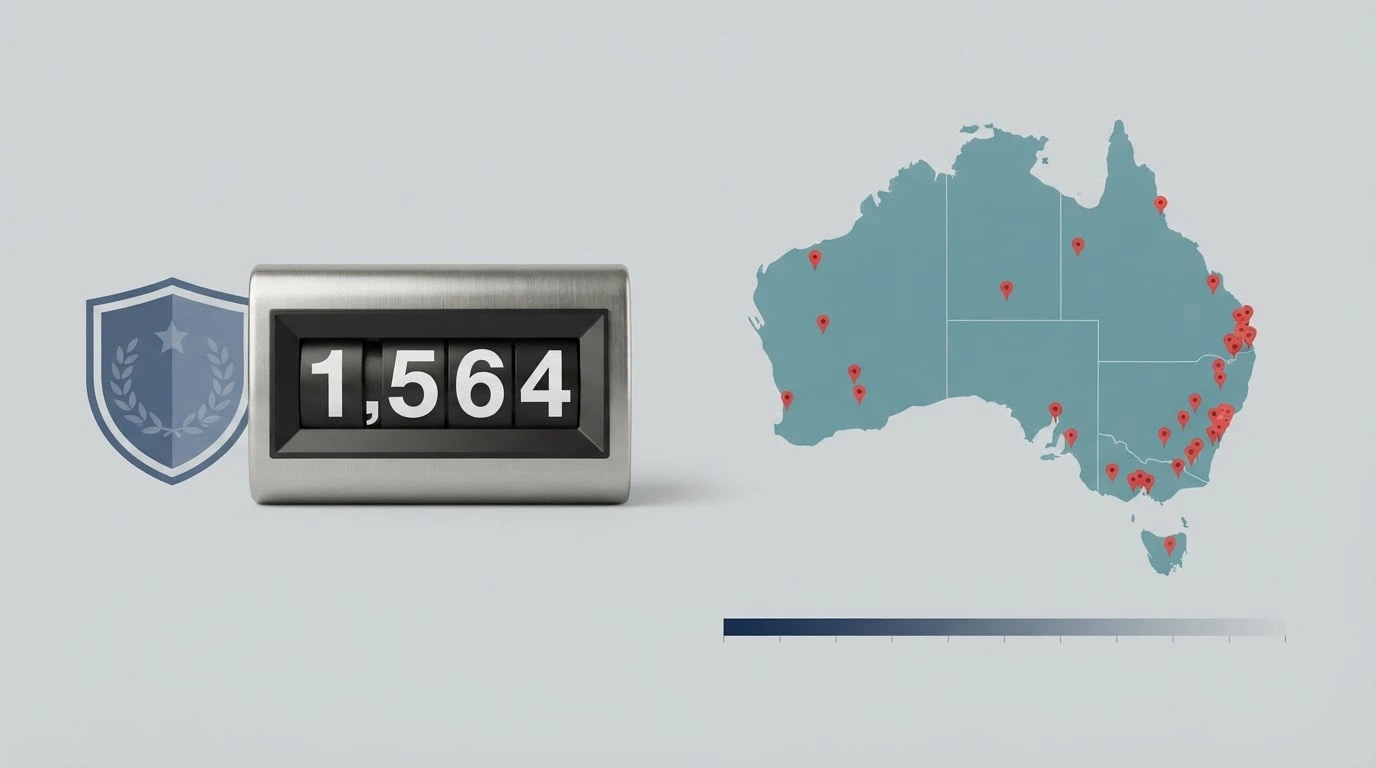
The Australian Communications and Media Authority has directed Australian ISPs to block access to illegal gambling and affiliate websites since November 2019. As of March 2026, the count sits at 1,564 blocked sites and more than 225 illegal services have withdrawn from the Australian market since 2017. The blocking is DNS-level, which is to say it is real but not absolute: it stops an Australian IP from resolving a domain, not a player using a VPN from reaching the same site. The block list is constantly refreshed but it lags the operator-side domain rotation that introduces fresh offshore mirrors as older ones are blacklisted.
VPN use for access is the practical reality, and the operators know it. All eight of the AU-facing offshore operators ChainBankroll tested officially exclude Australia from their Terms under IGA 2001 enforcement risk while continuing to accept Australian signups via offshore domains. The exclusion protects the operator; the acceptance at onboarding is what brings the player through. An Australian visa card, an Australian IP via VPN, and an Australian bank account funding a local exchange to on-ramp crypto: each of those steps is unremarkable on its own. The IGA’s enforcement engine runs against the provider, not the player; the regulator’s toolkit is structured that way.
The minimum age for any commercial gambling in Australia is 18 and nothing on these sites overrides that. The deeper point is that the offshore presence is the playbook, not the accident — these operators exist because the Australian market cannot be entered legally, and the player traversing them has, in the regulator’s accounting, not committed an offence but has also given up every Australian remedy if anything goes wrong.
Australia’s Accessible Anonymous Crypto Casinos in 2026 — Ranked
| # | Operator | Licence | Crypto Supported | Welcome Bonus | Wagering | Tested Withdrawal Speed |
|---|---|---|---|---|---|---|
| 1 | Lucky Block | Curaçao | BTC, ETH, USDT, plus more | 200% up to $10,000 AUD equivalent + 50 free spins | 35x | Up to 5 minutes |
| 2 | Jack (Jackbit) | Curaçao | BTC, ETH, USDT, Monero, plus more | 100% deposit match + 100 wager-free spins on Hot Chilli Bells | 0x on free spins | Under 5 minutes |
| 3 | Stake | Curação eGaming | BTC, ETH, LTC, DOGE, BCH, USDT | — | — | Faster than Wild Fortune |
| 4 | BC.Game | Curaçao | BTC, ETH, USDT, XRP, plus more | 4 deposit bonuses | — | 3h 12m average |
| 5 | Wild.io | Curaçao | BTC, ETH, TRX, plus more | — | — | — |
| 6 | Skycrown | Curaçao | BTC, ETH, USDT, LTC, DOGE, XRP, plus more | 450% up to A$8,000 + 400 free spins across four deposits | 40x | Daily cap A$7,500 crypto |
| 7 | CoinCasino | Anjouan | BTC, ETH, USDT, plus more | $30,000 bonus | — | 5–10 minutes (test: 7 min) |
| 8 | CryptoRoyal | Not stated in research | BTC, ETH, USDT, plus more (WalletConnect) | 100% up to 1 BTC + 10% weekly cashback up to 9,000 USDC | 30x on deposit plus bonus | Weekly cap 5,000 USDC |
| 9 | Goated | Curaçao | BTC, ETH, plus more | — | — | Instant in test |
| 10 | RocketPlay | Curaçao | BTC, ETH, LTC, DOGE, USDT, BCH | 100% up to 1,000 EUR + 100 FS first deposit; 200% up to 1,000 EUR second deposit | 30x–40x | — |
The ranking orders operators by closeness to the page’s subject — anonymity depth, bonus transparency, withdrawal reliability, breadth of crypto support — not by market share. Where the table shows a dash rather than a figure, the figure either was not in the publisher’s published bonus terms or was not measured by the testing outlet research consulted. Lucky Block led Bitcoincasinos.com’s Australian ranking on the strength of its 2,700-plus games and near-instant payouts, with the rest of the set clustered close behind.
The spread in the licence column is the more telling detail. Nine of ten operators sit under Curaçao eGaming or an Anjouan licence; one — CryptoRoyal — does not state a licence at all in the sources consulted, which is itself a flag. None holds an Australian licence, which is the entire point: there is no such licence. Reading the table, the reader should see a licence stamp that is genuinely real but genuinely distant from the player, and understand that what they are looking at is the offshore response to a product the IGA 2001 does not let any Australian company sell. Penalty for corporations that do: up to $1.1 million per day of contravention.
Lucky Block — The 200% Match and 2,700-Plus Game Library
Lucky Block’s headline is the bonus: a 200% match up to $10,000 AUD equivalent plus 50 free spins, behind a 35x wagering requirement, with a $1 AUD equivalent minimum deposit and email as the only registration field. The gambit is the contrast between the headline percentage and what 35x does to a $10,000 ceiling. A player claiming the full $10,000 match needs to wager $350,000 before any withdrawal — a sum that takes sustained play to clear even at the slots-weighted 100% wagering contribution operators of this scale typically run. The 2,700-plus game library is real, the email-only signup is genuine, and the near-instant payouts (up to 5 minutes in tests) match the marketing. What the marketing says and what the bonus costs the player diverge, and the right read of Lucky Block is a fast-payout, broad-library brand whose welcome bonus looks bigger than it plays.
Jack — Wager-Free Spins and Native Monero Privacy
Jack, formerly Jackbit, is the strongest anonymity profile in the featured set for one reason: it is the only operator with both the wager-free deposit-bonus structure and a native Monero wallet. The 100% deposit match on the welcome package comes with 100 wager-free spins on Hot Chilli Bells — zero wagering on the free-spin winnings, which is the rarest bonus configuration on the page. The 120 no-deposit free spins sit at 0x wagering too, capped at $50–$100 depending on the offer page. The email signup takes 30 seconds and verification is reserved for fraud and AML flags rather than routine cashouts. Withdrawals cleared in under 5 minutes in tests, the cursor on speed in the featured set. Jack is the closest read-the-name-and-mean-it choice for a player whose priority order is privacy first, then speed, then bonus — which is what the search itself implies.
Stake — The Provably Fair Veteran with Curaçao Credentials
Stake was established in 2017 and is the longest-running operator in the table. The Curaçao eGaming licence has been continuous since launch, the provably fair system runs alongside external providers, and the crypto support list — BTC, ETH, LTC, DOGE, BCH, USDT — is broad enough to test almost any rail a player wants to use. Where Stake’s table cells read as dashes, it is because the welcome bonus detail and the wagering multiple were not in the snippets reviewed. What testing did cover is withdrawal speed: faster than Wild Fortune in head-to-head tests. Stake’s pitch to a returning player is not bonus value — it is longevity, provably fair arithmetic, and the breadth of its crypto rails. It is the right read for the player who values a long-running licence and a transparent house-edge model over the headline percent.
BC.Game — Four-Deposit Bonus Structure Across Thousands of Games
BC.Game runs a four-deposit welcome package, supports BTC, ETH, USDT, XRP and additional currencies, and carries a Curaçao licence. The game count crosses into the thousands, which puts BC.Game in the deeper end of the featured set on library breadth; the tested withdrawal speed averages 3 hours 12 minutes, somewhere between the instant-withdrawal cluster and the slower end at Wild Fortune. Research carries no per-bonus figure for BC.Game’s welcome structure, which is itself a signal: it means the bonus specifics move target-by-target across promotions, and a player eyes BC.Game for combination of crypto rail breadth, game count and mid-tier withdrawal reliability rather than a single bonus number to hit.
Wild.io — A No-Deposit Entry Point Across 10-Plus Cryptos
Wild.io’s distinguishing offer is the 20 no-deposit free spins — 40x wagering on winnings, $50 max cashout, ledger opened with a wallet login or email and no deposit required. The 10-plus cryptos supported include BTC, ETH, TRX and additional. The Curaçao licence is the same baseline as the rest. Wild.io’s role in a ranking is the no-deposit entry point: the offer that lets a player sample the platform’s game library. The cap is the constraint — $50 maximum cashout means the upside on the no-deposit bonus is bounded, and 40x means whatever wins emerge from the spins need serious wagering before they become withdrawable. Wild.io is the read for a player who wants to test an anonymous casino on the operator’s money, understanding that the upside is bounded by design, no deposit is guaranteed, and no payout is guaranteed by any Australian regulatory body.
Skycrown — The 450% Match Spread Across Four Deposits
Skycrown posts the highest percentage in the featured set: a 450% deposit match up to A$8,000 plus 400 free spins across the first four deposits, 40x wagering on both match and free-spin winnings, max bet A$7.50, and a 14-day bonus validity window. The headline reads like a windfall. The fine print has two clauses that change the read. First, the 40x multiplier doubled by four deposits means a player claiming the full package is committing to substantial wagering on a strict timetable. Second, and decisively, Skycrown’s offer is not available to crypto players — the operator’s published bonus terms exclude the very customer base the table is built for. A crypto player looking at Skycrown is looking at a headline that does not apply. Curaçao licensed, daily withdrawal cap A$7,500 on crypto withdrawals. Skycrown is the 450% banner warning on a page: high number, narrow applicability, not for you if you came here to play in crypto.
CoinCasino — Anjouan-Licensed with Seven-Minute Withdrawals
CoinCasino holds the only Anjouan licence in the featured set, distinct from the Curaçao cluster and the licence-unstated CipherRoyal anomaly. The published payout window is 5 to 10 minutes and a June 2026 test cashout landed on-chain in seven. KYC is triggered only on unusually large or suspicious withdrawals — the soft-KYC approach to identity, threshold-gated. The $30,000 bonus ceiling is the headline number; the wagering multiple and the bonus terms in detail were not in the snippets research captured. CoinCasino’s role in the ranking is the strict-withdrawal-speed read: it is the operator the table puts forward when the priority is the seven-minute ledger lid and the threshold-gated KYC. The licence difference (Anjouan vs Curaçao) is a regulatory detail rather than a brand-quality one and does not, by itself, move CoinCasino up or down the ranking.
CryptoRoyal — WalletConnect-Only, No Email, No Password, No Account
CryptoRoyal sits at the ceiling of the anonymity tier and below most others on licence transparency. The model is WalletConnect-only: connect a wallet, deposit, play, never learn an email address or assign a password. No account creation in the conventional sense, no document request through the $750 USDC cashout test, weekly withdrawal cap 5,000 USDC. The welcome bonus is 100% up to 1 BTC plus 10% weekly cashback up to 9,000 USDC, 30x wagering on deposit plus bonus. The catch is the licence: research carries no live register entry for CryptoRoyal. A reader using CryptoRoyal is choosing the model on its anonymity, not on the licence stamp the table can show. That is the explicit positioning: the most anonymous operator in the set is also the one with the thinnest regulatory footprint, and a player picking it should pick it on the first rather than despite the second.
Goated — Soft KYC with Instant ETH Withdrawals
Goated’s published credentials are around the test record: 0.1 ETH deposited, 0.03 ETH withdrawn, both cleared instantly in an August 2026 live test. Curaçao licensed, soft KYC policy rather than upfront verification, BTC and ETH and more supported. Welcome bonus specifics were not in the snippets reviewed; that is the right shape to remember. Goated is the second-instant-withdrawal slot, paired with CoinCasino at the speed end of the table. A player who weights withdrawal speed above bonus value would look here; a player who needs the headline percent behind the bonus would not.
RocketPlay — Five-Day Bonus Window with Slots-Optimised Wagering
RocketPlay’s structure is dual-deposit: 100% up to 1,000 EUR plus 100 free spins on the first deposit, 200% up to 1,000 EUR on the second, wagering multiples sitting between 30x and 40x with slots contributing 100% and live games only 5%. The bonus validity window is five days from receipt, the shortest in the featured set. The max bet during wagering is AUD 7.50. Curaçao licensed. RocketPlay is the slots-skewed read: a player who plans to grind the wagering requirement on pokies will clear the bonus quickly because of the 100% slot contribution, but the live-dealer crowd and the table-games crowd will find their 5% contribution rate punishing. The five-day window is a deliberate speed test for the offer, and a casual player will find it hard to clear. RocketPlay is the right read for the disciplined slots player who knows exactly how much wagering they will do before signup.
Why Your 2026 Anonymous Casino Bonus Is Smaller Than It Looks
The arithmetic of casino bonuses runs the way it has always run, and the crypto version does not change the rule. A bonus pays back less than the headline figure because the wagering requirement multiplies the real cost of clearing it, the max-cashout cap bounds what can be withdrawn, and the validity window sets a clock most players miss. The crypto version sharpens the rule: deposits are faster, withdrawals are faster, the bonus turnover metric is the same. A 200% match looks bigger for being crypto-paid; the $350,000 of required turnover behind the headline is what the player feels.
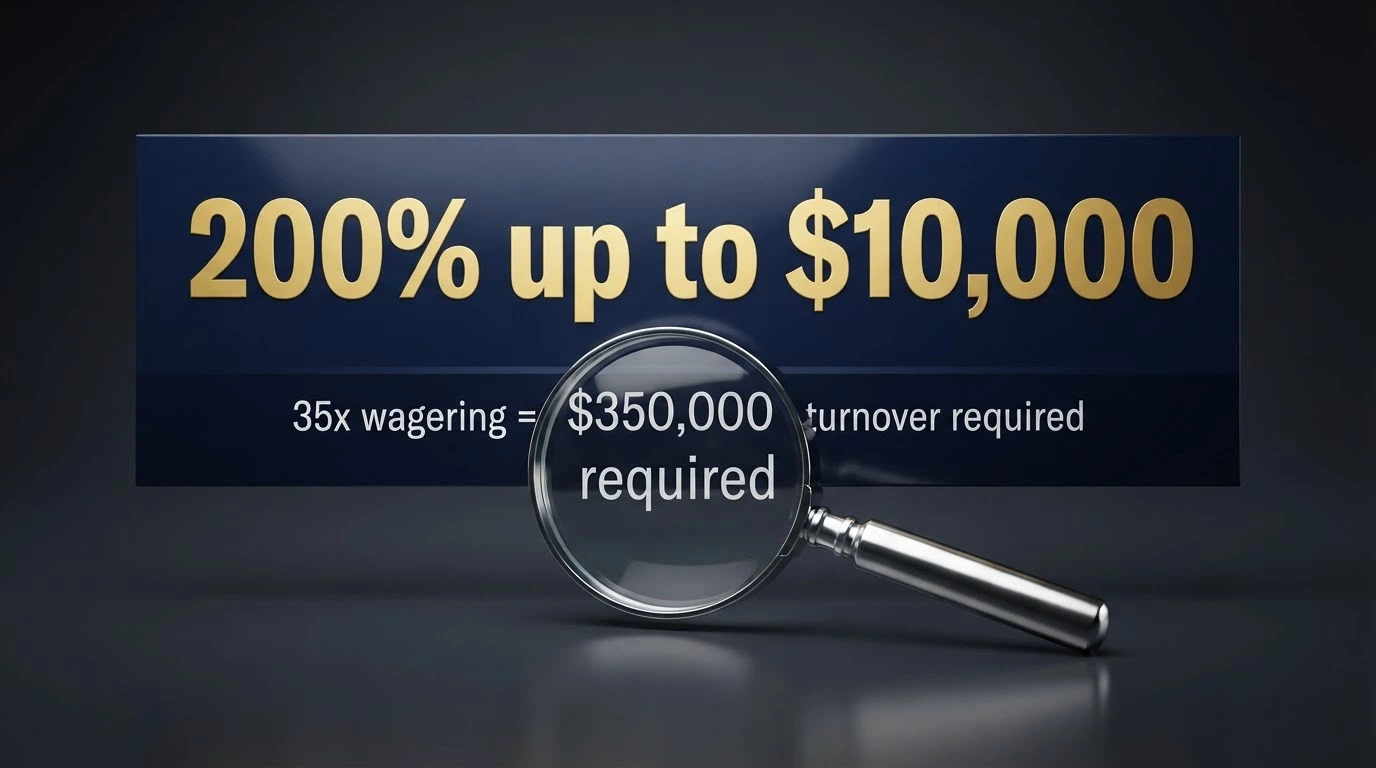
Take Lucky Block’s 200% up to $10,000 AUD with 35x wagering. A player who claims the full match needs to wager $350,000 — thirty-five times the bonus amount — before any withdrawal is allowed. The matched deposit ($5,000 to get the maximum $10,000 bonus) sits at a different ratio depending on operator: some carry 35x on bonus plus deposit, some carry 30x on bonus only. A Skycrown 450% match up to A$8,000 across four deposits at 40x requires an effective A$320,000 in turnover if the player chases the ceiling. CryptoRoyal’s 100% up to 1 BTC plus 10% weekly cashback comes with 30x on deposit plus bonus, and the bonus + deposit combination doubles the base versus bonus-only wagering.
Where the bonus ceiling is uncapped and the multiplier is heavy, the math runs faster than the player. A no-deposit bonus sits at the other end of the same problem: small headline, small upside, bounded by design. Maximum cashouts on no-deposit wins typically run $50 to $100 — well below the amount the spins would theoretically generate. A player who hits a meaningful line on a 40x no-deposit spins bonus at Wild.io runs into the cashout cap before they run into the wagering.
No-Deposit Bonuses — Free Spins That Do Not Ask for a Deposit
| Operator | Free Spins (No Deposit) | Wagering on Winnings | Max Cashout | Registration Required |
|---|---|---|---|---|
| BitStarz | 100 | 40x | €100 | |
| Wild.io | 20 | 40x | $50 | Wallet or email |
| 7Bit Casino | 75 | 45x | $50 | |
| Vave Casino | 15 | 35x | $50 | |
| Coins.Game | 150 | 30x | $100 | |
| FortuneJack | 150 | 0x | Not stated; deposit equal to winnings required to withdraw |
The shape across the six is consistent: 15 to 150 free spins, 30x to 45x wagering, $50 to $100 cashout caps. The exceptions carry their own caveats. BitStarz’s €100 cap is the highest in the set and the only one denominated in euro rather than dollar. FortuneJack’s 150 free spins carry 0x wagering — there is no playthrough on the winnings — but the bonus terms require a deposit equal to the free-spin winnings before withdrawal is permitted. The wagering requirement is zero; the deposit hurdle is not. The wagering question is different from the cash-out question, and FortuneJack is the read-the-terms case.
What no-deposit offers actually do is let a player sample an operator’s slot library on the operator’s money, capped losses bounded by the operator’s structure rather than the player’s. The expected value of any no-deposit bonus, once the wagering and the cap are factored in, is modest. The upside is the testing experience itself: a spin at an operator’s slot on the operator’s budget, with the right to walk away when the bonus is gone.
Deposit-Match Welcome Offers — the 200% Headline vs the Wagering Fine Print
The headline percentage is the marketing, and the wagering is the math. Behind every large match sits a turnover requirement that turns the percentage against the player over time. A 200% match on $5,000 at 35x requires $175,000 of slot play at 100% contribution (or its equivalent at partial contribution rates) to clear. A 450% match across four deposits at 40x blows past $300,000 of wagering. The casino does not lose on percentage; it loses, if anything, on the player’s failure to clear the wagering before the validity window expires.
The contribution table — the per-game-type rate at which wagers count toward the playthrough — is the silent multiplier behind the headline. Slots at most operators contribute 100% of each bet toward the wagering; table games typically 10% to 20%; live-dealer games often 5%. RocketPlay’s published structure is the most explicit: slots 100%, live games 5%. A roulette player at $50 a spin would need to wager 20 times more to clear than a slots player at the same stake. The headline looks undifferentiated; the contribution table differentiates everything.
The validity window is the third multiplier, often the most punishing of the three. Skycrown’s 14-day welcome validity and RocketPlay’s 5-day window are short on purpose: a casual player who claims the bonus and returns on day six finds the bonus gone, the winnings voided, and the original balance restored. The wagering arithmetic does not change; the ability to complete it does.
Wager-Free Spins — the Rare Offer That Lets You Keep What You Win
Two operators in the featured set attach zero wagering to free-spin winnings. Jack’s 100 wager-free spins on Hot Chilli Bells sit alongside the deposit match — the player keeps what the spins pay, no playthrough needed before withdrawal. Jack’s 120 no-deposit free spins also sit at 0x wagering, $50 to $100 cap. FortuneJack’s 150 no-deposit free spins carry 0x wagering but require a deposit equal to the winnings before withdrawal — the no-playthrough rule lets the player keep what they win, the no-playthrough rule does not let the player walk away without funding an account.
Against a 35x to 45x standard, 0x wagering is a different product class. A 40x wagering requirement on $10 of free-spin winnings means $400 of slot wagering to clear a $10 win; a 0x wagering requirement means the $10 is withdrawable (subject to the cap). The funnel underneath differs: a 0x free-spin offer is closer to a small gift; a 40x free-spin offer is closer to a chance at a small gift that the operator has priced at a 40x conversion rate. The number that survives all the marketing is the same one: how big is the cap, and what is the wagering behind it.
Where Australian Law Stands on Anonymous Crypto Casinos — and Where It Does Not Reach
Every operator on this page is offshore and unlicensed in Australia. Online casino is prohibited under the Interactive Gambling Act 2001 — there is no licence for online casino anywhere in the country, not federally, not in any state or territory. The Interactive Gambling Amendment (Credit and Other Measures) Act 2023 extended the prohibition to the payment method: credit cards and digital currency are banned as payment for online wagering since 11 June 2024, with a penalty of up to A$247,500 for operators who fail to enforce. An operator accepting crypto is outside the Australian rules by structure, not by accident. The Interactive Gambling Amendment (Gambling Reform) Bill 2026 passed Parliament on 19 August 2026; its measures commence on 1 January 2027, strengthening BetStop, extending bank/payment-provider blocking powers to digital currency, and restricting wagering advertising.
The IGA targets the provider of the prohibited interactive gambling service, not the player who uses it. An Australian accessing an offshore crypto casino has not committed an offence under the Act. The provision section 15(2A) at issue in Brisbane Poker Pty Ltd — $15 million in penalties against the company, $9 million against director Rhys Edward Jones, $240,000 against Brenton Lee Buttigieg for aiding and abetting — names the operator, not the customer.
What the player has done is give up every protection the Australian licence system grants. There is no Australian complaints body that can recover funds. There is no recourse to the Australian Financial Complaints Authority. The operator’s terms apply under the operator’s jurisdiction, the operator’s regulator (where there is one) handles disputes, and if the win is voided or the account closed or the site blocked mid-session, the loss is the player’s.
The Interactive Gambling Act 2001 — Why Australia Has No Licensed Online Casino
The statutory architecture starts with section 15 of the Interactive Gambling Act 2001. Under section 15, it is an offence to provide a prohibited interactive gambling service to a person in Australia. The Act was amended in 2017 to give the ACMA formal enforcement and ISP-blocking powers, and again in 2023 to add the credit-and-crypto payment ban (effective 11 June 2024). The credit-and-crypto ban is its own enforcement vector: a licensed Australian operator cannot process a credit-card or crypto deposit because doing so is an offence, and the penalty runs up to A$247,500 per breach. From 1 January 2027, banks and payment providers also gain express authority to block transactions (including digital currency) to illegal gambling operators.
The 2026 reform passed Parliament on 19 August 2026. The headline changes that touch the player are: ACMA’s infringement notice window extends from 12 to 24 months; BetStop operation is strengthened; and direct marketing of inducements is restricted — prohibited for 14 days after signup, three months after BetStop deregistration, and indefinitely for customers identified as at risk of harm. The reform does not change the underlying prohibition.
The architecture is not a path to legalisation through reinterpretation. Section 15 is the prohibition, and every operator on this page is operating against it. The reform is an enforcement intensification, not a regime change.
ACMA’s Blocking Powers — 1,564 Sites Blocked and Counting
The Australian Communications and Media Authority has had 1,564 illegal gambling and affiliate websites blocked by Australian ISPs since November 2019, as at March 2026. More than 225 illegal services have withdrawn from the Australian market since enforcement was strengthened in 2017. The toolkit runs through formal warnings, civil penalty proceedings, and ISP blocking directions; the regime works through administrative pressure and infrastructure cooperation rather than criminal prosecution of operators based abroad.
The blocking is DNS-level. A blocked site fails to resolve on Australian ISPs’ default DNS, which stops most readers; VPN and alternate DNS routes keep the rest of the access network intact. The blocking list is updated as new sites are identified, and operators behind blocked sites typically rotate to fresh domains or redirect through mirror infrastructure — the count grows and the effectiveness remains a contest between regulator and operator rather than a closed outcome.
The penalty frame against the operators extends. The penalty for corporations is up to $1.1 million per day of contravention; the Brisbane Poker judgment runs that to its dollar extent at the corporate level. ACMA’s 2026 extension of the infringement notice window from 12 to 24 months widens the period in which formal enforcement runs, but does not change what is prohibited.
What You Lose When You Play Outside the Regulated Market
A licensed Australian wagering customer is covered by the Australian consumer law, by state/territory dispute resolution processes, by BetStop, by the operator’s licence conditions that mandate harm-minimisation tools (deposit limits, take-a-break, activity statements, self-exclusion), and by the National Gambling Helpline as the upstream referral path. An offshore casino customer has none of those. The ACMA cannot recover player funds — the regulator’s enforcement toolkit does not run to fraud recovery; the helpline still applies, but it does not bind the operator.
The operator’s terms apply, and the operator chooses its own jurisdiction. Refused withdrawals, voided wins on bonus-abuse grounds, account closures on KYC grounds mid-session — each is enforceable to the extent the operator’s licence partner (Curaçao, Anjouan) holds it to account, which is rarely. The site can be blocked at any time, mid-session, with a balance on it; the DNS-level block does not pause the underlying account, but it does pause the player’s ability to reach the cashier. A blocked operator does not become a refunding operator.
The line to draw is the one the law already draws. The IGA does not target the player, and no Australian has been prosecuted for using an offshore casino. The Act targets the provider. The cost the player pays is not legal exposure; it is the absence of every remedy a licensed consumer takes for granted.
The Licensed Route — What IS Legal for Australian Punters
The wagering product that is licensable in Australia is pre-event sports and racing wagering, run through operators licensed by state and territory regulators whose de facto national licensor is the Northern Territory Racing and Wagering Commission (also Licensing NT). Sportsbet, bet365, Ladbrokes, Tab — these are NT-licensed operators offering a legal product. The legal deposit methods are debit card, bank transfer, PayID/Osko, and BPAY — fiat rails with KYC built into the payment itself. Identity verification is a licence condition. In-play betting, online casino games, and online pokies are not part of the legal product set, which is why none of the operators on this page holds an Australian licence — the licence does not exist for the product they offer.
This is the cleanest framing on the regulatory position: the licensed route is real, but the licensed route is not the casino route. A reader choosing between a licensed Australian operator and an offshore crypto casino is choosing between pre-event sports wagering and online casino games — they are not choosing between regulated and unregulated online casino, because the regulated option does not exist.
What You Give Up When You Wager Without an Identity
The features that make an anonymous casino attractive are the features that strip every harm-minimisation safeguard Australian regulation requires of licensed operators. That is the entire trade-off, and it is not specific to any offshore brand.
A licensed Australian wagering account runs an enforced deposit limit, configurable by the customer but bounded by the operator’s licence conditions. It runs take-a-break sessions, activity statements, and behavioural flags for sudden increases in stake size. It runs BetStop, the National Self-Exclusion Register — one registration excludes from every Australian-licensed wagering service. An offshore crypto casino runs none of those tools, and the IGA does not oblige it to.
The data behind the safeguards is what makes them a player-protective infrastructure rather than a regulatory inconvenience. BetStop has had 67,480 registrations in three years of operation as at 31 July 2026; 41,290 exclusions are still active; 78% of registrants were under 40; 38% chose lifetime exclusion. The decision to register typically follows a pattern of escalating harm, which is the regulatory reason the safeguards exist. The 67,480-registration count is what the harm-prevalence numbers below would multiply if the offshore exemption did not exist.
BetStop — Why Australia’s Self-Exclusion Register Cannot Reach Offshore Casinos
BetStop is the National Self-Exclusion Register; one registration excludes a person from every Australian-licensed wagering service — online, phone, app, the lot. It binds Australian-licensed wagering services only. An offshore casino is not licensed in Australia, is not connected to the register, and will keep taking a self-excluded person’s money. The distinction is regulatory rather than technical: BetStop’s enforcement runs through the operator’s licence obligation, and an offshore operator has no Australian licence to enforce against. The same registration that stops a Sportsbet account on the day it activates is functionally invisible to a CryptoRoyal session.
The 67,480 registrations as at 31 July 2026 carry the demographic weight that explains why the safeguard is built the way it is. People under 40 are 78% of registrants — exactly the age bracket most exposed to operator-targeted advertising and most likely to be early in a harm trajectory. Lifetime exclusion (chosen by 38% of registrants) is the right product for that bracket precisely because it cannot be undone impulsively. An offshore casino patient who has chosen lifetime exclusion on BetStop has made the right choice for the licensed market and the right choice that does not survive them.
The Numbers — How Many Australians Are Harmed by Gambling
Roy Morgan’s March 2026 release puts 15.1% of the Australian adult population — about 3.32 million people — as experiencing some level of harm from their own gambling behaviours or those close to them. The same firm’s 2024–2025 PGSI measurement puts the problem-gambling rate at 2.9% of adults, or 622,000 people, up from 2.4% in 2023–24 and 1.9% in 2022–23 — a 22% year-on-year increase. ANU Polis reports a near-doubling of risky gambling from 13.7% to 19.4% in a single year, against a backdrop of overall participation decline to 58.8%. Springer Nature (Journal of Gambling Studies) estimates 3.29 million Australians aged 5+ affected annually by their own or another person’s gambling, including 1.97 million adults at-risk or problem gambling, and over 400,000 Years Lived with Disability (YLDs) as the annual health loss.
Pokies are the most harmful single category: 51–57% of gambling problems trace to electronic gaming machines according to long-running analysis. The race and sports betting categories together account for another 19–20% of harm. Online gambling is now the dominant modality — ANU Polis’s 2025 finding that 56.1% of past-12-month gamblers participated mainly online, and that online play tracked with psychological distress and loneliness, makes the offshore casino venue class the venue class where the harm ceiling sits highest.
Both AIHW (1.8% high-risk in 2022) and AIFS (7.6% low risk, 4.8% moderate, 2.6% high risk in 2024) provide the longer-baseline readings that place the recent Roy Morgan figures in context: the trend is up, not flat, and the trend is happening at a time when the offshore venue class is growing too. The numbers are not a policy argument; they are the reason the policy exists.
Practical Harm-Minimisation Steps When Wagering Anonymously
- The National Gambling Helpline — 1800 858 858 — is free, confidential, staffed 24 hours a day, 7 days a week, with online chat and counselling through Gambling Help Online (gamblinghelponline.org.au). The helpline applies regardless of where a player wagers, and the offshore casino industry does not change the helpline’s availability.
- Set a personal weekly deposit limit and stick to it. The anonymous casino gives the player the only enforcement — most offshore sites do not enforce a default ceiling. The easiest place to lose is the one where the limit is the player’s own discipline.
- Cap session time before the session starts. The lack of a take-a-break tool means the time boundary lives on the player. Setting a phone alarm before the first spin enforces the boundary, and the alarm approach is what the safeguard is supposed to feel like.
- From 1 January 2027, direct marketing of wagering inducements is prohibited for 14 days after signup, three months after BetStop deregistration, and indefinitely for customers identified as at risk from gambling-related harm. A player who has self-excluded and deregistered knows the protected window the reform creates; the offshore casino industry operates outside that protection regardless.
- Recognise the signs: chasing losses, gambling to escape mood, betting more than planned, hiding wagering activity from family or colleagues. ANU Polis’s 2025 finding links online gambling to psychological distress and loneliness, which is the early-warning literature the helpline services were built to address.
How We Assessed and Ordered These Operators
The ranking is a reading of published information about each operator, not a weight-and-score exercise against invented criteria. The ordering decided the table’s position by closeness to the page’s subject — anonymity depth, bonus transparency, withdrawal reliability, crypto support breadth — and the ten operators shown are the ten that research surfaced as AU-accessible anonymous crypto casinos operating offshore.
Sources consulted ran across casino-testing outlets (Casinoshub, PayoutVerdict, NoKYC Vault, WagerX, ChainBankroll), affiliate bonus audits (Bitcoincasinos.com, PlayCasino, Gamble.io, FreeExtraChips), regulator and government publications (ACMA, AUSTRAC), and individual operator terms pages (Jack, Stake, CryptoRoyal, RocketPlay). Each operator was read for: bonus headline versus bonus terms; KYC policy as written and as tested; withdrawal speed from public tests; licence claim against the issuing register where available; and crypto support as published on the cashier.
Excluded from the ranking entirely are the licensed Australian wagering operators — SportsBet, Tab, bet365, Ladbrokes, PointsBet, Neds, Betr, Picklebet, Betfair — because they are not casinos. They are NT-licensed for pre-event sports and racing wagering only, the legal product Australian regulation permits, and they do not compete in the same venue class as the offshore crypto brands on this list. Land-based Australian casino operators (Crown, The Star) are state-licensed but are not online casinos and do not anchor any comparison the table runs.
The methodology is qualitative and exists in plain prose because that is what the research supports. No operator was tested by the editorial side, no wager was placed, no withdrawal tested personally; every figure in the table is the figure a publisher has published and a reader can verify against the source. Where the table shows a dash, the publisher’s published snippet did not contain the figure; a player who needs it to choose can read the operator’s own bonus terms page, which is the source the table draws from.
What an Australian Player Should Actually Do About Anonymous Crypto Casinos
The legal position is unambiguous. Online casino is prohibited in Australia. The IGA targets the provider; no Australian is prosecuted for using an offshore site; the player is not the offender the Act was built to catch. The cost is not legal exposure but the loss of every Australian remedy when something goes wrong. ACMA cannot recover funds; BetStop does not reach offshore; the operator’s jurisdiction, not the player’s, governs the complaint. Those are the prices — the absence of every safeguard a licensed wagering customer counts on.
The bonus arithmetic is the second cost, and it is a quieter one. The wagering alone — 35x to 45x across the featured set, against 5-day to 30-day validity windows and bounded contribution rates that divide the wagering between games — turns almost every headline match into a sustained clear-or-lose campaign. The 200% up to $10,000 at Lucky Block reads as a ten-thousand-dollar windfall and clears as a $350,000 turnover project. The 450% at Skycrown is the same shape at higher weights. The no-deposit bonuses sit at the opposite end with caps of $50 to $100 — small upside, bounded by design, useful mostly as a test surface.
The data on harm is the context the decision is being made in. 3.32 million Australians are experiencing gambling harm in some form; 622,000 are problem gamblers; pokies drive 51–57% of the harm; online gambling is the modality through which most of the marginal harm is now reaching players. The safety infrastructure (BetStop, the 1800 858 858 helpline, deposit limits, harm-minimisation tools) is what built up over the past decade in response to that data, and the offshore anonymous casino is the venue class where none of it applies.
What an Australian player should actually do depends on the player. A player who has decided to use an offshore casino has, by decision, traded the safeguards for the privacy, the speed, and the casino product the licensed market does not offer. The trade is the player’s. The right way to make it is with eyes open: the legal position known, the bonus math run, the harm-prevalence data acknowledged, the helpline saved as 1800 858 858, and the reality that the only deposit limit at most of these sites is the limit the player imposes on themselves. The recommendation in plain terms: read the wagering before you chase the headline, keep the wagering budget you would have spent at any other venue, and pick up the phone to the helpline if the line between budgeting and chasing has already started to blur.
Frequently Asked Questions
What is the difference between “no KYC” and “soft KYC” at crypto casinos?
A no-KYC casino does not request identity documents at any point in the customer relationship — registration, deposit, and routine withdrawals all proceed without document upload. CryptoRoyal is the closest fit in the featured set, with a WalletConnect-only model that collects no email and holds no personal identifiers. A soft-KYC casino allows registration and small withdrawals to proceed without verification, but triggers document requests past a threshold — typically A$2,000 to A$5,000 in cumulative lifetime withdrawals — or when a withdrawal is flagged as unusually large or suspicious. The threshold varies by operator; Goated and similar soft-KYC operators publish the rule but not always the exact number. Both models leave a player with their name off the cashier screen up to the threshold; the difference is what happens past it.
What cryptocurrencies can I use to deposit at anonymous casinos from Australia?
The featured set covers Bitcoin, Ethereum, Litecoin, Dogecoin, Bitcoin Cash, USDT on both ERC-20 and TRC-20, XRP, Tron and Monero. Bitcoin is the universal rail and accepted at every operator; Ethereum and USDT are next most common. USDT on TRC-20 (Tron) is the fastest network tested, clearing in under 10 minutes across all casinos Casinoshub measured. Litecoin is the low-fee Bitcoin alternative. Monero — supported natively at Jack — is the only on-chain private currency where the public ledger does not record sender, receiver, or amount. Pseudonymous currencies like BTC, ETH and USDT are, in anonymity terms, one subpoenaed exchange away from a name; Monero closes that link by construction.
What happens to my money if an offshore crypto casino is blocked in Australia?
A block on the operator’s domain does not close the player’s account or move the balance — it stops the Australian DNS from resolving the site. The cash remains in the operator’s system pending withdrawal, but reaching the cashier requires a workaround (alternate DNS, VPN, mirror domain). The ACMA has blocked 1,564 illegal gambling and affiliate sites since November 2019 as at March 2026, and the list rotates as operators deploy mirror domains. The substantive risk is not the block itself but the underlying position: the player has no Australian complaint mechanism if the operator refuses to pay the balance regardless of network reach, because ACMA cannot recover player funds and the operator’s regulator is where the licence was issued, not where the player lives. The block does not refund the balance; it only makes the balance harder to reach from the Australian ISP by default.
Are winnings from crypto casinos taxable in Australia?
For an Australian resident playing as a punter rather than as a business, gambling and betting winnings are not assessable income under section 6-5 of the Income Tax Assessment Act 1997, and losses are not deductible under section 8-1. No Australian case has held ordinary-punter winnings assessable. The position shifts if the ATO can establish the person is carrying on a business of betting or gambling, which requires more than casual play. The crypto-specific dimension is the conversion step — selling crypto winnings on an Australian exchange will generate a capital gains tax event on the difference between cost base and disposal price for any appreciation between deposit and sale. A player who deposited crypto bought for A$100 and sold winnings equivalent to A$200 has a A$100 capital gain to report, separate from the gambling-winnings treatment which itself is non-assessable.
How do I convert crypto casino winnings into Australian dollars in my bank account?
No AU-accessible no-KYC casino pays directly to an Australian bank account in AUD without a conversion step. The standard flow is: withdraw from the casino to a personal self-custodial wallet, sell the crypto on an Australian exchange (CoinSpot, Swyftx, Independent Reserve, all of which require identity verification at signup under AUSTRAC reporting), then transfer the AUD to bank via PayID, Osko, or BPAY. The full cycle runs 30 minutes to 24 hours depending on the crypto and exchange processing time; USDT on TRC-20 is the fastest network against this benchmark. The conversion step is also where AUSTRAC’s reporting applies — large or unusual transactions can attract reporting obligations the player should expect.
Prepared by the Jackpot Pokies Australia editorial staff.