
50 Free Spins No Deposit in Australia — What the Terms Really Decide
A “50 free spins, no deposit” offer costs the player nothing to claim. That is the entire selling point, and it is the only fact the marketing leads with. What the marketing does not lead with is the wagering multiple, the cashout cap, or the expiry window, and those are the three figures that decide whether the offer ever pays out. Read the headline and the headline is generous; read the terms and the offer is something else entirely. This page is a working-out of the gap between those two readings — what the offer is worth in dollars, what it costs in turnover, which offshore operators in 2026 actually deliver one, and what an Australian player gives up by accepting the offer in the first place.
The currency figures, licence claims and policy references below were verified against the operators’ own published terms and the Australian Communications and Media Authority (ACMA) register on 18 October 2026.
Table of Contents
- Why a 50 Free Spins No Deposit Bonus Isn’t What It Looks Like
- What 50 Free Spins Are Worth at an Australian Online Casino
- The Offshore Casinos Offering Free Spins to Australians — and What Each One Actually Delivers
- Can You Really Claim 50 Free Spins on Your Phone?
- New Casinos Bet Big on Free Spins — Here’s Why
- Offshore Spins, Australian Law: What You’re Actually Risking
- Staying Safe When the Safety Net Doesn’t Reach
- How We Found and Checked These 50 Free Spin Offers
- What You Should Actually Do About a 50 Free Spins No Deposit Offer
- Frequently Asked Questions
Why a 50 Free Spins No Deposit Bonus Isn’t What It Looks Like
A 50 free spins no deposit bonus is a credit the operator attaches to a new account, not a gift. The credit takes the form of a fixed number of spins on a single pokie at a fixed per-spin value, and what comes out of those spins is bonus money, not withdrawable cash. To make that bonus money withdrawable, the player has to wager it through a multiple that almost always sits between 30 and 50 times. On top of that, the operator sets a maximum cashout cap — typically A$50 to A$200 — and the bonus expires within 3 to 14 days. The advertised offer is fifty spins; the actual offer is a fixed amount of turnable bonus credit under a deadline, with a ceiling on what it can ever pay out.
The headline number is the spins. The number that decides the result is the wagering. The number that bounds the result is the cashout cap. Most players who read the first number never see the second two, and that is the entire business model.
What “No Deposit” Actually Means
“No deposit” means the player does not send money to claim the spins. The spins are credited on registration, sometimes after an identity check, and the player can play them without funding the account. That is the entire promise. It is not a statement about what happens after the spins, and it is not a statement about whether the winnings can be withdrawn.
Per-spin values for these offers sit between A$0.10 and A$0.25, so fifty spins at the low end is A$5 of total play and A$12.50 at the high end. The number is small, and that is by design. A small per-spin value keeps the operator’s exposure on the bonus bounded, even before the wagering and cashout terms are applied. The withdrawal barriers sit behind the no-deposit entry, which is why the absence of an upfront payment is not the same as the absence of cost.
The operator still demands full identity verification before any withdrawal. A player who wins and tries to cash out without completing KYC will not be paid. The verification is the operator’s protection; the wagering and cap are its second and third. The no-deposit entry is the front of a structure whose real weight sits further in.
Sign-Up Spins and How to Claim Them
The claim path runs in roughly the same shape across the offshore operators serving Australian players. The player creates an account, confirms an email address, and the spins appear either automatically or after contacting support. A subset of operators requires a bonus code to be entered at registration, and the code is sometimes supplied on the operator’s promotions page, sometimes through an affiliate link. Where a code is required, the spins do not credit without it.
The friction in this path is rarely the registration itself. It is the two points where the operator tests whether the player has actually read the terms. The first is the KYC step, which the operator typically waves through at sign-up but enforces on the first withdrawal. The second is the bonus code, where a missing or expired code means no spins credit at all, and the player has used up part of the validity window finding out. Expiry windows for these offers run from 3 to 14 days, with some at 24 hours, and the clock starts the moment the spins are credited, not the moment the player opens the account. The terms that govern whether the bonus ever plays are the same terms that govern how long the player has to discover that they govern it.
Wagering Requirements — The Catch Behind the Spins
Wagering is the multiplier applied to bonus winnings before they become withdrawable cash. A 40× wagering requirement on a A$10 win means the player has to place A$400 in qualifying bets before any of the bonus money can be taken out. Most no-deposit free spin offers in 2026 sit in the 30× to 50× range, with 30×–35× counted reasonable and 50× counted steep.

The wagering is calculated on the bonus winnings, not on the spin value. A player who claims fifty spins at A$0.10 each and wins A$20 from the bonus round has to wager A$20, not A$5. At 40×, that is A$800 in turnover. At A$5 a spin — the standard maximum bet during wagering at these operators — that is 160 spins, run on a single pokie, under a clock that may give the player only a week.
Game contribution rates decide how fast the turnover accumulates. Pokies contribute 100% of every bet toward the requirement; table games like blackjack and roulette contribute 10% or less. Wagering on blackjack at 10% contribution means ten times as much play to clear the same requirement, which is why the spins are locked to a pokie and the wagering is not. The operator is steering the player toward the games where the house edge is highest, because the player’s volume is the operator’s revenue.
A 50× multiple on a modest win and a week to clear it is not an accidental configuration. It is the structure that converts most bonus credits into operator margin before the player ever reaches a withdrawal page.
Cashout Caps: What You Can Actually Withdraw
The maximum cashout cap is the single number that determines the upper bound of the offer. No matter how much the player wins during the wagering phase, the cap is the most the operator will pay out. Caps on no-deposit free spin offers in 2026 sit between A$50 and A$200. Anything above the cap is forfeited, regardless of how the player reached it.
The cap is applied after wagering is cleared, not before. The sequence is: play the spins, win a bonus balance, clear the wagering requirement, then try to withdraw — and discover that the cap was sitting behind the wagering all along. A player who wins A$400 over the course of clearing a 40× requirement at a A$5 maximum bet will have the withdrawal reduced to the cap, typically A$100 to A$180, with the remainder voided.
Independent testing of 31 advertised A$50 no-deposit offers found that only six actually delivered the bonus credit the marketing described. The other 25 either required a hidden deposit, applied A$30–A$50 maximum cashout caps that crushed real winnings, voided wagering-cleared payouts under “irregular play” clauses, or used stale codes that no longer credited. The headline figure on the offer page is one number; the figure that survives into a player’s account is a smaller one, and the figure that ever lands in a bank account is smaller still.
Promo Codes and Bonus Tokens
Some operators require a bonus code to be entered at registration; others credit the spins automatically. The distinction matters because a missing code is a missing bonus, and a player who registers without the code has used the sign-up — the only sign-up any operator guarantees.
Codes expire independently of the offer, which is why a code captured from a six-month-old review may no longer credit. Testing found codes still being circulated on affiliate pages that the operator had retired, and the player who used one lost the bonus without losing the account. Where a code is required, the operator’s own promotions page is the most reliable source, and the only source that updates when codes change. Affiliate and aggregator pages are useful for orientation; they are not authoritative for a live claim.
A one-time token — sometimes delivered by email after registration, sometimes by SMS — is a different mechanism. It is single-use, tied to the account, and credited automatically. The trade-off is that it usually arrives with a shorter validity window, because the operator controls the timing and has no reason to extend it.
Which Pokies Your 50 Spins Unlock
Most no-deposit free spin offers lock the spins to a single pokie. The choice of pokie is the operator’s, and the choice sets the RTP and volatility that govern the player’s real chances. The four titles below are the ones confirmed across the offers researched for this page.
| Slot Title | RTP | Provider | Volatility | Max Win |
|---|---|---|---|---|
| Big Bass Splash | 96.71% | Pragmatic Play | High | 5,000× bet |
| Sweet Bonanza | 96.48%–96.51% | Pragmatic Play | High | 21,100× bet |
| Gates of Olympus | 96.5% | Pragmatic Play | High | 5,000× bet |
| Gates of Olympus 1000 | 96.5% | Pragmatic Play | Very high | 5,000× bet |
The RTP figures cluster between 96.48% and 96.71%, which means the house edge on each spin is roughly 3.3% to 3.5%. Volatility, not RTP, is the figure that determines the shape of the session. High and very high volatility titles produce long dry stretches punctuated by occasional large wins; the player is more likely to lose the bonus balance quickly and less likely to grind a small balance into a withdrawal-eligible one. The max-win multiplier looks dramatic in isolation — 21,100× on Sweet Bonanza — but it describes the ceiling of a single spin outcome, not the path through fifty of them.
Where the offer does not name the pokie, the player should treat the choice as the operator’s hedge. The title is selected because it serves the operator’s exposure, not because it serves the player’s chances.
What 50 Free Spins Are Worth at an Australian Online Casino
The monetary value of a no-deposit fifty-spin offer is the product of the per-spin value and the number of spins. At the low end of the per-spin range, fifty spins at A$0.10 are A$5 of total play. At the high end, fifty spins at A$0.25 are A$12.50. That is the headline value, and it is also the smallest of the three numbers the player needs.
The wagering requirement multiplies what the player has to do with that value. A 40× requirement on a A$10 win — a modest return on the spins — is A$400 in required turnover. The player has to run A$400 in qualifying bets before the A$10 becomes withdrawable, and the operator caps the bet at A$5 a spin during that phase. At A$5 a spin, 80 qualifying spins clear the requirement; at A$0.10 a spin, the same turnover takes 4,000 qualifying spins and is functionally impossible inside a 7-day window. The structure forces the player up the stake scale to have any chance of clearing the bonus in time.
The expected loss, which is what the offer actually costs, is turnover multiplied by one minus the RTP. On Gates of Olympus at 96.5% RTP, the house edge is 3.5%. The expected loss from A$400 in required turnover is A$14. That is the real cost of the bonus to the player, and it is paid before any cashout is considered. Against a cashout cap of A$100 to A$180, an expected loss of A$14 is the operator’s margin on a structure that the marketing describes as free.
The Spin-Value Maths
Fifty spins at A$0.10 each is A$5 of play. A player who wins A$5 from the spins faces a 40× wagering requirement of A$200 in turnover, run at a maximum A$5 bet, taking roughly 40 qualifying spins. The expected loss on those 40 spins at 96.5% RTP is A$1.40. The expected loss on the original 50 bonus spins is A$0.18. The combined expected loss is roughly A$1.60 against an offer that marketed A$5 of “free” play.
A player who wins A$10 from the same bonus — still a modest return — faces A$400 in wagering turnover and an expected loss of A$14 on that turnover alone. The bonus pays A$10 if cleared; it costs A$14 to clear. The arithmetic is unfavourable before the cashout cap is even considered, and the cap sits behind the wagering as a second compression.
Fifty spins at A$0.25 each doubles the play value to A$12.50, but the wagering requirement tracks the win, not the spin value, so a A$10 win from a higher-stake spin faces the same A$400 turnover. The economics of the offer do not scale with the per-spin value in the way the marketing suggests. They scale with the win, and the cap is what bounds the win.
Where These Spins Are Played
The spins are locked to a pokie, and the wagering is cleared on pokies, because pokies are the only game type that contributes 100% of each bet toward the requirement. Table games — blackjack, roulette, baccarat — contribute 10% or less, which means a player who tries to clear a A$400 turnover on blackjack at 10% contribution has to run A$4,000 in qualifying bets to clear the same requirement. The operator does not forbid the player from doing this; the structure simply makes it unworkable inside the validity window.
The pokie titles attached to these offers are uniformly high or very high volatility. Big Bass Splash, Sweet Bonanza, Gates of Olympus and Gates of Olympus 1000 all sit in the high or very high volatility class, which means long stretches without a return and the occasional larger win. High volatility suits a bonus structure built on a cashout cap: the cap converts the rare large win into a smaller capped payout, and the long dry stretches consume the rest of the bonus before the player reaches the cap. The volatility is part of the design.
The Offshore Casinos Offering Free Spins to Australians — and What Each One Actually Delivers
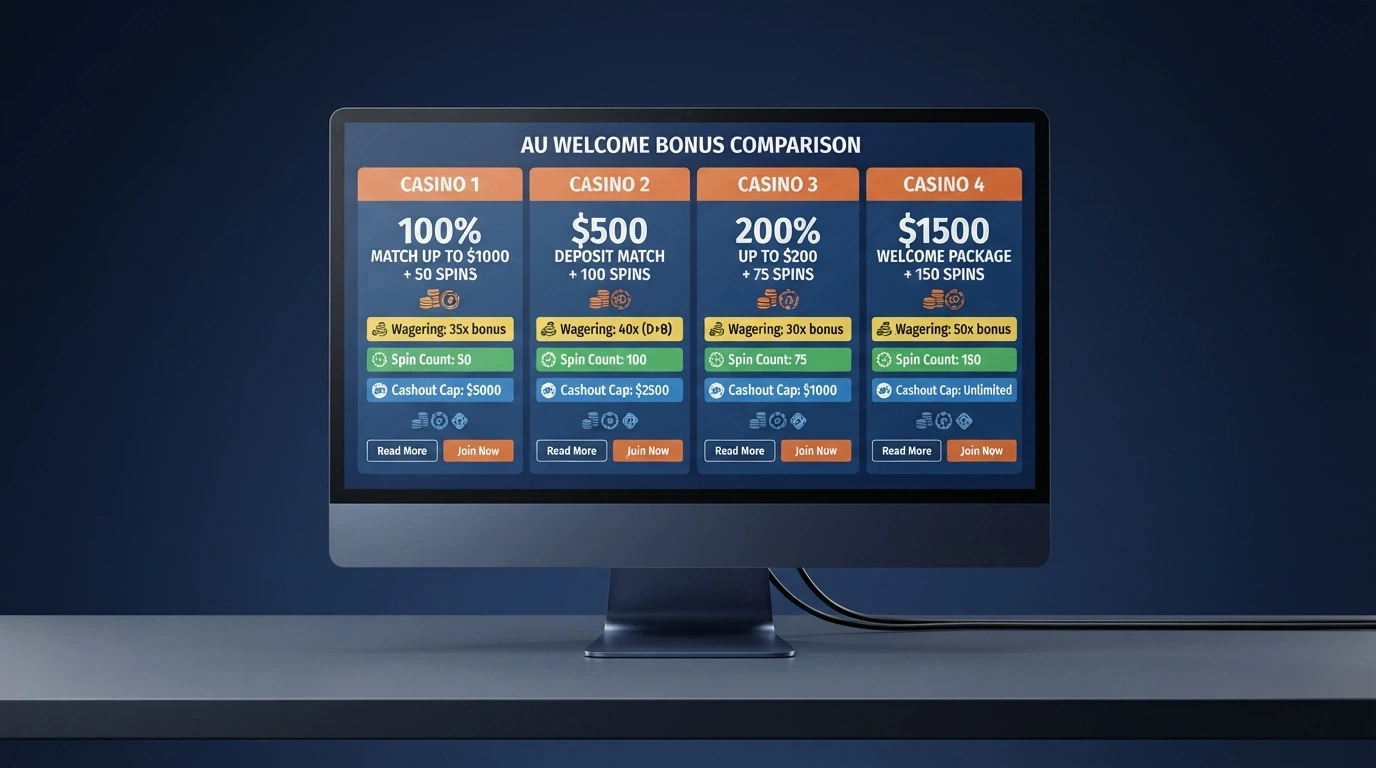
Every operator below is an offshore casino. None carries an Australian online casino licence, because none exists for this product. Players dealing with these operators have no Australian consumer protection, no BetStop coverage, and no recourse through the ACMA if a withdrawal is refused or an account is closed. The table compares the ten operators researched for this page; the write-ups below it cover each one in turn.
| Casino | Offshore Licence | Free Spins / No-Deposit Offer | Wagering | Deposit-Free? |
|---|---|---|---|---|
| Fair Go Casino | Curacao | 100 FS on Sparkling Fortunes; 30 FS on Fu Long Treasures | 60× on NDB winnings | Yes |
| RocketPlay | Curacao | 30 FS on Triple Fortune; 120 FS on Doragon’s Gems | 60× (30 FS); 40× (120 FS) | Yes |
| SkyCrown | Curacao | A$10 chip + 40 FS (≈A$50 equivalent) | 40×–45× | Yes |
| Rainbet | Offshore | 25 FS for new AU players | 40× | Yes (25 FS) |
| Royal Reels | Curacao | A$10 no-deposit chip | — | Yes (A$10 chip, not spins) |
| WinSpirit | Curacao | Weekly reloads (30%), tournaments | — | No fixed 50 FS NDB |
| Stake | Curacao | Rakeback and deposit boosts | — | No classic NDB |
| Scream Casino | Offshore | — | — | Not confirmed |
| Bizzo Casino | Curacao | Free spins (40× wagering, valid to 31 Dec 2026) | 40× | Not confirmed |
| Rocket Casino | Offshore | — | — | Not confirmed |
Fair Go Casino
Fair Go runs the most heavily documented no-deposit free spin offer in this set: 100 free spins on Sparkling Fortunes, valued at A$0.10 per spin for a total of A$10 in play value, with a 60× wagering requirement on the winnings, an A$180 maximum cashout, and a 7-day validity window. The same operator also runs a 30 free spin no-deposit offer on Fu Long Treasures with the same A$180 cashout cap, valid to 25 August 2026. The platform is RTG-powered and holds a Curacao licence.
The 60× wagering is the steepest in this comparison, and it is the figure a player has to clear before any withdrawal. A A$10 win requires A$600 in qualifying turnover; a A$50 win requires A$3,000. The A$180 cap means even a successful clearing run pays out at most A$180 regardless of the balance. The welcome package — a 100% deposit match up to A$200, redeemable five times for a total of A$1,000 — has no maximum cashout limit on the deposit bonus, but it is a separate offer and is not what the no-deposit spins are.
Fair Go is the operator to read first because its terms are the most explicit, and a player who understands this offer understands the structure of the category. The 60× is the trap; the 7-day window is the clock; the A$180 cap is the ceiling. The deposit welcome package is a different product, and the player should not let the generosity of one obscure the discipline the other demands.
RocketPlay
RocketPlay runs two distinct no-deposit free spin offers with different wagering tiers. The first is 30 free spins on Triple Fortune at 60× wagering, the steeper of the two configurations. The second is 120 free spins on Doragon’s Gems at 40× wagering with a A$100 maximum win. The welcome package sits separately: 100% up to €/$1,000 plus 100 free spins on first deposit, plus 200% up to €/$1,000 on second deposit, all at 40× wagering. The platform is powered by BGaming, Pragmatic Play and Evolution, and holds a Curacao licence.
The 120-spin offer at 40× wagering is the better of the two for a player who intends to clear, because the wagering is lower and the spin count is higher. The A$100 maximum win is the bound: no matter how the spins perform, the withdrawal cannot exceed A$100. The 30-spin offer at 60× is a different shape — fewer spins at a steeper multiple — and the player should treat the two as separate offers, not as a combined bundle.
RocketPlay is the operator to read for the contrast within a single brand: two offers, two wagering tiers, two cashout rules. The 120-spin route is the one a player optimising for a realistic clearing chance should look at. The 30-spin route is the one a player who wants to test the platform at minimal exposure should look at, knowing the cashout ceiling is tighter in practice.
SkyCrown
SkyCrown’s no-deposit offer is a hybrid: an A$10 no-deposit chip plus 40 free spins, presented as roughly A$50 in equivalent value. The wagering requirement sits at 40× to 45×, the maximum cashout on the no-deposit portion is A$80, and the validity window is 10 days. The welcome package runs across three deposits at 100% up to €100 plus 100 free spins, with the same 40× wagering applied. The platform is powered by Evolution Gaming and Pragmatic Play Live, and holds a Curacao licence.
The chip-plus-spins structure is SkyCrown’s way of presenting a no-deposit entry without offering a flat fifty spins. The A$80 cap is the tightest in this set, and the 10-day window is the second-shortest. A player who wins meaningfully from the chip and the spins combined is capped at A$80; a player who wins from the spins alone is capped at less, depending on how SkyCrown splits the cap between the two components.
SkyCrown is the operator to read for the chip-plus-spins pattern, which is one of the ways offshore brands disguise a no-deposit offer behind a lower headline spin count. The A$80 cap and the 10-day window are the two figures a player has to clear before any of the A$50-equivalent marketing survives into a withdrawal.
Rainbet
Rainbet is a crypto-focused operator that runs a modest 25 free spin no-deposit offer for new Australian players, with a welcome package of up to A$8,000 plus 200 free spins spread across three deposits at 150%, 75% and 125% match rates. The wagering requirement sits at 40× across the welcome offers, with a A$5 maximum bet during bonuses, and a A$30 minimum deposit on any deposit-gated offer. The platform holds no Australian licence and operates from an offshore jurisdiction.
Rainbet does not run a classic no-deposit bonus beyond the 25 free spins. Its model is a rakeback backbone — returning a percentage of house edge to active players — overlaid on the welcome package. For a player optimising for a 50 free spin no-deposit match, Rainbet falls short: the closest configuration is one-fifth of the headline count. For a player optimising for a rakeback relationship that compounds over time, the offer is a different product entirely.
Rainbet is the operator to read for the crypto-native model. The lack of a classic no-deposit bonus is not a defect of the review; it is a feature of the operator. A player who arrives at Rainbet expecting fifty free spins will leave disappointed, and a player who arrives looking for a rakeback relationship will find what they are looking for.
Royal Reels
Royal Reels offers an A$10 no-deposit chip — not free spins — alongside an A$500 welcome bonus on first deposit, with a 2000+ game library spanning multiple providers, crypto and fiat payment rails, and a Curacao licence. The wagering requirement on the no-deposit chip was not confirmed in this research run.
The headline distinction is that Royal Reels does not offer a 50 free spins no-deposit package. The operator competes in the no-deposit space with a chip rather than spins, and a player who arrived looking for fifty spins will find an A$10 chip instead. The chip and the spins are different products: the chip is a single fixed-amount credit, the spins are a fixed number of plays at a fixed per-spin value, and the economics of clearing each are different.
Royal Reels is the operator to read because it appears in the same search results as fifty-spin offers despite not offering one. The A$10 chip is a legitimate no-deposit entry; it is not a fifty-spin offer, and the player should not treat it as one.
WinSpirit
WinSpirit runs a deposit bonus and a loyalty programme, with weekly reloads at 30% and tournaments that include no-deposit entry spots. The platform is Curacao-licensed, with a 1000+ game library across multiple providers. A fixed 50 free spin no-deposit offer was not confirmed in this research run.
The model here is frequency rather than size. A player at WinSpirit is more likely to encounter a 10 or 20 free spin no-deposit credit attached to a tournament entry, a reload, or a loyalty milestone than a single fifty-spin bundle at registration. The aggregate over a month of active play can reach comparable volume; the offer at sign-up does not.
WinSpirit is the operator to read for the loyalty-tournament model. A player optimising for a single large no-deposit bundle will not find one here. A player who values ongoing no-deposit opportunities over a headline welcome package should assess if this model aligns with their gameplay.
Stake
Stake runs a rakeback model with deposit boosts. No classic no-deposit free spin offer was confirmed for Australian players in this research run. The platform hosts Stake Originals — proprietary titles — alongside third-party games, operates as a crypto-native casino, and holds a Curacao licence.
The absence of a no-deposit offer is not a gap in the research. It is the operator’s chosen model. Stake returns a percentage of the house edge to active players through rakeback, and converts first deposits into boosted value through deposit matches. A player looking for a fifty-spin no-deposit entry will not find it here, because the operator does not run one. A player who values a rakeback relationship on a crypto-native platform will find what was advertised.
Stake is the operator to read for the rakeback alternative. The category is real, the product is real, and the absence of a no-deposit free spin offer is the point, not the omission.
Scream Casino
Scream Casino appears in the market, but no current offer specifics — free spin count, wagering requirement, game providers, or deposit-gated welcome bonus — could be confirmed in this research run. The operator is offshore and does not hold an Australian licence.
The honest position is that Scream Casino is listed for completeness only. A player who arrives here looking for verified terms will not find them in this review, and a player who arrives looking for a fifty free spin no-deposit offer should look at the operators above with documented terms. Where the operator’s own promotions page carries more current information, that page is the source to consult.
Bizzo Casino
Bizzo Casino runs free spin offers at 40× wagering, with a validity window that runs to 31 December 2026. The platform holds a Curacao licence. The exact free spin count and the welcome bonus structure were not confirmed in this research run.
The two figures that are confirmed — 40× wagering and the year-end validity — are the two figures a player has to plan around. A 40× requirement is the midpoint of the market range and clears the threshold the player should accept. The 31 December 2026 validity is the deadline the player has to clear it by, after which the offer configuration may change without notice.
Bizzo Casino is the operator to read for the confirmed 40× rate and the explicit expiry. For those planning around a known wagering multiple against a fixed calendar deadline, this operator provides clarity on both fronts.
Rocket Casino
Rocket Casino appears in the market, but no current offer specifics — free spin count, wagering requirement, game providers, or welcome bonus — could be confirmed in this research run. The operator is offshore and does not hold an Australian licence.
The honest position is the same as for Scream Casino. Rocket Casino is listed for completeness, and a player who arrives looking for verified terms should look at the documented operators above. Where the operator’s own promotions page carries more current information, that page is the source to consult.
Can You Really Claim 50 Free Spins on Your Phone?
Yes. The claim process on a mobile device is the same claim process on a desktop, because the operator serves a single account across devices and the bonus credits to the account, not to the browser. The registration form, the KYC step, the bonus code field and the credited spins are identical on a phone. What changes is the surface, and the surface is built for the smaller screen by default.

The practical concern on a phone is connectivity, not access. A dropped connection mid-spin is a lost spin, and a session timed out at 24-hour expiry will not be reinstated. The browser-based play that dominates the offshore market also means there is no app to update, no permissions to grant, and no storage cost on the device. A modern phone running a current browser handles pokie gameplay without compromise.
App vs In-Browser Mobile Play
Most offshore casinos serving Australian players do not maintain a dedicated app. The Apple App Store and Google Play restrict real-money casino apps in most jurisdictions, and the offshore operators have responded by serving a mobile-responsive website that runs in the browser. The result is a site that adapts to the screen size without a download, an update cycle, or the app store’s geographic restrictions.
The trade-off is that the browser site has no native notifications, no offline mode, and no icon on the home screen for one-tap access. The gain is that the same site that works on a desktop works on a phone, and the same account that holds a bonus on one device holds it on the other. For a player claiming a no-deposit offer, the mobile experience is a smaller window onto the same offer, not a different offer.
No-Deposit Spins on the Small Screen
The terms of a no-deposit free spin offer do not change by device. A 40× wagering requirement on a phone is the same 40× on a desktop, and an A$180 cashout cap on a tablet is the same A$180 on a laptop. The expiry clock runs at the same rate, the KYC verification is the same, and the eligible pokie is the same. A player who claims on a phone and plays on a desktop, or claims on a desktop and plays on a phone, is dealing with one offer and one set of terms.
The performance consideration is the pokie’s own resource load. High-volatility Pragmatic Play titles with cascading reels and animated multipliers run smoothly on a current phone, but a four-year-old device on a weak connection can drop frames, and a dropped frame on a winning spin is a real loss. Where the player’s hardware is at the margin, the safer route is a desktop claim with a desktop clearing run, and the same offer played under more predictable conditions.
New Casinos Bet Big on Free Spins — Here’s Why
A new online casino launching into the Australian market has one problem: no one has heard of it. The marketing budget has to convert a stranger into a depositing player in a single session, and the cost of that conversion is paid in bonus generosity, not in media spend. A fifty-spin no-deposit bundle is the cheapest way to put a real-money game in front of a player who has not yet decided whether the brand is worth funding, and the player who plays fifty spins without depositing has cost the operator only the bonus value, the wagering margin, and the time.

The same economics that make the launch offer generous make the track record short. A casino that has been operating for six months cannot show a year of clean withdrawals, a year of dispute resolution, or a year of consistent terms. The wagering rate, the cashout cap, and the expiry window are visible on the first day; the operator’s behaviour under pressure is not visible until the player requests a withdrawal the operator would rather not pay.
Why New Casinos Lead with Bigger Offers
The acquisition cost of a new depositing player at a freshly launched offshore casino is the welcome bonus plus the marketing to deliver it. The marketing is the variable; the bonus is the fixed price of the customer. A casino that is willing to lose A$50 of bonus margin per signup is willing to do so because the player who clears the wagering and deposits has a lifetime value that exceeds the acquisition cost. The casino that offers twenty free spins at sign-up is pricing a cheaper customer; the casino that offers fifty is pricing a more expensive one. The price of the customer is what the player is competing for.
The trade-off is that the operator’s withdrawal record is unproven. A player who wins at a new casino, clears the wagering, and requests a withdrawal is testing a process the operator has run fewer times than a longer-established brand. The terms on the page are the same; the operational history behind them is shorter. A player who values the bonus value over the operational record will find what they are looking for at a new casino. A player who values the operational record will find it at an older one with a thinner welcome package.
Offshore Spins, Australian Law: What You’re Actually Risking
Online casino is prohibited in Australia. The Interactive Gambling Act 2001 makes it illegal for a provider to offer online casino, online pokies and in-play sports betting to a person physically in Australia. The IGA does not name the player; it names the provider, and the individual player is not prosecuted. That asymmetry is the whole story, and the practical consequence of it is that every protection a player would expect from a regulated market does not apply.

The Australian Communications and Media Authority enforces the prohibition. It investigates complaints, issues formal warnings, brings civil penalty proceedings, and directs Australian ISPs to block illegal sites. Since November 2019, 1,564 illegal gambling and affiliate websites have been blocked. Since 2017, more than 225 illegal services have withdrawn from the Australian market. The enforcement works against the supply, not the demand.
What an Australian player gives up by playing at an offshore casino is the safety net. There is no Australian consumer protection if the operator refuses a withdrawal, voids a win under an irregular-play clause, or closes the account. There is no BetStop coverage, because BetStop binds Australian-licensed wagering services only. There is no ACMA recourse for a disputed balance, because the ACMA’s role is to enforce the prohibition, not to mediate between player and offshore operator. And the site can be blocked at any time, with a balance still on it, which has happened to more than 1,500 sites since 2019.
What the Interactive Gambling Act Actually Bans
The Interactive Gambling Act 2001 prohibits the provision of online casino, online pokies and in-play sports betting to a person in Australia. There is no licence for online casino anywhere in the country — not federally, not in any state or territory. The prohibition is enforced by the ACMA, which can direct ISPs to block illegal sites and bring civil penalty proceedings against providers. Between November 2019 and March 2026, 1,564 illegal gambling and affiliate websites have been blocked, and more than 225 illegal services have withdrawn from the Australian market.
What is licensed is narrower than the offshore marketing suggests. Wagering on races and sport placed before the event begins is licensed, with state and territory business concentrated with the Northern Territory Racing and Wagering Commission and Licensing NT. Lotteries are licensed. Keno is licensed, though online keno faces an outright ban from 1 January 2027. None of these licences extends to online casino or online pokies, and no state or territory body can issue one.
The asymmetry the marketing relies on is that the player is not prosecuted. The IGA targets the provider, not the customer, and an Australian who plays at an offshore casino does not face a criminal penalty. The asymmetry is real, and the consequences of it are real too: no consumer protection, no complaints body, no BetStop coverage, and no recourse if the operator disappears. The legal position is unambiguous; the practical position is what the player has to live with.
What the Gambling Reform Bill Changes for Players
The Interactive Gambling Amendment (Gambling Reform) Bill 2026 passed Parliament on 19 August 2026, and its measures commence on 1 January 2027. The reform tightens advertising, gives banks and payment providers authority to block transactions to illegal operators, and extends the cooling-off regime on inducements. It does not legalise online casino.
The advertising restrictions cap wagering ads at three per hour between 5 am and 8:30 pm, bar ads during live sporting events from 15 minutes before to 5 minutes after the event, and prohibit athletes, celebrities and influencers from promoting wagering products. The bank-blocking authority, from 1 January 2027, lets financial institutions decline or delay transactions to illegal operators without liability for the interruption. The inducement cooling-off prohibits direct marketing of bonus offers for 14 days after sign-up, 3 months after BetStop deregistration, and indefinitely for customers identified as at risk of gambling harm.
Credit cards, credit-related products and digital currency have been banned as payment for online wagering since 11 June 2024. An operator that still asks for a credit card or a crypto deposit is operating outside the Australian rules, and the request itself is a signal. Online keno faces an outright ban from 2027, including for existing operators. The Wagering Advertising Opt-out Register is not expected to be operational by 1 January 2027.
The practical effect of the reform on a player at an offshore casino is limited, because the reform targets the licensed and advertising channels. A player who is already dealing with a Curacao-licensed operator has not been within the reform’s reach. What the reform does do is shrink the space the offshore operator can advertise in, which is the space the player first heard the offer in.
Staying Safe When the Safety Net Doesn’t Reach
Australia has the gambling-harm infrastructure of a country that has thought seriously about the problem. The National Gambling Helpline is 1800 858 858, free, confidential and staffed 24 hours a day, with online chat and counselling through Gambling Help Online. BetStop, the National Self-Exclusion Register, has registered nearly 60,000 people as of Q3 FY 2025–2026, with 37,247 active exclusions as of 31 March 2026. The harm-prevalence data is current and public: 3.32 million Australians experiencing some level of gambling harm, problem gambling at 2.9% in 2024–25, risky gambling at 19.4% of adults in January 2025. None of this infrastructure reaches the offshore casino offering the spins.
The reason is the same one that has run through this page. The safety net is built around Australian-licensed wagering services. The offshore casinos are not connected to BetStop, not subject to ACMA complaint handling, and not bound by the deposit limits and self-exclusion that the licensed operators carry. A self-excluded person can still deposit, still play, and still lose at an offshore site. The infrastructure exists; the offshore operator is outside it.
BetStop and Its Offshore Blind Spot
BetStop launched on 21 August 2023, and to the end of Q3 FY 2025–2026, 59,830 people had registered to self-exclude from all licensed online and phone wagering providers in Australia. As of 31 March 2026, 37,247 of those registrations were active exclusions; the remaining 22,583 had completed their self-exclusion period or cancelled early. The demographic profile skews young: 78% of registrants are under 40, and 38% have chosen lifetime exclusion.
BetStop binds Australian-licensed wagering services. Offshore casinos are not connected to the register, and a self-excluded person’s deposit is still accepted by them. The register’s design is a domestic one, and the offshore operators are outside its jurisdiction. A BetStop registration is a real intervention against the licensed market; it is not an intervention against the market this page describes.
For a player who is considering an offshore offer and who has registered on BetStop, the registration has not stopped them and will not stop them. The only things that will stop them are their own decisions and the support services listed below.
Help Resources and the Real Harm Numbers
The National Gambling Helpline is 1800 858 858, free, confidential, and staffed 24 hours a day, with online chat and counselling through Gambling Help Online (gamblinghelponline.org.au).
An estimated 3.32 million Australians (15.1% of the adult population) are experiencing some level of gambling harm, with 2.857 million affected by their own gambling behaviours. Problem gambling incidence (PGSI) has risen from 1.9% in 2022–23 to 2.4% in 2023–24 to 2.9% in 2024–25. Risky gambling among adults increased from 13.7% in 2024 to 19.4% in January 2025. Between March 2025 and March 2026, Australians lost A$36.0 billion to gambling. A separate model estimates that approximately 3.29 million Australians aged 5 and over are affected annually by gambling harm.
The practical steps a player can take are the same steps the licensed operators offer, and they work against the licensed operators and not against the offshore ones. Setting a deposit limit on a licensed account does nothing at an offshore site. A take-a-break request on a licensed account does not reach the offshore site. A self-exclusion through BetStop does not reach the offshore site. The player’s only effective control is the decision not to deposit, and the support services are there for the player who finds that decision hard to keep.
How We Found and Checked These 50 Free Spin Offers
The operators on this page were identified from the search results for the head term and from specialist casino databases, and each one was verified against the operator’s own published terms page at the time of review. Where the operator’s terms page and the affiliate copy disagreed, the operator’s terms page was treated as authoritative, because the affiliate copy carries the marketing claim and the terms page carries the obligation.
Every operator was also checked against the ACMA register. No operator listed holds an Australian online casino licence, because no Australian online casino licence exists for this product. The operators that hold Curacao or other offshore licences have no standing in Australia, and the IGA’s prohibition is unaffected by the licence an offshore operator holds.
The ranking reflects documented offer quality: the presence of a genuine no-deposit offer, the wagering rate, the cashout cap, the accessibility of the terms, and the completeness of the data. The ranking is not a recommendation to play, and the operator order is not a recommendation of one brand over another. A player who decides to claim a no-deposit offer is making that decision against the data on this page and against the legal position in the sections above.
What You Should Actually Do About a 50 Free Spins No Deposit Offer
The offer is real. The path from offer to withdrawal is engineered against the player at three points: the wagering multiple, the cashout cap, and the expiry window. The expected-loss calculation in the section above shows the bonus costs more than it gives in most configurations — a A$10 win at 40× wagering on a 96.5% RTP pokie is an A$14 cost to clear, against an A$100 to A$180 ceiling. The legal position is unambiguous: the product is prohibited in Australia, and the player is not prosecuted, but the safety net is not in reach.
What a player who decides to proceed should check before claiming is straightforward. The wagering rate, in the range of 30× to 50× and ideally at the low end. The cashout cap, which the player should set a personal floor on — an A$50 cap on a 50× offer is not a serious offer. The expiry window, which the player should match against the time they are willing to commit. And the payment method: an operator that accepts credit card or crypto is operating outside the Australian rules, and that is the operator most likely to be slow on withdrawals. A licensed-wagering style payment rail — debit card, PayID, bank transfer — is a partial tell, but a partial one only, because the offshore operator can still accept those methods without being licensed.
What a player who decides against it gains is the things the offer would have cost them. Their personal data — the KYC documents an offshore operator collects and retains. The balance that would have been trapped behind a blocked site if the ACMA directed an ISP to add the domain to the block list. The time that would have been spent clearing a 40× requirement under a 7-day clock. The decision is the player’s, and the data above is the data to make it on.
Frequently Asked Questions
What are wagering requirements on 50 free spins no deposit bonuses?
Wagering requirements are the multiplier applied to bonus winnings before they can be withdrawn. On Australian no-deposit free spin offers in 2026, the range is 30× to 50×, with 30×–35× considered reasonable and 50× considered steep. A 40× requirement on a A$10 win means A$400 in qualifying turnover before any withdrawal. The turnover is counted on pokie bets only, at a maximum bet of A$5 per spin, and must be cleared within the offer’s validity window.
Are 50 free spins no deposit bonuses legal for Australian players?
Providing online casino to a person in Australia is illegal under the Interactive Gambling Act 2001. The individual player is not prosecuted — the IGA targets the provider — but the player has no Australian consumer protection, no BetStop coverage, and no recourse through the ACMA if the operator refuses a withdrawal. Every operator offering these bonuses is offshore and unlicensed in Australia, which is the legal position the bonus is offered from.
What is the maximum I can withdraw from a 50 free spins no deposit bonus?
Maximum cashout caps on Australian no-deposit free spin offers in 2026 range from A$50 to A$200, with the most common range sitting between A$100 and A$180. The cap is applied after wagering is cleared, and any balance above the cap is forfeited regardless of how the player reached it. The cap is the upper bound of the offer, not the expected payout, and most players clear the wagering with a balance below the cap.
Do I need a bonus code to get 50 free spins no deposit?
Some offers credit spins automatically on registration; others require a bonus code to be entered at sign-up, sometimes supplied on the operator’s promotions page or through an affiliate link. A code that is missing or expired means the spins do not credit, and the player has used the sign-up. Where a code is required, the operator’s own promotions page is the most reliable source — affiliate pages are useful for orientation but are not authoritative for a live claim.
What happens if an offshore casino refuses to pay my winnings?
The player has no Australian consumer protection and no recourse through the ACMA, because the ACMA enforces the prohibition on the operator rather than mediating player disputes. The dispute is between the player and an offshore operator, and the resolution mechanism is whatever the operator’s own terms page sets out — typically an internal complaints process and then a Curacao Gaming Control Board review, neither of which is fast or guaranteed. This is the practical cost of the legal position summarised above: no safety net, no Australian complaints body, and no obligation on the operator beyond what its own terms say.
How does BetStop protect me when playing at offshore casinos?
BetStop does not protect a player at an offshore casino, because BetStop binds Australian-licensed wagering services only. The 59,830 registrations and 37,247 active exclusions on the register apply to licensed operators; offshore casinos are not connected. A self-excluded person’s deposit is still accepted by an offshore site. The only effective protection against offshore play is the player’s own decision not to deposit, and the support services at 1800 858 858 and gamblinghelponline.org.au are there for the player who finds that decision hard to keep.
No-Wagering Free Spins — Do They Exist?
A no-wagering free spins offer pays bonus winnings as cash, with no turnover requirement and — in the cleanest version of the structure — no cashout cap. It is the configuration every player wants, and it is the configuration that almost never appears among offshore operators serving Australian players.
Independent testing of 31 offers across 24 operators did not surface a single genuine no-wagering no-deposit offer. Where no-wagering spins do exist, they are usually attached to a deposit, not given on sign-up, and the cashout cap remains. The reason is structural: a no-wagering offer with no cap transfers the house edge from the operator to the player at every spin, and an operator that priced that offer to be sustainable would have to set the per-spin value so low that the marketing could not call it fifty spins with a straight face.
None of the operators reviewed on this page currently offer a no-wagering fifty free spins no-deposit package. Where a reader sees one advertised, the wagering requirement is almost always buried in the terms, and the “no wagering” claim is almost always a deposit-gated offer dressed up in no-deposit language.