
$1 Deposit Pokies in Australia: The Headline, the Deposit, and the Cashout
 Available in AU
The Australian market in 2026 does not carry a roster of casinos proudly advertising “$1 minimum deposit” across every payment method. The economics do not work. A $1 deposit through a credit card might cost the casino $0.30 to $0.50 in processing alone, and almost no operator runs a business at a loss on every customer. What Australians actually find when they search is a headline number that, on the way to the cashier, almost always resolves to A$5, A$10 or A$20 — and a payment method that quietly decides which of those floors applies.

This page is built around that gap. It explains what a $1 minimum deposit claim really means in practice, which payment rails can actually process one, and why the deposit headline is the wrong number to focus on once the spin button appears. The legal position sits underneath all of it: online casino games and online pokies are prohibited services in Australia under the Interactive Gambling Act 2001, and no operator in the comparison below holds an Australian casino licence. None can. Everything reviewed here is an offshore product, and the protections Australians associate with licensed wagering — BetStop, deposit limits enforced by a regulator, complaint pathways — are not part of the offer.
Current as of 18 October 2026 · Licence and regulatory claims verified against the Australian Communications and Media Authority (ACMA) and the Department of Infrastructure, Transport, Regional Development, Communications and the Arts.
Table of Contents
- The $1 Deposit Pokies Australians Search For — and What They Actually Find
- Your Payment Method Decides Whether $1 Is Even Possible
- From Deposit to Cashout: Where That $1 Really Goes
- Mobile $1 Deposit Pokies: Browser and App Options
- New Casinos Promise $1 Deposits — Here’s What They Actually Deliver
- Why No Australian Casino Can Offer $1 Deposit Pokies
- 10 Offshore Casinos Accepting Australian Players — Compared
- Responsible Gambling When Minimum Deposits Are This Low
- How We Selected and Evaluated These Operators
- What Your Next Move Should Be
- Frequently Asked Questions
The $1 Deposit Pokies Australians Search For — and What They Actually Find
The phrase “one dollar deposit casino” is one of the most common search terms in the Australian online-pokies space, and the search results deliver exactly what the words promise: a list of sites with $1 in the headline. Almost none of them honour it across all payment methods. The reason is straightforward, and it has very little to do with marketing dishonesty. It has to do with the cost of moving a dollar.
A typical $1 deposit through a credit or debit card costs the operator somewhere between $0.30 and $0.50 in processing fees, before a cent has been credited to a player’s balance. Take the fixed cost away and the casino is left with $0.50 to $0.70 of player money, which is then expected to fund a session, run a bonus, and ideally generate revenue for the operator. That arithmetic does not work, and operators respond the only way they can: by setting deposit floors above the cost of processing. The real floor at most Australian-facing offshore casinos sits at $10 for standard methods and $5 to $10 for crypto. The $1 number is a marketing position, not a cashier position.
What a “true” A$1 offer looks like, when one exists, is informative on its own. A genuine one-dollar deposit page shows the currency (AUD, not USD or EUR), the minimum deposit amount, the eligible payment methods, and the exact bonus terms all on the same screen. A weak offer shows $1 in the headline and then moves the real requirement to A$5, A$10 or a foreign-currency equivalent inside the cashier. The distinction is the difference between a sampling tool and a sales pitch. There are a few true $1 offers in the market, but they are tightly tied to specific payment methods — usually PayID or specific cryptocurrencies — and most low-deposit sites start at $5 or $10.
How the $1 Minimum Deposit Threshold Works in Practice
The mechanics of a minimum deposit are simple on the surface and messy underneath. A casino sets a floor for its cashier, and the floor is meant to be the smallest amount the system will accept and credit to a player balance. The catch is that “smallest” is governed by two separate decisions: the operator’s policy, and the payment method’s own rules. The operator might allow $1 in principle, but the payment method on the cashier screen might enforce a $5 or $10 minimum regardless. A player who tries to deposit $1 through a rail that has its own floor will see the transaction bounce before it ever reaches the casino.
The currency question adds a second layer. An offer advertised as “$1 deposit” in headlines or search results may be denominated in USD, EUR or another currency rather than AUD. At the cashier, the AUD equivalent of a US dollar deposit floor is roughly A$1.50 to A$1.60 — and that AUD amount may still be below the operator’s real floor, in which case the transaction is rejected or rounded up. The cleanest way to read a $1-deposit claim is to find the page that states the currency, the minimum and the eligible methods together, and to ignore any claim that separates the headline number from those details.
Australian banks add one more constraint that offshore casinos cannot override. Some banks flag transactions to gambling merchants or set their own minimum transfer limits of $5 to $10 on debit-card payments. A player whose bank treats the transaction as a gambling payment may see a $1 deposit blocked at the bank level, before the casino ever sees it. This is one reason PayID has become the default low-minimum route for Australian players: it processes as a standard bank transfer, not a gambling transaction, and avoids the bank’s own flagging.
Real-Money Play vs Free-Play Demo Mode
The cheapest way to try an offshore casino is not a $1 deposit. It is a demo mode that costs nothing at all. Most offshore casino platforms offer a free-play version of their pokies, usually accessible without registration, that lets a player spin the reels indefinitely on a virtual balance. Demo play carries no financial risk, no consumer-protection exposure, and no path to a real withdrawal — none of the winnings are real, and bonus eligibility is almost always excluded for play conducted in demo mode.
The trade-off is the entire point. A $1 real-money deposit gives the player a tiny bankroll, a chance at a real win, and exposure to the full terms of the casino — the withdrawal minimum, the verification process, the payment rails, the time it actually takes to cash out. Demo mode gives none of those. It is the right tool for a player who wants to know what a pokie looks and feels like before committing any money. It is the wrong tool for anyone who actually wants to test whether a particular offshore casino will pay out when asked.
For a player who has not decided whether to deposit at all, the sequence is straightforward. Demo the game first. If the pokie plays well and the casino’s interface is comfortable, consider a small real-money deposit on a payment method that supports both deposit and withdrawal, with a clear understanding of the offshore risk that comes with it. The point of the $1 headline is to lower the cost of that first real-money test. The point of demo mode is to make the test free.
Your Payment Method Decides Whether $1 Is Even Possible
The single biggest factor in whether a $1 deposit clears is not the casino’s policy. It is the payment method the player chooses. Of the four payment families that matter for Australian low-minimum depositors — PayID, cryptocurrency, credit and debit cards, and prepaid vouchers — only two can consistently process a deposit at or near A$1. The other two are structurally incapable of doing it, and the reasons are economic, regulatory, or both.
| Payment Method | Deposit $1 Capability | Withdrawal Capability |
|---|---|---|
| PayID | Yes | Yes |
| Cryptocurrency | Yes | Yes |
| Credit/Debit Cards | No | Yes |
| Prepaid Vouchers | Yes | No |
A rail that charges nothing, or near-nothing, can absorb the cost. PayID, Osko and most cryptocurrency networks fall into the second category. Card networks, with their $0.30 to $0.50 processing cost, fall squarely into the first. Prepaid vouchers sit somewhere in between, but they bring a different limitation: the player can deposit with one but cannot withdraw to it.
The hidden cost on tiny deposits is not the casino’s deposit minimum. It is the payment rail’s own economics. A $1 card deposit that the casino is willing to process can still cost the operator more than the deposit is worth, which is why so few will accept it. A $1 PayID or crypto deposit costs the operator close to nothing, which is why those are the rails where the headline actually matches the cashier.
PayID and Osko: The $1 Deposit Workhorse
PayID is the only mainstream Australian payment method where a genuine $1 deposit is consistently possible at offshore casinos. The reason is structural rather than promotional. PayID processes as a standard bank-to-bank transfer under the New Payments Platform (NPP) and Osko settlement layer, not as a gambling transaction. From the operator’s perspective, the cost of receiving a PayID payment is close to zero, which means there is no processing margin to protect with a higher deposit floor. From the player’s bank’s perspective, the transaction looks like any other instant transfer and avoids the gambling-flagging that hits card payments.
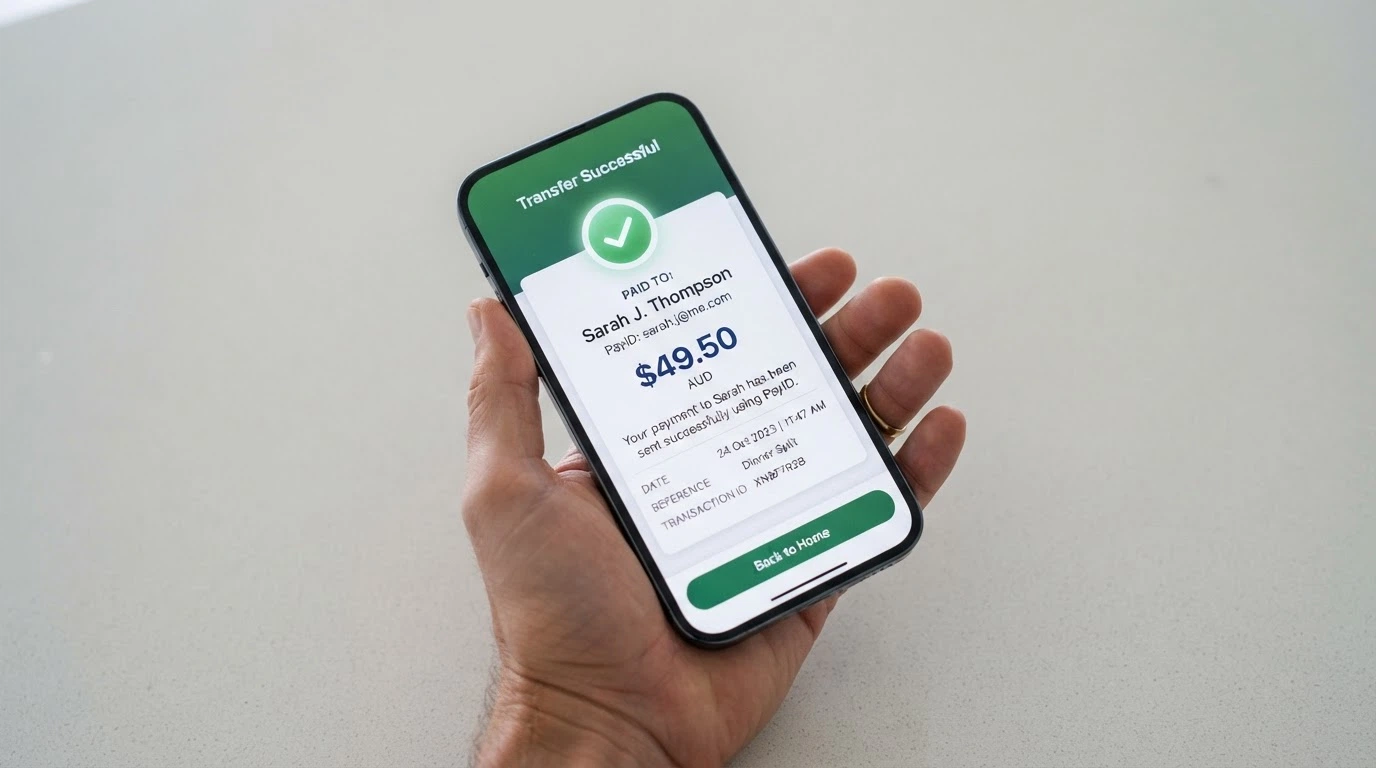
PayID deposits are also instant. A player who has linked their bank account to a casino cashier and selected PayID sees the money in their balance within seconds, and the same rail is used for withdrawals — typically processed within 0 to 24 hours once the casino has approved the cashout. That symmetry matters for low-deposit play specifically: a $1 deposit that takes seconds to land and a $20 minimum withdrawal that takes a day to clear is a much more workable experience than one that requires a separate, slower withdrawal method.
PayID’s other practical advantage is bank-level discretion. Some Australian banks set minimum transfer limits of $5 to $10 on debit-card transactions flagged as gambling, which is the rail PayID avoids. A player whose bank would block a $1 card deposit at source can usually push a $1 PayID through without issue. This is the route that most closely matches the search term, and it is the route that most consistently delivers on it.
Cryptocurrency: Low-Minimum Flexibility With Trade-Offs
Cryptocurrency is the most flexible payment family for low deposits, in the mechanical sense that a player can transfer a very small amount — well below $1 in network terms — and have it credited to a casino balance. The catch is that the same mechanics apply to withdrawals, which is useful, but the legal and practical position of crypto gambling in Australia is different from the payment-side economics.
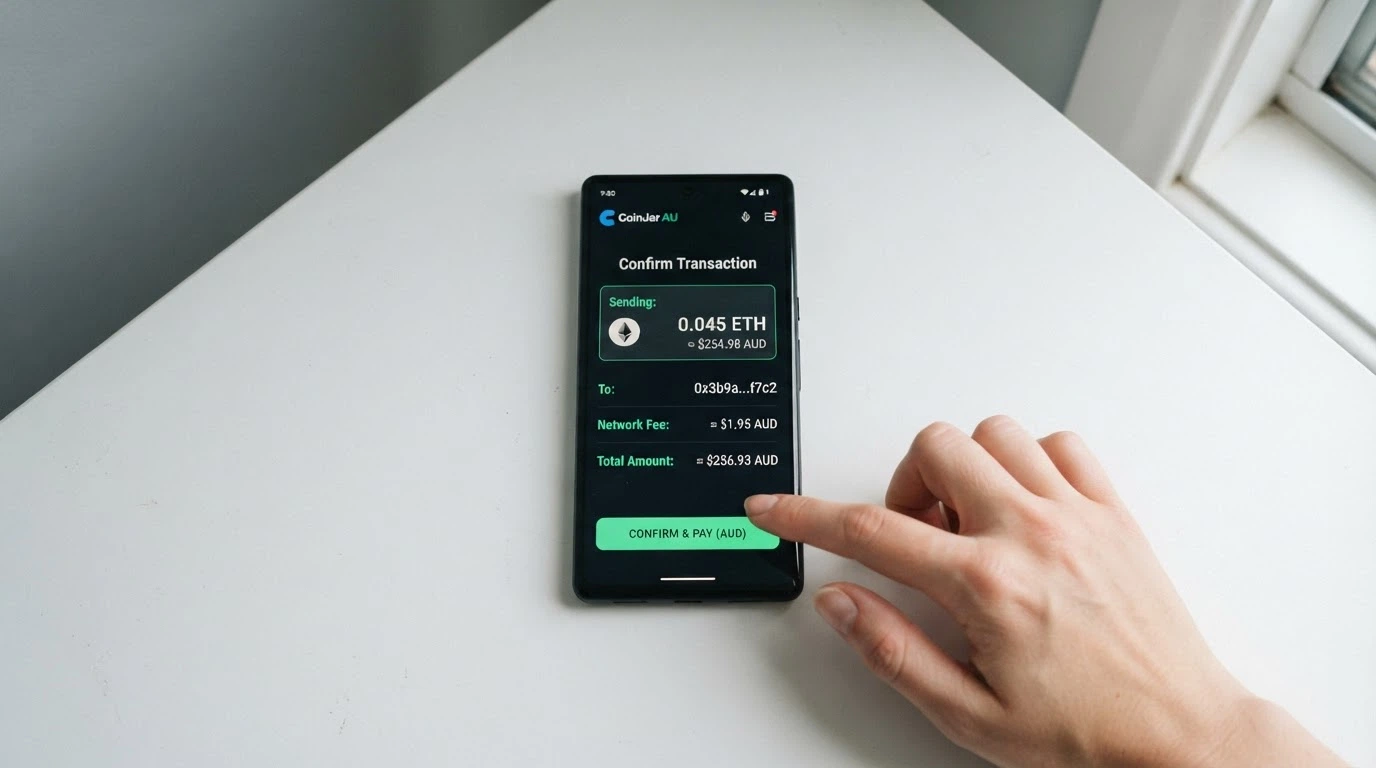
On the rail side, Bitcoin, Litecoin, USDT and Dogecoin are the coins that recur at low-minimum casinos. Litecoin and Dogecoin typically carry lower network fees than Bitcoin, which matters when the transfer amount is small. A $5 or even a $2 transfer in LTC or DOGE can clear a casino’s deposit with fees that amount to a few cents; the same transfer in BTC can be eaten entirely by network fees at certain congestion levels. For a player who wants to deposit the equivalent of A$1 to A$5 in crypto, Litecoin and Dogecoin are the practical choices.
On the legal side, the position is clear. From 11 June 2024, the Interactive Gambling Amendment (Credit and Other Measures) Act 2023 banned credit cards, credit-related products and digital currency as payment for online wagering by licensed providers. The penalty for non-compliance is up to $247,500. The ban applies to licensed wagering operators. An offshore casino is not bound by it. The practical consequence is direct: a casino that accepts cryptocurrency for casino play is, by definition, not Australian-licensed. The presence of a crypto deposit option on a casino site is itself evidence the operator sits outside the Australian regulatory framework.
This does not make crypto deposits at offshore casinos illegal for the player. The Interactive Gambling Act targets the provider, not the person gambling. But it does mean a player depositing via crypto at an offshore casino carries the full set of risks that come with the offshore product: no BetStop coverage, no ACMA dispute path, no Australian consumer protection, and a balance that can be stranded if the site is blocked.
Why Credit and Debit Cards Almost Never Work at $1
Card payments are the most familiar deposit method for Australian players, and the most structurally incapable of supporting a $1 deposit at scale. A $1 credit or debit card transaction costs the operator between $0.30 and $0.50 in processing — a margin that is negative before any other cost of doing business is counted. Operators respond by setting card-specific deposit floors well above $1, or by declining $1 card payments entirely.
The credit-card side is also legally closed for licensed wagering. From 11 June 2024, credit cards and credit-related products have been banned as payment for online wagering by Australian-licensed providers. An offshore casino that accepts credit cards for casino play is, again, signalling it is not Australian-licensed. The player-facing consequence is the same as for crypto: a credit-card deposit option is a tell, not a feature.
Debit cards remain legal for licensed wagering, but they run into two separate ceilings. The first is the operator’s own floor, which usually sits at $10 or above for card payments. The second is the bank’s own minimum transfer limit on gambling transactions, which can be $5 to $10 regardless of what the casino accepts. A player who tries to push a $1 debit-card deposit through will often see it bounce at the bank level, before the casino’s terms are even applied. The combination of operator floor and bank floor makes $1 card deposits functionally impossible at almost every Australian-facing offshore casino.
Neosurf and Prepaid Vouchers: Deposit-Only, No Withdrawal Path
Neosurf is a prepaid voucher system that lets a player buy a fixed-value voucher with cash at a retail outlet, then enter the voucher code at a casino cashier to load the balance. The advantage is privacy: no bank account or card details are shared with the casino. The disadvantage is structural and unforgiving: a Neosurf voucher cannot be used to receive a withdrawal. A player who deposits via Neosurf has to nominate a different method — a bank account, an e-wallet, or a crypto wallet — for the cashout, and that secondary method carries its own minimum and processing time.
For a player depositing $1, this is a meaningful constraint. The deposit clears instantly through the voucher. The withdrawal, when the player has accumulated enough to clear the casino’s cashout floor, has to go somewhere else. The “somewhere else” may itself carry a $20 to $45 minimum withdrawal, and the player has just discovered that the $1 deposit headline was the easy part of the equation.
Prepaid vouchers are the right tool for a player who is specifically trying to keep their gambling spending disconnected from their bank account. They are the wrong tool for a player who wants the full deposit-to-cashout experience on a single rail. The voucher solves one problem and creates another, and the player has to be willing to live with the trade-off.
From Deposit to Cashout: Where That $1 Really Goes
The deposit is the visible half of the transaction. The withdrawal is the half the marketing copy never mentions, and it is where the cost of a $1 session actually lives. Minimum withdrawals are set separately from minimum deposits, and the gap between the two is the single most important number a low-deposit player can know before they spin a single reel.
A typical offshore casino’s withdrawal minimum sits at A$20 to A$45. The deposit minimum, on the same casino, might be $1 or $5. The asymmetry is not an accident. The deposit side is built to attract players; the withdrawal side is built to ensure that the player who does withdraw is doing so over an amount that justifies the operator’s processing cost. From the operator’s perspective, paying out $5 in winnings from a $1 deposit is a customer-service loss. Paying out $30 is a transaction. The floor is set accordingly.
This is the structural reason a $1 deposit is a sampling tool, not a viable bankroll. A player who deposits $1 and runs a typical 94 to 96 percent RTP pokie can expect to end the session with a balance below the original $1, not above it. The expected bankroll after $1 of real-money play is, in plain arithmetic, somewhere between $0.94 and $0.96. The withdrawal minimum is 20 to 45 times that. The arithmetic does not add up to a cashout, and that is the point: the deposit floor and the withdrawal floor are designed for different jobs.
Withdrawal Minimums: The Real Barrier After a $1 Deposit
A player depositing $1 at an offshore casino has to meet a withdrawal minimum that is typically 20 to 45 times their original deposit before any cashout is possible. At a typical pokie RTP of 94 to 96 percent, the expected bankroll after $1 of play is below $1, not above it. The expected return does not clear the cashout floor; it falls short of it by a factor of 20 or more. The withdrawal minimum, not the deposit headline, is the real cost of the session.
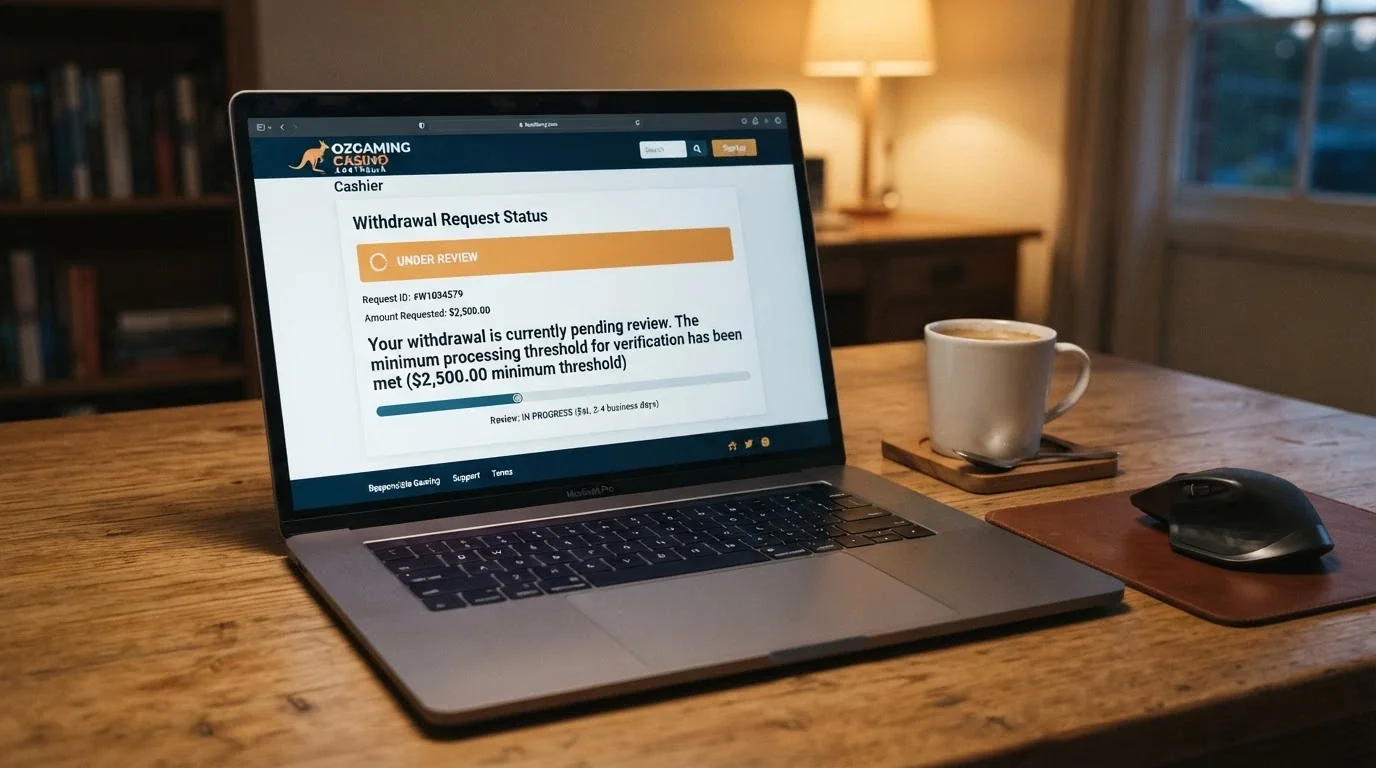
This is not a flaw in the operators’ terms. It is the structure of the product. Offshore casinos set withdrawal minimums to cover their own processing costs and to ensure that withdrawals represent a real win rather than a refund. The minimum is the operator’s protection, and it sits squarely in the way of a $1 depositor who has any intention of ever cashing out.
The practical consequence is straightforward. A $1 deposit is a way to test a casino’s cashier, see whether the platform works on a real-money basis, and confirm that a withdrawal is technically possible. It is not a way to build a bankroll or to expect a cashout. The player who treats it as the former gets a useful piece of information. The player who treats it as the latter is going to be disappointed.
Processing Speeds by Payment Method
The method that takes a player’s $1 in seconds may take a day or more to send anything back. The fastest rails — PayID and cryptocurrency — process withdrawals within 0 to 24 hours at most reputable operators. The slower rails — bank transfers and cards — can take 1 to 3 business days or longer, depending on the operator’s internal review process and the receiving bank’s processing window.
“Processing time” at an offshore casino has two distinct components. The first is the operator’s internal review: a stage where the casino checks the player’s identity, verifies the bonus terms have been met if applicable, and authorises the payment. The second is the network speed of the payment rail itself. For an offshore casino, the operator review is the part the casino controls. The network speed is the part the payment method controls. Both have to align for a withdrawal to land quickly, and either can stall a payout.
The Australian-specific context matters here. Offshore casinos are not subject to Australian payout-timeline requirements because no such requirements exist for the prohibited product. ACMA cannot compel an offshore operator to honour a published payout timeline, and there is no Australian dispute-resolution body with jurisdiction over an offshore casino’s withdrawal process. The timeline an operator publishes is voluntary, and the player who hits a stalled withdrawal has limited recourse. The licensed wagering product, by contrast, sits inside state-based regulatory frameworks with formal complaint pathways. The offshore product does not.
Mobile $1 Deposit Pokies: Browser and App Options
Mobile play at $1 minimums is widely available at offshore casinos through the mobile browser. Dedicated casino apps are rare for the Australian offshore market, and the reason is regulatory. Apple and Google do not distribute real-money online casino apps in Australia, because the product is prohibited under the Interactive Gambling Act. Both storefronts enforce geographic restrictions that prevent real-money casino apps from being made available to Australian users, and the few apps that exist for offshore brands are typically installed through direct download from the operator’s website rather than from an app store.

The practical consequence is that the mobile browser is the default for almost every Australian player. Modern offshore casino sites are built on responsive frameworks that adapt to a phone screen, and the cashier flow — selecting a payment method, entering a deposit amount, confirming the transaction — works through the browser with one-touch deposit options for saved payment methods. The deposit minimum is method-driven, not device-driven: a player who can deposit $1 on PayID through a desktop can deposit $1 on PayID through a phone, and a player whose payment method has a $10 floor will hit that floor on either device.
The mobile experience is functionally equivalent to the desktop experience for the activities that matter at the $1-deposit level: spinning a pokie, navigating the cashier, requesting a withdrawal. The differences are mostly ergonomic — smaller screen, touch controls, portrait or landscape orientation. None of those change the underlying economics of a $1 deposit or the fact that the withdrawal minimum sits 20 to 45 times above it.
New Casinos Promise $1 Deposits — Here’s What They Actually Deliver
New and recently launched casinos use the $1 deposit as a customer-acquisition headline. The marketing logic is sound: a $1 floor lowers the cost of trying a new site, and a player who deposits a dollar is a player who has converted from search to sign-up. What the marketing does not typically mention is that the welcome-bonus minimum deposit — the amount a player has to deposit to actually unlock the welcome offer — is almost always well above $1.
The pattern is consistent across every featured operator with published terms. RocketPlay’s first-deposit bonus minimum sits at AUD 30, and the bonus carries 40x wagering on the bonus amount. SkyCrown’s minimum qualifying deposit for the welcome package is A$20, and the package itself runs across four deposits. Fair Go’s minimum is $20. Rainbet’s minimum is $15. Bizzo’s minimum is AU$15. In every case, the welcome-bonus floor is 15 to 30 times the $1 deposit headline.
A new player who deposits $1 at any of these operators gets the deposit processed, assuming the payment method supports it. They do not get the welcome bonus. The bonus is gated behind a deposit floor the $1 figure does not reach, and the marketing copy rarely explains this in plain language. The result is a player who has spent a dollar to test a cashier and has nothing to show for it in bonus terms.
This is not a shortcoming of any particular operator. It is the structure of the welcome-bonus market, where the deposit that triggers the bonus is set high enough to ensure the bonus is meaningful and the wagering requirement is workable. The $1 figure is a sign-up hook, not a bonus threshold. The player who understands the distinction deposits $1 to test the cashier and does not expect a bonus. The player who does not understand it feels misled.
How Long It Takes to Clear a Welcome Bonus
The bonus-cost calculation asks how many hours of real play it takes to clear a representative welcome bonus under the published terms. Using RocketPlay’s first-deposit bonus as the example — AUD 30 minimum deposit, 40x wagering on the bonus amount, maximum bet during wagering AUD 7.50 — the required turnover is A$30 multiplied by 40, which gives A$1,200 of total wagering. At a maximum bet of A$7.50 per spin, that is 160 spins to clear the requirement. At five seconds per spin, 160 spins is roughly 13 minutes of real play.
Thirteen minutes to clear a bonus is unusually fast. The reason is that RocketPlay’s bonus carries the highest maximum bet in the featured set at A$7.50, and that ceiling is what allows the turnover to be reached in so few spins. Most other operators cap the maximum bet during wagering at A$5, which stretches the same A$1,200 turnover to 240 spins, or 20 minutes. A bonus with a $5 maximum bet and the same 40x wagering takes 20 minutes; a bonus with the same terms and a $7.50 cap takes 13 minutes. The arithmetic is simple, and it is the part the marketing does not usually volunteer.
The deeper point is that the welcome bonus is gated behind a deposit floor the $1 figure does not reach. A $1 depositor is not in the calculation at all. The player who wants to access the bonus has to deposit 15 to 30 times the $1 headline, depending on the operator, and then play through the wagering requirement in the time the terms allow. The five-day bonus validity at RocketPlay is the shortest window in the featured set, and even a 13-minute clear-time leaves no margin for a player who is not actively spinning. A player who deposits on day one and returns on day four has used 80 percent of the validity window before the first spin.
Why No Australian Casino Can Offer $1 Deposit Pokies
The Interactive Gambling Act 2001 is the page’s factual foundation, and the reason it appears early is that everything else on the page depends on it. The IGA makes it an offence to provide online casino games and online pokies to a person in Australia. There is no licence for online casino anywhere in the country — not federally, not in any state or territory. The IGA’s enforcement architecture, run by the Australian Communications and Media Authority (ACMA), gives the regulator the power to investigate complaints, issue formal warnings, pursue civil penalty proceedings, and direct Australian ISPs to block illegal sites.
The individual player is not prosecuted under the IGA. The Act targets the provider, not the person gambling. A player who opens an account at an offshore casino and deposits $1 has not committed an offence under Australian law. What the player has done is engage with a product that is prohibited from being offered, and the player carries the full set of consequences that flow from that choice: no Australian consumer protection, no ACMA complaint pathway, no BetStop coverage, and no recourse if the operator refuses a withdrawal or disappears with the balance.
The legal position is not ambiguous, and the offshore casinos accepting Australian players are not operating in a grey area. They are offering a prohibited product. The reason they continue to operate is that the IGA’s enforcement is directed at the providers, not the players, and that offshore operators are difficult to reach from within Australian jurisdiction. The IGA is enforced where it can be: through ISP blocking, civil penalties, and formal warnings. Since November 2019, ACMA has had 1,564 illegal gambling and affiliate websites blocked by Australian ISPs, and more than 225 illegal services have withdrawn from the Australian market since 2017. Those numbers reflect what enforcement looks like at scale, and they are why the offshore product exists in the form it does: accessible, technically legal for the player, and structurally outside the Australian regulatory framework.
What the Interactive Gambling Act Actually Prohibits
The IGA draws a clear line between prohibited and permitted services, and most Australians do not know where the line sits. On the prohibited side: online casino games, online pokies, and in-play sports betting. None of these can be offered to a person in Australia by a licensed provider, and no licence exists for any of them. On the permitted side: wagering on races and sport placed before the event begins, lotteries, and keno. These are licensed by state and territory regulators, with the Northern Territory Racing and Wagering Commission acting as the de facto national licensor for online wagering.
The distinction matters for the $1 deposit question because the product the search returns — $1 deposit pokies at an online casino — sits squarely in the prohibited column. A player who searches for $1 deposit pokies in Australia is searching for a product that the IGA makes it an offence to provide. The fact that offshore operators offer it, and that Australian players can access it, does not change its legal status. The IGA prohibits the offering. The provider is the target. The player is the consumer of a prohibited product, with all the protections that absence implies.
ACMA’s enforcement toolkit is broad. The regulator can investigate complaints, issue formal warnings, refer matters for civil penalty proceedings, and direct Australian ISPs to block illegal services. The blocking power is the most visible tool: 1,564 sites blocked since November 2019 is a number that reflects the regulator’s willingness to use it. The penalties are substantial: civil penalty proceedings can result in fines significant enough to make the Australian market unviable for an operator that does not withdraw.
The Credit Card and Cryptocurrency Payment Ban Explained
From 11 June 2024, the Interactive Gambling Amendment (Credit and Other Measures) Act 2023 banned credit cards, credit-related products and digital currency as payment methods for online wagering by Australian-licensed providers. The penalty for non-compliance is up to $247,500 per breach. The ban is a licensed-wagering obligation, and it covers credit cards, credit-related products like digital wallets funded by credit, and digital currencies such as Bitcoin and Ethereum.
The ban’s reach is precise. It applies to licensed wagering providers. An offshore casino is not bound by it, because an offshore casino is not a licensed wagering provider in Australia. The practical consequence is direct: a casino that accepts credit cards or cryptocurrency for casino play is, by definition, not Australian-licensed. The presence of a credit-card or crypto deposit option on a casino site is itself evidence that the operator sits outside the Australian regulatory framework.
This does not make the deposit illegal for the player. The IGA targets the provider, not the person paying. But the regulatory tell is informative. A player who sees a crypto deposit button or a credit-card logo on a casino cashier has just been told, by the operator’s own design choices, that the site is not regulated in Australia. From that point, every other claim on the site — bonus terms, payout timelines, dispute resolution — sits outside the protections that come with an Australian licence.
BetStop’s Offshore Blind Spot and ACMA Enforcement
BetStop is Australia’s most powerful player-protection tool, and it does not reach the casinos offering $1 deposits. BetStop — the National Self-Exclusion Register — launched on 21 August 2023 and now covers approximately 150 licensed wagering providers in Australia. One registration excludes a person from every Australian-licensed online and phone wagering service. To the end of June 2024, 25,972 people had registered to self-exclude, and 21,381 had active exclusions as of 30 June 2024. Self-exclusion can last from a minimum of 3 months up to a lifetime, and removal requires a statutory declaration confirming counselling or advice from a qualified counsellor, psychologist or doctor.
The register’s coverage is its strength and its limitation. BetStop covers licensed wagering. It does not cover offshore online casinos. An Australian who self-excludes from every licensed wagering provider can still deposit, play and lose at any of the offshore casinos listed on this page, and the register gives no protection against it. The offshore casino is not connected to BetStop, has no obligation to check BetStop, and will keep accepting a self-excluded person’s money indefinitely.
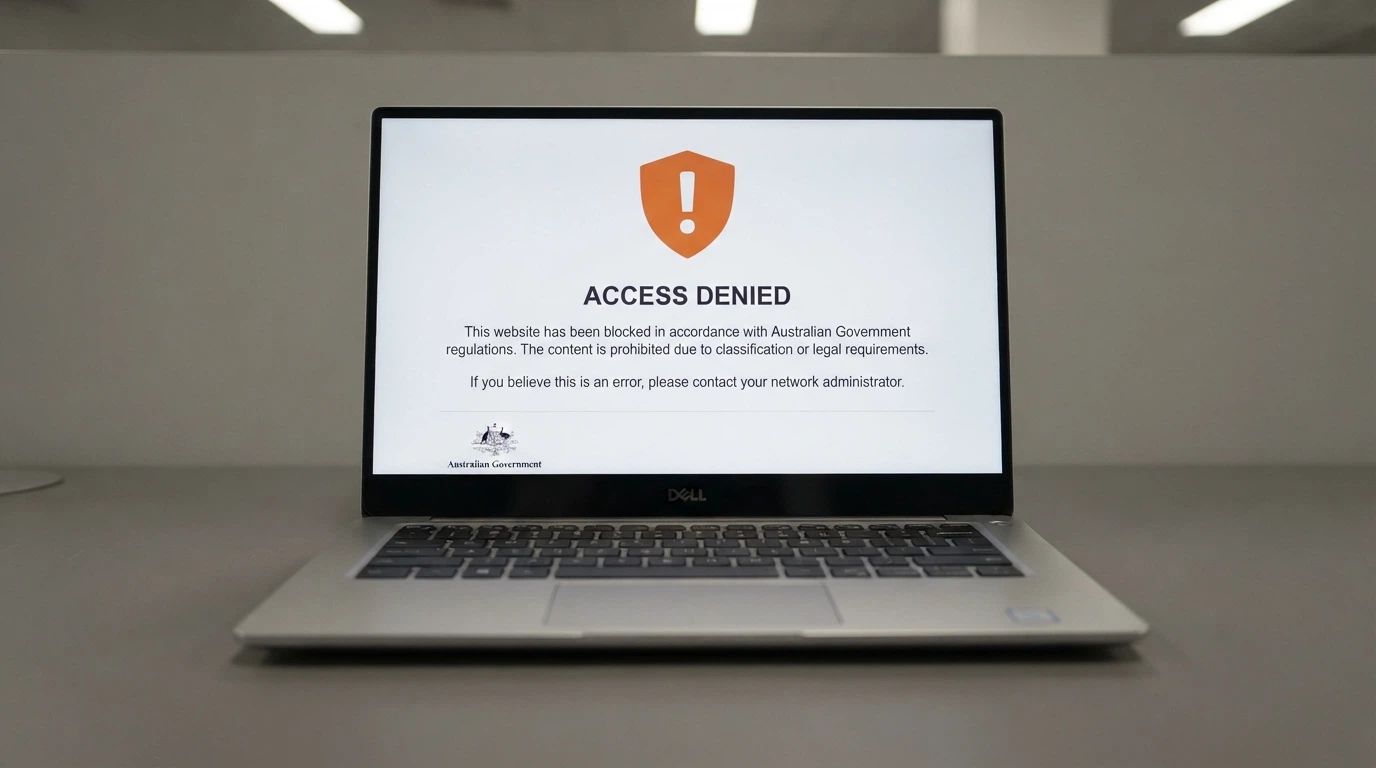
ACMA’s enforcement adds a different layer of risk. The regulator can direct Australian ISPs to block an illegal site, and 1,564 sites have been blocked since November 2019. A blocked site is inaccessible from a typical Australian internet connection, but a player who already has an account and a balance on that site has a problem that blocking does not solve. The site is unreachable, the balance is stuck, and ACMA cannot compel an offshore operator to return funds. The blocked-site scenario is the most concrete version of the offshore risk, and it is the one that has no remedy inside the Australian system.
10 Offshore Casinos Accepting Australian Players — Compared
The table below lists ten offshore brands that Australians encounter when searching for $1 deposit pokies. Every operator holds a Curaçao offshore licence. None holds an Australian casino licence, and none can — the IGA prohibits the offering, and no Australian licence category for online casino exists. The brands are listed for market literacy, not as recommendations, and the column entries reflect what is publicly stated in each operator’s own terms and conditions. Where terms were not confirmed in this review, the cell carries an em dash.

| Operator | Licence | Welcome Bonus | Free Spins | Wagering | Min. Deposit for Bonus |
|---|---|---|---|---|---|
| RocketPlay | Curaçao OGL/2024/1307/0748 (Scores55 Tech B.V.) | 100% up to AUD 1,000 (1st deposit) | 100 FS (20/day × 5 days) | 40x bonus | AUD 30 |
| SkyCrown | Curaçao | Up to A$8,000 across 4 deposits | 400 FS total | 40x bonus / 30x FS winnings | A$20 |
| Royal Reels | Curaçao | A$10 no-deposit + welcome package | — | 30x–35x bonus | — |
| Fair Go | Curaçao | 100% up to $200 × 5 deposits (total $1,000) | 15 FS no-deposit (Bubble Bubble) | 30x deposit bonus / 60x no-deposit FS | $20 |
| Rainbet | Curaçao eGaming | 100% up to $700 or gradual no-wager bonus | 50 FS on Sweet Bonanza (1st deposit) | 40x bonus | $15 |
| Bizzo Casino | Curaçao | Deposit match + free spins | Yes (details vary) | 40x | AU$15 |
| WinSpirit | Curaçao | — | — | — | — |
| Scream Casino | Curaçao | — | — | — | — |
| Stake | Curaçao | — | — | — | — |
| Rocket Casino | Curaçao | — | — | — | — |
The two columns that carry the most weight for a $1-deposit reader are the last two. The wagering column shows what clearing a bonus actually costs in turnover. The minimum-deposit-for-bonus column shows the floor that gates the welcome offer, and across the five operators with published terms, that floor is 15 to 30 times the $1 deposit headline. A $1 deposit does not reach any of them.
The four operators at the bottom of the table — WinSpirit, Scream Casino, Stake, and Rocket Casino — appear in the Australian-facing search landscape, but their published bonus terms, game-provider rosters, and minimum-deposit specifics were not confirmed in this review. Their inclusion is for completeness: they are brands an Australian player will encounter, and the reader should verify their current terms directly before depositing. Their absence of confirmed terms is itself informative.
RocketPlay
RocketPlay is a Curaçao-licensed offshore casino operating under licence OGL/2024/1307/0748, issued to Scores55 Tech B.V. The casino is not Australian-licensed and cannot be. The first-deposit bonus is a 100 percent match up to AUD 1,000, with 40x wagering on the bonus amount, 100 free spins released at 20 per day over five days, a bonus validity of five days, a maximum bet during wagering of AUD 7.50, and a maximum win from the bonus of AUD 5,000. The minimum qualifying deposit for the welcome offer is AUD 30.
A $1 depositor gets zero bonus access here. The AUD 30 floor is 30 times the headline deposit amount, and the five-day bonus validity is the shortest window in the featured set. A player who deposits on day one and returns on day four has used 80 percent of the validity window before the first spin. The AUD 7.50 maximum bet during wagering is the highest in the set, and it is the only reason the bonus clears as quickly as it does. Even so, the arithmetic favours a player who plans the session in advance and is ready to spin within hours of depositing.
RocketPlay’s licence is clearly stated, the bonus terms are specific, and the wagering requirement is at the standard 40x level. The five-day validity is the standout constraint, and it is the figure that determines whether the bonus is worth claiming at all.
SkyCrown
SkyCrown is a Curaçao-licensed offshore casino offering over 5,500 games from multiple providers. The welcome package is the largest in the featured set: up to A$8,000 plus 400 free spins across four deposits, with 40x wagering on the bonus amount and 30x wagering on free-spin winnings. The minimum qualifying deposit is A$20, the maximum bet during the bonus is A$5, and the bonus validity is 14 days per tier. The package is structured to reward a player who deposits four times, not once, and the full value requires the player to clear all four tiers.
The A$20 floor still locks out a $1 depositor. The 30x free-spin wagering is lower than the 40x bonus wagering, which is a small structural advantage: winnings from free spins clear faster than the deposit bonus itself. The 14-day per-tier validity is generous compared to RocketPlay’s five days, and it gives a player who cannot sit down for a single marathon session the time to clear the bonus across multiple visits.
SkyCrown’s terms are clearly stated and the licence is verifiable. The headline number — A$8,000 — is the largest in the set, but it is also the most conditional, requiring four qualifying deposits to reach it.
Royal Reels
Royal Reels is a Curaçao-licensed offshore casino offering over 5,400 pokies from 40-plus providers. The welcome package is the only one in the featured set that includes a genuine no-deposit bonus — A$10 credited after phone verification, with no deposit required. The deposit-triggered welcome package runs 100 percent up to A$500 on the first deposit, 75 percent up to A$750 on the second, and 100 percent up to A$1,250 on the third, with 30x–35x wagering across the package. Withdrawals via crypto and PayID are processed instantly, and the casino runs a 10-tier VIP program.
The no-deposit bonus is the differentiator. It gives a player a way to test the casino’s actual games and withdrawal flow without committing any money at all, which is the closest the set comes to the demo-mode experience on a real-money basis. The 30x to 35x wagering is at the lower end of the featured range, and the instant crypto and PayID withdrawals are the fastest payout rails in the comparison.
The package’s structure rewards a player who deposits three times. The minimum qualifying deposit for each tier was not confirmed in this review. Royal Reels provides a no-deposit option and instant withdrawals. The 30x to 35x wagering is at the lower end of the featured range, and the instant crypto and PayID withdrawals are the fastest payout rails in the comparison.
Fair Go
Fair Go is a Curaçao-licensed offshore casino with a long Australian-facing track record and a single-provider catalogue from RealTime Gaming (RTG). The welcome bonus is 100 percent up to $200 across five deposits, for a total of $1,000, with 30x wagering on the deposit bonus. The no-deposit offer is 15 free spins on Bubble Bubble, with 60x wagering on the winnings. The minimum deposit is $20.
The 60x no-deposit free-spin wagering is the highest in the featured set. A $10 free-spin win requires $600 in turnover before the cashout is possible, and at a typical pokie RTP the expected bankroll after $600 of turnover is well below $600. The 30x deposit-bonus wagering is more reasonable, and the five-deposit structure rewards a player who plans to return. The RTG-only catalogue is a constraint for a player who wants the breadth of a multi-provider library, but it is a known quantity for a player who has played RTG pokies before.
Fair Go features a long Australian-facing track record and is comfortable with the RTG catalogue. The 60x no-deposit wagering is the standout constraint, and it is the figure that determines whether the free-spin offer is worth claiming at all.
Rainbet
Rainbet is a Curaçao eGaming-licensed offshore casino offering games from Pragmatic Play, Hacksaw, Nolimit City and other providers. The welcome package is the only one in the featured set that gives the player a choice: a 100 percent match up to $700 at 40x wagering, or a no-wager bonus released gradually as the player plays. The minimum deposit is $15 (or equivalent), and the package includes 50 free spins on Sweet Bonanza on the first deposit.
The no-wager bonus is the structural differentiator. It releases gradually as the player plays rather than locking funds behind a turnover requirement, which is the closest the set comes to a bonus that a very low depositor might actually access. The $15 floor is the lowest in the set among operators with published terms, though it still excludes a pure $1 deposit. The 40x wagering on the alternative bonus is at the standard level.
Rainbet is an option for a player who prefers the no-wager option and the low minimum-deposit floor. The choice between the two bonus structures is a genuine one, and the 50 free spins on a Pragmatic Play title are a credible addition.
Bizzo Casino
Bizzo is a Curaçao-licensed offshore casino with a mid-sized library of 3,500-plus games from multiple providers. The welcome offer is a deposit match plus free spins, with the specifics varying by active promotion. The constants are 40x wagering and a minimum deposit of AU$15. The casino is best understood as a standard multi-provider site at a standard minimum-deposit floor, with the specific bonus terms rotating by promotion.
The AU$15 floor is at the lower end of the featured set. The 40x free-spin wagering is at the standard level. The game library is broad enough to cover most player preferences without standing out in any particular category. Bizzo is a site for a player who values provider diversity and is willing to check the active promotion terms before depositing.
WinSpirit
WinSpirit is an offshore Curaçao-licensed casino with Australian market presence. The brand appears in the Australian-facing search landscape, and its presence in that landscape is established. Its published bonus terms, game-provider roster, and details were not confirmed, and the reader should verify the current terms directly before depositing.
WinSpirit is listed for market-literacy completeness. The brand is one an Australian player will encounter when searching for low-deposit pokies, and the page does not omit it on the grounds that the terms are thin. The right reading is the opposite: the terms are thin precisely because the brand has not published them, and a player who values transparency should treat that absence as information.
Scream Casino
Scream Casino is an offshore Curaçao-licensed casino with Australian market presence. Like WinSpirit, its published bonus terms, game-provider roster, and details were not confirmed. The brand is listed for completeness, and the reader should verify current terms directly before depositing.
The same reading applies. Scream Casino appears in the Australian-facing landscape, and its absence of confirmed terms is the most informative thing the row says. A player who values clearly stated conditions will look elsewhere; a player who is willing to register and check the cashier themselves can still consider the brand.
Stake
Stake is the highest-profile brand in the featured set — a globally recognised Curaçao-licensed offshore casino with Australian accessibility. The licence is verifiable, the game-provider roster is broad, and the brand’s visibility is the result of a global marketing operation rather than an Australia-specific one. The Australian-facing product’s specific bonus terms and minimum-deposit terms were not confirmed in this review, because Stake’s terms vary by jurisdiction and the terms shown to an Australian-logged-in account can differ from the terms shown elsewhere.
Stake is a choice for a player who values brand recognition and is willing to log in to see the local terms. The verification step is the reader’s responsibility, because the published terms in one jurisdiction are not a reliable guide to the terms in another.
Rocket Casino
Rocket Casino is an offshore Curaçao-licensed casino with Australian market presence. The name overlaps with RocketPlay but the two are separate operators, and the similarity is worth flagging to prevent reader confusion. Rocket Casino’s published bonus terms, game-provider roster, and minimum-deposit specifics were not confirmed in this review, and the reader should verify current terms directly before depositing.
The same reading applies as for the other thin-terms brands. Rocket Casino is listed for completeness, the name overlap with RocketPlay is a known source of confusion, and the absence of confirmed terms is itself the most informative thing the row says.
Responsible Gambling When Minimum Deposits Are This Low
A $1 deposit floor is not a responsible-gambling strategy. It is a low barrier to entry, and the two are not the same. A low barrier helps a casual player test a casino cheaply, and it also helps a player who is already in harm’s path keep playing at a scale that looks small in any single transaction. The structural feature is the same; the consequence depends on who is using it.

The Australian help infrastructure exists, and it is accessible regardless of whether the person gambled at a licensed wagering provider or at an offshore casino. The National Gambling Helpline is 1800 858 858 — free, confidential, and staffed around the clock. Gambling Help Online at gamblinghelponline.org.au provides online chat, counselling and self-help tools. The services are not contingent on the operator, the jurisdiction, or the amount deposited. They are available to anyone who reaches out.
The harm-prevalence data sets the scale. About 2.1 percent of Australian adults — roughly 430,000 people — experience problem gambling. The 2024 National Gambling Prevalence Study Pilot found 15 percent of Australian adults at some risk of gambling harm: 7.6 percent at low risk, 4.8 percent at moderate risk, and 2.6 percent at high risk. The NSW Gambling Survey 2024 found 0.9 percent of adults at high risk, 3.1 percent at moderate risk, and 6.7 percent at low risk. Past-year gambling participation in the Australian adult population was 60.3 percent in 2024.
The help-seeking gap is the most striking figure. Only 13.5 percent of those engaged in moderate-risk or high-risk gambling in NSW reported seeking help for gambling-related issues, and 87.5 percent of at-risk gamblers who did not seek help said they did not feel they had a problem. The barrier to help-seeking is not access. It is recognition. A $1 deposit does not create a gambling problem, but a $1 deposit at a low-barrier offshore casino is exactly the kind of transaction that can keep a problem hidden from the person paying for it.
Budget Discipline and Deposit-Limit Tools
The tools that licensed Australian wagering operators are required to offer — deposit limits, take-a-break functions, activity statements — are not required at offshore casinos. A licensed operator must provide a deposit-limit tool that the player can set and adjust, a take-a-break function that pauses the account for a chosen period, and activity statements that show what the player has deposited, wagered, and lost over time. An offshore casino may offer some or all of these, and the player has to check the cashier or the responsible-gambling page to find out.
The practical self-limiting tools that work regardless of operator are the ones that sit outside the casino. Bank-level gambling blocks — set through the player’s own bank — stop gambling transactions before they reach any operator. Prepaid-voucher budgeting — using Neosurf or a similar method — caps the player’s spend at the value of the voucher and disconnects the spend from the bank account. Both are blunt instruments, but they work at any offshore casino, on any payment method the operator accepts.
The right reading of a $1 deposit floor is that it lowers the cost of the first transaction, not the cost of the habit. A player who can comfortably afford to lose $1 and walk away is a player for whom the $1 floor is a useful sampling tool. A player who deposits $1, wins, deposits the winnings, loses, deposits more, and keeps going is a player for whom the $1 floor is the entry point of a session that will end somewhere very different from where it started.
Self-Exclusion, BetStop and the Offshore Gap
BetStop is the National Self-Exclusion Register, and it is Australia’s most powerful player-protection tool. One registration excludes a person from every Australian-licensed online and phone wagering service — approximately 150 providers. Self-exclusion can last from 3 months to a lifetime. To the end of June 2024, 25,972 people had registered, and 21,381 had active exclusions as of 30 June 2024. Removal from the register requires a statutory declaration confirming counselling or advice from a qualified counsellor, psychologist or doctor.
The register’s offshore gap is not a footnote. An Australian who self-excludes from every licensed wagering provider can still deposit, play, and lose at any of the offshore casinos listed on this page. The offshore casino is not connected to BetStop, has no obligation to check BetStop, and will keep accepting a self-excluded person’s money indefinitely. The protection BetStop provides is real and substantial for the licensed product, and it is exactly zero for the offshore product.
The help infrastructure that works regardless of operator is the helpline and the online counselling. The National Gambling Helpline at 1800 858 858 is free, confidential, and staffed 24/7. Gambling Help Online at gamblinghelponline.org.au provides online chat, counselling, and self-help tools. The services are available to anyone who reaches out, regardless of where they gambled or how much they deposited. For a player who has self-excluded from licensed wagering and is still gambling at offshore casinos, the helpline is the route to the support that BetStop cannot reach.
How We Selected and Evaluated These Operators
The operators in the comparison were selected on a single foundational criterion: each one is a brand that an Australian player will encounter when searching for $1 deposit pokies. The set is descriptive, not prescriptive. The ranking prioritises operators whose bonus terms, deposit minimums, and licence details are publicly stated and verifiable from the operator’s own terms and conditions pages or from independent audit databases. Operators with unconfirmed terms are listed for market-literacy completeness, with that absence clearly marked.
The verification work touched several sources. The Australian Communications and Media Authority’s published register and blocking notices provided the regulatory context and confirmed that no operator in the comparison holds an Australian casino licence — the category does not exist. Each operator’s own terms and conditions page, accessed in 2026, provided the bonus, wagering, validity, and minimum-deposit figures where they were available. Independent casino-audit databases provided the licence numbers, the operating companies behind the brands, and the game-provider rosters where they were published.
The evaluation did not produce a scoring system or a weighting. The ranking reflects a qualitative order based on how much each operator has chosen to publish about its own product. Operators with clear, specific, verifiable terms are at the top. Operators with thin or missing terms are at the bottom, with their absence marked. A player who wants to deposit $1 today is better served by a casino that has stated its bonus terms clearly than by one that has not, and the ordering reflects that.
The limitation is honest. Operator terms change. The bonus terms and minimum-deposit figures shown in the table were accurate at the time of verification, but they can change without notice. The reader should verify the current terms on the operator’s own site before depositing. The page’s value is in the framework — what to look for, what to ask, what the offshore product does and does not provide — not in any single operator’s current terms.
What Your Next Move Should Be
The $1 deposit is real on specific payment rails, and it is not real on others. PayID and certain cryptocurrencies can process a $1 deposit at most offshore casinos. Credit and debit cards cannot, in practical terms, because the operator’s processing cost exceeds the deposit. Prepaid vouchers like Neosurf can, but the withdrawal path runs through a different method with its own minimum. The deposit headline is a marketing position, and the cashier is where the position becomes a fact.
The real cost of a $1 session is not the $1. It is the gap between the deposit and the withdrawal minimum. A player who deposits $1, plays a pokie at a typical 94 to 96 percent RTP, and ends the session with a balance below $1 has not lost the dollar — they have lost the dollar plus the chance of a cashout, because the withdrawal minimum sits 20 to 45 times above their starting bankroll. The expected return from $1 of real-money play does not clear the cashout floor, and that is the structural reality the deposit headline does not address.
The legal status means every operator on this page is offshore, and the protections Australians associate with licensed wagering are not part of the offer. There is no BetStop coverage, no ACMA complaint pathway, no Australian consumer protection, and no recourse if the operator refuses a withdrawal or closes the account. The site can be blocked at any time, and a balance on deposit at the time of blocking is stranded. These are not theoretical risks. They are the structure of the offshore product.
The reader’s decision framework is straightforward. Demo mode is the right first move for anyone who wants to know what a pokie looks and feels like. A small real-money deposit on a payment method with a withdrawal path — PayID or crypto — is the right second move for anyone who wants to test the cashier end-to-end, with full awareness of the offshore risk and the gap between the deposit floor and the withdrawal floor. The welcome-bonus offers at AUD 15 to AUD 30 minimum are a third move, and they are accessible only to a player who decides to deposit at that level. None of the three moves requires a player to spend more than they can afford to lose, and all of them are better made with the helpline number — 1800 858 858 — saved in a phone, just in case.
Frequently Asked Questions
Are $1 minimum deposit pokies legal in Australia?
Online casino games and online pokies are prohibited services in Australia under the Interactive Gambling Act 2001. There is no Australian licence for the product, and no operator in the comparison below holds one. The individual player is not prosecuted, but the providers are, and any casino offering $1 deposit pokies to Australians is operating outside the Australian regulatory framework.
Which payment methods can I use to deposit $1 at an online casino in Australia?
PayID and certain cryptocurrencies — particularly Litecoin and Dogecoin — are the only methods that can consistently process a $1 deposit at offshore casinos. Credit and debit cards cannot, because processing fees exceed the deposit value. Prepaid vouchers like Neosurf can, but the withdrawal has to go through a different method. The payment method decides whether $1 is even possible.
Do Australian banks block gambling deposits to offshore casino sites?
Some Australian banks flag gambling transactions or set minimum transfer limits of $5 to $10 on debit-card payments. PayID avoids this by processing as a standard bank transfer rather than a gambling transaction. A player whose bank blocks a card deposit can usually push a PayID through, and cryptocurrency sidesteps the bank entirely.
Can I claim a welcome bonus if I only deposit $1?
No, not at the operators with published terms. RocketPlay’s first-deposit bonus minimum is AUD 30. SkyCrown’s is A$20. Fair Go’s is $20. Rainbet’s is $15. Bizzo’s is AU$15. A $1 deposit clears the cashier but does not reach the bonus threshold, and the welcome offer remains locked. The bonus is gated 15 to 30 times above the $1 headline.
What happens to my money if an offshore casino is blocked by ACMA?
Since November 2019, ACMA has had 1,564 illegal gambling and affiliate websites blocked by Australian ISPs. A blocked site is unreachable from a typical Australian internet connection, but a player who already has an account and a balance on that site has a problem blocking does not solve. The balance is stranded, and ACMA cannot compel an offshore operator to return funds. The blocked-site scenario is the most concrete version of the offshore risk, and it has no remedy inside the Australian system.
How far does one dollar go on a real-money online pokie?
Not far, and almost never far enough to clear the withdrawal minimum. A typical pokie runs at 94 to 96 percent RTP, which means a $1 deposit returns an expected $0.94 to $0.96 after a session of play. The withdrawal minimum at most offshore casinos is A$20 to A$45, which is 20 to 45 times the expected return. The dollar buys a session; it does not buy a cashout.
What protections do I lose by playing at an offshore casino with a $1 minimum?
A player at an offshore casino gives up the protections attached to Australian-licensed wagering: BetStop coverage, deposit-limit and take-a-break tools mandated by regulation, ACMA complaint pathways, and the ability to escalate a dispute to an Australian regulator. The site can be blocked at any time, the operator can refuse a withdrawal, and there is no Australian body with jurisdiction to intervene. The $1 floor is the entry point to a product that sits entirely outside the Australian consumer-protection framework.
Does BetStop cover offshore online casinos that accept Australian players?
No. BetStop — the National Self-Exclusion Register — covers approximately 150 Australian-licensed wagering providers. It does not cover offshore online casinos, and an offshore casino is not connected to the register, has no obligation to check it, and will keep accepting a self-excluded person’s money indefinitely. The helpline at 1800 858 858 and Gambling Help Online are the routes to support that work regardless of where the gambling happened.
Created by the ”Jackpot Pokies Australia” editorial team.