What Australian Players Actually Find When They Search for the Best Live Casino Online
 Available in AU
A live dealer casino streams a real table — cards, wheel, croupier — into a player’s browser or phone in real time. The dealer is paid by the hour. The cards are physical. The bet is settled by optical recognition, not a random number generator. That is the product Australians search for when they type “best live casino online Australia” into Google. What they find is something else: every result sits offshore, every site is unlicensed under Australian law, and the regulatory environment that protects a bettor at a licensed venue stops at the border.
Data current as of 18 October 2026 and cross-checked against the Australian Communications and Media Authority register of licensed interactive wagering providers.
Table of Contents
- What a Live Casino Online Actually Is — and What It Isn’t in Australia
- The Live Dealer Sites Australians Are Using in 2026
- Every Live Casino Game Worth Your Time (and Your Money)
- The Software That Powers Every Live Table You Play
- Why Your Live Casino Bonus in 2026 Is Harder to Clear Than It Looks
- Live Dealer Games on Your Phone — What Actually Works
- Getting Money In and Out of an Offshore Live Casino
- Can You Play Live Dealer Games for Free?
- The Legal Reality of Live Casino Play in Australia
- Staying in Control When the Tables Are Always Open
- How We Picked and Ranked Every Live Casino on This Page
- What Australian Players Should Actually Do About Live Casino in 2026
- Frequently Asked Questions
What a Live Casino Online Actually Is — and What It Isn’t in Australia
A live casino is not a digital slot dressed up with a video clip. It is a real gaming table run by a real dealer, captured by cameras and streamed to a remote player who places bets through an on-screen interface. The player sees the cards being dealt, hears the wheel spinning, and can chat with the dealer in writing. The dealer cannot see the player but can read the chat and respond. Outcomes are decided by the physical equipment on the table, and software on the dealer’s side translates the result back into the player’s account.
That description matters because it is what most affiliate-comparison pages skip past. They blur the distinction between a licensed wagering site — which is legal in Australia for pre-event sports and racing — and an offshore online casino — which is not legal at all. The Interactive Gambling Act 2001 makes it illegal for providers to offer certain online services to people in Australia, and online casinos are explicitly on the list of banned services the Australian Communications and Media Authority enforces. No Australian licence exists for the product the search term is asking about. Every operator on this page sits outside that licensing system.
This is not a nuance. It shapes every choice that follows. A deposit at an offshore live casino is not covered by the BetStop self-exclusion register. A withdrawal dispute does not run through the Australian Financial Complaints Authority. A harmed player cannot ask the ACMA to intervene on the operator. The offshore site has its own rules, its own regulator (usually Curacao or Anjouan), and its own idea of what constitutes fair treatment.
How a Live Dealer Table Actually Works
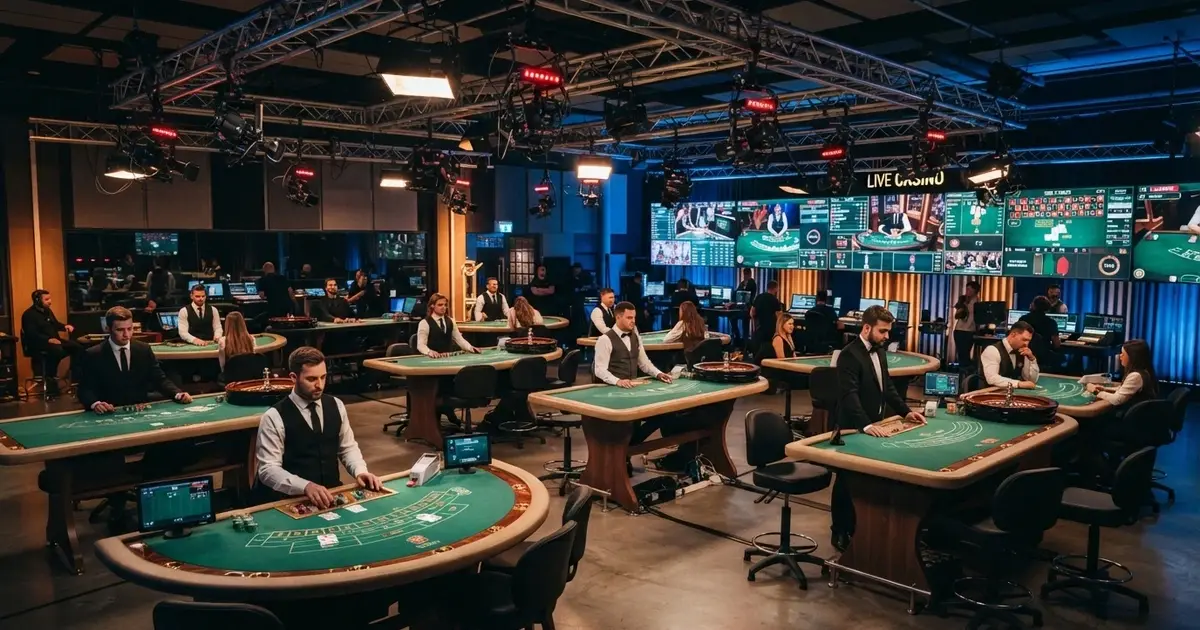
The setup is a small studio with a table at its centre. Above the table, two or three cameras capture angles — a wide shot of the dealer and the layout, a close-up of the dealing area, sometimes an overhead shot for games like roulette where the wheel itself is the focus. A game-control unit sits beside the dealer. It is the dealer’s interface: it registers the cards being drawn, the position of the roulette ball, the spin of the wheel. Optical character recognition reads the cards and the wheel and translates them into the digital signals the player’s screen needs to settle bets in real time.
The player sees the feed on a browser or phone. The betting interface overlays the video — chip denominations, the layout for placing bets, a timer showing how many seconds remain before the betting window closes. Decisions are made on the player’s side, not the dealer’s. A click on the blackjack betting square sends a signal back through the stream; the dealer’s shoe, the cards drawn, the dealer’s hand — all of it flows through the same channel in the other direction.
The latency is the thing most players notice first. A two-second delay is comfortable; a six-second delay starts to make decisions feel like guesswork. The major providers run their own streaming infrastructure and locate studios in jurisdictions where bandwidth is cheap and licences are accessible — Malta, Romania, the Baltic states, the Philippines, Colombia. The player in Sydney is rarely connecting to a studio in Sydney. The geography is invisible, but the network distance is real.
Live Casino vs a Land-Based Casino Floor — What You Gain and What You Lose
The land-based floor offers a physical room, a dealer you can see in three dimensions, other players you can talk to, the smell of the place, and the wait between hands while the shoe is shuffled. A live dealer casino offers none of those sensory details. What it offers is convenience — a seat at the table whenever the player wants one, without a drive, a dress code or a wait for the next shoe. The pace of play is also faster. No chips to stack, no physical cards to cut, no one arguing about a payout. The player clicks, the dealer deals, the bet settles.
The table-limit spread is, in some respects, wider online than on most physical floors. Standard live-dealer tables start at A$0.10 a hand for roulette and blackjack, and the high-end VIP rooms carry per-hand maximums exceeding A$25,000. A Crown Casino in Melbourne runs VIP tables, but the bet ceiling is rarely that high on the floor itself. The online VIP product is built for a smaller, wealthier clientele than the average live-dealer room — and the minimums at the low end sit below anything a casino floor would bother staffing.
What the player loses is harder to put a number on. The lack of a crowd changes the social dimension. The lack of a physical cashier removes the friction that, in a land-based setting, slows the rate at which chips leave the player’s hand. Continuous play is built into the product: no dealer change, no shift end, no closing time. The stream never sleeps.
The Australian Live Casino Landscape in 2026
Australian search behaviour for “best live casino online Australia” lands almost entirely on affiliate-comparison pages, not operator homepages. OnlineGamblingAus, CasinoAudit, LiveCasinoRank, PokiesAustralia, slotspeak, AustralianGamblers and the Metrotimes/TheSunPapers-style roundups dominate the first page. Each one typically ranks eight to twelve casinos, lists a Curacao-licensed posture in the footer, and foregrounds payment rails Australian players recognise — PayID, POLi, crypto.
The comparison is the product. The operator behind it is an afterthought. The reader who clicks through arrives on a Curacao-licensed offshore site that no Australian regulator has authorised for online casino play. The reader who clicks off the comparison and onto the ACMA’s register of licensed interactive wagering providers will not find a single live dealer casino on it, because none exists. There is no licensed Australian online casino to compare against. The market the search term implies is a market the law does not permit.
The Live Dealer Sites Australians Are Using in 2026
Ten offshore operators surface repeatedly in the Australian live-casino search results. They are listed below in the order they appear in the affiliate rankings, with the operator carrying the most independently verified detail — SkyCrown — at the top of the table. None holds an Australian licence for online casino. Every one runs under an offshore regime, usually Curacao eGaming.
| Operator | AU legal status for online casino |
|---|---|
| SkyCrown | Offshore — unlicensed in Australia (Curacao eGaming noted in site footer) |
| Rocket Play | Offshore — unlicensed in Australia |
| Royal Reels | Offshore — unlicensed in Australia |
| WinSpirit | Offshore — unlicensed in Australia |
| Stake | Offshore — unlicensed in Australia |
| Rainbet | Offshore — unlicensed in Australia |
| Scream Casino | Offshore — unlicensed in Australia |
| FairGO | Offshore — unlicensed in Australia |
| Bizzo Casino | Offshore — unlicensed in Australia |
| Rocket Casino | Offshore — unlicensed in Australia |
The rest of this section walks through each operator in turn, with what is and is not independently confirmed. The data on SkyCrown is the most detailed. The other nine carry far less verifiable information — in several cases only the name and offshore status could be confirmed this round, and the operator write-ups flag that.
SkyCrown
SkyCrown is the data-rich operator in this set. Three pieces of information about its live-casino product are independently confirmed in the affiliate sources: a weekly live cashback of 10% up to A$1,500 with zero wagering on the standard tier, an AU-exclusive welcome package up to A$8,000 plus 400 free spins, and a live lobby powered by Evolution Gaming and Pragmatic Play Live. The bonus has the structure most Australian players recognise: a 450% deposit match across four deposits, an A$30 minimum, 40x bonus wagering, 40x free-spins wagering, a A$7.50 maximum bet for bonus money, and 14 days to clear it.
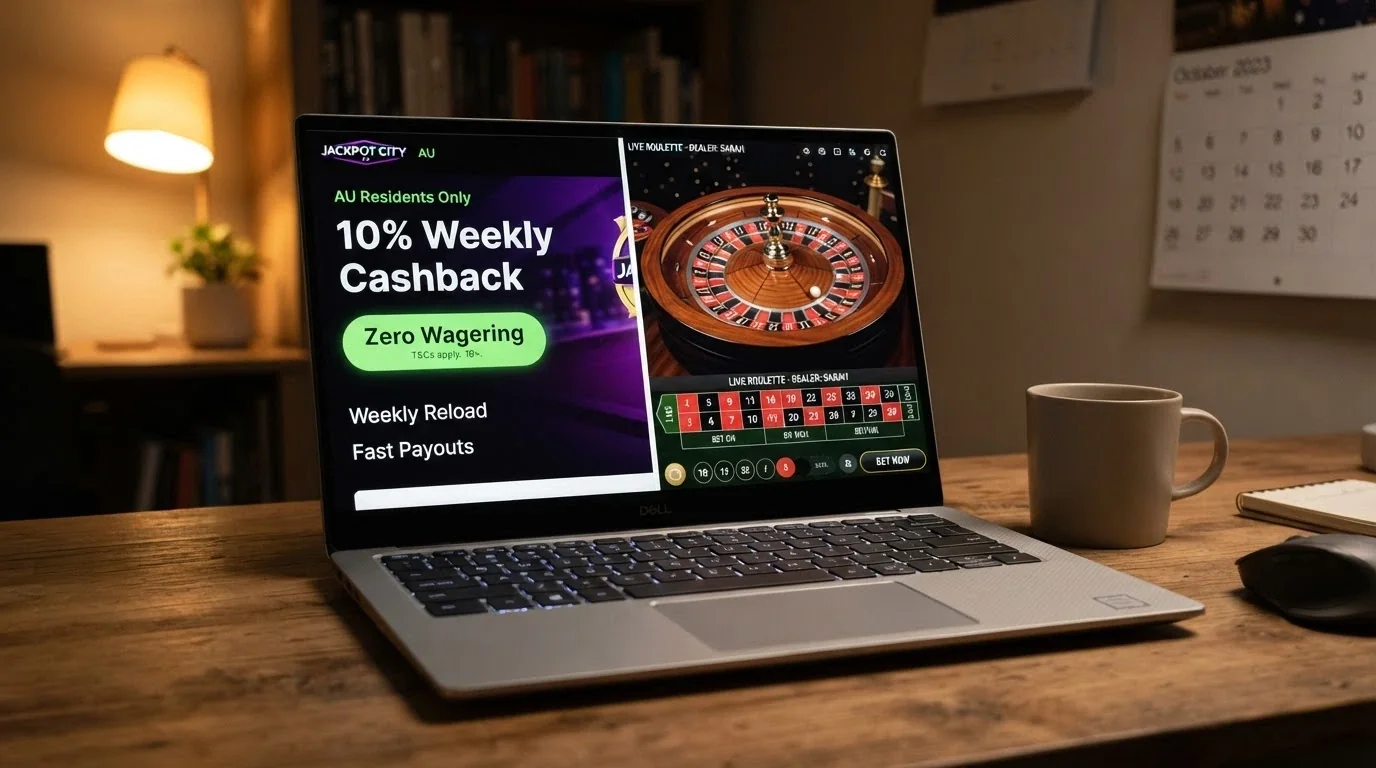
The cashback is where the offer does something different. The standard weekly live cashback pays 10% of net losses at the live tables, capped at A$1,500, with a minimum qualifying loss of A$150 and a minimum payment of A$15 — and it carries no wagering requirement at all. The cashback lands in the player’s account as real money. The VIP tier runs the same headline (10% up to A$1,500) but applies a 3x wagering requirement, and that wagering counts only on slots. For a player whose play is mostly at the live tables, the standard tier is the cleaner offer.
The welcome package is the larger number but the more constrained one. The live casino contributes 0% to the welcome bonus wagering, which means every dollar cleared has to come from slot play. A$30 deposit, 40x bonus, 14 days, A$7.50 max bet. The arithmetic is unkind: a player chasing the full A$8,000 cap faces A$320,000 in required slot turnover, none of which clears the bonus at a live table. The free spins land in batches across the four deposits, and the same 40x wagering applies to any winnings.
Crypto withdrawals are the speed claim that distinguishes SkyCrown in the comparison pages — once the account is verified, withdrawals are processed in under 10 minutes. The verification is the friction that determines whether that speed is actually realised. There is also a 20-spin no-deposit offer on registration, but those spins are for slots, not for the live lobby.
SkyCrown is the only operator in this set whose welcome offer and live cashback could be independently confirmed with figures attached. For a player prioritising live-dealer play, the cashback is the offer that actually pays out. The welcome bonus is a slot-clearing exercise disguised as a live-casino gift.
Rocket Play
Rocket Play surfaces in the Australian live-casino comparison pages but carries little that is independently verifiable. The site itself markets to an AU audience, and the operator’s New Zealand-facing page references a 100% first-deposit match plus 100 free spins and a 200% second-deposit match — but no AU-specific live-casino bonus terms could be confirmed this round. The licence register, the provider catalogue, and the deposit and withdrawal thresholds for Australian players were not independently verified.
The NZ page terms give an indication of the shape of the offer without confirming its AU form. A 100% first-deposit match with 100 free spins is a familiar construction in this market, but it is not the offer an Australian player should expect to land on until the AU-specific terms are checked on the operator’s cashier page. Rocket Play is, like every brand in this set, offshore and unlicensed for Australian online casino.
For a player who has already decided to use an offshore site and is comparing Rocket Play against the others in this list, the unresolved terms are the main problem. The welcome offer is large enough to be a draw but not large enough to be the reason to choose this operator over another. An Australian player choosing Rocket Play is choosing on the operator’s brand surface, not on independently verified bonus terms.
Royal Reels
Royal Reels is one of the quieter brands in the Australian live-casino comparison set. The name surfaces in the affiliate rankings, the site carries an AU-facing landing page, but the licence register, the provider catalogue, the welcome offer terms and the AU-specific deposit thresholds were not independently confirmed this round. The brand presents as offshore; the regulatory home is not stated in the materials reviewed.
There is little to compare Royal Reels against other than its offshore status and the absence of a confirmed offer. A player considering this brand should treat the comparison pages’ headlines as marketing copy and check the cashier and terms pages directly before depositing. What Royal Reels claims versus what Royal Reels is confirmed to offer are two different lists; the comparison page is not the authoritative one.
WinSpirit
WinSpirit appears in the Australian comparison listings alongside the more familiar names. The brand’s AU-facing site exists, but no independently verified specifics about its live-casino welcome offer, wagering requirements, provider catalogue or licence date came through this round. The operator presents as offshore; the underlying regulator is not confirmed.
The honest read of WinSpirit in 2026 is that an Australian player can find the site, register an account, and play — but cannot rely on the comparison-page summary for the bonus terms. The terms will be on the site itself, and they need to be read before any deposit is made. The bonus terms are not in the public record this round.
Stake
Stake is a brand most Australian readers will have heard of outside the live-casino context. It is internationally prominent, sponsors sporting organisations, and carries a recognised name. That prominence does not change its Australian regulatory status for online casino: Stake is offshore and unlicensed in Australia. No AU-specific live-casino terms were independently confirmed this round.
For a player who values brand recognition, Stake is the operator in this list they will have heard of first. The recognition does not extend to a regulatory standing the operator does not hold. Stake’s international name recognition is the operator’s only real differentiator in this set, and it does not translate into Australian regulatory standing.
Rainbet
Rainbet is another name surfacing in the Australian live-casino comparison rankings without enough independently verified detail to support a confident write-up. The AU-facing site exists, the brand positions itself for Australian players, but the licence register, provider catalogue, and AU-specific bonus terms were not confirmed this round. The regulatory home is not stated in the materials reviewed.
The operator write-up is short because the data is short. The verified write-up on Rainbet is short because the verified data is short — and the comparison page is not the place to close the gap. A player interested in Rainbet should check the operator’s own site for terms rather than relying on this page for the specifics.
Scream Casino
Scream Casino appears in the same set of comparison listings as the other brands on this page. The offshore status for Australian online-casino play is the same: not licensed in Australia, not regulated by ACMA. No independently verified live-casino welcome offer, wagering terms, provider catalogue or licence date came through this round.
There is little to differentiate Scream Casino from the rest of the set on independently confirmed grounds. An Australian player choosing Scream Casino is choosing on the brand surface, not on independently confirmed specifications. That is the decision the absence of verified data forces.
FairGO
FairGO carries an Australian-facing name and an AU-targeted landing page. The branding is pointed at Australian players; the regulatory status is not. FairGO is offshore and unlicensed for online casino in Australia. The licence register, provider catalogue, welcome-offer terms and AU-specific deposit thresholds were not independently confirmed this round.
The name signals an Australian focus, and the operator’s site presumably honours that focus in its payments, its customer support and its bonus construction. None of that is a regulatory protection. FairGO’s Australian-facing name is the marketing; the offshore licence is the regulatory standing. The two are not the same product.
Bizzo Casino
Bizzo Casino rounds out the comparison set with the same general profile as the other names on this list: offshore, unlicensed in Australia, AU-facing site, no independently verified bonus terms or provider catalogue this round. The brand surfaces in the affiliate rankings, the underlying regulator is not stated in the materials reviewed, and the AU-specific live-casino offer is not on the public record.
The honest read of Bizzo Casino is the same as the honest read of several other names on this list: the comparison page tells the player the brand exists; the operator’s own terms pages tell them what the offer is worth. A direct visit is the only path to verified detail.
Rocket Casino
Rocket Casino surfaces in the Australian comparison listings and is easy to confuse with Rocket Play, the operator covered earlier. They are not the same brand. Rocket Casino presents its own AU-facing site, its own bonus construction, and its own licence register — none of which were independently confirmed this round.
The naming overlap is a hazard for any reader cross-checking the comparison roundups. Two rocket-themed offshore brands with Australian-facing landing pages are not interchangeable, and a player who intends to play at one should confirm the domain they actually landed on before depositing.
Every Live Casino Game Worth Your Time (and Your Money)
The game a player chooses is the single biggest determinant of what a session costs them. The bonus terms, the wagering multiplier, the cashback rate — all of those matter, but they sit on top of a more fundamental number: the house edge on the game being played. A 40x wagering requirement on blackjack with basic strategy and a 40x wagering requirement on a multiplier-led roulette variant are not equivalent offers, because the games underneath them cost the player different amounts per spin in the first place.

The table below lists the titled live-dealer games for which confirmed RTP figures exist in the research base, alongside the provider and the return-to-player percentage. French roulette is included as a variant rather than a titled game — the RTP applies to any French-rules table.
| Game title | Provider | RTP |
|---|---|---|
| Infinite Blackjack | Evolution | 99.47% |
| Lightning Blackjack | Evolution | 99.56% |
| ONE Blackjack 1 | Pragmatic Live | 99.59% |
| VIP Blackjack 5 – Ruby | Pragmatic Live | 99.54% |
| Live European Roulette | Evolution | 97.30% |
| Live Caribbean Stud Poker | Evolution | 98.94% |
| French Roulette (La Partage / En Prison) | — | 98.70% |
The rest of this section walks through each game type and explains what the numbers above actually mean for the player sitting at the table.
Live Blackjack — The One Game Where You Can Nearly Erase the House Edge
Blackjack is the cheapest live-dealer game for a player who plays the basic strategy correctly. With the mathematically optimal decision on every hand, the house edge on a standard live-dealer blackjack table sits near 0.5%. The titled variants in the table above push the RTP higher still — Infinite Blackjack at 99.47%, Lightning Blackjack at 99.56%, ONE Blackjack 1 at 99.59%, VIP Blackjack 5 – Ruby at 99.54% — because the rules and side-bet structures on each one shave a further fraction off the edge.
The catch is “correct basic strategy.” A player who hits on 16 against a dealer’s 7, splits tens, or takes insurance on every hand gives those percentages back. The basic strategy chart is freely available; it is about twenty lines of decisions and can be committed to memory in a session or two. The chart does not need to be deployed openly at the table — most live-dealer lobbies show the basic-strategy hint next to the betting interface if the provider has built it in.
The gap between standard blackjack and a multiplier-charged variant is small but compounding. A multiplier side bet at a Lightning Blackjack table pays 5x, 10x, 25x and beyond on certain hand combinations — but the multiplier is funded by a reduction in the base-game RTP. The base game on Lightning Blackjack is more expensive than Infinite Blackjack, even though both look similar at the table.
For an Australian player prioritising cost-per-hand, a standard live-dealer blackjack table with basic strategy is the cheapest seat in the lobby. The titled variants with confirmed RTPs above 99.5% are a step better still. The game-show spin-offs — those with the multipliers and the bonus wheels — are not.
Live Roulette — Not All Wheels Spin the Same
European roulette — a single zero on the wheel — sits at 97.30% RTP, which works out to a 2.7% house edge on every spin. That is the standard product. It is not the best the table offers. A French-rules roulette wheel with the La Partage rule returns half the player’s even-money stake when the ball lands on zero; with both La Partage and En Prison in play, the RTP rises to 98.70%. The trade-off is the same as in any land-based casino: French-rules tables are less common, the betting interface may take a moment to find, and the variants are not always available 24/7.
The multiplier-led roulette variants are the eye-catching tables in the lobby — Lightning Roulette, PowerUP Roulette, and their peers. They add random multipliers to certain straight-up numbers, paying out 50x, 100x, 250x, or more. The multiplier is funded by a reduction in the RTP on the underlying game. Multiplier-led live roulette variations typically sit at around 95% RTP, which is meaningfully more expensive than the 97.30% European wheel and dramatically more expensive than the 98.70% French-rules variant. The 2.7% edge on European roulette becomes a 5% edge on a typical multiplier variant.
To price what the difference actually costs, take a 100-spin session at A$1 per spin. At the European wheel’s 97.30% RTP, the session carries an expected loss of A$2.70 — a statistical estimate over many sessions, not a guaranteed outcome for any individual player. The same session on a multiplier-led variant at roughly 95% RTP carries an expected loss of A$5.00. Same number of spins, same stake, almost double the cost. That is the price gap the marketing tends to leave out.
Live Baccarat — Low Edge, High Pace, No Strategy Required
Baccarat offers three bets: banker, player, and tie. The banker bet holds a 1.06% house edge after the 5% commission charged on a winning banker stake. The player bet carries a slightly higher edge. The tie bet is the worst of the three by a wide margin and is not a bet a player should make. None of these bets require a strategy decision — the player picks a side, the dealer does the rest.
The pace is what makes baccarat the high-roller’s game. A hand takes seconds. Decisions are minimal. The volatility is low compared to roulette or blackjack. The VIP rooms at the major live-dealer platforms run baccarat tables with per-hand maximums exceeding A$25,000, which is the upper limit of what an Australian player can stake in a single hand at a live table anywhere in the world — and that ceiling is, on some platforms, the actual reason a high-roller chooses baccarat over blackjack.
For an Australian player who has not played baccarat before, the learning curve is essentially flat. The decision is binary, the rules are simple, and the only strategy question is whether to back banker or player — and the math says banker.
Live Poker — Not the Table You Think, and That Changes the House Edge
Live casino poker is not poker. The games that carry the “poker” label at a live-casino table — Caribbean Stud, Casino Hold’em, Three Card Poker, Ultimate Texas Hold’em — are casino-banked games. The house is the dealer. The other players at the table are not opponents; they are fellow punters with no bearing on whether the player’s hand wins. The house always has a built-in edge.
The named variant for which research carries a confirmed RTP is Live Caribbean Stud Poker at 98.94%, with low volatility. That is a respectable return for a casino-banked game, but it is not a return a player will find at a player-vs-player poker table, where the house edge is replaced by a rake. Live casino poker is a different product, and the comparison should not be made.
The skill element within a casino-banked poker game is real but narrow: the player still has decisions to make about whether to fold or raise, whether to call the bet, when to play the bonus side bet. The mathematically optimal strategy on Caribbean Stud is published and consistent. Following it brings the session cost close to the 98.94% RTP. Ignoring it costs more.
Live Game Shows — Entertainment First, RTP Second
Crazy Time, Monopoly Live, PowerUP Roulette, and the other game-show titles that dominate the live lobby’s marketing are built for spectacle. A presenter in a studio spins a wheel, draws from a puck machine, or triggers a bonus round with a theatrical animation. The format is engaging and the production is high — which is exactly the point. The RTP on these titles is typically below the table games. Most of them are structured around a low base-game RTP and a long-tail hit on the bonus rounds, which means the session cost is higher than a standard table-game session even though the visual appeal is greater.
No per-title RTP figures for the live game-show products were independently confirmed this round. A player sitting down at Crazy Time or Monopoly Live should check the rules tab inside the game itself — every Evolution and Pragmatic Live title carries an information panel that lists the RTP and the payout structure. The absence of confirmed RTP in the research base is not an argument that the games are unfair; it is an argument that the player should not assume a return they have not checked.
Other Live Table Games — Sic Bo, Craps and Dragon Tiger
Sic bo, craps and dragon tiger round out the live lobby. They are lower-volume games than blackjack or roulette and are not always available at every hour. Sic bo is a dice game with multiple bet types; craps is the dice game most familiar to American players; dragon tiger is a two-card comparison game popular in Asian markets. All three are offered by Evolution and Pragmatic Play Live on their respective platforms.
The RTP on these titles varies by bet type and was not independently confirmed this round. The standard advice is the same as for every other live-dealer game the player has not played before: check the rules tab inside the game, look at the payout table, and avoid the bets the table marks as the worst value (in sic bo, that is the small and big totals; in craps, the proposition bets in the centre of the layout). The published RTP on the better-been bet types for each game is the number the player should be playing to.
The Software That Powers Every Live Table You Play
The live-dealer experience lives and dies on three things: the provider that built the studio, the technology that streams the table to the player’s screen, and the dealer in front of the camera. The first determines the catalogue and the production values. The second determines the latency and the stream stability. The third determines whether the session feels like a professional product or a frustrating one.
The Two Providers That Run Nearly Every Live Table Australians See
Evolution Gaming is the dominant supplier. The company runs dozens of studios across multiple jurisdictions, employs thousands of dealers, and supplies the majority of the live-dealer tables at the major offshore operators Australians encounter. The Evolution catalogue covers blackjack, roulette, baccarat, poker, craps, sic bo, dragon tiger, and the live game-show titles — Crazy Time, Monopoly Live, Lightning Roulette, Dream Catcher, and the rest.
Pragmatic Play Live is the second confirmed name in this set. The provider’s catalogue is smaller than Evolution’s but its reach is comparable: the same major offshore operators carry Pragmatic Play Live tables alongside Evolution’s. SkyCrown’s live lobby is the only one for which the dual-provider arrangement was independently confirmed, but the same dual setup is typical across the offshore operators Australians encounter.
Ezugi is the third name referenced in the search results, alongside Evolution and Pragmatic Play Live, at SkyCrown. Ezugi’s catalogue is smaller again — focused on the standard table games — but the brand adds another supplier to the lobby’s rotation.
For the player, the practical implication is that the same handful of suppliers power most live-dealer tables anywhere an Australian searches. The provider is not a differentiator at most operators; it is a baseline. What varies is the catalogue the operator chooses to expose and the table limits the operator sets on each title.
How the Stream Gets from the Studio to Your Screen
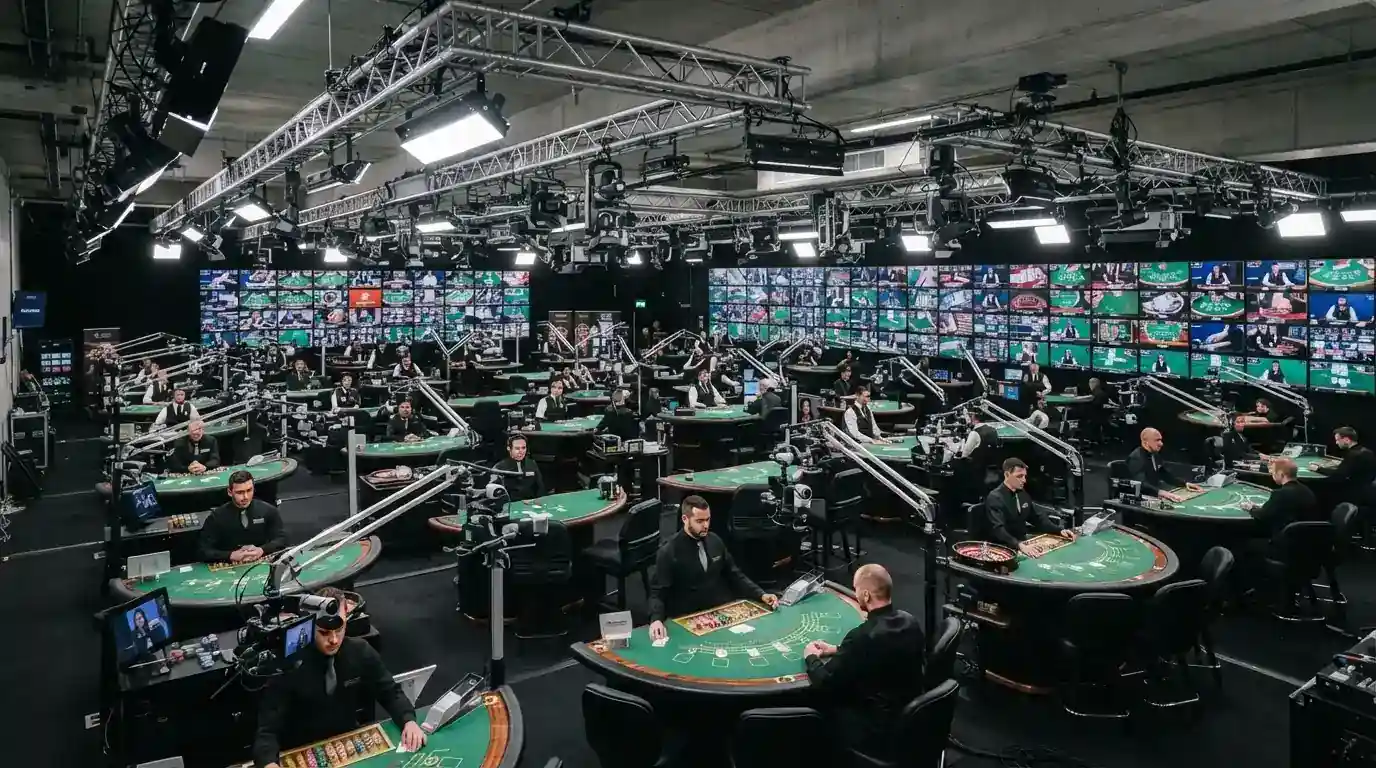
A live-dealer table is a small production. Two or three cameras per table, a game-control unit beside the dealer, optical character recognition to translate the physical result into a digital signal, an encoder to compress the stream for delivery, and a content delivery network to distribute that stream to the player’s browser or phone. The whole pipeline is built to keep latency low — most Evolution and Pragmatic Live streams aim for a delay of under three seconds.
The studio-to-screen distance matters more than most players realise. A studio in Malta, Romania or Latvia serves European players efficiently; an Australian player is connecting across longer network paths and the latency is correspondingly higher. The studios that supply Australian-facing operators are not located in Australia. The stream reaches the player in Sydney through a network route that may add a second or two of delay. The two-second delay is comfortable; the four-second delay starts to feel sluggish.
The player’s own connection quality is the other half of the equation. A stable home broadband connection is fine. A patchy 4G signal on a train is going to drop frames, pause the stream, and break the betting interface. Live-dealer play on mobile is fully supported by every major provider, but it works best on a stable connection.
What Makes a Live Dealer Worth Playing With
The dealer is the face of the product. The studio may be professional and the technology may be flawless, but a dealer who cannot run the table smoothly makes the session feel long. The major providers train their dealers in game procedure, customer service, and the chat function that lets the player talk to the table. The best dealers keep a steady pace, call bets clearly, and acknowledge the chat without slowing the game.
The language question is one Australian players should pay attention to. The major providers run native-English tables for most of their shifts, but the off-peak hours may be staffed by dealers whose first language is not English. A player who values the chat dimension should check the table’s language setting before sitting down. A player who does not care about chat can play any table.
The pace question matters for the cost calculation. A faster dealer closes more hands per hour, which means more bets resolved, which means more expected loss over a fixed session. The provider’s table-speed setting — Standard, Speed, VIP — controls how many hands per hour the player sees. Speed tables run roughly twice the hand-rate of Standard tables.
Why Your Live Casino Bonus in 2026 Is Harder to Clear Than It Looks
The welcome offer on every offshore live casino’s homepage carries a number — “up to A$8,000”, “100% match”, “400 free spins”. The number after “up to” is a ceiling, not a grant. The minimum deposit, the wagering multiplier, the game contribution rate, the maximum bet while wagering, and the validity window are the terms that decide whether any of it converts into withdrawable cash. The marketing presents the ceiling. The terms determine the payout.
Welcome Bonuses at Live Casinos — the Headline vs the Reality
A deposit-match welcome bonus is the standard construction: the operator matches a percentage of the player’s first deposit up to a stated cap, often spread across the first two to four deposits. SkyCrown’s AU-exclusive welcome is a 450% match up to A$8,000 plus 400 free spins across the first four deposits — a structure that puts a quarter of the bonus on each deposit and a tranche of free spins alongside. A player chasing the full cap faces an A$8,000 ceiling that requires the maximum deposit at each tier.
The conditions sit underneath. An A$30 minimum deposit, 40x bonus wagering, 40x free-spins wagering, a A$7.50 maximum bet for all bonus money, and 14 days bonus validity. The 40x multiplier on a bonus of, say, A$1,000 is A$40,000 in required turnover — and that turnover has to come from play that contributes to the bonus. The single most important term is the contribution rate. Live casino games contribute 0% to the welcome bonus wagering at SkyCrown. Every dollar of required turnover has to come from slot play. The welcome bonus is a slot-clearing exercise.
Market-wide, the same shape holds. Live-casino wagering requirements typically range from 30x to 40x the bonus amount, and live-dealer games often contribute only 10–20% to the wagering when they contribute at all. A 30x bonus on A$500 with 20% live contribution needs A$75,000 in live-dealer turnover — and only A$15,000 of it counts. The player chasing the bonus at the live tables is doing twice the play for half the credit.
Live Casino Cashback — the Offer Type That Actually Works for Table Players
Cashback on live-casino losses is the bonus structure where the live-dealer play is the point, not an afterthought. SkyCrown’s standard weekly live cashback pays 10% of net losses at the live tables, capped at A$1,500, with a minimum qualifying loss of A$150 and a minimum payment of A$15. The standard tier carries no wagering requirement — the cashback lands as real money, withdrawable on the same terms as any other balance.
The VIP tier runs the same headline — 10% up to A$1,500 — but applies a 3x wagering requirement, and the wagering counts only on slots. For a player whose play is split between live tables and slots, the VIP tier is a downgrade: the same cap, the same percentage, but the wagering condition moves the cashback from real money to bonus money. For a player whose play is exclusively at the live tables, the VIP tier is unusable — there is no path to clear the wagering on slots.
The minimum-qualifying-loss floor (A$150) and the minimum-payment floor (A$15) are the boundaries that define who the offer actually serves. A player losing A$150 in a week receives A$15 cashback — a 10% return. A player losing A$15,000 in a week receives A$1,500 cashback, the cap. A player losing A$100 receives nothing; the minimum threshold is not met. The offer is built for the regular live-table player, not the casual weekend visitor.
The Fine Print That Rewrites the Offer
Five terms turn a generous-looking bonus into an unbeatable one. Wagering multiplier, game weighting, max-bet cap, validity window, and max cashout. They interact, and the interaction is what costs the player.
A 40x wagering requirement means the player has to turn over the bonus amount forty times before the bonus becomes withdrawable. On a A$1,000 bonus, that is A$40,000 in qualifying play. The game-weighting table decides what counts. Live-dealer games contribute 10–20% in most cases — meaning A$1 of live play counts as A$0.10 to A$0.20 of the A$40,000 requirement. The player who tries to clear the bonus at the live tables plays five to ten times the turnover they would have played at the slots.
The max-bet cap is the next trap. While a bonus is active, most operators cap the player’s bet at A$5 to A$10 per hand or spin. A player who bets A$50 a hand breaches the cap and forfeits the bonus. The cap is enforced through the betting interface; the operator’s system rejects the over-cap bet and warns the player. The cap is there to prevent a player from burning through the wagering requirement in a single lucky spin. It is a real restriction.
The validity window is the clock. Most live-casino bonuses carry a 7- to 30-day completion window. The bonus that is not cleared in time is forfeit. The 14-day window on SkyCrown’s main bonuses is on the shorter end. The wagering at 10–20% live contribution is slow; the player who tries to clear the bonus at the live tables often runs out of clock before they run out of bonus.
Max cashout is the final cap. Some bonuses — particularly no-deposit offers and free-spin bundles — carry a ceiling on how much can be withdrawn from bonus-derived winnings. A$5,000 is a typical cap on a welcome bonus; smaller caps apply to free-spin wins. The cap is applied at the withdrawal stage, not the play stage. A player who wins A$8,000 from a bonus capped at A$5,000 walks away with A$5,000.
The marketing presents the ceiling. The terms determine the payout. The five terms above are where the determination happens.
Live Dealer Games on Your Phone — What Actually Works
Every operator in this set runs a mobile-responsive live lobby. The technology that powers a desktop stream — Evolution Gaming and Pragmatic Play Live — also powers the mobile stream, and the player interface has been rebuilt for a 6-inch screen. The chip selector sits at the bottom of the screen, the betting layout scales to fit, the video feed sits above the interface, and the chat window shrinks to a sliver or hides behind a tap.
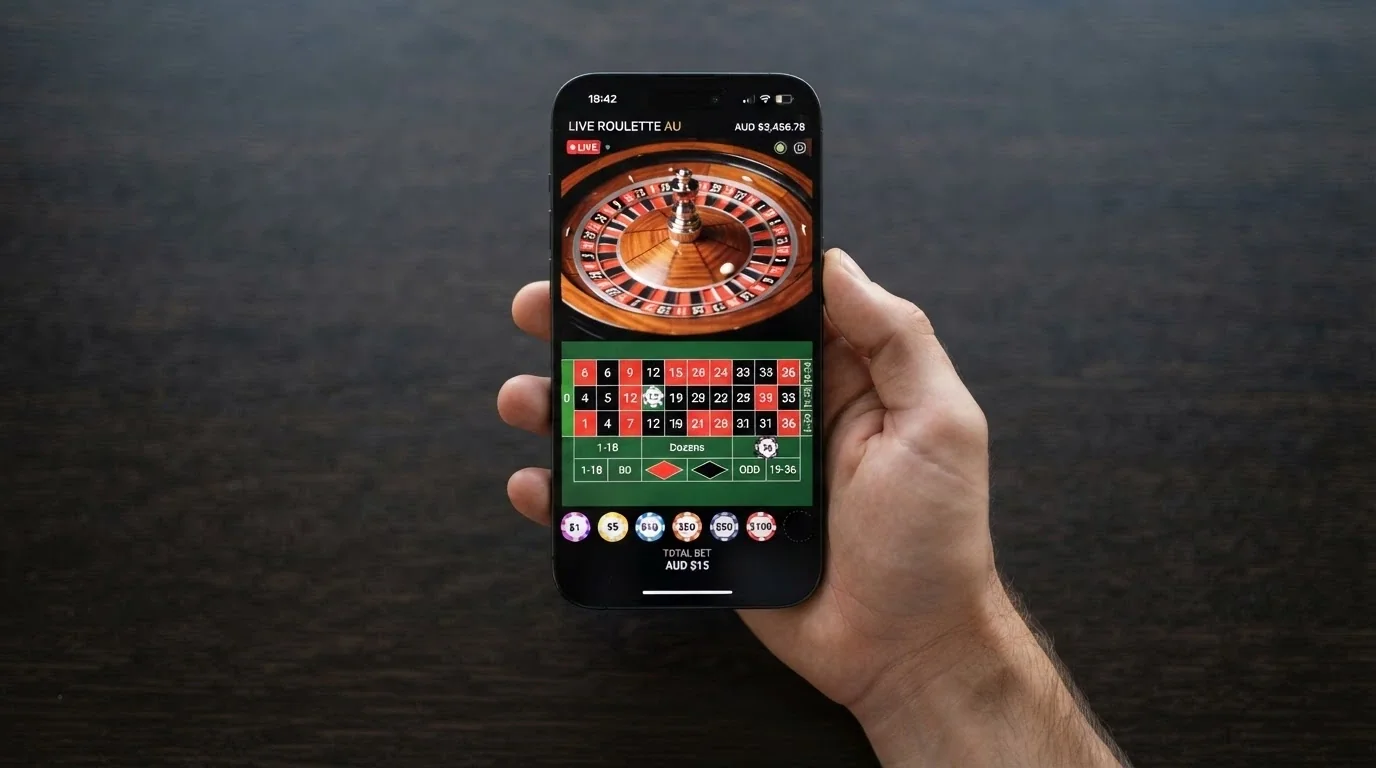
What works on mobile is the standard live-dealer experience: blackjack, roulette, baccarat, the game-show titles. The betting interface translates cleanly to a phone. The latency penalty for connecting on 4G or 5G is small — most providers optimise for mobile bandwidth and degrade gracefully when the connection drops.
What does not work as well is the multi-table experience. A desktop player can run two or three live tables at once, watching one while betting on another. A phone player is effectively limited to one table at a time. The split-screen multi-table setup is technically possible but cramped, and the betting interface becomes hard to read at smaller sizes.
No confirmed per-operator native-app data came through this round for the brands in this review. Most offshore operators offer browser-based play rather than dedicated apps — the regulatory position of an Australian app-store listing for an offshore casino is uncertain, and operators have settled on a mobile-responsive browser as the standard delivery. A player should check whether their chosen operator offers a dedicated app or browser-only play before assuming either.
Getting Money In and Out of an Offshore Live Casino
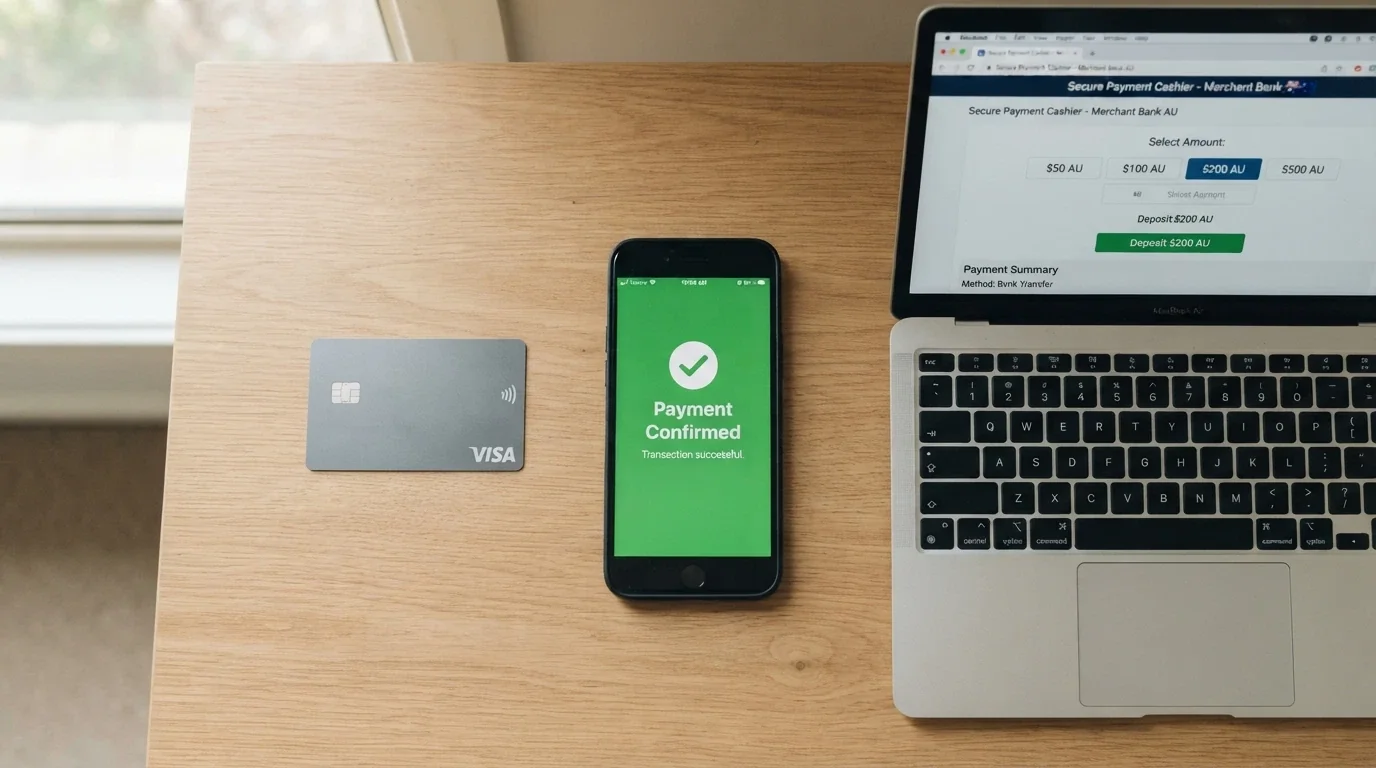
Depositing at an offshore live casino from Australia means using payment rails the licensed Australian market has already restricted for domestic wagering. The credit-card and crypto ban that took effect on 11 June 2024 applies to licensed Australian operators; it does not reach the offshore sites an Australian player is actually using. The offshore cashier still accepts Visa and Mastercard, still accepts Bitcoin and Ethereum, still processes withdrawals through bank transfer. The licensed-market restrictions and the offshore-market reality are not the same.
Payment Methods Australians Can Actually Use at Live Casino Sites
- PayID and Osko — instant bank-transfer rails built on the New Payments Platform. Most Australian banks support them. Deposits clear in seconds; withdrawals land in the linked account within minutes to a few hours, depending on the operator’s processing window.
- POLi — an Australian payment intermediary that connects the player’s bank account to the merchant’s deposit system without a card. POLi is widely supported at offshore casinos targeting Australian players; the player’s bank statement shows a POLi reference, not the casino name.
- Debit cards — Visa and Mastercard debit cards issued by Australian banks. The credit-card ban does not extend to debit cards, but some Australian banks have introduced their own blocks on gambling-related debit-card transactions. A player whose bank has imposed a block may need to use POLi or PayID instead.
- Bank transfer — direct deposit from the player’s bank account. Slower than PayID but universal; every Australian bank supports it.
- Crypto — Bitcoin, Ethereum, Litecoin, and the stablecoins. Crypto withdrawals are the speed claim that distinguishes some operators: SkyCrown processes crypto withdrawals in under 10 minutes once the account is verified. The verification is the friction that determines whether the speed is realised.
Every payment method at an offshore operator shares one condition: the player has to verify their identity before the first withdrawal. The verification usually means a government-issued ID, a proof of address, and occasionally a source-of-funds check. The verification is the operator’s compliance requirement, and the operator holds the withdrawal until the check is complete. A player who has not verified an account cannot expect a fast payout regardless of the payment method chosen.
Can You Play Live Dealer Games for Free?
Mostly, no. A live dealer is paid by the hour. The studio, the cameras, the game-control unit, the streaming infrastructure — none of it runs without a cost that an operator could absorb for a demo product. The result is that almost no live-dealer table offers a free-play mode. The player cannot sit at a blackjack table for fun, place bets with no money behind them, and learn the interface at no cost.
The free-play offers that exist adjacent to the live lobby are almost always for slots. SkyCrown’s 20 no-deposit spins on registration are slots spins, not live-dealer hands. The free-play welcome bonuses that some operators advertise are free spins on selected slot titles. A player who wants to try the live lobby before depositing has to do it with real money at a low-limit table — most live-dealer platforms carry A$0.10 minimums at the standard tables, which is the closest the live product comes to a free trial.
A small number of operators offer a spectator mode on selected tables — the player can watch a hand being dealt without placing a bet, which lets them see the dealer’s pace and the table’s interface before they commit. The spectator mode is not universal. Where it exists, it is the closest a live-casino lobby gets to a demo.
The Legal Reality of Live Casino Play in Australia
The Interactive Gambling Act 2001 prohibits providers from offering online casino services to people in Australia. Online casinos are explicitly listed as banned services by the Australian Communications and Media Authority. No Australian licence exists for live-dealer play. Every operator on this page is offshore. The legal picture is not ambiguous.

What the Interactive Gambling Act Actually Says — and Who It Applies To
The IGA targets providers, not players. The offence is offering the prohibited service, not using it. Subsection 15(2A) of the Interactive Gambling Act 2001 is the section ACMA’s investigations cite: providing a prohibited interactive gambling service to customers physically present in Australia can contravene the Act. The player is not the subject of the prohibition. The Australian Federal Police do not pursue individuals for placing bets at offshore sites.
What the IGA does prohibit is broader than online casino. The banned services list includes online casinos, in-play sports betting, unlicensed sports betting services, and betting on the outcome of a lottery. Licensed wagering on races and sport placed before the event begins is permitted; lotteries and keno can be state- or territory-licensed; online casino and online pokies are not.
The Interactive Gambling Amendment (Gambling Reform) Bill 2026 passed Parliament on 19 August 2026 and its measures commence on 1 January 2027. The 2026 reform strengthens BetStop, imposes federal advertising restrictions, and gives banks and payment providers express authority to block transactions to illegal gambling operators. The current state of the law is the state described above; the 2027 changes sharpen it.
Offshore Operators and Australian Law — What the Government Can and Cannot Stop
The ACMA has blocked offshore gambling websites since November 2019. More than 225 illegal services have withdrawn from the Australian market since 2017 — some as a result of formal ACMA action, others in response to the enforcement environment. The website-blocking programme is real, but it is a moving target: new domains appear faster than they can be listed, and operators move their brands to fresh URLs when the ACMA closes the old ones.
The 2027 reform changes the dynamic. From 1 January 2027, banks and payment providers gain express authority to block transactions to illegal gambling operators. The federal advertising restrictions from the same date cap wagering advertising at three ads per hour between 6:00am and 8:30pm, with a live-sport blackout window from 15 minutes before to 5 minutes after live sport. The 2027 measures are aimed at licensed operators, but the payment-blocking authority in particular tightens the position of offshore operators by giving the banking system a direct lever.
The legal reality for an Australian player in 2026 is unchanged by the 2027 reform: playing at an offshore casino is not, in itself, a criminal offence, but the regulatory environment is being actively tightened, and the protections the licensed market offers do not extend offshore.
Player Protections That Do Apply — and the Ones That Do Not
BetStop, the National Self-Exclusion Register, launched on 21 August 2023. By the end of Q3 FY 2025–2026, 59,830 people had registered to self-exclude from all licensed online and phone wagering providers. As of 31 March 2026, 37,247 people held active exclusions. Self-exclusion periods range from a minimum of three months up to a lifetime. BetStop binds the approximately 150 licensed wagering providers in Australia — and that is the limit of its reach.
BetStop does not bind offshore online casinos. A player who has registered with BetStop can still open an account at an offshore operator. The exclusion is enforced at the licensed-provider end. The gap is structural: there is no register an Australian player can join that excludes them from every offshore site they might encounter. The same gap applies to deposit limits, session timers, and the responsible-gambling tools the licensed operators are required to offer.
The protections that do apply regardless of jurisdiction are the Australian harm-minimisation services. The National Gambling Helpline is 1800 858 858 — free, confidential, open 24 hours a day, seven days a week. Gambling Help Online offers live chat, email counselling, and self-help advice. Both are Australian Government-funded, both are available to anyone in Australia, and both are reachable regardless of whether the play happened at a licensed operator or an offshore one.
Staying in Control When the Tables Are Always Open
The 2025 gambling participation data tell the background story. Overall gambling participation in Australia in January 2025 was 58.8%. Risky gambling — the prevalence of behaviours associated with harm — rose from 13.7% in 2024 to 19.4% in 2025. More than half of Australians who gambled — 56.1% — mainly participated online. Approximately 5.9% of Australian adults reported being harmed by another person’s gambling in the past 12 months.

The design of a live casino is built for continuous play. The dealer never tires. The next hand starts in seconds. The stream never closes. A live-dealer session has none of the natural stopping points a land-based floor has — no closing time, no shift change, no walk to the cashier. The session runs as long as the player keeps clicking.
Tools That Actually Work for Australian Players — Onshore and Offshore
- Operator-level deposit and session limits — most offshore operators carry deposit-limit, loss-limit, and session-timer tools in the account settings. They are not as binding as BetStop (the player can usually lift a limit after a cooling-off period), but they are real controls a player can set in under a minute.
- Operator-level self-exclusion — most offshore operators carry an account-closure or self-exclusion toggle that locks the account for a chosen period. The exclusion applies to that operator only; it does not extend to other brands.
- BetStop — the National Self-Exclusion Register covers approximately 150 licensed wagering providers. It does not bind offshore online casinos. A BetStop registration is the right step for a player whose play is at licensed Australian operators; it is not sufficient on its own for a player whose play has shifted offshore.
- The National Gambling Helpline (1800 858 858) — free, confidential, 24 hours a day, seven days a week. Available regardless of jurisdiction. The first call for any player who feels their play is moving beyond their control.
- Gambling Help Online — live chat, email counselling, self-help resources. Australian Government-funded, jurisdiction-agnostic, free.
The operator-level tools are imperfect. A player who has decided to exclude themselves from offshore play needs to do it at every operator they have used, and the exclusion does not stop them opening an account at a new one. The Australian services are the jurisdiction-agnostic backstop. The first call is the right step regardless of where the play happened.
How We Picked and Ranked Every Live Casino on This Page
The ranking on this page reflects the depth of independently confirmable information available at the time of review. SkyCrown sits at the top because the affiliate sources carry specific, named figures for its welcome offer, live cashback, wagering terms, and provider catalogue. The other nine operators carry less verifiable detail — in several cases only the name, the offshore status, and the AU-facing landing page could be confirmed this round.
The ranking criteria applied here, in qualitative order, begins with the Australian legal status for online casino, which is checked first. Every operator in the set is offshore and unlicensed in Australia, so the ranking does not differentiate on it. Next are independently confirmed bonus terms — covering the welcome offer, wagering multiplier, validity window, max bet cap, contribution rate, and cashback structure — where SkyCrown is the only operator for which these were confirmed with figures attached. This is followed by the independently confirmed provider catalogue, listing the live-dealer studios supplying the operator’s lobby, where Evolution Gaming and Pragmatic Play Live are confirmed at SkyCrown. Finally, the AU-facing posture considers if the operator presents an Australian-facing landing page, Australian-dollar banking, and Australian-friendly payment methods, as most operators in the set do.
Several operator fields could not be confirmed from primary sources this round. Where the affiliate comparison pages carry a figure that could not be independently verified — a licence date, a provider list, an AU-specific bonus term — this page says so. The verification limitation is real, and the ranking reflects it rather than papering over it.
What Australian Players Should Actually Do About Live Casino in 2026
The legal reality, the mathematical reality, and the practical steps are three separate things, and they belong together.
The legal reality is the starting point. Online casino is prohibited for providers under the Interactive Gambling Act 2001. No Australian licence exists for live-dealer play. Every operator on this page is offshore, and the protections the licensed market offers — BetStop, AFCA dispute resolution, ACMA enforcement — do not reach them. The 2027 reform tightens the position further. The legal picture is not going to soften.
The mathematical reality sits underneath. A 100-spin session at A$1 per spin carries an expected loss of A$2.70 on European roulette — a statistical estimate over many sessions under the stated assumptions, not a guaranteed outcome for any single player. The same session on a multiplier-led roulette variant at roughly 95% RTP carries an expected loss of A$5.00. The basic-strategy house edge on live blackjack is near 0.5%, which makes it the cheapest live-dealer game a player can sit at. The game a player chooses is the single biggest determinant of what a session costs them — more than the bonus headline, more than the wagering multiple, more than the cashback percentage.
The practical steps follow from those two. Check the RTP of the specific table before betting — the rules tab inside every Evolution and Pragmatic Live title carries the figure. Read the bonus terms before depositing — the wagering multiple, the contribution rate, the validity window, the max-bet cap are the four terms that decide whether the bonus is worth claiming. Set a deposit limit before the session starts — the operator-level tools work, and the friction they create is the point. Know that the Australian helpline (1800 858 858) and Gambling Help Online are available regardless of where the play happened.
No operator on this page can be recommended as a “safe” place to play in the regulatory sense. The page is a description of what Australian players actually find when they search for live dealer casinos — not a guide to which one to choose. The reader who chooses to play anyway is making a decision the operator’s licence status cannot protect.
Frequently Asked Questions
Can Australian players be prosecuted for using offshore live casinos?
No. The Interactive Gambling Act 2001 targets the providers of prohibited services, not the players who use them. ACMA’s enforcement is directed at operators, not at individuals placing bets at offshore sites. Playing is not risk-free, but it is not a criminal offence either.
Do Australian responsible-gambling tools like BetStop cover offshore live casinos?
No. BetStop excludes a player from approximately 150 licensed wagering providers in Australia. It does not bind offshore online casinos. A BetStop registration will not stop an excluded player from opening an account at an offshore operator — that’s the structural gap.
What does it actually cost to turn a bonus into withdrawable cash?
It depends on the wagering multiple, the contribution rate, and the validity window. A 40x bonus on A$1,000 requires A$40,000 in qualifying turnover. With 10–20% live contribution, the player needs A$200,000 to A$400,000 of live play to clear it.
What payment methods can Australians use on live casino sites?
PayID, POLi, debit cards, bank transfer, and crypto are the rails Australian players encounter at offshore live casinos. The credit-card and crypto ban from 11 June 2024 applies to licensed Australian wagering only. Every method requires identity verification before the first withdrawal.
What do Australians actually play at live dealer tables?
Blackjack, roulette, and baccarat are the most-played live-dealer tables. Multiplier-led roulette variants and live game-show titles (Crazy Time, Monopoly Live) draw significant play for the spectacle. The cost per hand varies sharply by game — from near 0.5% on blackjack to around 5% on multiplier roulette.
Created by the ”Jackpot Pokies Australia” editorial team.