
Offshore Crypto Casinos for Australian Punters: A 2026 Verdict
 Available in AU
This is the picture for an Australian in 2026: online casino is a prohibited service under the Interactive Gambling Act 2001. There is no licence for it anywhere in the country — federally, in any state, in any territory. Every crypto casino an Australian can actually deposit at runs offshore, answers to a foreign regulator, and turns Australian dollars into a conversion step away from Bitcoin, Ethereum, USDT or one of the dozen other coins they accept. None of that is buried in the fine print — the deposit screen says it, the licence footer says it, the absence of any Australian recourse says it. The ten operators ranked below are ranked honestly, the wagering on every bonus is run through the arithmetic, and the offshore status sits on every row of the comparison table rather than at the bottom of a footnote.

Data current as of 18 October 2026, licence claims verified against the operators’ own licence registers and the ACMA list of blocked services.
Table of Contents
- What Offshore Play with Digital Currency Delivers for an Aussie Punter
- Gambling Without ID: How No-KYC Crypto Sites Handle Australian Players
- Why Crypto Withdrawals Land Faster Than a Licensed Bookie Can Match
- Crypto Casino Bonuses Worth Your Attention — and the Fine Print That Shrinks Them
- Which Crypto Pokies Australians Are Playing Right Now
- Freshly Launched: The Newest Crypto Casinos Open to Aussie Punters
- The 2026 Shortlist of Offshore Crypto Casinos Accepting Australians
- Is Wagering with Crypto Legal Down Under? The Honest Answer
- Staying Safe: Deposit Limits, Self-Exclusion and Help When You Need It
- How We Picked and Ranked These Crypto Casinos
- What This Means for Your Next Crypto Casino Session
- Frequently Asked Questions
What Offshore Play with Digital Currency Delivers for an Aussie Punter
A crypto casino is an online casino that takes deposits and pays out winnings in cryptocurrency rather than in fiat through a bank. From the punter’s side the difference looks small — there is still a games lobby, a balance, a cashier, a withdrawal button — but underneath the surface three things have changed. The cashier is a wallet address instead of a card form. The house edge on a chunk of the catalogue can be verified by the player rather than trusted on faith. And the entire operation sits outside the Australian regulatory net, because no Australian-licensed operator accepts crypto and has not been able to since 11 June 2024, when credit cards, credit-related products and digital currency were banned as payment for licensed online wagering.
That ban is the hinge. Any gambling site that takes Bitcoin from a person in Australia is, by that very fact, an offshore operator. It holds a Curaçao, Anjouan or Costa Rica licence, accepts Australian customers in spite of the prohibition, and operates on terms negotiated with a regulator that has no jurisdiction over the player. The IGA 2001 targets the provider, not the person on the other end of the wallet, so accessing one of these sites is not a criminal offence. What the player trades away is the entire Australian consumer-protection layer: no BetStop coverage, no Australian Consumer Law, no ACMA to complain to, no deposit limits set by a regulator, and a balance that can be stranded if the site is blocked at the DNS level overnight.
What the player gets in return is what this page measures: speed of withdrawal, anonymity up to a threshold, a catalogue of crypto-native titles like BGaming’s provably fair range, and welcome bonuses larger than anything a licensed Australian bookie can legally offer. Whether that exchange is worth it depends on what the reader values most — and that is the question the rest of the page is built to answer.
What Sets a Crypto Casino Apart from a Regular Online Bookie
The three differences that actually matter are payment rails, verification and game fairness. On payment rails, a crypto casino moves money through a blockchain instead of through the NPP or the eftpos network — Solana confirms in seconds, BTC can take the better part of an hour, and either way the operator does not wait three business days for a bank. On verification, crypto casinos run on a graduated model that defaults to no-KYC for small balances and only requests documents once cumulative withdrawals cross a threshold in the A$2,000 to A$5,000 band, which sits well below the AU$10,000 at which AUSTRAC’s Travel Rule formally kicks in. On game fairness, the crypto-native edge is provably fair — a cryptographic handshake between the player’s browser and the casino’s server that lets the punter verify, after the spin, that the outcome was not tweaked mid-game.
The verification model deserves a closer look. The default is no documents at all: an email address, a wallet, a deposit. AUSTRAC’s identity requirement binds the Australian exchange where the player bought the Bitcoin, not the offshore casino receiving it — the player’s name is attached to the wallet at the exchange level, but the casino does not see it until the cumulative withdrawal total forces a verification request. Above the threshold, the casino typically asks for government ID and a proof of address, and the withdrawal takes days while the documents are checked.
Game fairness is the third leg. A land-based pokie in a Crown or Star gaming floor is a sealed machine inspected by a state regulator; a fiat online slot trusts the operator’s published RTP. A provably fair title from a crypto-first provider like BGaming — whose catalogue runs at a typical 97 to 97.5% RTP — exposes a client seed, a server seed and a combined hash before the spin. The punter can re-run the math in a verifier and confirm the outcome was not adjusted after the bet was placed. That is the structural innovation crypto brought to the table.
Gambling Without ID: How No-KYC Crypto Sites Handle Australian Players
The anonymity story is a gradient, not a switch. Every no-KYC crypto casino in the featured set will let a player open an account, deposit, play and withdraw small amounts without ever seeing a document request — and every one of them will ask for documents the moment cumulative lifetime withdrawals climb through the verification threshold. The marketing leans on the first part; the small print governs the second.
The threshold itself is not industry-fixed. Research across tested casinos puts the typical no-KYC trigger at roughly A$2,200 equivalent per withdrawal, and the band across the market at A$2,000 to A$5,000 in cumulative lifetime withdrawals. The two numbers describe the same mechanism from different angles: a single withdrawal below the trigger processes automatically, while cumulative play above the band — across multiple withdrawals — eventually trips the same verification wall. Above the band, the casino sends a document request, the withdrawal stalls for two to five business days, and the punter’s anonymity at the casino is over.
What the casino does not see, and what AUSTRAC’s identity requirement still binds, is the on-chain trail at the Australian exchange where the crypto was bought. Every AUSTRAC-registered digital currency exchange has to verify the customer’s identity as a condition of its own registration, which means a player who buys Bitcoin on a domestic platform has their name attached to the wallet address at the exchange level from day one. The casino may never ask for that proof, but if it ever does — or if a regulator issues a production order — the trail is recoverable. AUSTRAC’s Travel Rule formally kicks in at AU$10,000, which sits well above any casino’s no-KYC threshold; that gap is the practical anonymity budget a player is working with.
Where the No-KYC Line Is Drawn: Withdrawal Amounts That Trigger Verification
The numbers are tight enough to plan around. Below the trigger, withdrawals are automatic. Above the band, they slow to days while documents are reviewed. The casino does not advertise the trigger — players find out by hitting it — and the casino does not refund the convenience the no-KYC path gave them up to that point.
When a casino sends the verification request, the documents it asks for follow a familiar pattern across the market: a government-issued photo ID, a recent utility bill or bank statement as proof of address, and occasionally a selfie holding the ID. Some operators add a source-of-funds check at higher cumulative volumes. None of that is exotic, but all of it pauses the withdrawal until the casino’s compliance team clears it — and offshore compliance teams work office hours in their own jurisdiction, which adds a timezone penalty on top.
How Anonymous Registration Works at a Crypto Casino
The sign-up flow at a no-KYC crypto casino sits at one end of the spectrum that runs from full KYC at a licensed Australian bookie to true wallet-only play. Most featured operators in this space take an email and a password, generate a deposit address on confirmation, and stop there. A subset — Betpanda being the clearest example among recently-launched brands, founded in 2023 and operated from Costa Rica on eleven coins — push further: crypto-only across the cashier, no fiat rail at all, no KYC prompt at any stage until the verification threshold forces one.
The data the casino actually collects at the wallet-and-email tier is small: an email address (which the player can throwaway), a wallet address (which is pseudonymous by design), and the IP and device fingerprint the browser sends by default. None of that is identifying on its own. What makes the model workable for the operator is that the verification threshold lets it request documents after the fact — the no-KYC default is a marketing convenience, not a permanent state.
Picking a Crypto Site You Can Trust Without a Licence to Check
With no Australian regulator to lean on, the trust signals have to come from elsewhere. Four are worth weighing. Provably fair verification is the structural one — a BGaming title that lets the player re-hash the outcome after the spin is a different kind of product from one that asks for trust. Community reputation on player forums carries weight, partly because a slow-paying offshore casino accumulates complaints faster than it accumulates marketing. Longevity is a coarse filter — an operator that has paid out for three years is a different risk from one that launched last month, though that gap is closing as the newer brands invest in compliance teams. Licence jurisdiction is the fourth: Curaçao is the dominant licence in the featured set, Anjouan is the next most common, and the reputation gap between them is small but real, with Curaçao having the longer enforcement record.
What none of these signals substitute for is recourse. An offshore casino that refuses to withdraw has no Australian regulator the player can complain to, and the Curaçao or Anjouan regulator’s enforcement record in player disputes is thinner than the marketing implies. The honest version of “trust” in this market is “operator is unlikely to scam you” — not “you will be made whole if something goes wrong.”
Why Crypto Withdrawals Land Faster Than a Licensed Bookie Can Match
The speed hierarchy runs from under five minutes to over an hour, and the coin is the lever. Solana is the fastest — most withdrawals land in under five minutes because the Solana mainnet confirms in roughly 400 milliseconds and the casino’s internal processing is faster than the network. Litecoin and USDT on TRC-20 settle under ten minutes for the same reason. Bitcoin is the slowest — block confirmation times stretch BTC to thirty to sixty minutes, and on a congested day can push it past an hour. The advertised “instant withdrawal” claim at most crypto casinos is honest, but the word “instant” hides a coin-shaped asterisk.
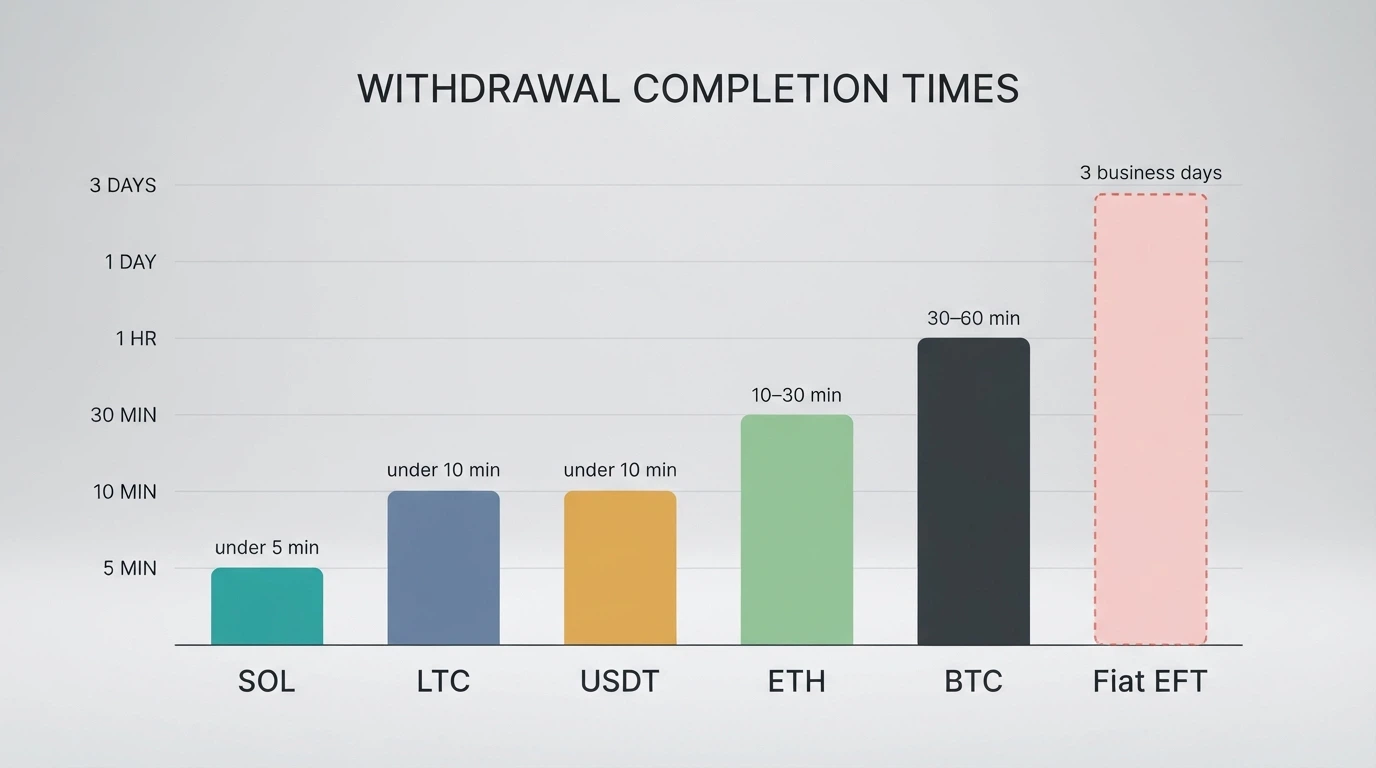
The licensed bookie cannot match these times for a structural reason. A domestic wagering operator that takes PayID or eftpos pays out into the NPP, which clears in seconds between banks but still has to navigate the operator’s own withdrawal-approval queue, which most punters experience as one to five business days. A crypto casino that takes Bitcoin pays out to a wallet, which only has to navigate the operator’s approval queue — the network does the rest, in minutes rather than days.
The Real-World Withdrawal Speeds Australian Punters Are Getting
Tested times diverge from advertised ones in the usual ways. A CoinCasino 1.5 ETH withdrawal in June 2026 was approved and arrived in a MetaMask wallet in fourteen minutes. Rainbet’s audited withdrawals sit in the five to fifteen minute band. The advertised end of the spectrum — sub-minute Solana payouts — is rare outside the largest brands and is rarely tested under congestion.
What stretches a fast coin is network load. Bitcoin block times are roughly ten minutes on a quiet day and stretch when the mempool is congested, which is precisely when punters try to move funds to capture a price move. Ethereum gas spikes do the same thing on the ERC-20 rail. The honest read on withdrawal speed is the median under typical conditions, not the marketing-floor figure that ignores load.
A second constraint sits on the Australian side of the rail. The big four banks — CommBank, Westpac, ANZ, NAB — restrict outbound transfers to crypto exchanges differently. CommBank and Westpac restrict large transfers outright; ANZ and NAB flag rather than fully block; ING and Macquarie are the most permissive. The friction does not block small deposits, but it does shape which exchange a player uses to on-ramp AUD into crypto, and how often they have to do it.
Which Coins Give You the Fastest Payout and the Lowest Network Fee
The choice of coin is a choice of trade-off. Solana wins on speed but its network has had stability incidents, which translate into missed withdrawals on a bad day. USDT on TRC-20 is fast and cheap but Tron is a more centralised chain than most crypto users prefer. Ethereum is the most accepted coin across the featured set but its ERC-20 gas fees eat small withdrawals. Bitcoin is the most universally accepted and the slowest. Litecoin is the unsung compromise — sub-ten-minute settlement, low fees, broad casino support.
The casino side of the support matrix is uneven. RocketPlay supports BTC, LTC, DOGE, BCH, ETH and USDT across thirty-four payment methods. Rainbet supports twenty-five or more coins including the long tail. Betpanda runs eleven coins across a crypto-only cashier. CoinCasino covers BTC, ETH, LTC, USDT, SOL and DOGE. The exchange-to-casino-to-exchange flow is the practical round trip — AUD out of a bank into an exchange, crypto across to the casino, crypto back to the exchange, AUD back to the bank — and the bottleneck is usually the bank leg at either end, not the casino in the middle.
Crypto Casino Bonuses Worth Your Attention — and the Fine Print That Shrinks Them
The headline bonus number is the smallest part of the offer. A 100% match up to A$500 with 40x wagering on the bonus is not a A$500 gift; it is a commitment to turn over roughly A$20,000 before the bonus clears, with the house taking its edge on every spin of that volume. The arithmetic is what the rest of this section runs.

The expected cost of clearing Royal Reels’ headline bonus — A$500 at 40x wagering, played on a single high-RTP pokie like Gates of Olympus (96.50% RTP from Pragmatic Play) — works out to about A$700 in expected loss. The bonus pays A$500. The house edge over the wagering volume costs the player A$700 in expectation. The “free” money has a price of roughly 140% of its face value. That figure is an average across many spins under the stated assumptions — it is not what any individual player will lose, and it is not what any individual session looks like. It is the price the offer actually carries.
| Item | Value |
|---|---|
| Bonus amount (max) | A$500 |
| Wagering requirement | 40x bonus |
| Required turnover | A$20,000 |
| RTP (Gates of Olympus) | 96.50% |
| House edge | 3.50% |
| Expected loss | A$700 |
The A$500 bonus costs an expected A$700 to clear, assuming every cent of wagering goes through one high-RTP pokie at 96.50%. Mixed-game play at lower RTPs costs more; a smaller bonus at a lower wagering multiple costs less. The headline figure is what the marketing carries; the expected loss is what the offer actually means.
The No-Deposit Offer Reality Check
No-deposit bonuses exist in the featured set, but the only one a featured operator carries is Royal Reels’ AUD 10 starter. Vave runs 40 no-deposit free spins on Lady Wolf Moon MEGAWAYS, with winnings capped at 50 USDT, 40x wagering, and at least one deposit required before withdrawal — which means the “no-deposit” tag describes the trigger, not the payout.
The mechanics are roughly the same everywhere. A no-deposit bonus hands the player a small balance to play with, then attaches the standard package of small print: a win cap that limits how much can be withdrawn from the bonus balance, a wagering multiple on the winnings, and a deposit requirement that has to be cleared before any withdrawal is processed. An AUD 10 no-deposit bonus with a 50 USDT win cap and 40x wagering is a marketing tool that exists to get a player’s email address, not a serious value proposition.
Welcome Packages That Look Generous Until You Run the Numbers
Multi-deposit packages amplify the headline figure and the clearing burden in lockstep. RocketPlay’s 100% up to A$2,000 plus 100 free spins carries 40x wagering on both the bonus and the free-spin winnings, with the spins drip-released at twenty per day over five days and a €5 max bet while clearing. Rainbet’s 250% up to A$2,100 plus 60 free spins is split across three deposits — 100% up to A$700 plus 20 FS, then 50% up to A$700 plus 20 FS, then 100% up to A$700 plus 20 FS — at 40x wagering or a no-wager gradual-release path, with a max bet of one to two percent of deposit and a tight seven-day validity window. SkyCrown’s 100% up to €100 plus 100 free spins spread over three deposits carries 40x on the bonus amount alone, a A$6.50 max bet, and weekly withdrawal caps of A$7,500 and A$15,000 a month that gate the cashout regardless of how the bonus clears.
The wagering distinction matters. Where Rainbet and SkyCrown apply 40x to the bonus only, RocketPlay applies it to bonus plus free-spin winnings — the same headline number with materially different clearing volume behind it. A player who reads only the headline walks away with the wrong impression of what each offer costs.
Free Spins: What the Bundle Actually Delivers
Free spins are a separate wagering event from the match bonus and rarely worth valuing at face. Wazamba’s 100 free spins release at ten per day for ten days with 40x wagering on the winnings. RocketPlay and WinSpirit both run 20 spins per day for five days. The drip is a pacing mechanism — the casino wants the player logging in daily — and the wagering on winnings is the casino’s protection against a lucky first-day hit.
The real-world value of a free spin depends on the underlying game’s RTP and the stake per spin, both of which the casino chooses. A 20-spin batch on a high-volatility Hacksaw title like Chaos Crew 2 (96.27% RTP, 20,000x max win) carries a much wider distribution than the same 20 spins on a low-volatility NetEnt classic, but the expected value per spin sits in a tighter band than the variance suggests. Players who treat free spins as a free lottery ticket are undervaluing the wagering attached; players who treat them as the casino’s most generous marketing line are overvaluing the expected return.
Which Crypto Pokies Australians Are Playing Right Now
The titles Australians search for at crypto casinos are the same titles that dominate the fiat lobby: Gates of Olympus and Sweet Bonanza from Pragmatic Play, Wanted Dead or a Wild from Hacksaw Gaming, Book of Dead from Play’n GO, the Big Bass Bonanza series, the BGaming catalogue and the Megaways range that runs up to 117,649 ways to win. What crypto adds is a parallel layer of provably fair titles from BGaming and a handful of smaller crypto-first studios whose RTPs sit a notch above the Pragmatic Play average.

RTP and volatility are the two numbers that actually change a punter’s experience at a pokie. The Return to Player is the long-run payback — a 96.50% RTP pays back A$96.50 of every A$100 wagered, on average, across millions of spins. Volatility is the distribution around that average — a high-volatility pokie delivers fewer wins but bigger ones, a low-volatility pokie delivers smaller wins more often. The marketing page leads with RTP because it is the larger-sounding number; the math leads with volatility because it is the one that determines whether a session ends in a balance or a bust.
The Slot RTP Table: What Each Pokie Returns Over the Long Run
The table below carries only the figures research confirmed per title. A pokie research carries no RTP for is not on the list — a player who sees a number in front of them needs to know the source carries it.
| Pokie Title | Provider | RTP | Volatility | Max Win |
|---|---|---|---|---|
| Gates of Olympus | Pragmatic Play | 96.50% | High | 5,000x |
| Sweet Bonanza | Pragmatic Play | 96.48% | — | — |
| Wanted Dead or a Wild | Hacksaw Gaming | 96.38% | Extremely High | 12,500x |
| Book of Dead | Play’n GO | 96.21% | High | 5,000x |
| Big Bass Bonanza | Pragmatic Play | 96.71% | — | — |
| Starburst | NetEnt | 96.09% | — | — |
| Gonzo’s Quest | NetEnt | 95.97% | — | — |
| Elvis Frog in Vegas | BGaming | 96.79% | High | 5,000x |
| Chaos Crew 2 | Hacksaw Gaming | 96.27% | High | 20,000x |
Across the broader dataset, NetEnt’s arithmetic mean RTP sits at 96.39%, Big Time Gaming at 96.25% and Push Gaming at 96.15%. BGaming’s typical RTP runs higher, at 97 to 97.5%, partly because the provider builds for crypto-first casinos whose players can verify the math. The edge a high-RTP pokie offers is small in any single session but compounds across the volume the bonus wagering demands — which is why a player clearing a 40x bonus on Elvis Frog in Vegas at 96.79% RTP walks away with more of their bankroll than the same player on Gonzo’s Quest at 95.97%. The difference across the table is roughly 0.8 percentage points of turnover, which on a A$20,000 bonus clear is about A$160 of expected loss saved. Not a fortune — but not nothing.
Wanted Dead or a Wild carries a footnote the rest of the table does not: it ships in four RTP configurations, which means the published 96.38% is the operator’s choice rather than a fixed number. A player who wants the higher-RTP version has to confirm which configuration the casino is running before they deposit, which most crypto casinos do not surface in the lobby.
Provably Fair: The Crypto Feature a Land-Based Pokie Cannot Offer
The mechanism is simpler than the marketing makes it sound. Before each spin, the casino publishes a hashed server seed it has committed to, the player’s browser generates a client seed, and the two combine with a nonce to determine the outcome. After the spin, the casino reveals the unhashed server seed and the player runs the same calculation in a verifier — if the hash matches, the outcome was not changed mid-spin.
What that handshake delivers is a structural answer to the house-edge trust problem. A land-based pokie in Crown Melbourne is inspected by the state regulator; a fiat online slot trusts the operator’s published RTP and the regulator’s audit trail; a provably fair title lets the player verify the math themselves. The verification only covers the games built for it — Pragmatic Play’s catalogue is not provably fair, BGaming’s is — which is why crypto casinos carry both, and why the BGaming titles sit at the top of the high-RTP table.
Freshly Launched: The Newest Crypto Casinos Open to Aussie Punters
The newest entrants in this space offer two things the established brands do not: a launch bonus that is materially larger than the market average, and a platform built for the current state of crypto rails rather than retrofitted onto them. Betpanda, the clearest example in the featured set, launched in 2023, operates from Costa Rica on a no-KYC, crypto-only cashier across eleven coins, and offers a 100% match up to 1 BTC plus 10% weekly wager-free cashback. Rainbet is older but still in its first operational stretch under the Anjouan licence, and supports twenty-five-plus coins at five to fifteen minute tested withdrawals.
The counterweight is the diligence gap. A new operator has a thin complaint history, an unproven payments team, and a licence jurisdiction that may not have audited them yet. A player who picks a launch brand for the headline bonus is trading a known risk — the established operator’s slow payouts or thin support — for an unknown one — the new operator’s first six months of complaints, software bugs and payment-rail teething. The diligence is straightforward: confirm the licence on the regulator’s register, read the terms page in full, and check the first twenty pages of any forum complaint thread. None of that takes more than an hour, and it is the difference between a bad surprise and a known one.
The 2026 Shortlist of Offshore Crypto Casinos Accepting Australians
The table below is the honest version. Every operator is offshore — there is no Australian-licensed online casino, which means none of them holds a licence a player can verify against an Australian register. Where the licence jurisdiction is not confirmed in this round of research, the row carries that gap honestly rather than guessing.
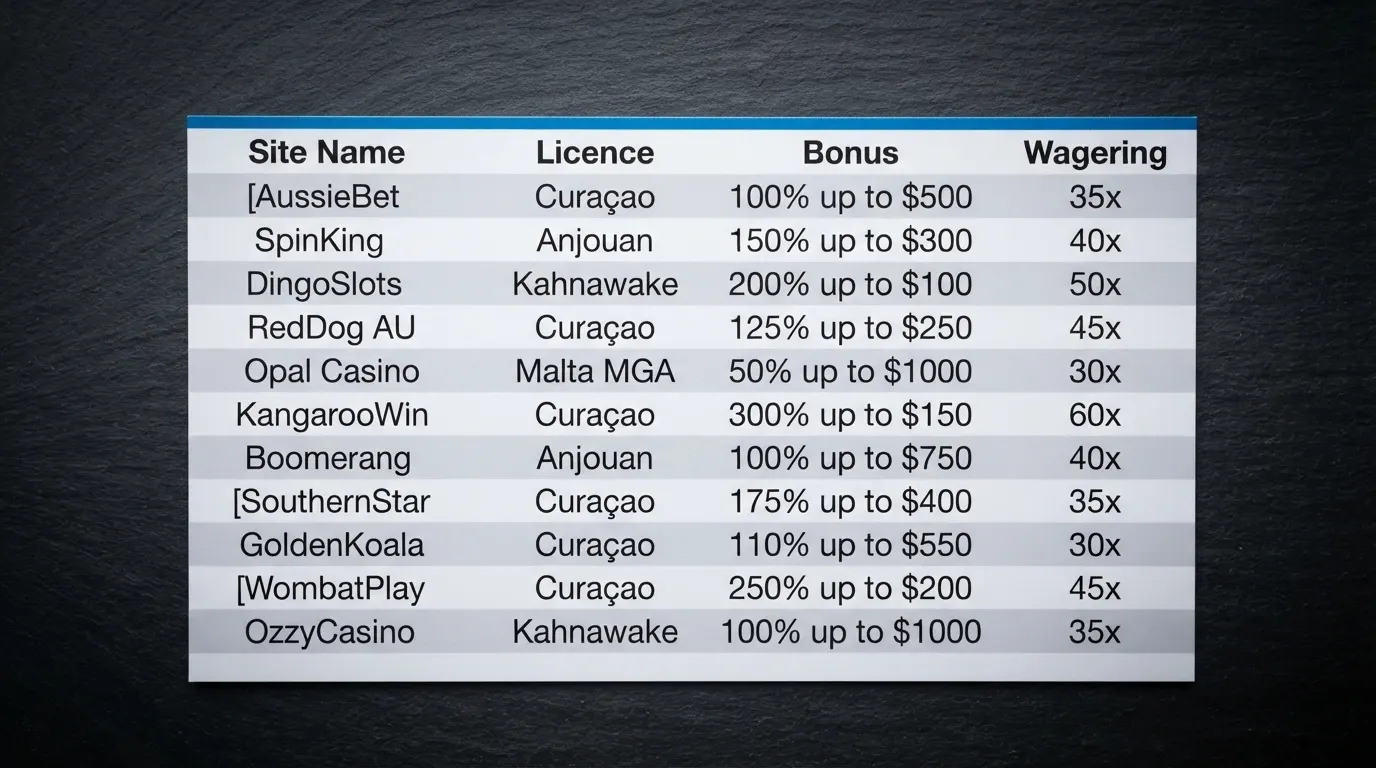
| Casino | Licence & Jurisdiction | Welcome Bonus | Wagering Requirement |
|---|---|---|---|
| Stake | Curaçao (unlicensed in AU) | Not confirmed this run | Not confirmed this run |
| RocketPlay | Curaçao Gaming Authority (unlicensed in AU) | 100% up to A$2,000 + 100 FS | 40x bonus + FS winnings |
| SkyCrown | Curaçao, Hollycorn N.V. (unlicensed in AU) | 100% up to €100 + 100 FS over 3 deposits | 40x bonus only |
| Royal Reels | Curaçao (unlicensed in AU) | 100% up to AUD 500 + AUD 10 no-deposit | 30–40x |
| WinSpirit | Curaçao, SoftSwiss platform (unlicensed in AU) | 100% up to A$1,000 + 100 FS (1st); 200% up to A$1,000 (2nd) | 40x |
| Rainbet | Anjouan, RBGAMING N.V. (unlicensed in AU) | 250% up to A$2,100 + 60 FS over 3 deposits | 40x or no-wager release |
| Scream Casino | Licence not confirmed (unlicensed in AU) | Not confirmed this run | Not confirmed this run |
| FairGO | Licence not confirmed (unlicensed in AU) | Not confirmed this run | Not confirmed this run |
| Bizzo Casino | Licence not confirmed (unlicensed in AU) | Not confirmed this run | Not confirmed this run |
| Rocket Casino | Licence not confirmed (unlicensed in AU) | Not confirmed this run | Not confirmed this run |
The market-share numbers behind this shortlist run from RocketPlay at 9.4% of tracked Australian crypto casino traffic through to Bizzo and Rocket Casino at 0.57% each. The top of the table is the most heavily-trafficked, the bottom is the most thinly documented, and the rank order is a function of both — a high-traffic operator that no one is reviewing is a red flag rather than a recommendation.
Stake: The Global Heavyweight with Provably Fair Originals
Stake sits at the top of the global crypto-casino conversation by market presence — proprietary Stake Originals, provably fair verification, a Curaçao licence and a games lobby that runs Pragmatic Play, Evolution, Hacksaw Gaming, Nolimit City, Push Gaming and BGaming alongside the in-house titles. Australian players access the platform via its offshore domain, the same way they access every other operator on this list, and the experience is the most polished of the featured set.
The honest gap on Stake this round is the welcome offer. Stake’s bonus terms vary by region and the Australian-facing offer did not surface in the research pass — which means a player reading this page has no confirmed figure to plug into a wagering calculator. The brand reputation carries the offer in the meantime, which is not nothing but is not a substitute for knowing the number. Stake is the operator to watch for the player who values catalogue depth and provably fair originals over a confirmed headline bonus.
RocketPlay: The High-Traffic Contender with 34 Payment Rails
RocketPlay is the runner-up in Australian crypto casino market share by a clear margin and the operator with the deepest cashier bench in the featured set — thirty-four payment methods including Bitcoin, Litecoin, Dogecoin, Bitcoin Cash, Ethereum and Tether. The welcome package is 100% up to A$2,000 plus 100 free spins, with 40x wagering on both the bonus and the free-spin winnings, a daily-release schedule of twenty spins over five days, and a €5 max bet while clearing.
The wagering applies to bonus plus free-spin winnings, which is a tighter clearing load than SkyCrown’s bonus-only structure even though the headline figure is materially larger. A player who plans to clear the bonus has to commit to roughly A$40,000 of wagering at a 3.5% house edge — an expected cost north of A$1,400 across the volume. The figure is a wagering commitment, not a guaranteed loss, but it is the number the marketing page does not carry.
SkyCrown: Bonus-Friendly Terms Where Wagering Hits the Bonus Alone
SkyCrown’s welcome package is small in headline terms — 100% up to €100 plus 100 free spins spread over three deposits — but the structure is unusually player-friendly. The wagering multiple is 40x on the bonus amount only, which is materially lighter than RocketPlay’s bonus-plus-free-spin-winnings structure. The max bet while clearing is A$6.50, and the operator runs a 10% crypto cashback and a rakeback programme on top.
The withdrawal limits are the constraint to weigh: A$7,500 a week and A$15,000 a month, with VIP exceptions possible. A high-roller clearing a SkyCrown bonus at the top of the cashback curve will hit the monthly cap before they hit the wagering target, which means the bonus stops being useful even though it has not technically expired. The player SkyCrown suits is the one whose bankroll sits comfortably under the weekly and monthly caps.
Royal Reels: The AUD-Native Option with a No-Deposit Starter
Royal Reels is the only featured operator that quotes in Australian dollars directly across the cashier and bonus page, and the only one that carries a no-deposit bonus alongside the headline offer. The welcome package is 100% up to AUD 500 with an AUD 10 no-deposit starter, a minimum deposit of AUD 30, and 30–40x wagering. The catalogue runs 2,000-plus games from thirty-plus providers including Pragmatic Play, Evolution Gaming, Yggdrasil and Hacksaw Gaming, with crypto payment support throughout.
The AUD-native cashier is the convenience: no conversion fees on either side of the deposit, no surprise rounding on withdrawals. The mixed player reviews on support and RTP transparency are the honest gap — Royal Reels is a brand that some punters have had smooth experiences with and others have not, and the page is not in a position to resolve that asymmetry. The AUD 10 no-deposit is a marketing tool to capture an email rather than a serious value proposition, but it is the only no-deposit component in the featured set.
WinSpirit: The 80-Provider Catalogue with a Two-Stage Welcome
WinSpirit runs on the SoftSwiss platform with a catalogue of 6,000-plus titles from 80-plus providers — NetEnt, Microgaming, Pragmatic Play, Play’n GO, Evolution, BGaming, Yggdrasil, Endorphina, Quickspin and Hacksaw Gaming among them. The welcome package splits across two deposits: 100% up to A$1,000 plus 100 free spins on the first, then 200% up to A$1,000 on the second. Free spins release at twenty per day for five days. Wagering is 40x, the max win on the bonus is capped at A$3,000, and the minimum deposit is A$30.
The weekly cashback is the second-look offer: up to 10% every Thursday with a A$1.50 minimum, 5x wagering and a two-day validity on the cashback itself. That is a fast-velocity offer compared to the welcome bonus — easier to clear, easier to convert to withdrawable cash, and the kind of recurring deal that matters more than the headline match. WinSpirit also offers a sportsbook alongside the casino, which is useful for a player who wants both in one wallet.
Rainbet: The Anjouan-Regulated Pick with a Dual Bonus Structure
Rainbet is the only Anjouan-licensed operator in the featured set, operated under RBGAMING N.V. (Company Reg. 16077, gaming licence ALSI-152406029-FI2). The catalogue runs 7,000-plus titles from 47-plus providers, withdrawals are tested at five to fifteen minutes across twenty-five-plus supported coins, and the welcome package is 250% up to A$2,100 plus 60 free spins across three deposits.
The dual structure is the unusual feature. Rainbet offers two paths: a Wager Lock version at 40x, or a no-wager gradual release that hands the bonus back in tranches as the player wagers. The Wager Lock is the higher-headline path; the gradual release is the lower-expected-cost path. High-RTP games above 97.4% are excluded from bonus clearance, which means the wagering has to happen on the bulk of the catalogue rather than the BGaming top end — a constraint the casino enforces through its bonus terms rather than a regulator.
Scream Casino: Limited Public Data — What We Could Verify
Scream Casino has market presence in tracked Australian crypto casino traffic — 0.99% market share, around A$94.87M in revenue — but the operator-level details did not surface in this research pass. The licence jurisdiction is not confirmed. The game providers are not confirmed. The welcome bonus, free spins, wagering and bonus validity are not confirmed. What a player reading this paragraph has is the market-share figure and an absence everywhere else.
The honest read is that a less-documented operator carries a higher diligence burden, not a higher risk per se. The steps are mechanical: confirm the licence number on the regulator’s register, read the terms page in full including the bonus terms and withdrawal policy, check the first twenty pages of any player complaint thread, and run a small test withdrawal before committing any meaningful bankroll.
FairGO: The Australia-Facing Brand with AUD Support
FairGO is built for the Australian market — the brand is Australia-facing, the cashier is in AUD, and the marketing language is pitched at a local audience. Market share runs at 0.8% with around A$69.11M in revenue tracked in Australia. The licence jurisdiction, game providers and bonus terms did not surface in this research pass.
The AUD-native banking is the structural convenience for an Australian player: no conversion fees, no FX rounding, and a cashier that supports the local payment expectations of a player who is more used to POLi and BPAY than to wallet addresses. The diligence steps that apply to a thin-data operator apply here, and the AUD-native branding is not a substitute for the licence check.
Bizzo Casino: What the Available Data Shows
Bizzo Casino has affiliate presence in the Australian market and 0.57% tracked market share with around A$51.38M in revenue. The operator-level details — licence, providers, welcome offer, wagering — did not surface in this research pass. The affiliate coverage and the public-verification gap are a useful contrast: a brand that ranks across affiliate sites is not necessarily a brand whose details are independently confirmed.
A player who meets Bizzo in an affiliate ranking and wants to verify what is behind it runs the same diligence sequence as any other thin-data operator on this page. The brand presence is real; the underlying data is what each player needs to gather themselves.
Rocket Casino: Distinct from RocketPlay — What We Know
Rocket Casino shares part of its name with RocketPlay and is a separate entity. Market share runs at 0.57% with around A$43.22M in tracked Australian revenue. Licence jurisdiction, providers, bonus terms and wagering did not surface this round.
The name similarity is a diligence flag rather than a recommendation against. A player who lands on Rocket Casino expecting RocketPlay’s terms page — or vice versa — is the player most likely to deposit before they notice the swap. Confirming the operator’s legal entity on the licence register before any deposit is the cheap way to avoid that mistake.
Is Wagering with Crypto Legal Down Under? The Honest Answer
The Interactive Gambling Act 2001 makes it an offence to provide online casino games, online pokies or in-play sports betting to a person in Australia. There is no licence for any of those products — federally, in any state, in any territory. The Act targets the provider, not the player: an Australian who accesses an offshore crypto casino is not prosecuted. What the player trades is the entire Australian consumer-protection layer.

The regulator is the Australian Communications and Media Authority. ACMA investigates complaints, issues formal warnings, brings civil penalty proceedings, directs Australian ISPs to block illegal sites, and refers operators for enforcement. The numbers are not abstract: since the first blocking request in November 2019, ACMA has had 1,564 illegal gambling and affiliate websites blocked by Australian ISPs, and more than 225 illegal services have withdrawn from the Australian market since enforcement was strengthened in 2017. The civil penalties for providing prohibited services can run to A$2,475,000 per day for an individual and A$12,375,000 per day for a corporation.
What has not yet happened — but is on the statute book — is the next round of enforcement. The Interactive Gambling Amendment (Gambling Reform) Bill 2026 passed Parliament on 19 August 2026 and commences 1 January 2027. From that date, banks and payment providers gain express authority to block transactions to illegal gambling operators, which closes the on-ramp an Australian currently uses to move AUD to a crypto exchange and on to a casino wallet.
What the IGA 2001 Actually Prohibits — and What It Leaves Alone
The line the IGA draws is between services it bans and services it licences. Prohibited: online casino games, online pokies (slots), in-play sports betting. Licensed: pre-event wagering on racing and sport, lotteries, keno — though online keno is itself banned from 1 January 2027 under the 2026 reform. Land-based casinos (Crown, The Star and the state-licensed venues) sit outside the IGA’s online prohibition but hold no licence for online operation.
A useful way to read the line: if the wager is placed on a phone or a laptop and pays out before or during a sports match, the product is licensed only for racing and pre-event sport; for casino and pokies, the product is prohibited regardless of where the punter sits. Crypto does not change the line — it changes which operator sits on the other side of it.
Offshore vs Licensed: The Protections You Give Up When You Play at an Offshore Crypto Casino
The licensed Australian wagering market gives a player a stack of protections that offshore play does not. BetStop — the National Self-Exclusion Register, live since 21 August 2023 — registers a person once and excludes them from every Australian-licensed online and phone wagering service, with 67,480 registrations and 41,290 still active as at 31 July 2026. Licensed operators offer customer-set deposit limits and activity statements, accept Australian Consumer Law disputes, and answer to a state or territory regulator. None of that reaches an offshore crypto casino.
Offshore play means no BetStop coverage, no ACMA recourse, no Australian Consumer Law protection, and a balance that can be stranded if the site is added to an ISP block list. The 2026 reform gives banks and payment providers the power to block transactions to illegal operators from 1 January 2027, which means the on-ramp from a domestic bank account to an offshore casino is on a closing window.
The 2026 Reform: What Changes for Crypto Casino Players from January 2026
The Interactive Gambling Amendment (Gambling Reform) Bill 2026 passed Parliament on 19 August 2026 and commences 1 January 2027. It is law; it is not yet in force. The two states are different for a player reading this page, and the gap between them is roughly four months.
The key measures that affect a crypto casino punter: banks and payment providers gain express authority to block transactions to illegal gambling operators. Advertising tightens — a maximum of three wagering ads per hour between 6am and 8.30pm, a live-sport blackout, no ads in sports venues or on player uniforms, athletes and influencers barred from promoting wagering, and a Wagering Advertising Opt-out Register administered by ACMA. Direct marketing of inducements is prohibited for fourteen days after sign-up and three months after BetStop deregistration. Online keno is banned from the same commencement date. The reform’s stated intent — substantially reducing wagering advertising and minimising children’s exposure — is a public-health framing rather than a player-protection framing, but the bank-blocking power is the practical change for anyone moving AUD into crypto for a casino deposit.
Staying Safe: Deposit Limits, Self-Exclusion and Help When You Need It
The tools that exist for an Australian who plays at offshore crypto casinos fall into two groups: the ones that work regardless of where the punter plays, and the ones that work only at Australian-licensed operators. The first group is small but real. The second group is comprehensive but does not reach offshore casinos.
The National Gambling Helpline is 1800 858 858 — free, confidential, staffed twenty-four hours a day, seven days a week. Gambling Help Online runs online chat and counselling. The minimum gambling age is 18 across all commercial gambling in Australia. Problem-gambling prevalence runs at roughly 2.1% of Australian adults, around 430,000 people; the AIHW put high-risk gambling at 1.8% in 2022. None of that requires the punter to be at a licensed operator to access it.
BetStop is the comprehensive tool that does not reach offshore casinos. The National Self-Exclusion Register covers every Australian-licensed online and phone wagering service and is binding on the operators — 78% of registrants are under 40 and 38% have chosen lifetime exclusion. An offshore crypto casino is not on the register, will not check it, and will continue to accept deposits from a self-excluded person. That is the structural gap, and it is the one a player who has self-excluded needs to know about before they deposit at an offshore brand.
The Help Infrastructure Every Aussie Punter Can Access Right Now
The helpline is the first call. 1800 858 858 routes to free, confidential counselling twenty-four hours a day; Gambling Help Online adds chat and email for those who would rather type. Both services work for an Australian whether they play at a licensed operator or at an offshore crypto casino, and both are the right starting point for anyone whose play has moved past comfortable.
For self-imposed limits at an offshore casino, the work is the player’s own. The casino will offer deposit limits and session timers in the responsible-gambling section of the account settings, and they are worth setting on day one. Some operators offer cooling-off periods and self-exclusion at the account level, which is closer to BetStop in spirit but does not transfer to any other brand. A player who needs the structural force of BetStop is a player who needs to be at a licensed operator, and that is a different conversation than this page is built for.
How We Picked and Ranked These Crypto Casinos
The ranking orders by Australian market presence — primarily tracked market share and revenue — with data completeness as the secondary filter. Where an operator carries thin operator-level data, the write-up below the table flags the gap rather than papering over it.
The sources consulted were operator websites for current bonus terms and licence footers, casino-review databases for game catalogues and complaint history, the ACMA enforcement records for blocking numbers and IGA detail, and the AU regulation skill file for AUSTRAC identity rules. The licence check cross-references each operator’s claimed jurisdiction against the regulator’s own register where one exists — Curaçao via the GCB public register, Anjouan via the ALSI register. Where the licence could not be confirmed in this round of research, the row in the comparison table carries that gap rather than guessing.
The evaluation criteria, in order of weight: licence status and jurisdiction, bonus terms and the wagering they actually carry, game-provider breadth and the RTP transparency of the catalogue, payout speed and coin support, and Australian market accessibility. No criterion is sold as science — the order is editorial and the weightings are not derived from a model. What the page does not do is recommend one operator over another; the rank order is a description of market presence, and the choice between them is the reader’s.
What This Means for Your Next Crypto Casino Session
The offshore status is the structural cost, and it sits on every row of the comparison table. The player who accepts that cost is the player for whom speed, anonymity up to a threshold and the bonus size justify the absence of Australian consumer protection. The player who does not accept it has no licensed alternative — online casino is prohibited — and the right answer is not to play at all.

The three filters that matter, in the order the page has already laid them out: the licence check, which is the diligence step that costs an hour and prevents the worst surprises; the wagering calculation, which is the arithmetic that converts a headline bonus into its expected cost (the A$500 Royal Reels bonus costs an expected A$700 to clear on Gates of Olympus at 96.50% RTP); and the withdrawal-speed test, which is the small first cashout that proves the operator pays before any larger balance is committed. None of the three is a brand pick — they are the inputs to whatever choice the player makes between them.
The page’s verdict is the one the table makes for it: every operator on the shortlist is offshore, every welcome bonus carries a wagering commitment that exceeds its face value, and every withdrawal speed is faster than a licensed bookie can match. The honest next step is not to pick a winner from the list. It is to pick the filter that matters most — speed, anonymity, or bonus depth — and use the comparison table to narrow the shortlist to two or three, then verify the licence claims on each before the first deposit. Anything beyond that is the punter’s own call.
Frequently Asked Questions
How does AUSTRAC affect crypto casino deposits and withdrawals?
AUSTRAC requires every Australian-registered cryptocurrency exchange to verify customer identity — so your name attaches to the wallet at the exchange level when you buy Bitcoin domestically. The offshore casino does not see that trail until cumulative withdrawals cross its no-KYC threshold, typically A$2,000 to A$5,000. AUSTRAC’s Travel Rule formally kicks in at AU$10,000, well above any casino threshold, so the practical anonymity budget is the gap between the casino’s trigger and the exchange’s record.
Do I have to pay tax on crypto casino winnings in Australia?
For an ordinary recreational punter, no. Betting and gambling winnings are not assessable income under section 6-5 of the ITAA 1997, and gambling losses are not deductible under section 8-1. The exception is a person carrying on a business of betting or gambling. The casino does not withhold tax, and recreational winnings need not be declared on a return.
What happens if an offshore crypto casino refuses to pay out my winnings?
You have no Australian regulator to complain to. ACMA’s enforcement covers Australian-licensed operators; offshore casinos are outside its jurisdiction, and BetStop does not bind them. The Curaçao or Anjouan regulator’s player-dispute enforcement is thin. Practical recourse is the casino’s complaint process, an AskGamblers or CasinoGuru thread, and a small test withdrawal on day one before committing a meaningful bankroll.
How does BetStop work — does it cover offshore crypto casinos?
BetStop is the National Self-Exclusion Register, live since 21 August 2023, and binds every Australian-licensed online and phone wagering service. One registration excludes a person across all of them. As at 31 July 2026, 67,480 people had registered, with 41,290 still active. BetStop does not cover offshore crypto casinos — they are not licensed in Australia and are not connected to the register.
What are the risks of playing at an unlicensed crypto casino from Australia?
The structural risks: no Australian consumer protection, no BetStop coverage, no ACMA recourse, no Australian Consumer Law, and a balance stranded if the site is blocked. The financial risk: the bonus carries a wagering commitment that exceeds its face value. The operational risk: an offshore refusal has no Australian court a player can cheaply enforce in.
Published by the Jackpot Pokies Australia team.