
High Cashback Casino Offers in Australia: What the Offshore Market Actually Pays
A “high cashback” headline is doing what casino marketing always does. It names a number, surrounds it with a glowing badge, and lets the reader assume the gap between that number and what they keep at the end of the month is small. For Australian players that gap is the whole story, because every cashback casino they can actually reach is an offshore operator running outside Australian law, and the headline rate is the first of several numbers that get smaller as you read down the page. This page ranks the ten offshore operators holding the largest share of Australian traffic, sets out what their cashback profiles actually amount to, and lays out the legal, payment and responsible-gambling framework that shapes the choice.

Data current as of 18 October 2026. Licence and enforcement claims verified against the Australian Communications and Media Authority and the Interactive Gambling Act 2001.
Table of Contents
- Cashback Casinos in Australia: What the Market Actually Looks Like in 2026
- Why a “High Cashback” Bonus Almost Never Pays What You Expect
- The Best Cashback Casinos Accessible to Australian Players in 2026
- Crypto, Cashback and the Payment Rules That Catch Australian Punters
- The Legal Reality: Every Online Casino Taking Australians Is Offshore
- Staying Safe: Deposit Limits, Self-Exclusion and the BetStop Gap
- How We Picked the Operators on This Page
- What You Should Actually Do About Cashback Casino Offers in 2026
- Frequently Asked Questions
Cashback Casinos in Australia: What the Market Actually Looks Like in 2026
What a Cashback Casino Is
A cashback casino is one that returns a percentage of what a player has either lost or deposited over a defined period, typically as bonus credit. The mechanism is older than online gambling itself — bookmakers have always settled losing accounts with a goodwill payment when a customer threatened to leave, and the digital version simply formalises it. The shape of the offer is what distinguishes it from the welcome bonus most players meet first: a sign-up match multiplies a deposit once and then stops being relevant, while cashback is recurring, pegged to ongoing play and usually framed as a retention tool rather than an acquisition one.
The Australian wrinkle is structural. A genuine AU-licensed online casino does not exist, because the Interactive Gambling Act 2001 prohibits the provision of online casino games to persons in Australia, and what the Act permits — wagering on races and sport before the event, lotteries and keno — does not include a casino product. So when an Australian-facing page talks about “the best cashback casino”, it is talking about an offshore operator that has chosen to serve the Australian market in spite of the prohibition. The cashback offer itself is unremarkable; the legal wrapper around it is what makes the decision worth thinking about.
How the Cashback Credit Works
Cashback lands in one of two forms, and the form decides everything that follows. Real-cash cashback posts as withdrawable balance — what you get is yours, modulo any maximum-cashout cap the operator attaches. Bonus-fund cashback posts as locked credit, and unlocking it requires wagering the credited amount a stated number of times before withdrawal. The split between the two is not symmetrical: most operators in this market default to bonus-fund form, with real-cash cashback reserved for higher-tier players or shorter-cycle promotions.
The wagering burden on cashback is, on the whole, lighter than the burden on a standard welcome bonus. Industry practice sits somewhere between 1x and 10x the credited amount, with the low end common for loss-based daily cashback and the higher end more typical of weekly or promotional structures. A cap on maximum withdrawable winnings often sits beside the wagering requirement, which is the mechanism by which a generous headline rate quietly loses most of its punch. Cashback also has a cadence — daily, weekly or tied to a specific event — and the cadence determines whether a player can expect a steady drip of small refunds or a single weekly lump sum.
Why Australian Players Only Access Offshore Cashback Casinos
The Australian market for online casino is not a regulated market with offshore competitors; it is a prohibited product with an offshore supply. The Interactive Gambling Act 2001 makes the provision of online casino games, online pokies and in-play sports betting to a person in Australia an offence, and no Australian licence exists for any of those products. What can be licensed is wagering on horse races and sporting events placed before the event begins, lotteries and keno. The Northern Territory Racing and Wagering Commission handles most online wagering licensing through Licensing NT, but a casino licence is not among the things it can issue.
Enforcement has been ratcheting up for the better part of a decade. The Interactive Gambling Amendment Act 2017 closed a series of offshore loopholes and gave the ACMA the power to order Australian internet service providers to block illegal gambling and affiliate websites. Since November 2019, the ACMA has had 1,564 illegal gambling and affiliate websites blocked at the ISP level, and more than 225 illegal services have withdrawn from the Australian market since 2017. The provider is the target of the law; the individual player is not prosecuted. What the player gives up in return for that forbearance is the entire Australian consumer-protection framework: no ACMA recourse in a dispute, no BetStop coverage, no guarantee that funds on account will survive the next round of site blocking.
Why a “High Cashback” Bonus Almost Never Pays What You Expect
Cashback Offer Types: Flat Rate, Loss-Based and Promotional
Three structures account for almost every cashback offer in this market, and the differences between them are not cosmetic. Loss-based cashback is the most common — a percentage (typically in the 5–25% range) of net losses over a defined window, returned after the window closes. Deposit-based cashback returns a percentage of deposits regardless of outcome, which sounds generous but pays out even on sessions the player ended ahead on, eroding the value of any winning streak. Promotional cashback is event-tied — a weekend, a new slot launch, a sports final — and tends to carry the heaviest conditions of the three because the operator is using it to drive volume at a specific moment.

The structural choice matters because each type changes the math in a different direction. Loss-based cashback is the only one of the three that actually compensates for what the player lost; the other two return funds on money that may not have been lost at all. A 20% deposit cashback on $500 is worth $100 even if the player won $200 on those funds; the same headline on a loss-based structure would be worth $0 in that scenario. The marketing copy rarely makes the distinction clear.
100% Cashback and Other Headline Rates: What the Fine Print Actually Says
A 100% cashback headline is the genre’s purest marketing construct. It implies the player walks away whole, and almost no offer that uses it actually delivers that result. The 100% sits on top of a wagering requirement (commonly in the 1x–10x range for cashback) that turns the credited funds into locked balance, and a maximum-cashout cap that limits what can ever be withdrawn from the offer, regardless of what happens during play. A minimum-loss threshold is another common qualifier — the cashback triggers only after the player has lost more than a stated amount, which means a session that ends slightly down produces nothing at all.
What the headline rate measures, then, is not the return but the gross credit. A 100% loss-based cashback capped at $200 with a 5x wagering requirement and a $500 maximum cashout returns, in the best case, $500 in withdrawable funds from a credit of up to $200 — and only if the player manages to run the wagering requirement up without busting the cap. The headline is not a lie; it is a number that has been chosen so that what it doesn’t say is more important than what it does.
No-Deposit Cashback Offers: What Makes Them Different and Harder to Cash Out
No-deposit cashback is the rarest of the three structures and the easiest to misunderstand. The “no deposit” element is real — the player is not required to fund an account to qualify — but the rest of the offer tends to be calibrated for that concession. The credited amount is small, the wagering multiple is heavier than on a deposit-triggered cashback (because the operator is taking all the risk), and the maximum cashout is usually tight. The category exists because operators use it as an acquisition tool for new sign-ups who have not yet deposited, and the structure prices in the fact that most of those sign-ups will never convert to depositing players.
For an Australian reader, the additional consideration is the operator behind it. No-deposit cashback at an offshore casino is, by definition, an offer extended to a player in a market where the product is prohibited. The offer itself is not the issue; the legal status of the operator extending it is.
Daily, Instant and Real-Money Cashback: Which Cadence Actually Delivers
The cadence of a cashback offer — daily, weekly, or instant on the conclusion of a session — is more than an operational choice. It determines when the credited funds become available, and that in turn determines whether the player can compound them into further play or extract them. Daily cashback, common on loss-based structures, gives the player a fresh batch of locked credit each day and effectively extends the wagering runway; weekly cashback is a single lump sum that the player must run through in a longer window. Instant cashback is the rarest and usually the most player-friendly: the credit posts at the end of the session, often in real-cash form, with no further play required.
Real-money cashback is the form that matters most. A cashback paid in real cash — withdrawable immediately, subject only to a maximum-cashout cap if any — is the closest the genre comes to a true refund. Bonus-fund cashback is a loan against future play, and the operator’s terms decide how expensive that loan turns out to be.
How Cashback Is Actually Calculated: Deposits vs Net Losses
The calculation method is the single largest determinant of what a cashback offer is actually worth. A net-loss calculation measures losses minus wins over the period: if a player deposits $500, wins $200 and loses $700, the net loss is $500 and a 20% cashback returns $100. A deposit-based calculation ignores the wins entirely: the same play on a 20% deposit cashback would return $100 against the $500 deposited, regardless of the fact that the player finished roughly even. Worked against the same play, the deposit-based method is more generous when the player wins and less generous when the player loses, which is precisely why operators prefer it.
A worked comparison makes the difference concrete. Suppose a player deposits $500, runs the balance up to $700, then loses it back down to $200 over a week. Net losses: $300 (the $500 deposit minus the $200 ending balance). A 20% loss-based cashback returns $60. A 20% deposit-based cashback returns $100. The player finished $300 down on the week either way, but the deposit-based method paid them $40 more for the same play. Reverse the outcome — suppose the player deposits $500, wins up to $1,200, then drops back to $800. Net losses: $0. A loss-based cashback pays nothing; a 20% deposit-based cashback still pays $100. The deposit-based structure is a more reliable payout, which is why it dominates the marketing — and why it is not, strictly speaking, compensating the player for loss.
The Best Cashback Casinos Accessible to Australian Players in 2026
The table below ranks the ten offshore operators holding the largest estimated share of Australian traffic. None is AU-licensed; the cashback column is qualitative because live verification of specific bonus terms was not possible at the time of writing, and any figure a reader encounters at an operator’s site should be checked against the terms page directly before relying on it.
| Casino | AU-legal? | Est. AU market share |
|---|---|---|
| Rocket Play | No (offshore) | ~9.4% |
| Skycrown | No (offshore) | ~8.55% |
| Royal Reels | No (offshore) | ~2.51% |
| WinSpirit | No (offshore) | ~1.55% |
| Stake | No (offshore) | ~1.28% |
| Rainbet | No (offshore) | ~1.28% |
| Scream Casino | No (offshore) | ~0.99% |
| FairGO | No (offshore) | ~0.8% |
| Bizzo Casino | No (offshore) | ~0.57% |
| Rocket Casino | No (offshore) | ~0.57% |
Market share figures are estimates drawn from third-party traffic data; revenue and share figures should be read as orders of magnitude, not audited numbers.
Rocket Play
Rocket Play holds the largest share of Australian traffic among the operators on this page, at roughly 9.4% with estimated revenue around $632.69M. The scale is the first thing to register, and with it the fact that a brand carrying nearly one in ten Australian casino sessions is doing so entirely outside the Australian regulatory framework. Cashback terms could not be verified live, so the operator’s profile here is qualitative: a market-leading brand in this segment is also a brand the ACMA is empowered to order blocked at any time. A player evaluating Rocket Play’s cashback offer should weight the headline rate against the structural risk that the site itself may not be reachable next month.
Skycrown
Skycrown sits second in the AU traffic ranking at roughly 8.55% share with estimated revenue near $436.07M. The cashback profile, like Rocket Play’s, could not be verified directly, but the scale of the Australian player base suggests a cashback structure that is competitive with the rest of the top tier. Skycrown’s standing in this ranking is best read as a brand-name preference among Australian players rather than a regulatory endorsement, and the same offshore-status caveat applies in full.
Royal Reels
Royal Reels holds around 2.51% of the Australian market with estimated revenue of $243.99M. The brand presents as Australian-facing in its marketing, which is worth noting because that framing is a positioning choice, not a regulatory fact. Royal Reels is an offshore operator and the product it offers is prohibited under Australian law. Its cashback terms are unverified for this article; readers should treat any specific figure they encounter as needing confirmation against the operator’s own terms page.
Stake
Stake runs at roughly 1.28% Australian share with estimated revenue of $115.67M, and it is the most distinctive name on this list because of its crypto-native positioning. Crypto deposits for online wagering in Australia have been banned since 11 June 2024 under the Interactive Gambling Amendment (Credit and Other Measures) Act 2023, with operator penalties of up to $247,500 for failing to enforce the ban. A crypto-first operator offering cashback in crypto-denominated funds is therefore operating in the most exposed corner of the offshore market — not just outside Australian law on the casino product, but actively facilitating a payment method that is itself prohibited. The cashback offer is, on the face of it, the same kind of offer as any other operator’s; the route through which it is funded makes it categorically different.
FairGO
FairGO holds around 0.8% Australian market share with estimated revenue of $69.11M, and the brand name is a positioning cue worth flagging directly. “FairGO” reads as Australian; the operator is not. No AU online casino licence exists, so the brand is marketed to Australian players from outside Australia, and the cashback offer sits inside that same wrapper. A player drawn to FairGO for its branding should not mistake that branding for a regulatory relationship — there is no Australian regulator behind the offer, and no AU consumer protection framework attached.
WinSpirit
WinSpirit carries roughly 1.55% AU share, sitting in the middle tier of the ranking. The cashback profile is qualitative for this article. A mid-tier operator competing on cashback in a market this crowded usually does so with terms that are competitive on headline rate but heavier on conditions — the standard retention play for a brand that cannot outspend the leaders. Specific terms should be checked at the operator’s site before any commitment.
Rainbet
Rainbet holds around 1.28% AU share, in line with Stake. As a relatively newer name on the Australian offshore scene, Rainbet’s cashback terms are the part of its offering that most warrants direct verification. New operators use cashback aggressively to build a player base, and the higher headline rate is typically the trade the player makes for a shorter operator track record. The fund-safety exposure that comes with any offshore operator is amplified for newer brands.
Scream Casino
Scream Casino sits at roughly 0.99% AU share — a small footprint relative to the leaders. The cashback offer at a smaller operator is usually pitched harder than the market leaders’, because the brand has less traffic to fall back on, and the fine print tends to carry more of the load. Readers should pay particular attention to the wagering multiple and the maximum-cashout cap here; small operators also tend to be the ones that disappear quickly under ACMA enforcement pressure.
Bizzo Casino
Bizzo Casino holds around 0.57% AU share. At this tier the cashback offer is best read as a single data point rather than a competitive anchor — the brand does not have the traffic base to make its cashback profile a market reference. A reader comparing Bizzo’s offer against the leaders should weight the cashback rate against the operator’s withdrawal history, which is the more relevant indicator at this end of the ranking.
Rocket Casino
Rocket Casino is the smallest of the featured set at roughly 0.57% AU share. The offer-versus-traffic trade-off is sharpest here: a small operator competing for the same player as Rocket Play has to lean hard on promotional terms to win attention, and the cashback headline is where that lean shows. Specific terms could not be verified live. A cashback offer at a brand this small carries the most idiosyncratic terms in the ranking, and those terms deserve a careful read before any deposit.
Crypto, Cashback and the Payment Rules That Catch Australian Punters
Crypto-Deposit Cashback: How It Works and Why Offshore Casinos Push It
Crypto cashback works the same way as fiat cashback at the structural level — a percentage of losses or deposits returned, with the same wagering and cap considerations — but the asset it is denominated in changes the risk profile. A cashback credited in bitcoin or another cryptocurrency carries the volatility of the underlying asset on top of the casino’s terms, which means the AUD value of the credited funds can move materially between the time the cashback posts and the time the player decides to convert or wager it. Offshore operators favour crypto deposits because the payment sits outside the Australian banking system, where ACMA enforcement and bank transaction-blocking authority (from 1 January 2027) cannot easily reach it. That is precisely why the payment-method rules target crypto specifically.
Bitcoin Cashback and the Australian Payment Ban
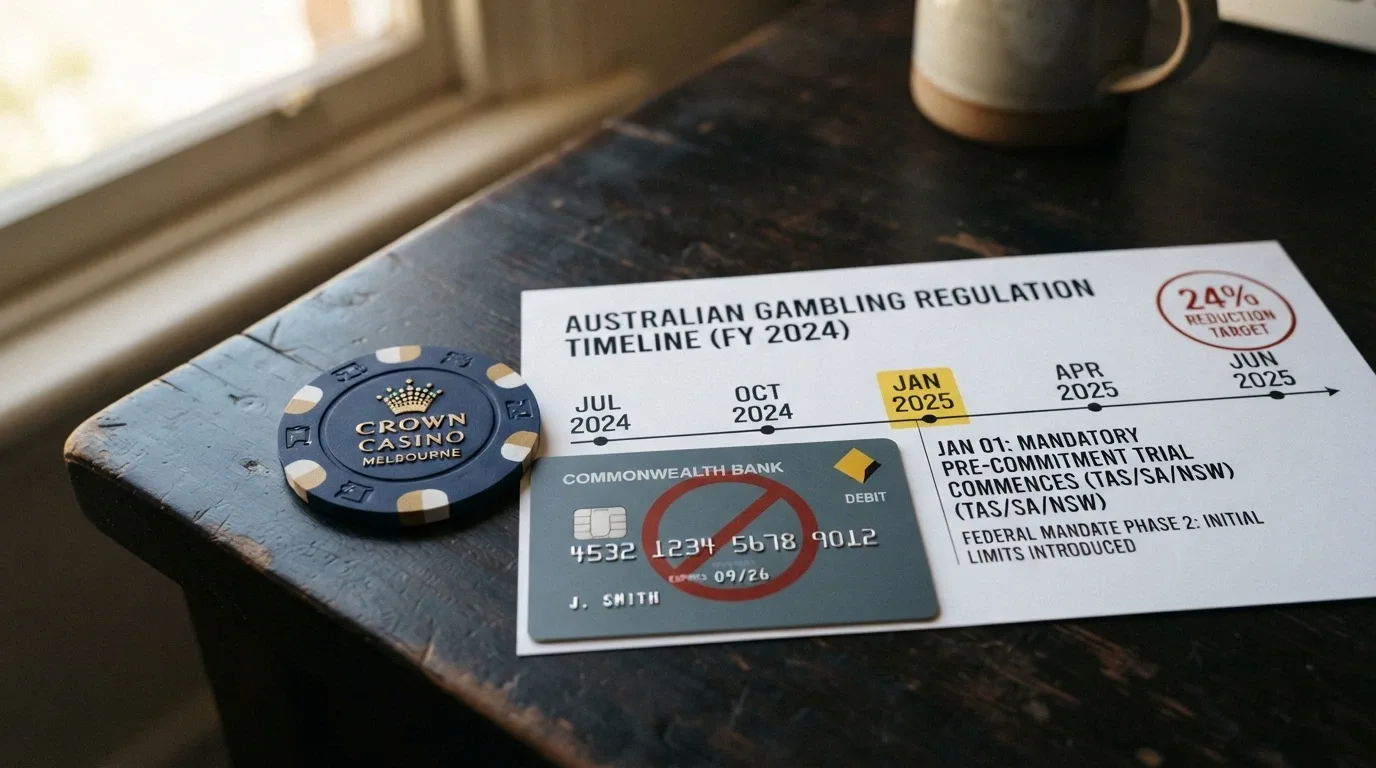
Bitcoin deposits for online wagering in Australia have been banned since 11 June 2024. The Interactive Gambling Amendment (Credit and Other Measures) Act 2023 prohibits credit cards, credit-related products and digital currency as payment for online wagering, and operators that fail to enforce the ban face penalties of up to $247,500. The ban is on the operator, not the player; using bitcoin to deposit at an offshore casino is a reliable indicator that the operator sits outside Australian rules. From 1 January 2027, banks and payment providers gain express authority to block transactions to illegal gambling operators, which closes a further route that has historically been used to fund offshore casino accounts. A bitcoin cashback offer is, in this light, a marker of the operator’s regulatory exposure rather than a perk.
Anonymous and Offshore-Friendly Play: What You Actually Give Up
“Anonymous” and “no-KYC” framings are common in offshore casino marketing, and they carry an implicit promise: that the player can play without their identity being verified, their funds being traced, or their activity being monitored. The Australian reader should hear that promise as a list of what is being given up, because every item on the list is something the Australian regulatory framework would otherwise provide. No KYC means no ACMA recourse in a dispute. No Australian consumer protection means no pathway to recover funds if the operator withholds them. No BetStop coverage means a self-excluded player can still deposit and play. Fund seizure risk is real — the ACMA has blocked 1,564 sites since November 2019, and any operator on this list is a candidate for the next round of blocking. The player is not prosecuted under the IGA, which is often presented as the upside; it is more accurately the reason the law has no protective mechanism to offer.
The Legal Reality: Every Online Casino Taking Australians Is Offshore
The ACMA, the IGA and Why No Online Casino Licence Exists in Australia
The Interactive Gambling Act 2001 prohibits the provision of online casino games, online pokies and in-play sports betting to persons in Australia. Section 15 of the Act is the operative provision, and the ACMA is the federal regulator responsible for enforcement. What is licensable in Australia is a different list: wagering on horse races and sporting events placed before the event begins, lotteries and keno. None of those is a casino product. The Northern Territory Racing and Wagering Commission, administered through Licensing NT, is the de facto national licensor for online wagering, but its jurisdiction stops at the casino door. A page describing “the best licensed online casinos in Australia” is describing something that does not exist, and writing one produces a factual error on every screen.

The 2017 amendment to the IGA strengthened the prohibition and gave the ACMA the power to order Australian ISPs to block illegal gambling and affiliate websites. The 2026 reform, passed by Parliament on 19 August 2026 and commencing on 1 January 2027, layers further enforcement on top: bank transaction-blocking authority, ad caps, athlete-promotion bans and a post-signup inducement cooling-off. The trajectory has been consistent for two decades. The product is prohibited, and enforcement has only grown.
Offshore vs AU-Licensed: The Protections You Do and Don’t Have
| Protection | AU-licensed wagering operator | Offshore casino |
|---|---|---|
| Australian consumer-protection law | Yes | No |
| ACMA recourse in a dispute | Yes | No |
| BetStop self-exclusion coverage | Yes | No |
| Credit / crypto deposits | Banned | Usually accepted |
| Responsible-gambling tools (deposit limits, activity statements) | Required under state/territory conditions | Operator’s discretion |
| Site blocking risk | Low (regulated) | High (1,564 sites blocked since November 2019) |
| Fund safety in operator insolvency | State-backed complaints pathway | No Australian pathway |
An AU-licensed wagering operator sits inside the Australian regulatory framework; an offshore casino sits outside it. Every row in the table is a place where the licensed side has a mechanism the offshore side does not, and the difference matters most when something goes wrong.
What the 2026 Reform Changes for Australian Punters from January 2027
The Interactive Gambling Amendment (Gambling Reform) Bill 2026 was passed by Parliament on 19 August 2026, and its measures commence on 1 January 2027. The headline changes for a reader evaluating offshore cashback offers are these. Wagering advertising is capped at three ads per hour between 6:00 am and 8:30 pm, with a live-sport blackout running 15 minutes before to 5 minutes after events. Direct marketing of inducements is prohibited for 14 days after a customer signs up, for three months after deregistering from BetStop, and indefinitely for at-risk customers. Athletes, celebrities and influencers are barred from promoting wagering products, and wagering advertising is banned inside sports venues and on player uniforms. Radio wagering ads are barred during school drop-off and pick-up times, and broadcasting sporting odds is banned outright. From 1 January 2027, banks and payment providers gain express authority to block transactions to illegal gambling operators — a measure that closes off the remaining easy route by which Australian funds have historically reached offshore casinos.

The cumulative effect is to make offshore cashback marketing harder to run and harder to fund from Australia. Operators serving the Australian market will still exist after 1 January 2027; reaching them, and funding them, will be more difficult than it has been.
Staying Safe: Deposit Limits, Self-Exclusion and the BetStop Gap
Deposit and Time Limits: What AU-Licensed Operators Must Offer
Licensed wagering operators in Australia are required to offer customer-set deposit limits and activity statements under state and territory licence conditions. A player can set a daily, weekly or monthly deposit ceiling, request an activity statement showing time and money spent, and use take-a-break tools to suspend an account for a defined period. These are not optional features; they are conditions of holding an Australian wagering licence. What the Australian framework does not impose is a federal deposit, loss or stake ceiling — because the product such a ceiling would govern is banned outright, and what is capped instead is the payment method. Credit cards and crypto are banned; the deposit ceiling is the player’s own.

Offshore casinos are not subject to state or territory licence conditions, and there is no Australian regulatory requirement that they offer deposit limits or activity statements. Where they are offered, it is at the operator’s discretion and on the operator’s terms. A reader comparing offshore offers should not assume that a deposit-limit slider visible on a casino site carries the same weight as the equivalent tool at an AU-licensed bookmaker.
BetStop and Self-Exclusion: The Register That Offshore Casinos Ignore
BetStop, the National Self-Exclusion Register, has been live since August 2023. A single registration excludes a person from every Australian-licensed online and phone wagering service, and the framework is intended to be a hard break — a player who has decided to stop can register once and be confident the entire licensed market will respect that decision. As at 31 July 2026, BetStop had 67,480 registrations, of which 41,290 exclusions were still active (more than 60%). 78% of registrants were under 40, and 38% chose lifetime exclusion.
The limit of the register is its scope. BetStop binds Australian-licensed wagering services only. An offshore casino is not connected to the register, and a self-excluded person’s money is still accepted by unlicensed operators. For a player who has registered with BetStop, the offshore market is an open door the register cannot close. That is the part of the responsible-gambling framework the offshore cashback casino does not participate in.
Where to Get Help: The Helpline, Counselling and the Problem-Gambling Numbers
The National Gambling Helpline is 1800 858 858 — free, confidential and staffed 24 hours a day, seven days a week. Online chat and counselling are available through Gambling Help Online at gamblinghelponline.org.au. These services are Australian, free at the point of use, and available regardless of whether the player has been using an AU-licensed operator or an offshore casino.
The scale of the harm these services address is large. The Australian Institute of Health and Welfare estimated in 2022 that about 2.1% of Australian adults — roughly 430,000 people — experience problem gambling, with high-risk gambling at 1.8%. The figures are population-level, not specific to offshore casino users, but the underlying exposure — a high headline rate, easy credit, no Australian recourse — is concentrated in the offshore market the operators on this page sit inside.
How We Picked the Operators on This Page
The ranking is built on third-party traffic data estimating each operator’s share of the Australian market, ordered from highest to lowest share. The criteria for inclusion were: real Australian traffic (a brand that Australians actually use, not a brand merely willing to take Australian sign-ups), a cashback or similar loss-rebate offer accessible to Australian players, and verifiable market-share data. Ten operators met the criteria.
The ranking does not reflect regulatory standing. No operator on this list is AU-licensed, because no AU online casino licence exists. It also does not reflect the quality of each operator’s cashback terms, because specific terms — bonus amounts, wagering multiples, maximum cashout caps, eligible games, RTPs — could not be verified via live search at the time of writing. The cashback column in the comparison table is therefore qualitative; readers should treat any specific figure they encounter at an operator’s site as needing confirmation against that operator’s own terms page.
Two caveats are worth stating directly. First, the market-share estimates are third-party and should be read as orders of magnitude rather than audited numbers. Second, the legal characterisation is the same for every operator on the list: each one is offering a product the Interactive Gambling Act 2001 prohibits the provision of to persons in Australia. The ranking orders the operators by traffic; it does not certify them.
What You Should Actually Do About Cashback Casino Offers in 2026
The decision in front of an Australian player looking at a cashback casino offer has three layers, and a reader who skips any one of them is making the decision on incomplete information.

The first layer is the legal one. No AU-licensed online casino exists. Every operator on this page is offshore, and the offer is being extended to an Australian player in a market where the product is prohibited. The ACMA pursues providers, not players, but the forbearance is not a protection — it is the reason the law has no mechanism to help the player if the operator fails.
The second layer is the cashback terms. The headline rate is the first number on the page, not the last. The real return depends on the wagering multiple, the maximum-cashout cap, the cadence of crediting, the form of the credit (real cash vs bonus funds) and the calculation method (net losses vs deposits). A 100% loss-based cashback with a 10x wagering requirement and a $500 maximum cashout is not a 100% return. It is, at best, $500 in withdrawable funds from a credit that started at a lower figure, conditional on running the wagering requirement without busting the cap. Read the terms before reading the headline.
The third layer is the responsible-gambling framework. BetStop does not cover offshore casinos. A self-excluded player is still welcome at every operator on this list. The National Gambling Helpline on 1800 858 858 and Gambling Help Online at gamblinghelponline.org.au are free, confidential and available around the clock, and they are the part of the Australian system that is open to every player regardless of which operator they have been using. If gambling is causing harm, those numbers are the most important ones on this page.
The most informed choice is to understand what is being given up before any deposit is made: Australian consumer protection, ACMA recourse, BetStop coverage, and the assurance that the operator will be reachable next week. A high cashback headline does not compensate for any of those.
Frequently Asked Questions
How does a casino cashback bonus work?
A casino cashback bonus returns a percentage of what a player has either lost or deposited over a defined period, usually as bonus credit. The headline rate is the gross figure; the real return depends on the wagering requirement, maximum-cashout cap, cadence and the form of the credit. Loss-based cashback covers actual losses; deposit-based cashback pays out regardless of outcome.
Are cashback bonuses subject to wagering requirements?
Cashback bonuses are commonly subject to wagering requirements, typically lighter than standard welcome-bonus wagering — often in the 1x to 10x range of the credited amount. A maximum-cashout cap often applies alongside. Real-cash cashback, where the credited funds are withdrawable, is the exception rather than the rule.
Can I claim a no-deposit cashback bonus from Australia?
No-deposit cashback offers exist at some offshore casinos, but they are rare, typically small in amount, and usually carry heavier wagering requirements than deposit-triggered cashback. The operator extending the offer is, in any case, an offshore operator, because no AU-licensed online casino exists. The legal status of the operator is the same regardless of whether a deposit is required.
What payment methods can I use at Australian online casinos?
For AU-licensed wagering operators, accepted methods typically include debit cards, PayID, BPAY and bank transfer. Credit cards, credit-related products and cryptocurrency have been banned as payment for online wagering in Australia since 11 June 2024, with operator penalties of up to $247,500 for non-compliance. Offshore casinos often accept crypto and sometimes credit cards, which is itself a reliable indicator that the operator sits outside Australian rules.
What happens if an offshore casino blocks my withdrawal?
The first recourse is the operator’s own complaints process, which sits outside any Australian regulatory framework. There is no ACMA pathway for disputes with offshore operators. If the operator becomes unreachable — through ACMA site blocking, insolvency or a withdrawal freeze — there is no Australian statutory mechanism to recover funds. This is the core fund-safety risk of using an unlicensed operator, and it is why the operator’s track record matters more than its headline cashback rate.
Live Dealer and Mobile Cashback: Do the Terms Change?
Live dealer and mobile play are often treated separately in an operator’s bonus terms, and the cashback treatment can differ from the standard slots offer. Some operators exclude live dealer from cashback entirely, on the grounds that the house edge is lower and the bonus therefore represents a bigger concession. Others run a parallel cashback structure for live casino, sometimes at a lower headline rate to compensate. Mobile-specific cashback offers do exist, usually as a short promotional window for players who first deposit through the mobile platform, and they tend to be smaller and shorter than the desktop equivalent. None of this is standardised across the market; each operator sets its own carve-outs.
New-Casino Cashback Offers: Are They Worth the Risk?
New offshore operators use aggressive cashback terms to build a player base fast, and the headline rates are often the highest in the market. The risk profile is also higher. A brand with no track record has no published payout history, no third-party dispute resolution and no reason to believe it will still be operating in twelve months. The ACMA’s record of blocking sites at the ISP level means a new operator is more likely to disappear overnight, with player funds on account, than an established one. Cashback terms at a new casino should be read with that exposure in mind: a higher headline rate does not compensate for a fund-safety risk the player is taking on personally.