
No deposit bonus casinos in Australia: free credit from a market that doesn’t license online gambling
Every “no deposit bonus casino Australia” page treats the offer as the product. The bonus is what the reader came for. What those pages leave out is that the offer sits inside an Australian legal frame where the product itself is banned: there is no licence for online casino anywhere in the country, every operator taking Australian players is offshore, and the regulator that polices the prohibition cannot recover a player’s money when the operator refuses to pay. The bonus is real cash if you clear the terms. The protection that an Australian-licensed product would give you is not.

This page walks through what the bonus is, what it costs in time and expected loss, which offshore operators are currently offering one to Australian players, and what the law and the protection gap mean for the reader. Figures are current as of 18 October 2026 and were checked against operator terms pages, the ACMA blocked-sites register, and the regulator’s published enforcement record.
Table of Contents
- What a no deposit bonus actually is — and isn’t
- Why every no deposit bonus casino Australians see is offshore
- Online vs land-based: why the no deposit bonus is an online-only proposition
- Why your 2026 no deposit bonus is smaller than it looks
- Welcome bonuses vs no deposit bonuses: what you’re really comparing
- Free spins vs free chips: the two no deposit bonus types explained
- Bonus codes: do you need one to claim an AU no deposit bonus?
- Wagering requirements: the maths that decides whether you ever see a dollar
- No deposit bonus casinos that accept Australians: ranked for 2026
- The pokies your no deposit bonus actually lets you play
- Getting paid: why the withdrawal is where every no deposit bonus gets hard
- New no deposit bonus casinos 2026: fresher offers, same offshore risks
- The law Australia’s no deposit bonus guides never mention
- When the free spins stop: responsible gambling help that actually works in Australia
- How we selected and ranked these no deposit bonus casinos
- What Australian players should actually do about no deposit bonuses in 2026
- Frequently asked questions
What a no deposit bonus actually is — and isn’t
A no deposit bonus is bonus credit or free spins an offshore casino credits to a new account before the player makes a deposit. Two formats dominate: a free chip (cash bonus paid into the bonus balance) and free spins (a fixed number of spins on a named pokie at a fixed per-spin stake). Either way, the player has not paid in.
What the bonus is not is a demo. The distinction matters, and the marketing tends to blur it. A demo-mode pokie pays in virtual credits that cannot be withdrawn and cannot be wagered. A no deposit bonus credits real AUD to a bonus balance, with a wagering requirement attached, and any cash you end up with after meeting that requirement can be sent to your bank — subject to a maximum cashout cap. The difference is the difference between playing for free and playing with the operator’s money, with the operator’s terms.
The path from credit to cashout has three stages. First, the bonus lands in your account and you play it through the eligible games. Second, whatever balance is left becomes “real cash” once the wagering requirement is cleared. Third, you request a withdrawal up to the cap, and the operator processes it under whatever payment rails it accepts.
Free-spin offers add a wrinkle. The spin count alone is half the story. One hundred spins at A$0.05 per spin is A$5 in starting value. Fifty spins at A$0.25 per spin is A$12.50. Two offers with the same spin count can sit a country mile apart on real money, and the comparison page that prints only the spin number has not told the reader what the bonus is worth. Per-spin values at AU-facing offshore casinos commonly sit at A$0.10, A$0.20 or A$1.00 — the same offer can carry very different starting bankrolls depending on which line the operator picked.
The other mechanic that decides whether the bonus is reachable is the wagering basis. Two structures dominate. Some offers make you wager the bonus amount itself — A$20 of bonus credit at 40× means A$800 of bets before cashout. Others make you wager only the winnings you earn from the bonus. The latter is significantly more achievable: if A$20 of bonus credit turns into A$8 of winnings, the wagering target drops from A$800 to A$320 at 40×. Reading the basis before claiming is the single highest-leverage move a player can make.
Why every no deposit bonus casino Australians see is offshore
There is no licensed online casino in Australia. Not federally, not in any state or territory. The Interactive Gambling Act 2001 makes it an offence to provide online casino games, online pokies and in-play sports betting to a person in Australia. Every operator that runs an NDB promotion targeting Australian players is therefore offering an unlicensed product from outside the country.
The Australian Communications and Media Authority (ACMA) enforces this prohibition. It investigates complaints, issues formal warnings and infringement notices, refers operators for civil penalty proceedings, and directs Australian ISPs to block illegal sites. The scale is not theoretical: since the first blocking request in November 2019, 1,564 illegal gambling and affiliate websites have been blocked, and more than 225 illegal services have withdrawn from the Australian market since 2017. In January 2026 the ACMA issued 8 infringement notices to Tabcorp for providing a prohibited in-play service, totalling A$158,400. In July 2025 the Federal Court ordered A$24.24 million in penalties against three prohibited online poker operators. The penalty ceiling sits at A$360,000 per day for an individual and A$1.8 million per day for a body corporate; civil penalties can reach A$2.475 million per day for an individual and A$12.375 million per day for a corporation.
The Act targets the provider, not the customer. The individual player is not prosecuted. That is genuinely useful to know, and it is also exactly the framing that lets an offshore market operate in plain view. “Not illegal for you” is not the same as safe. No Australian consumer protection law applies. No Australian complaints body has jurisdiction over the operator. If the operator refuses a withdrawal, voids a win, or closes your account mid-wagering, the ACMA cannot recover your money — its job is to enforce the prohibition, not to mediate disputes.
The offshore status also changes what “free” means in another way. The site offering the bonus can be blocked tomorrow. The 1,564 blocked domains are not a list of historical curiosities; new ones are added as ACMA investigations close. A balance on a blocked site is not a balance you can withdraw from it. The operator can also disappear. More than 225 services have already withdrawn from the Australian market, and a “new casino” with a generous NDB is by definition an operator with no Australian payout track record.
Online vs land-based: why the no deposit bonus is an online-only proposition
The Australian casino landscape is two different things. Land-based casinos in Melbourne, Sydney, Perth, the Gold Coast and elsewhere are state-licensed venues with croupiers, tables and pokies on the floor. Crown and The Star are the largest of these. They operate under state casino control regimes, with harm-minimisation obligations, responsible gambling officers and surveillance. None of them offers a no deposit bonus — they don’t need to. They have the building and the licence; the player walks in.
Online casino is the other thing. Online casino is the thing that is banned in Australia. There is no state or territory licence for an online casino to hold, because the Interactive Gambling Act 2001 makes the provision of online casino games and online pokies to Australians an offence. A land-based Crown or Star licence does not extend to operating an online casino for Australian customers — that licence category does not exist.
The no deposit bonus is therefore purely an online phenomenon, and the entire universe of NDB offers to Australian players sits outside the regulated system. A reader comparing options in this market is not choosing between a licensed Australian product and a foreign one. They are choosing between one offshore offer and another. That is the only kind of choice the Australian legal frame allows.
The wagering and maximum-cashout terms that follow in the next section are written into offshore terms pages. The reader accepts them by signing up. There is no Australian regulator to appeal to if the terms change mid-promotion or if a withdrawal is refused.
Why your 2026 no deposit bonus is smaller than it looks
The headline number on an NDB promotion — “100 free spins”, “A$20 free” — is the starting bankroll, not the take-home. Four terms in the fine print decide what comes out the other end: the wagering multiple, the cashout cap, the expiry window, and the game contribution rates. Read them all or read none.
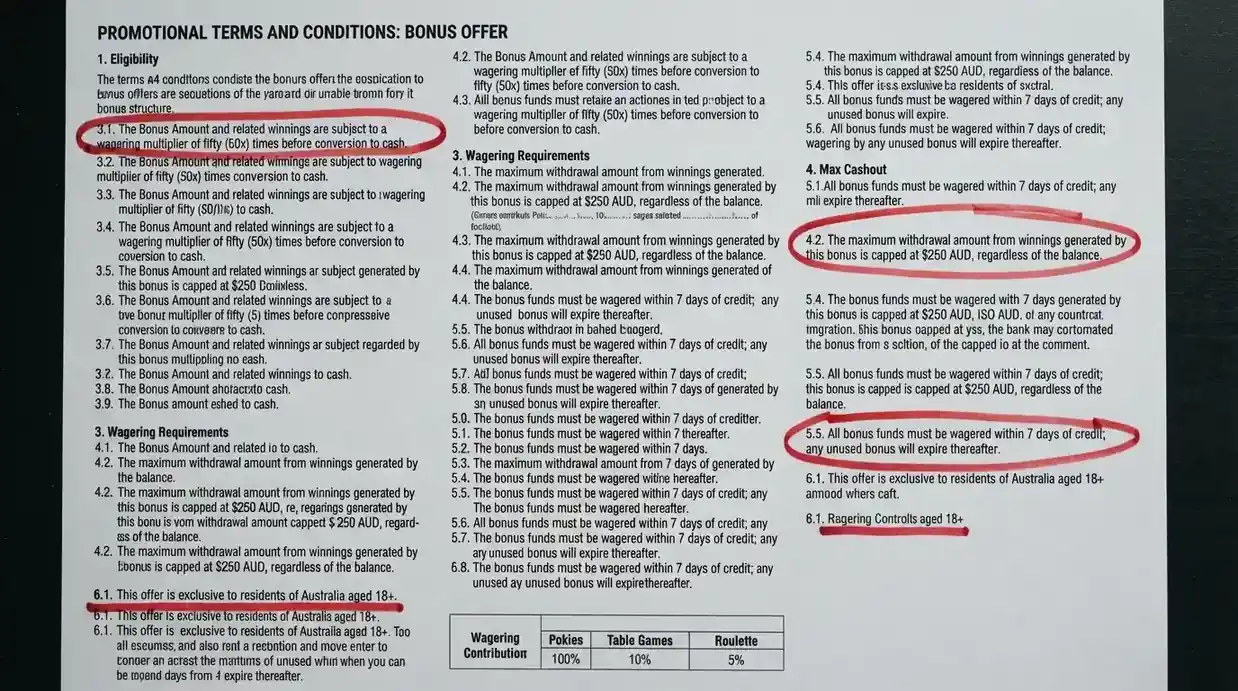
Wagering multiples at AU-facing offshore casinos in 2026 sit in the 30×–50× range for most NDB offers, with outliers at both ends. A wagering multiple is the figure the player must bet through before a withdrawal is permitted. The basis matters as much as the number: wagering on the bonus amount means betting the bonus value N times; wagering on winnings means betting only what the bonus actually produced. An A$20 free chip at 40× on the bonus amount requires A$800 in total bets before cashout. The same A$20 chip at 40× on winnings might require A$300 or less, depending on how the spins went.
Maximum cashout caps are the second clamp. A$50–A$200 is the typical range across AU-facing NDB offers in 2026. A bonus can theoretically produce a balance well above the cap; the cap is what the player can actually withdraw. The remainder is forfeit. A bonus that clears at A$180 with a A$100 cap walks out at A$100, not A$180, and the difference is not a rounding error.
Expiry windows are the third. Seven to fourteen days is the standard window for an NDB. The clock starts when the bonus is credited, not when the player first plays. A 7-day window on a 40× wagering requirement on the bonus amount is tight. A 14-day window is more forgiving. The window is the difference between a player who has the time to grind through the requirement and one who runs out of clock with most of the wagering still to clear.
Game contribution rates are the fourth, and the one that decides whether a player can use any game they like or is steered toward the pokies. Pokies contribute 100% toward wagering at virtually every AU-facing NDB. Table games contribute 5%–20%. Live dealer games contribute 0%–10%. A player who tries to clear wagering on blackjack is betting A$10 to clear A$1 of the requirement, and the bonus dies long before the requirement is met. The structure exists because the operator does not want bonus bankroll going to low-house-edge games.
The expected cost of an NDB, run through the wagering requirement, is rarely what the headline number suggests. Take a worked example from the terms in this market: an A$20 no deposit bonus at 40× wagering, played through on a Pragmatic Play pokie with an average RTP of 96.5% (the AU-facing portfolio average). The required turnover is A$800 (A$20 × 40). The expected loss on A$800 of bets at a 3.5% house edge is A$28 — meaning the player is statistically expected to lose A$28 clearing a bonus that paid them A$20 in starting credit. The bonus is real cash on the way in; on average, it costs the player A$8 more than it pays. That is the maths underneath the word “free”. A player with a particularly lucky run beats the average; a player with a typical run does not. The cap on the way out then clips the upside. The bonus is a marketing tool, not a value transfer.
Welcome bonuses vs no deposit bonuses: what you’re really comparing
The NDB is small and the welcome package is large. The welcome package at Fair Go offers a 100% deposit match up to A$200, redeemable five times, for up to A$1,000 in bonus credit. Joe Fortune’s welcome package runs up to A$5,000 plus 450 free spins across five deposits, with 50× playthrough on deposit plus bonus. Joe Fortune’s first deposit alone, paid in crypto, gets a 150% match up to A$2,000 plus 30 free spins; paid by card, a 100% match up to A$2,000 plus 30 free spins. The numbers are larger by an order of magnitude than any NDB.
Two differences make them not directly comparable. The first is that the welcome package costs the player money. Every dollar of the deposit is the player’s own AUD, and the deposit plus the bonus are both subject to wagering. The second is that wagering applies to deposit plus bonus, not to bonus alone — at Joe Fortune, 50× on deposit plus bonus means a A$1,000 deposit unlocking A$1,000 of bonus credit requires A$100,000 of bets before withdrawal, with the player’s own A$1,000 at risk on the way.
The NDB is small because the player has not paid in. The wagering runs 30×–50× on either the bonus or the winnings, with a cap on the way out. The welcome package is large because the player has paid in. The wagering is bigger because both the deposit and the bonus sit inside the requirement. Each costs the player differently: the NDB costs time and attention; the welcome package costs AUD. The reader picking between them is picking between risking time and risking money, and the choice should be made on that basis rather than on the size of the headline.
Free spins vs free chips: the two no deposit bonus types explained
Free spins and free chips are the two NDB formats the Australian-facing market uses. The free chip is a small cash credit — A$20 or A$35 — paid into the bonus balance, with wagering attached. Aussie Play’s A$35 free chip carries 50× flat rollover on the credit’s face value, meaning the player must bet through A$1,750 on eligible games before withdrawal. The free spins bundle is a set number of spins on a named pokie at a fixed per-spin value. SkyCrown’s 100 free spins are loaded onto a single pokie at A$0.20 per spin, for A$20 of starting value.
The wagering basis separates them in practice. Free spins tend to carry wagering on winnings only — what the spins produce, not the bonus credit. Free chips more often carry wagering on the bonus amount itself. That structural difference is why a 100-spin offer with 30× on winnings can be more achievable than an A$20 chip at 50× on the bonus amount, even though the headline numbers look comparable.
Cashout potential differs in the same direction. Free-spin offers typically cap cashout at A$100 with a 7-day window, with Royal Reels running as high as A$200 over a 7–14 day window. Free-chip offers typically cap at A$50–A$100. The cap is the ceiling on what the player actually walks out with, and it sits well below the balance the bonus can theoretically produce.
Bonus codes: do you need one to claim an AU no deposit bonus?
Two mechanics dominate. Some NDB offers credit automatically when the new account is verified — typically after email confirmation or mobile phone verification, with no code required at any stage. Others require a code entered at registration or in the cashier. SkyCrown’s 100 free spins, for instance, are unlocked after mobile verification, no code in the loop. Fair Go’s 10 free spins are sent by email to eligible players.
The published code lists are unreliable. Affiliate pages list codes for casinos that have either changed their offer or stopped serving Australian players, and a code that worked last month may sit on a page indefinitely. The check is the operator’s own terms page, refreshed for the current month, and even that can move between the time the player reads it and the time the offer is claimed.
Code rotation is the rule, not the exception. Codes expire; offers change; terms pages get updated without notice. The practical move is to treat any published code as potentially stale until verified against the operator’s current terms. The verification round carried out in July 2026 found that most of the “currently active” codes on competing guide pages either did not work for Australian players or pointed at offers that had been withdrawn.
Wagering requirements: the maths that decides whether you ever see a dollar
Wagering requirements are the operator’s tool for converting bonus credit back into expected profit. The math is mechanical: at a 3.5% house edge, A$1 of turnover returns A$0.965 to the player. A wagering requirement of 40× on the bonus amount means the player must bet through A$40 for every A$1 of bonus, and the expected loss over those A$40 of turnover is A$1.40 — more than the bonus itself. The bonus is, on average, a losing proposition for the player before any cashout cap is applied.
The basis — bonus amount or winnings — is the lever that moves whether the offer is reachable. A$20 of bonus credit at 40× on the bonus amount: A$800 of turnover, A$28 of expected loss on a 96.5% RTP pokie. The same A$20 of bonus credit converted into A$10 of winnings, with 40× on winnings: A$400 of turnover, A$14 of expected loss. The second is half the cost of the first. The first is the structure most A$20–A$35 free chips use. The second is what most free-spin offers use, which is why free spins at lower wagering multiples can outvalue free chips at higher multiples.
Game choice within the eligible set is the second lever. The eligible set is almost always pokies, because pokies contribute 100% to wagering. A live dealer game contributes 0%–10%, meaning every A$1 of live dealer bets clears A$0–A$0.10 of the requirement. A table game contributes 5%–20%. The structure exists because table and live dealer games have low house edges, and the operator does not want bonus bankroll playing games where the player is close to even. Picking a 96.5% RTP pokie over a 95% RTP pokie is worth about A$6 per A$800 of turnover in expected loss — meaningful, but secondary to picking a bonus with reasonable wagering and a real cashout cap.
Fair Go’s 60× on NDB winnings sits at the high end of the range in this market. BitStarz runs 40× on winnings. KatsuBet runs 30× on winnings — the lowest in the featured set. 7Bit runs 45× on winnings — the highest winnings-based multiple. Royal Reels runs 30×–40× on the bonus amount itself, which is a different structure and harder to clear than the same multiple on winnings.
No deposit bonus casinos that accept Australians: ranked for 2026
The ranking below compares ten offshore casinos that Australian players reach. Every row is the same on the legal point: every casino is offshore, no Australian licence exists for online casino, and ACMA actively blocks domains in this category. The ranking orders operators by the quality and transparency of their current NDB terms, not by regulatory status (because no AU licence is available). Terms in cells research did not confirm are marked with a dash.

| Casino | Legal status in Australia | NDB offer | Wagering | Max cashout | Bonus validity |
|---|---|---|---|---|---|
| SkyCrown | Offshore — no AU licence | 100 free spins | 40× on bonus / 30× on FS winnings | A$300 | 14 days |
| BitStarz | Offshore — no AU licence | 100 free spins | 40× on winnings | A$100 | 7 days |
| KatsuBet | Offshore — no AU licence | Free spins | 30× on winnings | A$100 | 7 days |
| Mirax Casino | Offshore — no AU licence | Free spins / free balance | 35× on winnings | A$100 | 7 days |
| 7Bit Casino | Offshore — no AU licence | Free spins | 45× on winnings | A$100 | 7 days |
| Fair Go Casino | Offshore — no AU licence | 10 free spins via email | 60× on NDB winnings | — | — |
| Neospin | Offshore — no AU licence | 100 free spins | 40× | — | — |
| Bizzo Casino | Offshore — no AU licence | 10 free spins | 40× | A$75 max win | 7 days |
| Royal Reels | Offshore — no AU licence | Free spins | 30×–40× on bonus | A$200 | 7–14 days |
| Rocket Play | Offshore — no AU licence | — | — | — | — |
SkyCrown leads on terms transparency. Its 100 free spins are confirmed AU-eligible, the wagering is split into a 40× bonus track and a 30× winnings track (the latter is the more achievable basis), the A$300 max cashout is the highest in the ranking, the 14-day validity is the longest, and the A$0.20 per-spin value is documented. The A$7.50 max-bet cap while the bonus is active is also stated. The bonus slots come from named providers (IGTech, BGaming, Booongo, Booming), which is the only row in the table that names providers.
Rocket Play is in the ranking on AU market presence — it sits third by AU market share at 9.4% — but its current NDB offering could not be verified this run. The placement reflects traffic, not a reviewed bonus, and a reader using this ranking to choose where to play should treat Rocket Play as “popular, terms unknown” rather than as a confirmed offer.
SkyCrown
SkyCrown’s 100 free spins NDB is the best-documented offer in the ranking. Players receive the spins after mobile verification, no code required, on a bonus slot from one of the named providers (IGTech, BGaming, Booongo or Booming). The A$0.20 per-spin value gives A$20 of starting credit. Wagering splits across two tracks: 40× on the bonus amount and 30× on free spin winnings, with the latter being the more achievable path. The A$300 max cashout per deposit stage is the highest cap in the ranking, and the 14-day validity is the longest.
The welcome package is up to A$8,000 plus 400 free spins across four deposits, with a 120% match up to A$1,200 plus 125 free spins on the first deposit. Per-deposit max cashout on the welcome package is A$5,000, with the same 40×/30× wagering split.
SkyCrown’s edge is terms transparency and the longest validity window in the ranking. The wagering split is the most generous interpretation of the bonus on the page — wagering on winnings is the easier track, and SkyCrown lets the player choose it. A player who values knowing the exact per-spin value, the exact cap and the exact window will find SkyCrown’s terms the easiest to plan around.
BitStarz
BitStarz’s 100 free spins NDB runs 40× on winnings, with a A$100 max cashout and a 7-day validity. The brand is one of the most widely recognised in the offshore market and its provider portfolio is known to include NetEnt, Microgaming, Pragmatic Play and Evolution — a depth of providers that most of the rest of the ranking cannot match. Per-spin value was not confirmed this run, but comparable sites in the same market cluster at A$0.10–A$0.20 per spin, putting the starting value somewhere between A$10 and A$20.
The 7-day window is the tighter end of the validity range and is the main trade-off against the rest of the ranking. A player with limited time to play will feel it; a player who plans to clear the requirement in a session or two will not. BitStarz’s NDB is the most playable of the longer-window offers once the wagering is done — Evolution’s live dealer titles are reachable in demo, the pokie portfolio is wide, and the brand is established enough that withdrawal disputes, while not formally appealable in Australia, are not unheard of in player forums.
KatsuBet
KatsuBet’s NDB free spins sit at the lowest wagering multiple in the ranking: 30× on winnings. The cap is the standard A$100, the validity is the standard 7 days. Provider list was not confirmed this run, which limits the ability to assess which pokie the spins will land on.
The 30× on winnings is the structural advantage. At A$10 of winnings from the free spins, the wagering target is A$300 — meaningfully lower than the same winnings at 40× or 45×, and the difference shows up as a higher probability of clearing the requirement before the 7-day window closes. KatsuBet is the ranking’s best fit for a player whose priority is the lowest barrier to cashout.
Mirax Casino
Mirax’s NDB structure is one of two options: free spins or a free-balance tier. Wagering is 35× on winnings, the cap is A$100, the validity is 7 days. Mirax is the standout on payout speed for crypto: Bitcoin and Litecoin withdrawals clear fastest, in line with the 8–18 minute range that USDT TRC-20 hits across the market.
A player who plans to withdraw via crypto and has already accepted the offshore framing will find Mirax’s payout speed a clear advantage over the bank-based options. The free-balance tier is the alternative if the player prefers a cash credit to free spins. Provider list was not confirmed this run.
7Bit Casino
7Bit’s NDB free spins carry 45× wagering on winnings, the highest winnings-based multiple in the featured set. The cap is the standard A$100, the validity is the standard 7 days. The 45× on winnings is the structural disadvantage: at A$10 of winnings, the wagering target is A$450, and the 7-day window is tight against that target.
7Bit is on the ranking because it is an operator Australian players reach, not because the terms are competitive. The cap and validity are standard; the wagering is the highest winnings-based figure on the page. A player who values the brand’s reputation over the offer’s reachability will find it here; a player whose priority is clearing the bonus will not.
Fair Go Casino
Fair Go’s NDB is 10 free spins sent by email to eligible new players, with 60× wagering on NDB winnings. The 60× is the highest in the featured set by a wide margin, and the terms make Fair Go the hardest NDB in the ranking to clear. The welcome package — a 100% deposit match up to A$200, redeemable five times for up to A$1,000 total — runs at 30× on the deposit bonus, which is the standard range. The cashback offer, up to 40% of net losses, is unusual in this market and is Fair Go’s structural counterweight to the steep NDB wagering.
Fair Go is RTG-only on the provider side, which limits the pokie portfolio but means the games are well-known to long-term AU-facing players. The casino has a long AU operating history, with a 0.8% AU market share — small but established. The maximum cashout on the NDB was not confirmed this run; the 60× wagering on winnings is the figure the player should plan around.
Fair Go’s verdict for the player who reads this page: the NDB is the toughest to clear in the ranking, the welcome package is the standard structure at standard wagering, and the cashback is the genuine safety net. A player who plans to play regularly will find the cashback worth more than the NDB. A player chasing the NDB specifically will find the 60× a heavier lift than the rest of the ranking.
Neospin
Neospin’s 100 free spins NDB runs at 40× wagering. The spin count is competitive with SkyCrown and BitStarz; the terms around max cashout and validity were not confirmed this run. The 40× on its own places the offer in the middle of the ranking.
The missing terms are the constraint. A player considering Neospin should not commit on the spin count alone — the cashout cap and the validity window decide whether 100 spins at A$0.10–A$0.20 each is reachable, and Neospin has not been confirmed on either. Treat as “competitive spin count, unconfirmed terms” rather than as a finished offer.
Bizzo Casino
Bizzo’s NDB is 10 free spins at 40× wagering, with a A$75 maximum win and a 7-day validity. The A$75 cap is the lowest in the ranking — A$25 below the A$100 floor that the rest of the cluster sits at. The 40× wagering is standard. The 0.57% AU market share is the smallest in the ranking, putting Bizzo at the edge of the AU traffic map.
The A$75 cap is the verdict-defining feature. A bonus that produces more than A$75 in the bonus balance is clipped to A$75 on the way out, and the rest is forfeit. The low cap combined with the small spin count makes Bizzo the tightest NDB in the ranking by both the entry and the exit. Serious bonus hunters should likely look elsewhere given the restricted upside.
Royal Reels
Royal Reels’ NDB free spins run at 30×–40× wagering on the bonus amount — not on winnings, which is the structural difference from the rest of the ranking. The A$200 max cashout is the highest in the featured set, and the 7–14 day validity is the longest tied with SkyCrown. The 2.51% AU market share places Royal Reels in the middle of the AU traffic map.
The wagering-on-bonus-amount structure is the trade-off. A player whose spins produce A$10 of winnings must wager A$300–A$400 of the bonus amount, not A$300–A$400 of the winnings — and that is materially harder to clear. The A$200 cap is the reward for clearing it. Royal Reels is the highest-ceiling, hardest-to-reach NDB in the ranking. Provider list was not confirmed this run.
Rocket Play
Rocket Play is on the ranking on AU market presence. With 9.4% AU market share, it sits third behind SportsBet and Tab among offshore operators reaching Australian players, and ahead of every other casino in the ranking by that measure. Its current NDB offering could not be verified this run, and neither could its welcome package, wagering terms, or provider list.
Rocket Play’s verdict for the player who reads this page: the casino has the AU traffic to suggest an established player base, but the absence of confirmed NDB terms means the offer cannot be compared on the same footing as the rest of the ranking. A player who has used Rocket Play before and trusts the brand can rely on prior experience. A player choosing on the basis of this page alone cannot.
The pokies your no deposit bonus actually lets you play
The free spins an NDB credits almost always land on a specific pokie or a specific provider’s portfolio. The bonus is locked to those games for the wagering requirement. Playing outside the eligible set does not clear wagering — it burns the bet without contributing to the target, except where the operator runs a partial-contribution policy.

The contribution-rate hierarchy decides which game types count and how much. Pokies contribute 100% to wagering at virtually every AU-facing NDB. Table games contribute 5%–20%. Live dealer games contribute 0%–10%. A$100 of blackjack bets clears A$5–A$20 of a wagering requirement; A$100 of pokie bets clears A$100. The structure exists because table and live dealer games have a much lower house edge than pokies — blackjack sits near 0.5% with basic strategy, the best pokies sit at 3.5%. The operator is steering bonus bankroll to the games where the house has the most edge.
The pokies the player actually ends up playing are usually the operator’s choice, not the player’s. SkyCrown names four providers in its bonus slot terms. BitStarz’s provider portfolio is known to include NetEnt, Microgaming, Pragmatic Play and Evolution. The rest of the ranking has not confirmed providers this run. Reading the eligible-games list before claiming is part of the same move as reading the wagering and the cap.
Provider RTP averages are the second layer. Pragmatic Play’s AU-facing portfolio averages 96.5% RTP, with volatility ranging medium to high. NetEnt’s portfolio averages 96.3%, with volatility levels between low and medium. Microgaming’s portfolio averages 96.1%, with volatility from medium to high. Games Global (the Microgaming successor) sits at 95.8%–96.3% across most games. A pokie below 95% RTP is the operator skewing the maths against the player — a line that holds across providers.
| Pokie title | Provider | RTP | Volatility |
|---|---|---|---|
| Gates of Olympus | Pragmatic Play | 96.5% | High |
| Sweet Bonanza | Pragmatic Play | 96.49% | Medium-high |
| Big Bass Bonanza | Pragmatic Play | 96.71% | High |
| Starburst | NetEnt | 96.09% | — |
| Gonzo’s Quest | NetEnt | 95.97% | — |
| Blood Suckers | NetEnt | 98% | Lower variance |
| Dead or Alive 2 | NetEnt | 96.82% | Very high |
| Money Train 4 | Relax Gaming | 96.00% | Very high |
Gates of Olympus (Pragmatic Play, 96.5% RTP, high volatility, 5,000× max win) and Big Bass Bonanza (Pragmatic Play, 96.71% RTP, high volatility, 2,100× max win) are the two highest-RTP Pragmatic Play titles in the table, and both are commonly named in NDB eligible-game lists. Sweet Bonanza (96.49% RTP, medium-high volatility, 21,175× max win) sits just behind them.
Blood Suckers (NetEnt, 98% RTP, lower variance) is the table’s outlier. The 98% RTP and the lower variance combine into a pokie where the player’s balance moves slowly but the house edge is unusually small. Operators frequently restrict high-RTP titles from bonus play for exactly this reason — Blood Suckers is the kind of pokie a player wants on an NDB and the kind an operator will often exclude from one. Confirming eligibility on the terms page is the move.
Which pokies qualify: game restrictions and contribution rates explained
The eligible-games list is not negotiable. Free spins credit on a specific pokie — or, with a few operators, a choice of one pokie from a short named list. The wagering requirement is cleared on pokies only, in nearly every AU-facing NDB. The other game types are not blocked outright — the player can usually still play blackjack, roulette or live dealer — but their contribution rates are set so low that the wagering does not move.
The reason for the structure is the house edge. A 96.5% RTP pokie returns A$0.965 per A$1 bet. A blackjack hand with basic strategy returns around A$0.995 per A$1 bet. A 35× wagering requirement on A$20 of bonus credit played at 96.5% RTP loses, on average, A$28 — a losing proposition for the player, a profitable one for the operator. The same A$20 played at blackjack loses around A$1.60 — a profitable proposition for the player, an unprofitable one for the operator. The contribution-rate hierarchy is the operator’s defence against the second outcome, and the reason a bonus bankroll should not be wasted on table games.
The restriction also extends within pokies. Operators routinely exclude the highest-RTP titles from bonus play. Blood Suckers at 98% RTP is the classic example. The eligible list is whatever the operator publishes on the bonus terms page. The player’s job is to check which games qualify before claiming, not after.
Live dealer and table games: why your NDB barely counts here
Live dealer and table games are the worst use of bonus bankroll. Live dealer contributes 0%–10% of every bet toward wagering. Table games contribute 5%–20%. A$100 of live dealer bets at the high end (10%) clears A$10 of a wagering requirement, leaving A$90 of the bet to do nothing for the bonus. A$100 of blackjack at 20% clears A$20.
The NDB is best spent on the 100%-contribution pokies the bonus is locked to. Moving to a table game mid-session is a slow leak of the requirement. A player who tries to clear an NDB wagering requirement on blackjack will, in most cases, run out the bonus balance before the requirement clears. The maths is mechanical: the contribution rate is too low, the bet sizes needed are too high, and the 7–14 day window does not forgive the mismatch.
Getting paid: why the withdrawal is where every no deposit bonus gets hard
Clearing wagering is half the job. Getting the cashout out is the other half, and it is the half where the offshore terms bite. Three things decide whether the money lands: payment method, verification deposit, and KYC queue.
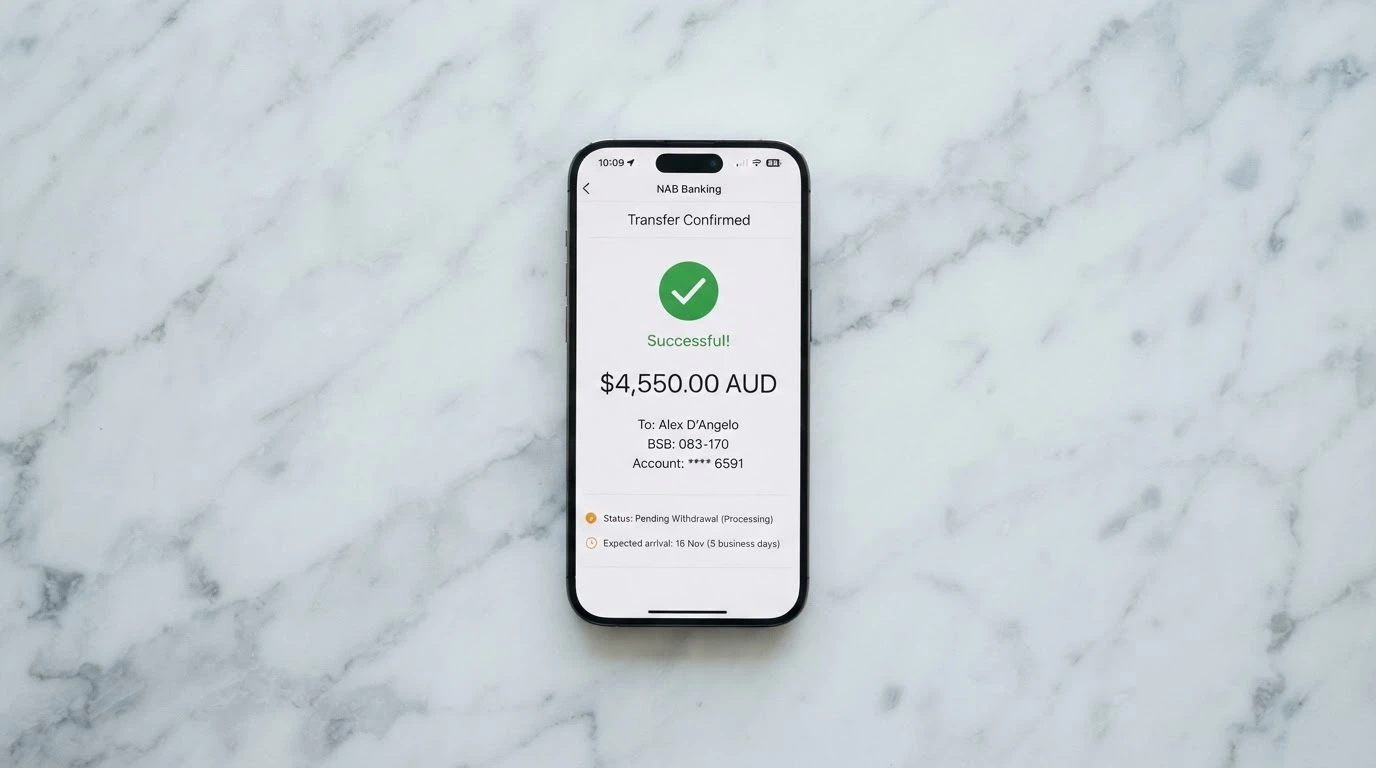
PayID is the AU-preferred rail for offshore casinos. Deposits via PayID clear in under 60 seconds; withdrawals average around 24 hours. Operator-level results from earlier in 2026 put Goldenbet at 28 minutes and Lucky7 at 35 minutes. VegasNow averaged 14 minutes across 8 test cashouts on bonus winnings — the fastest result reported in the market. PayID is not available at every AU-facing offshore casino, but it is the rail to look for first.
Crypto is faster but more exposed. USDT TRC-20 withdrawals clear in 8–18 minutes at most AU-facing sites — well below PayID’s ~24 hours. The trade-off is on the regulatory side: credit cards and crypto are banned as payment for licensed Australian wagering since 11 June 2024, and an operator asking for either is operating outside Australian rules. A player using crypto at an offshore casino is bypassing the Australian payment ban, not the Australian prohibition on the product itself.
E-wallets sit in the middle. Withdrawal speed is typically 24–48 hours, with debit and credit cards at 2–5 business days and bank transfers at 3–7 business days. Some Australian banks decline direct card transactions to offshore casinos — the bank has its own risk policy on gambling transactions, and the player gets a “transaction declined” at the point of payment. The workaround is crypto, e-wallet or Neosurf. The decline itself is information: a bank that refuses the transaction is telling the player something the regulator does not.
PayID withdrawals for no deposit bonus winnings
PayID is the fastest AUD rail for AU players. Deposits clear in under 60 seconds; withdrawals average around 24 hours. Goldenbet’s 28 minutes and Lucky7’s 35 minutes are the named operator-level results; VegasNow’s 14 minutes across 8 test cashouts is the fastest reported in the market this year.
The “around 24 hours” average hides the range. Some operators process PayID withdrawals in minutes. Others take the full 24 hours. A few sit longer. The PayID rail is the OSKO / New Payments Platform infrastructure operated by Australian banks, and the speed depends on the receiving bank and the operator’s processing queue, not just on the operator’s stated payout time.
Not every featured operator supports PayID. The rail is most common at AU-facing offshore casinos that have integrated with an Australian payments partner. The reader choosing an operator specifically for PayID speed should confirm support on the operator’s banking page before claiming the NDB.
Crypto, e-wallet and card: which payment method actually reaches your bank
Crypto is the fastest at 8–18 minutes for USDT TRC-20. The trade-off is on the regulatory side. Crypto is banned as payment for licensed Australian wagering since 11 June 2024, alongside credit cards. An offshore casino asking for either is operating outside Australian rules, and the player using crypto at such a casino is using a payment method that the Australian regulator has decided is inappropriate for wagering. The transfer is fast because the rails bypass the Australian banking system; the regulatory framing is that the rails bypass the Australian payment ban by design.
E-wallets sit at 24–48 hours for withdrawals. They sit between crypto’s speed and the card rails’ slowness, and they are the most common fallback when PayID is unavailable and the player prefers not to use crypto.
Cards and bank transfers sit at the slow end. Debit and credit cards take 2–5 business days; bank transfers take 3–7 business days. Some Australian banks decline card transactions to offshore casinos outright, and the player gets a decline at the point of payment. The workaround, where PayID and crypto are unavailable, is e-wallet or prepaid voucher (Neosurf). The decline itself is a signal worth paying attention to: a bank that refuses the transaction is signalling a risk policy that the regulator has not formally mandated.
The verification deposit and how long payouts really take
Some offshore casinos require a small verification deposit — typically A$10–A$20 — before processing the first cashout from a no deposit bonus. The deposit is refundable and is a form of KYC. The mechanic exists because the offshore operator has no way to verify the player’s payment rail otherwise, and a small deposit confirms the rail works before the operator releases the larger cashout.
The deposit itself is rarely the friction. The friction is the KYC queue that follows. The first withdrawal at an offshore casino triggers identity verification — passport, driver licence, proof of address. The queue at a small operator can run days; at a larger one it can run hours. The “fast payout” claim the operator publishes usually survives the KYC queue, but rarely on the first withdrawal.
The gap between advertised and actual payout speed is widest on the first withdrawal. After the first one clears, subsequent withdrawals typically process faster — the account is verified, the rail is confirmed, and the operator’s risk review is done. The first withdrawal is where most of the player complaints about “pending” status originate.
The verification deposit also runs into the offshore status question. No Australian consumer protection law applies to the transaction. If the operator takes the A$10–A$20 verification deposit and then refuses the cashout, the player has no Australian complaints body to appeal to. The ACMA cannot recover the money; it enforces the prohibition, not the contract. The deposit is a bet that the operator will pay out — the same bet as the NDB itself, with the same offshore framing.
New no deposit bonus casinos 2026: fresher offers, same offshore risks
New offshore casinos launch with aggressive NDB offers to build a player base. The same logic applies as for any new entrant in a competitive market: the offer is the marketing spend. Free spin counts at the top of the range, wagering at the bottom of the range, cashout caps at the top of the range. The terms can look better than the established operators’ — and the operator has no AU payout history to back the offer.

The risk is the operator’s track record. A “new” casino in the AU context is an offshore launch with no ACMA history, no Australian complaints data, and no third-party verification of payouts. New domains are not immune to ACMA blocking — the 1,564 blocked sites include launches from the past year. New domains can vanish faster than established ones, because there is no player base to lose and no reputation to protect. A site that offered A$200 in free spins last month can be blocked, redirected, or shut down next month, with the player’s bonus balance still on it.
The market-mechanics note is that “new” can also mean “still operational”. More than 225 illegal services have withdrawn from the Australian market since 2017, but the ones that stayed have built track records that the new launches do not yet have. Rocket Play, the third-largest AU market share among offshore casinos at 9.4%, was a new launch not long ago and now sits in the established bracket. The reader choosing between a new and an established operator is choosing between an unknown and a known, and the known has the data the unknown does not.
What “new” means for an offshore casino targeting Australians
A “new” casino in the AU context is an offshore operator without ACMA enforcement history — without an infringement notice, without a blocked domain, without a Federal Court penalty. The absence is not the same as the presence of a clean record; it is the absence of any record at all. The brand has launched, registered a domain, integrated payment rails, and started running NDB promotions. The track record from that point forward is unbuilt.
The risk is asymmetric. The new operator has more to gain from a generous NDB — the bonus is the acquisition cost — and less to lose from a bad outcome. The player claiming the bonus has more to gain from a generous offer and more to lose from an operator that refuses the cashout. The two sides of the trade face different downside curves, and the player’s side is the steeper one.
A new operator that survives its first 12 months and builds a player base becomes an established operator. The transition is not guaranteed. The operator that vanishes mid-wagering leaves the player’s balance where it was, and there is no AU consumer protection to recover it.
The law Australia’s no deposit bonus guides never mention
The interactive gambling framework is the part of the no deposit bonus market that most pages skip. Most NDB guides treat offshore casinos as the normal operating environment and move past the legal frame in a footer disclaimer or not at all. The legal frame is what decides who can recover money, who can complain, and what changes next year. Skipping it leaves the reader with the offer and not the context.

The Interactive Gambling Act 2001 prohibits the provision of online casino games, online pokies and in-play sports betting to a person in Australia. The penalty for providing the service runs to A$360,000 per day for an individual and A$1.8 million per day for a body corporate; civil penalties run to A$2.475 million and A$12.375 million per day. The Act targets the provider, not the customer. The individual player is not prosecuted. That framing is accurate, and it is also the framing that lets the offshore market operate openly. “Not illegal for you” is not the same as safe.
The ACMA enforces the prohibition. It investigates complaints, issues formal warnings and infringement notices, refers operators for civil penalty proceedings, and directs ISPs to block illegal sites. The scale is not theoretical: 1,564 websites blocked since November 2019, more than 225 services withdrawn since 2017, A$158,400 in infringement notices to Tabcorp in January 2026, and A$24.24 million in Federal Court penalties against three prohibited online poker operators in July 2025.
The 2026 reform changes the framework from 1 January 2027. The Interactive Gambling Amendment (Gambling Reform) Bill 2026 passed Parliament on 19 August 2026 and commences on 1 January 2027. Banks and payment providers gain express authority to block transactions to illegal gambling operators from that date. Wagering advertising is capped at three ads per hour between 6:00 am and 8:30 pm, with a live-sport blackout from 15 minutes before to 5 minutes after a live event. Direct marketing of inducements is prohibited for 14 days after sign-up and for three months after BetStop deregistration. The bonus offers the offshore casino runs today sit in a market the regulator is actively trying to shut down, and the legal frame around them tightens on a fixed timetable.
What the Interactive Gambling Act 2001 actually prohibits
The Interactive Gambling Act 2001 prohibits online casino games, online pokies (slots) and in-play sports betting — any game of chance or mixed chance and skill provided over the internet to a person in Australia. What it does not prohibit is wagering on races and sport placed before the event begins, lotteries, and keno, all of which are licensable through state and territory regimes.
The penalty structure makes the prohibition enforceable. A$360,000 per day for an individual provider, A$1.8 million per day for a body corporate; civil penalties up to A$2.475 million per day for an individual and A$12.375 million per day for a corporation. The Tabcorp infringement notices totalled A$158,400 in January 2026. The Federal Court ordered A$24.24 million in penalties against three prohibited online poker operators in July 2025.
The Act targets the provider, not the customer. “Anyone who breaks the rules may face criminal charges and/or civil penalties. This includes anyone who helps someone break the rules.” That quote from the ACMA is the regulator’s framing: the operator, the affiliate, the payment processor, and the platform that hosts the service. The individual player is not the target, but the player’s money is not the regulator’s responsibility either.
KYC verification: why “no KYC” casinos are a red flag for Australian players
A casino that advertises “no KYC” is telling the player it skips identity checks. The promise sounds like a privacy feature. In the AU context it means no barrier to taking the player’s money and no trail when the operator refuses to pay.
Legitimate offshore operators run KYC because they need to — to verify the payment rail, to comply with anti-money-laundering obligations in their own jurisdiction, and to manage the risk of chargebacks. Some casinos require a small verification deposit of A$10–A$20 before processing the first NDB cashout; this is a form of KYC, refundable, and standard practice. The verification deposit is the operator’s tool for confirming the rail works before releasing the larger sum.
The “no KYC” framing also creates a data-security problem. An offshore operator is outside Australian data-protection law. The Privacy Act 1988 and the Australian Privacy Principles do not apply to a casino incorporated in Curaçao or another offshore jurisdiction, and the player’s passport, driver’s licence and proof of address are being sent to an entity that Australian regulators cannot reach. The player’s identity documents are also being stored on offshore servers, in jurisdictions where breach notification law is not the same as Australia’s Notifiable Data Breaches scheme. The reader giving ID to an offshore casino is making a data-security trade-off the casino’s marketing page does not mention.
Australian-licensed wagering vs offshore casino: the protection gap
The protection gap between an Australian-licensed wagering operator and an offshore casino is the single most important comparison on this page. The two are not the same kind of product, and the protections that apply to one do not apply to the other.
| Protection | Australian-licensed wagering | Offshore casino (no AU licence) |
|---|---|---|
| Regulator oversight | ACMA + state/territory regulator | Offshore jurisdiction only — no AU oversight |
| Complaints body | State/territory body accessible | None accessible to AU players |
| BetStop self-exclusion | Covered — binding | Not connected — self-exclusion ignored |
| Payment method restrictions | Credit cards and crypto banned since June 2024 | No Australian restrictions enforced |
| Consumer recourse on disputes | Formal complaints process with enforceable outcomes | No enforceable recourse — operator controls the decision |
| Advertising regulation | Federally capped from January 2027 | None applicable |
Australian-licensed wagering operators (SportsBet, Tab, Bet365, Ladbrokes, TABtouch, Neds, PointsBet, Betr, Picklebet, Betfair) hold state and territory licences for sports and race wagering only — they are not casino operators and they do not offer online casino games. The comparison above is between what those operators offer in their licensed product and what an offshore casino offers in its unlicensed product.
The offshore column is what an NDB player faces. No regulator with jurisdiction over the player’s money. No complaints body. No self-exclusion binding the operator. No enforced payment-method restrictions. No enforceable recourse. No advertising regulation. The bonus is the same kind of bonus; the protection underneath it is not.
When the free spins stop: responsible gambling help that actually works in Australia
The offshore casino is not connected to BetStop and ignores every Australian harm-minimisation safeguard. The help that does work sits with the Australian services that have always existed — the National Gambling Helpline, Gambling Help Online, and the BetStop register itself, which binds Australian-licensed wagering but not offshore casinos. The NDB player’s first port of call, if gambling stops being fun, is the Australian services, not the offshore operator’s terms page.
The prevalence data is real. About 2.1% of Australian adults — roughly 430,000 people — experience problem gambling. The Australian Institute of Health and Welfare put high-risk gambling at 1.8% in 2022. BetStop recorded 67,480 registrations since going live in August 2023, with 41,290 exclusions still active as at 31 July 2026. 78% of registrants were under 40; 38% chose lifetime exclusion. The numbers are not abstractions; they are the population of people who have decided, formally, that the AUD wagering environment is no longer safe for them. None of those 67,480 registrations reached an offshore casino.
BetStop and self-exclusion: what works and what offshore casinos ignore
BetStop — the National Self-Exclusion Register — is Australia’s single most powerful self-exclusion tool. One registration excludes a person from every Australian-licensed online and phone wagering service. The numbers are real: 67,480 registrations as at 31 July 2026, with 41,290 active exclusions. 78% of registrants were under 40. 38% chose lifetime exclusion. The register binds every Australian-licensed wagering operator and is enforced at the platform level.
BetStop does not reach a single casino on this page. An offshore casino is not connected to the register and will keep taking a self-excluded person’s money. The legal frame that lets the offshore casino operate in Australia is the same legal frame that lets it ignore BetStop — there is no Australian licence to suspend, no Australian regulator to enforce against. A person registered on BetStop who then plays at an offshore casino has no Australian mechanism to stop them, and the offshore operator has no Australian obligation to stop them.
The 2026 reform, commencing 1 January 2027, adds pressure from a different angle. Banks and payment providers gain authority to block transactions to illegal gambling operators from that date. A person who has self-excluded and continues to deposit at an offshore casino may find the bank refusing the transaction. The mechanism is not BetStop — it is the bank. The effect is similar.
Where to get help: Australian gambling support services
The Australian gambling support services are free, confidential and reachable regardless of where the player has been playing.
- National Gambling Helpline: 1800 858 858 — free, confidential, staffed 24/7.
- Gambling Help Online: gamblinghelponline.org.au — online chat and counselling.
Both are reachable from anywhere in Australia, do not require the player to have played at an Australian-licensed operator, and do not collect information about the offshore casino. The 24/7 phone line is the fastest option in a crisis; the online chat is the option for players who prefer text. Both will, on request, refer the player to BetStop or to financial counselling services if the player’s situation has moved beyond gambling harm.
The prevalence numbers belong alongside the help lines. 2.1% of Australian adults — about 430,000 people — experience problem gambling. 1.8% are classified high-risk. The numbers do not predict who will be affected, and they do not justify delay in calling. They do put the experience in proportion: problem gambling is statistically common, it is not a personal failing, and the help services exist for the population the numbers describe.
How we selected and ranked these no deposit bonus casinos
The ranking is built from operator terms pages, affiliate verification data, and the ACMA blocked-sites list. The operator set is the 10 offshore casinos that Australian players in fact reach, drawn from the AU traffic and revenue data and supplemented by verified bonus search results.
The verification round carried out in July 2026 checked each operator’s current NDB terms against the operator’s own published terms page. The check found that most of the “currently active” codes on competing guide pages either did not work for Australian players or pointed at offers that had been withdrawn. The ranking reflects what was verifiable at that point in time, and a reader using the ranking to choose where to play should confirm the current terms at the operator’s own site before claiming.
The ranking criteria — NDB availability, wagering terms, max cashout, bonus validity, provider quality — were assessed qualitatively. No weighted scoring system was used. The order reflects a reading of how reachable each offer is in practice, with the harder-to-clear, less-transparent offers ranked lower. The legal-status column is uniform across the ranking: every operator is offshore, no AU licence exists, and the ACMA actively blocks sites in this category.
The ranking is not a recommendation. A reader using this page to choose where to play should treat the comparison as a description of what each operator’s terms actually say, not as an endorsement of where to play. The protection gap described in the section on Australian-licensed wagering vs offshore casino applies to every operator on the ranking.
What Australian players should actually do about no deposit bonuses in 2026
The arithmetic behind the offer, run end-to-end, is this. An A$20 no deposit bonus at 40× wagering, played through on a 96.5% RTP pokie, requires A$800 of total bets. The expected loss on A$800 of bets at a 3.5% house edge is A$28. The player is statistically expected to lose A$8 clearing a bonus that paid them A$20 in starting credit. The maximum cashout cap — typically A$100 — clips the upside. A player with a particularly lucky run beats the average; a player with a typical run does not. The expected value of the bonus, before any cap, is negative. The “free” in free bonus is a marketing word, and the maths underneath it is the operator’s edge.
The legal frame around the offer is that the product is prohibited in Australia. Every operator on the ranking is offshore; no AU licence exists. The ACMA actively blocks sites (1,564 blocked since November 2019). The 2026 reform, commencing 1 January 2027, gives banks authority to block transactions to illegal gambling operators and tightens advertising restrictions. The market the bonus sits in is the market the regulator is trying to shut down.
The protection gap is the consequence. No Australian consumer protection applies. No Australian complaints body has jurisdiction. No BetStop coverage reaches an offshore casino. A player who has self-excluded and continues to play at an offshore site has no Australian mechanism to stop them. The help that does work sits with the National Gambling Helpline (1800 858 858) and Gambling Help Online (gamblinghelponline.org.au), both free, confidential and 24/7.
The reader’s path through this page is the reader’s own. The page has walked through what the bonus is, what it costs in expected loss, which operators currently offer one, what the law says about the product, and what the protection gap costs the player who claims. Whether to claim one is a decision only the reader can make, and the page has tried to make sure that decision is made with the numbers and the legal frame visible. The number the bonus paid in is the easy figure; the expected loss on the wagering is the figure underneath it; the missing Australian protection is the figure that does not appear on the terms page.
Frequently asked questions
Are no deposit bonuses at Australian online casinos legal?
The individual player is not prosecuted under the Interactive Gambling Act 2001 — the Act targets the provider, not the customer. But every operator offering an NDB to Australian players is offshore and unlicensed in Australia, because no AU licence exists for online casino. The bonus is legal to claim; the product is banned to provide; the protection that comes with an Australian-licensed product does not apply.
What is the maximum you can withdraw from a no deposit bonus in Australia?
Maximum cashout caps on no deposit bonuses at AU-facing casinos in 2026 typically sit at A$50–A$200, with Royal Reels at the top of the range at A$200 and Bizzo at the bottom at A$75 max win. The cap applies regardless of how high the bonus balance goes — anything above the cap is forfeit on withdrawal. Fair Go’s NDB cap was not confirmed this run.
Which Australian online casinos offer a $50 no deposit bonus in 2026?
None of the featured operators in this ranking currently offer a $50 free chip NDB. The closest equivalent is VegasNow’s 50 free spins on Big Bass Splash at approximately A$50 value, with 40× wagering on bonus winnings, A$100 max cashout, and 14-day expiry. Free-spin offers in the A$50 starting-value range are the market’s substitute for a $50 free chip, with different wagering and a cap structure applied to winnings rather than to a cash credit.
What happens if an offshore casino refuses to pay my no deposit bonus winnings?
The player has no enforceable Australian recourse. The ACMA enforces the prohibition on providing the service; it does not mediate disputes. No Australian complaints body has jurisdiction over the offshore operator. The player’s options are the operator’s internal dispute process (if any) and third-party mediation services, neither of which can compel a payout. The balance is at risk the moment it sits in an offshore account, and the protection that would apply to an Australian-licensed product does not apply here.
Why do most no deposit bonuses expire within 7 days?
The 7-day window is the operator’s defence against the wagering requirement turning unprofitable. A wagering requirement of 30×–50× on bonus credit takes time to clear, and a long window gives the player enough time to grind through the requirement at a pace the operator cannot profit from. The short window is also why a player who claims an NDB should plan to clear the wagering in a focused session or two, not across a week of casual play. 14-day windows exist (SkyCrown, Royal Reels, VegasNow) and are the more forgiving end of the market.
Is it safe to give my ID to an offshore casino for KYC verification?
The ID submission is a data-security trade-off the casino’s marketing page does not mention. An offshore operator is outside Australian data-protection law — the Privacy Act 1988 and the Australian Privacy Principles do not apply, and the player’s passport, driver’s licence and proof of address sit on offshore servers in jurisdictions where breach notification law differs from Australia’s Notifiable Data Breaches scheme. The KYC submission is necessary to clear the operator’s first-withdrawal verification; the player is trusting the operator with identity documents the operator is not legally bound to protect under Australian law.
New-casino NDBs vs established operators: is the bonus worth the unknown?
The terms comparison usually favours the new operator. The free spin count is higher. The wagering multiple is lower. The cashout cap is at the top of the range. The marketing page reads better than the established operators’ pages.
The trade-off is the operator’s longevity. An established offshore casino has months or years of payout data, player forums discussing withdrawals, and a brand reputation that survives complaints. A new operator has none of those. A site can be blocked mid-wagering; the 1,564 blocked domains include recent launches. The terms page that the player reads at claim time may not be the terms page in force at withdrawal time, and the offshore operator sets its own terms.
The practical framework for the reader is: the new casino’s NDB is worth claiming if the reader values the offer’s terms over the operator’s track record. The established casino’s NDB is worth claiming if the reader values the track record over the terms. The reader cannot have both at the same time, and the choice is theirs. Most player forums in this market suggest weighting the track record over the terms, because an unreachable bonus is a worse outcome than a reachable bonus with slightly higher wagering.