
What a No-Deposit Free Spins Bonus Really Pays Australian Players in 2026
The no-deposit free spins offer is the most heavily marketed product in the offshore casino market that serves Australian players. Twenty free spins, fifty, one hundred — the number is the headline, and the headline sells the account. Behind it sits a mechanism that is harder to clear than the marketing suggests, and behind that sits a legal position that strips every player of the protections the licensed Australian wagering market would otherwise provide. This page works through all three layers in order.
Data current as of 18 October 2026, checked against the Australian Communications and Media Authority (ACMA) register and the Interactive Gambling Act 2001 as enforced.

Table of Contents
- Why Your 2026 Free Spins Bonus Is Smaller Than It Looks
- Free-Play Pokies: The Risk-Free Path the Licensed Market Won’t Give You
- The Best No-Deposit Free Spins Offers Available to Australians Right Now
- Online Pokies and Australian Law: What the IGA Actually Prohibits
- Getting Paid: The Payment Methods That Work (and the Ones That Signal Trouble)
- How We Evaluated Every Operator on This Page
- Your Next Move: What This Means for Where You Play
- Frequently Asked Questions
Why Your 2026 Free Spins Bonus Is Smaller Than It Looks
A no-deposit free spins offer looks generous on the surface. The casino promises you twenty to one hundred and twenty spins on a real-money pokie, with no deposit required. The fine print, however, sits behind four levers that each shrink the real value of the offer before a cent reaches your wallet: the wagering multiplier that demands you turn over winnings many times before withdrawal, the maximum cashout ceiling that caps what survives the clearing process, the bonus expiry clock that determines how long you have to do it, and the per-spin stake that sets the size of every individual bet the casino funds.
Across the AU-facing offshore market in 2026, no-deposit free spins offers cluster between twenty and one hundred and twenty spins, with wagering requirements usually set between thirty times and sixty times the winnings produced. Industry copy frames these offers as a “completely risk-free path to testing real-money pokies,” and that framing is not wrong about the deposit — there is no deposit. What it elides is what happens after the spins stop.
The no-deposit free spins mechanism: how it works
A no-deposit free spin is exactly what the name says: a single spin on a real-money pokie, funded by the operator’s promotional credit rather than by a deposit the player has made. When you register a new account, the casino credits a fixed number of these spins to your account, usually tied to a specific pokie title or a short list of titles. Each spin runs at a fixed stake, typically A$0.10 to A$0.20 per spin, and any winnings produced are credited as bonus funds rather than as withdrawable cash.
This is the critical distinction. A no-deposit free spin is not a cash bonus. The casino is not handing you money to bet with — it is handing you a fixed number of pre-paid spins on a specific game, and whatever those spins win is locked behind the bonus terms. A cash no-deposit bonus, by contrast, gives you a credit balance you can spread across multiple games, and is rarer in this market. Royal Reels’ A$10 free cash on registration is one example of the cash variant; almost every other offer in the AU-facing market is the spin variant.

The promotion lives inside the casino’s promotions tab, usually labelled “no deposit bonus,” “free spins,” or “welcome offer,” and the terms sit one click away. The terms are what determine whether the offer is worth claiming, and they are the part most readers skip.
Sign-up spins: what triggers them and what you actually get
Registration is the trigger for the vast majority of no-deposit free spins offers in this market, but registration alone is sometimes not enough. Skycrown’s one hundred free spins no-deposit offer requires mobile phone number verification — you register an account, then confirm a code sent by SMS, and only then do the spins credit to your balance. Royal Reels’ A$10 free cash follows the same pattern: registration plus SMS verification.
The phone-verify step is a regulatory hedge. The operator wants to know it can reach you, and it wants a record that you confirmed the contact channel. What it costs the player is a single SMS, and what it sometimes delays is the credit — a support chat is occasionally needed before the spins appear in the lobby, particularly when an account fails automated verification on the first pass.
The practical result: a player who registers, completes the SMS verification, and lands in the lobby will usually see the spins already credited, but should not be surprised if the spins require a chat to surface. The check is the kind of thing a player does once and forgets.
Real-money free spins vs demo spins: the distinction that matters
A demo spin costs nothing and pays nothing. The casino loads you a fun-credit balance — typically ten thousand demo dollars — and you spin the reels for as long as the balance lasts, with no registration, no payment method, and no path to a real withdrawal at the end. Demo mode is a software feature embedded in the pokie itself, a marketing tool designed to let a player try the game before staking anything.
A no-deposit free spin is the opposite economic structure. The casino funds the spin from its own promotional budget. If the spin produces a win, that win is real money — denominated in Australian dollars, sitting in the player’s account balance, theoretically withdrawable. The catch is the gauntlet between the win and the withdrawal. Real-money winnings from no-deposit free spins in the 2026 AU-facing market carry wagering requirements of thirty times to sixty times the win amount, and a max cashout cap of A$100 to A$250 that bounds what survives the clearing process.
The two experiences look identical at the reel — same game, same animations, same outcome per spin — and they could not be more different in their economic implications. Treating a no-deposit free spin as a demo spin is a mistake: the former carries conditions that the latter never touches.
The playthrough burden: how turnover conditions shrink your payout
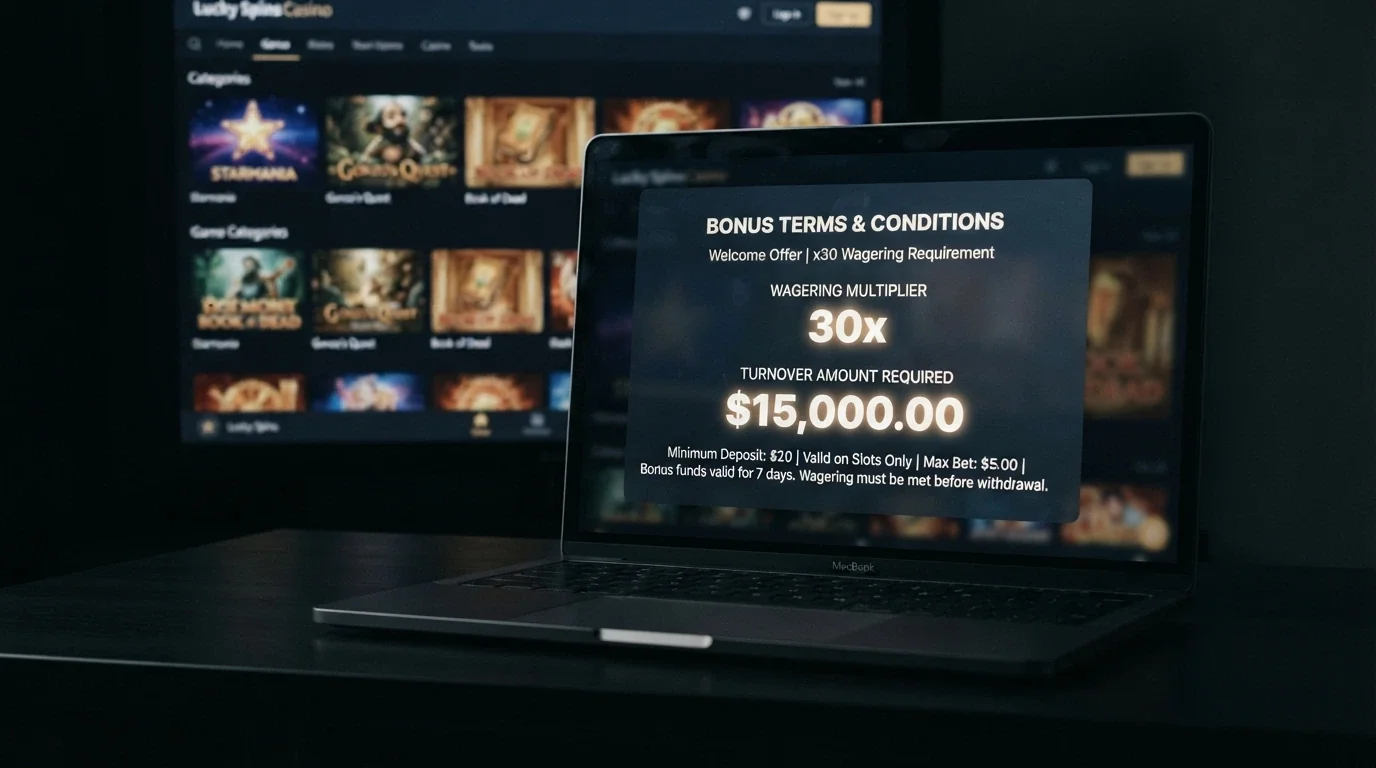
A wagering requirement is the multiplier the casino applies to your bonus winnings before they become withdrawable. Forty times wagering on A$20 of winnings means A$800 must pass through the reels before a cent of the A$20 becomes cash you can take out. Sixty times on the same A$20 means A$1,200. The house edge takes its cut on every spin along the way.
The relationship is mechanical. A higher wagering multiple does not change the size of the win — it changes how much turnover the casino requires before releasing it. The casino’s expected profit scales with the turnover, because every spin carries a house edge. At thirty-five times wagering on A$20 of winnings, the player must turn over A$700 on a pokie with a 96.5% return — the expected loss is around A$24, which already exceeds the original win. The bonus is, on average, a transfer from the player to the operator.
Slot RTPs for popular titles in this market sit close to the 96.5% mark: Big Bass Bonanza at 96.71%, Sweet Bonanza at 96.48%, Sweet Bonanza 1000 at 96.50%, Big Bass Bonanza 1000 at 96.50%. The mathematical implication is consistent across the set — every dollar turned over at these games returns roughly 96.5 cents in expectation, with the remaining 3.5 cents absorbed by the house. Work through the wagering requirement and the house keeps a percentage of every dollar the bonus produced.
Beyond fifty times wagering on no-deposit bonus winnings, the offer becomes practically uncle arable for most players. The expected loss approaches or exceeds the original win before the turnover target is reached, and the player is paying the casino for the privilege of clearing the bonus.
| Slot Title | Provider | RTP | Volatility | Max Win |
|---|---|---|---|---|
| Big Bass Bonanza | Pragmatic Play / Reel Kingdom | 96.71% | Medium-High (4/5) | 2,100× |
| Sweet Bonanza | Pragmatic Play | 96.48% | High | 21,100× |
| Sweet Bonanza 1000 | Pragmatic Play | 96.50% | Very High | 25,000× |
| Big Bass Bonanza 1000 | Pragmatic Play | 96.50% | High | 10,000× |
Using Big Bass Bonanza as the worked example — the most common free-spins target in this market — a player who wins A$20 from a no-deposit offer at 40× wagering must turn over A$800 at 96.71% RTP. The expected loss over that turnover is A$800 × (1 − 0.9671) = A$26.23, which already exceeds the original A$20 win. The bonus’s real cost, in expectation, is a small transfer to the operator — not the headline “free” win the marketing implies.
The withdrawal ceiling and the bonus expiry clock
Even after the wagering requirement is cleared, the operator caps what you can withdraw. Standard max cashout caps in the 2026 AU-facing offshore market sit between A$100 and A$250 for no-deposit bonus winnings. A player who clears a 40× wagering requirement on A$20 of winnings and walks away with a A$500 bonus balance still cannot withdraw more than A$100, regardless of what the balance shows. The remainder is forfeited on withdrawal.
Royal Reels sits at the bottom of this range with an A$50 max cashout on its A$10 free cash offer. Fair Go’s two no-deposit free spins offers sit at the upper end — with A$180 and A$250 max cashout caps on the Plentiful Treasure and Fortunate Buddha spins, respectively. Both numbers are well below the balance a player could realistically accumulate on a high-variance pokie, and both function as a hard ceiling on what the bonus is ultimately worth.
The expiry clock runs alongside. Seven-day validity is the market norm for no-deposit offers at offshore casinos serving Australian players — BitStarz, KatsuBet and Mirax all run seven-day windows. A player who fails to clear the wagering requirement inside that window forfeits the bonus and any winnings tied to it. For a forty-times wagering requirement on A$20, the player needs roughly A$800 of turnover inside seven days — achievable at A$0.10 per spin over several sessions, but not something a player can leave for the weekend.
25, 50 or 100 spins: what the count actually changes
The spin count is the number that does the marketing work, and it is the number that tells the reader least about the offer’s real value. A 25-spin no-deposit offer at A$0.10 per spin produces a maximum of A$2.50 in pre-wagering winnings; a 100-spin offer at A$0.20 per spin produces a maximum of A$20. The two differ by a factor of eight in headline, and by a comparable factor in expected value — but both pass through the same wagering gauntlet once the reels stop.
King Johnnie’s 25 free spins on 3 Coins Hold and Win with zero wagering sits at one end of the market — a bonus where what you win is what you withdraw, full stop. BitStarz’s 50 free spins on Alien Fruits with 40× wagering and A$100 max cashout sits in the middle. Ozwin’s 100 free spins on Oz Golden Trail at 60× wagering and A$180 max cashout, A Big Candy’s 120 free spins on Tarot Destiny at 35× wagering, PlayCroco’s 75 free spins on Coyote Cash 2 at 60× wagering and A$180 max cashout — all of these promise larger spin counts, and all of them require a heavier turnover before any of it converts to cash.
Spin count alone is a poor measure of an offer’s worth. A 25-spin zero-wagering bonus pays out exactly what it produces; a 100-spin 60× wagering bonus may pay out less after the house edge and the cashout cap are applied. The number is a marketing figure, not a value figure.
Free-Play Pokies: The Risk-Free Path the Licensed Market Won’t Give You
There is a way to spin pokies that costs nothing, requires no registration, asks for no payment method, and pays out nothing at the end — because the credits are not real. It is called demo mode, or fun mode, and it is a software feature embedded in the pokie itself rather than a licensed product. Online pokies are prohibited under the Interactive Gambling Act 2001, and there is no Australian licence for the real-money version. The demo version sits in a different category entirely — it is a marketing tool the game provider uses to let prospective players try the title, and it is freely available from every major pokie studio and every aggregator site that hosts the games.

No-download, no-registration demo play
A player opens a browser tab, navigates to a site that hosts the pokie, and clicks “play for fun.” The game loads in seconds, the demo credits reset to ten thousand (or whatever the studio has set), and the reels spin. No account creation, no email, no password, no payment method, no identification check. The only input the player provides is the click.
This is what “free” looks like when the word is taken seriously. The demo credits cannot be withdrawn, cannot be converted to real money, and reset every time the player reloads the game. What they do is let the player experience the pokie — the bonus rounds, the volatility profile, the hit frequency — without any of the financial exposure a real-money session would carry. A player who wants to know what Big Bass Bonanza plays like before staking anything can find out in under a minute.
Free spins inside free-play pokies
Many demo pokies include a free-spins bonus round as part of the game’s own feature set. These in-game free spins are triggered by the pokie’s own mechanics — usually a scatter symbol landing in sufficient quantity — and they are entirely separate from the casino’s no-deposit free spins promotion. Big Bass Bonanza’s free-spins round, Sweet Bonanza’s free-spins mode, Gates of Olympus’s tumble feature with its bonus round: all of these exist inside the demo version and trigger on the same symbol combinations as the real-money version.
A player who plays through a bonus round in demo mode learns what the feature actually does — how often it triggers, how the multipliers stack, what a typical payout looks like — without paying for the lesson. The same feature in real-money mode behaves identically, except the credits on the reels are dollars rather than fun-money and a real balance is at stake.
Pick-up-and-play: free pokies on your phone
The mobile-browser demo experience matches the desktop one feature for feature. No app store visit, no download, no native installation — the same browser tab, the same demo credits, the same touch interface. A player who wants to test a pokie during a commute can do it without installing anything, and the game performs on a modern smartphone much the way it performs on a laptop.
The pick-up-and-play path is the genuinely risk-free way to spin. There is no wagering requirement, no max cashout cap, no expiry clock, and no site that can vanish with a balance on it. The credits reset when the player closes the tab, and the player has lost nothing that was ever theirs to lose.
The Best No-Deposit Free Spins Offers Available to Australians Right Now
The table below ranks the ten AU-facing offshore operators this page covers, with their licence status and welcome bonus terms where research carries them. Every operator listed sits outside the Australian regulatory framework — no Australian licence exists for online casino or pokies. The offers differ. The legal status does not.

| Operator | Licence Status | Welcome Bonus |
|---|---|---|
| Skycrown | Offshore — Curacao | Up to A$8,000 + 400 FS across 4 deposits, 40× wagering |
| Royal Reels | Offshore — no AU licence | A$10 free cash, 40x wagering |
| WinSpirit | Offshore — Curacao 8048/JAZ | Up to A$4,500 + 250 FS across 3 deposits, 45× wagering |
| FairGO | Offshore — Curacao | Up to A$1,000 across 5 deposits, 30× rollover on deposit + bonus |
| Bizzo Casino | Offshore — no AU licence | Up to A$7,250 + 175 FS, min deposit A$20 |
| Rocket Play | Offshore — no AU licence | — |
| Stake | Offshore — no AU licence | — |
| Rainbet | Offshore — no AU licence | 250% up to A$2,100 + 60 FS across 3 deposits, 40× Wager Lock or No Wager Lock |
| Scream Casino | Offshore — no AU licence | — |
| Rocket Casino | Offshore — no AU licence | — |
Skycrown
Skycrown runs the highest no-deposit spin count in the featured set at one hundred free spins, gated behind a mobile phone number verification step. The welcome package behind it is the largest in the set: up to A$8,000 plus 400 free spins spread across four deposit tiers, with forty times wagering on all stages and pokies contributing one hundred percent to the turnover requirement. The lobby holds more than 7,200 games.
The phone-verification gate is a deliberate step: Skycrown wants a confirmed contact channel before releasing the no-deposit spins. The welcome package, by contrast, scales with deposit size — the full A$8,000 headroom requires four deposits at the maximum match tier. A player who deposits the minimum and never tops up sees a fraction of the headline figure, and the four-hundred free spins split unevenly across the four deposit tiers.
Verdict: Skycrown is the volume play in the set. The one hundred no-deposit spins sit at the top of the market, the welcome package scales aggressively, and the lobby is large enough that the wagering requirement can be cleared across a wide range of titles. For a player who intends to deposit anyway, the package terms are competitive against the broader market. The forty-times wagering requirement on winnings is consistent with the market norm.
Royal Reels
Royal Reels is the odd one out in the featured set — it offers A$10 in free cash on registration rather than free spins, and the maximum cashout is the lowest in the set at A$50. The wagering requirement sits at forty times. Verification is via SMS.
The free-cash variant is rarer in the AU-facing market than the free-spins variant, and the A$10 starting position is smaller than what a typical 50-spin no-deposit offer produces in pre-wagering winnings. Forty times wagering on the A$10 bonus means A$400 of required turnover before any withdrawal, and the A$50 cap means even a successful clear cannot exceed A$50 out. The offer rewards persistence more than luck — a player who clears the wagering requirement at a high-RTP pokie on a low-volatility session may walk away with the maximum.
Verdict: Royal Reels is the niche product in the set. A$10 free cash with an A$50 cashout cap is a small, slow offer — best suited to a player who wants to test the cashier and the withdrawal process at minimum exposure rather than chase a headline spin count. It is not the offer to compare against Skycrown or Fair Go on volume.
WinSpirit
WinSpirit is a Curacao-licensed operator — licence number 8048/JAZ, issued through master licensee Antillephone N.V., with Hollycorn N.V. as the operating company established in 2021. The welcome package totals up to A$4,500 plus 250 free spins across three deposits, with forty-five times wagering on the bonus amount and a maximum bet of A$5 per spin while the bonus is active. The lobby holds more than 6,000 pokies and 400-plus live tables from providers including Pragmatic Play, Play’n GO, Big Time Gaming, Quickspin, Evolution and BGaming.
The research this page is built on did not surface a confirmed no-deposit free spins offer from WinSpirit. The operator’s profile sits on what the welcome package and the licence documentation do carry, and the absence of a no-deposit offer is a real gap in the data, not a feature to spin. The forty-five-times wagering is heavier than Skycrown’s forty, and the A$5 max-bet cap is meaningful on a high-variance pokie where the natural betting pattern exceeds it.
Verdict: WinSpirit is the depth play in the set. Six thousand pokies is a serious lobby, the provider list reads like a who-is-who of the major studios, and the licence documentation is more transparent than most in this market. The forty-five-times wagering is heavier than the cluster norm, and the no-deposit gap means a player testing the operator has to deposit to engage. For a player who values lobby depth over headline bonus size, WinSpirit sits near the top of the set.
FairGO
Fair Go Casino is the longest-running brand in the featured set — established 2017, operating under a Curacao licence. Two distinct no-deposit free spins offers sit on the promotions page: one hundred free spins on Plentiful Treasure and seventy free spins on Fortunate Buddha, both at sixty times wagering on winnings, with maximum cashout caps of A$180 and A$250 respectively. The welcome package behind them is smaller than most of the set — up to A$1,000 spread across five deposits (each matched one hundred percent up to A$200), with thirty times rollover on the deposit plus bonus amount.
The sixty-times wagering on the no-deposit offers is at the top of the market range and well above the threshold where clearing becomes impractical for most players. The welcome package’s thirty-times rollover on deposit plus bonus is, by contrast, the lightest load in the set — applied to a smaller base, but materially easier to clear than Skycrown’s forty-times on bonus alone.
Verdict: FairGO is the brand to read carefully. Two no-deposit offers with high spin counts are tempting, but the sixty-times wagering on winnings means the expected cost of clearing the bonus approaches or exceeds the win itself. The welcome package is light on the rollover, but the no-deposit shelf is heavy. A player who wants FairGO’s longevity and brand stability should treat the welcome package as the primary value and the no-deposit offers as a peripheral test.
Bizzo Casino
Bizzo Casino holds the largest game lobby in the featured set — more than 8,000 titles from seventy-plus providers. The welcome package offers up to A$7,250 plus 175 free spins, with a minimum deposit of A$20 and the maximum one hundred and twenty-five percent match requiring a deposit of A$250 or more.
The closest thing Bizzo runs to a no-deposit offer is a notifications-triggered bonus, the type and amount of which research did not confirm. The wagering terms on the welcome package were likewise not confirmed from the snippets this page is built on. What is confirmed is the lobby scale — eight thousand titles is a serious number, and the seventy-plus provider count means the catalogue covers the full range of major studios and most of the smaller ones.
Verdict: Bizzo is the catalogue play in the set. Eight thousand titles is meaningful for a player who values variety over headline bonus, and the welcome package ceiling is competitive. The data gaps on the no-deposit offer and the wagering specifics mean a player who wants to compare terms before signing up has to verify them on the operator’s own page. The lobby is the strongest argument for the brand; the bonus terms are the question mark.
Rocket Play
Rocket Play is a recognised brand in the AU-facing offshore market, but confirmed promotional data for the operator was unavailable during the research phase. The brand’s offshore status is well-documented in the market.
The absence of confirmed data is not the same as the absence of an offer. Rocket Play, like every operator in the featured set, runs promotions — the gap is in what the research pass was able to surface, not in what the operator provides. A player who wants to evaluate Rocket Play on the merits of its offer has to consult the operator’s own promotions page.
Verdict: Rocket Play is the brand the data did not land on. The market presence is real; the offer specifics this page can speak to are not. A player comparing operators before signing up should treat Rocket Play as a name to investigate rather than a profile to evaluate from this page alone.
Stake
Stake is a globally recognised brand with an AU-facing presence. As with Rocket Play, specific bonus terms for the AU-facing product were unavailable to this research. The brand’s global profile and offshore status are documented.
Stake’s market presence extends well beyond Australia, and the operator’s product mix is broader than most in this set — sports betting, casino, and original in-house games all sit on the same platform. The data gap on the promotional terms is a gap on this page, not a gap on the operator’s site.
Verdict: Stake is the global brand the data did not land on. A player who knows Stake from its broader market profile should not assume the AU-facing terms match what they have seen elsewhere — and should not assume they do not. The verification step is the same as for Rocket Play: consult the operator’s own page.
Rainbet
Rainbet’s welcome package offers a two hundred and fifty percent match up to A$2,100 plus sixty free spins across three deposits, with a choice between two paths: a forty-times Wager Lock path and a No Wager Lock path. The latter is the unusual term — winnings on the No Wager Lock path require no turnover before withdrawal, subject to a A$200 max cashout cap.
The No Wager Lock path is the closest equivalent in the featured set to the zero-wagering benchmark at the wider-market end of the spectrum. The trade-off is the A$200 cap — a player who clears the wagering on the Wager Lock path may take out more, if the cap is higher on that path, but pays for the chance with forty-times turnover. The choice is between a smaller withdrawal amount with certainty and a larger contingent one with higher turnover.
Verdict: Rainbet is the structural outlier in the set. The dual-path welcome is unusual in this market and gives the player a real choice between certainty and ceiling. For a player who values certainty over size, the No Wager Lock path is the closest thing to a clean offer on this page. For a player chasing headline volume, the Wager Lock path competes with the rest of the set on raw size.
Scream Casino
Scream Casino is a newer entrant to the AU-facing offshore market. Research this page is built on did not surface confirmed bonus data — no welcome package, no no-deposit offer, no wagering multiplier. What is documented is the offshore status and the brand’s market entry.
A newer entrant to this market is, by definition, less documented than an established brand. The gap on bonus data is not unusual for a brand at this stage of its market presence. A player who wants to evaluate Scream Casino on offer terms has to check the operator’s own page.
Verdict: Scream Casino is the new entrant the data did not land on. Market entry is recent; the promotional terms this page can confirm are not yet documented. Treat the brand as a name to investigate, not a profile to evaluate from this page alone.
Rocket Casino
Rocket Casino is a distinct AU-facing brand from Rocket Play — the two share a first word but are separate operators. Research this page is built on did not surface confirmed bonus data for either, and the data gap on Rocket Casino is the same shape as the gap on Rocket Play: offshore status confirmed, offer specifics not documented.
The distinction from Rocket Play matters because a player who confuses the two will land on the wrong site. Both are offshore, both serve Australian players, both sit outside any Australian regulatory framework, and neither has confirmed bonus data on this page.
Verdict: Rocket Casino is the brand to keep separate from Rocket Play. The names overlap, the offshore status is identical, and the offer data is equally thin on this page. A player evaluating either should not assume the two share terms, products, or policies.
Online Pokies and Australian Law: What the IGA Actually Prohibits
Every operator on this page is offshore, and every one of them offers a product that is prohibited in Australia. The Interactive Gambling Act 2001 makes it an offence to provide online casino games, online pokies and in-play sports betting to a person physically in Australia. The Act was strengthened by amendments in 2017, and it has been enforced consistently since. There is no Australian licence — federal, state or territory — for any operator offering online casino or pokies to Australians. The product this page describes exists because the providers operate from jurisdictions outside Australia’s reach.

The IGA prohibition: what’s banned and who it actually targets
The Interactive Gambling Act 2001 divides interactive gambling services into two categories: prohibited services and licensable services. Online casino games, online pokies and in-play sports betting sit in the prohibited category. Pre-event wagering on races and sport, lotteries and keno sit in the licensable category, licensed by state and territory regulators — with the Northern Territory Racing and Wagering Commission, through Licensing NT, acting as the de facto national licensor for online bookmakers.
The ACMA enforces the online prohibition. It investigates complaints, issues formal warnings, brings civil penalty proceedings, refers operators for further enforcement, and directs Australian ISPs to block illegal sites. Since November 2019, the ACMA has had 1,564 illegal gambling and affiliate websites blocked by Australian ISPs as of March 2026, and more than 225 illegal services have withdrawn from the Australian market since the 2017 amendments.
The individual player is not the target. The IGA makes it an offence to provide a prohibited service — the operator is the party at risk, not the customer. No Australian has been prosecuted for playing at an offshore casino. What the player loses by playing offshore is the consumer protection framework the licensed Australian wagering market provides, not their legal status.
Offshore operators: what Australian players give up by playing there
The licensed Australian wagering market provides a stack of protections an offshore casino does not. BetStop, the National Self-Exclusion Register, binds every Australian-licensed wagering provider — a single registration excludes a person from all of them. The ACMA operates a complaints and enforcement mechanism that an Australian player can use when a licensed operator fails to pay. Consumer protection law applies to the licensed provider the way it applies to any other Australian business. The site cannot be blocked by an ISP direction while the player’s balance sits on it.
None of these protections reach an offshore casino. BetStop covers approximately 150 licensed wagering providers and none of the operators on this page. The ACMA has no jurisdiction over a Curacao-licensed operator and cannot compel a withdrawal. Australian consumer law does not apply to a transaction with an entity that has no Australian presence. The site can be added to the ACMA’s blocking list at any time, and a player with a balance still on deposit when that happens has no domestic recourse.
This is the trade-off the offshore market asks a player to accept. The offers are larger than anything the licensed Australian market could match (because the licensed market does not offer the product). The protections are smaller because the protections were designed for a market the operator is not in.
The 2026 gambling reform and what changes from January 2027
The Interactive Gambling Amendment (Gambling Reform) Bill 2026 passed Parliament on 19 August 2026. Its measures commence on 1 January 2027. The reform package touches advertising, inducements, payment blocking and the registers that underpin the existing self-exclusion infrastructure.
The advertising restrictions are the most visible. From 1 January 2027, wagering advertising during live sporting coverage is banned — the blackout runs from fifteen minutes before to five minutes after a live sporting event. Radio wagering advertising is barred during school commute and school hours. Broadcasting sporting odds is banned outright. Online wagering advertising can only be served to users who are logged in, verified as over eighteen and have not opted out of wagering advertising through AdStop, the new national opt-out register to be administered by the ACMA. Wagering ads do not appear in sports venues or on player uniforms, and athletes, celebrities and influencers are barred from promoting wagering products.
The inducement restrictions sit alongside. From 1 January 2027, direct marketing of wagering inducements is prohibited for fourteen days after a customer signs up with a licensed operator, for three months after the customer deregisters from BetStop, and indefinitely for customers identified as at-risk. The intent is to dampen the promotional pressure the licensed market has built over the last decade.
The payment-blocking authority is the most consequential change for offshore operators. From 1 January 2027, banks and payment providers gain express authority to block transactions to illegal gambling operators. PayID, BPAY and direct bank transfers to a known illegal-gambling recipient become blockable at the institution’s discretion. The reform does not force the block — it authorises it. A bank that wants to refuse to process a PayID payment to an offshore casino now has the legal cover to do so.
The self-exclusion register and the safety net that stops at the border
BetStop, the National Self-Exclusion Register, launched on 21 August 2023. One registration excludes a person from every Australian-licensed online and phone wagering service. The terms run from a minimum of three months to a maximum of lifetime. To the end of Q3 FY 2025–2026 (31 March 2026), 59,830 people had registered, and 37,247 of those registrations were active.
The register is a genuine achievement of the Australian regulatory framework. It is also a register that stops at the border. BetStop binds licensed Australian wagering services — every major online bookmaker in the country is connected. An offshore casino is not connected, and will keep accepting a self-excluded person’s money without intervention. The register is the strongest tool available to an Australian who wants to stop gambling on the licensed side of the market, and it does not reach the offshore side at all.
The National Gambling Helpline — 1800 858 858 — is free, confidential, staffed 24/7 and connects to Gambling Help Online at gamblinghelponline.org.au for online chat and counselling. The service is available regardless of where a person plays, and it is the one piece of support infrastructure that does reach the offshore side.
The real scale of gambling harm in Australia — and where to get help
Between March 2025 and March 2026, Australians lost A$36.0 billion to gambling. Roy Morgan’s July 2026 study put gambling-harm prevalence at 15.1% of the population — approximately 3.32 million Australians experiencing some form of harm from their own or another person’s gambling. The ANU Centre for Social Policy Research found that risky gambling increased from 13.7% in 2024 to 19.4% in 2025, a near-doubling since the COVID-19 lockdowns of 2020–2021. The Australian Institute of Health and Welfare put problem gambling at approximately 2.1% of adults — roughly 430,000 people.
The harm statistics describe a country that gambles heavily and is gambling more riskily than it did five years ago. The total annual gambling turnover exceeds A$36 billion; the harm prevalence exceeds 3.3 million people. The gambling-reform measures commencing on 1 January 2027 are a response to that scale, and the existing support infrastructure exists because the scale was already large before the reform.
The help infrastructure is real and it reaches anyone in Australia. The National Gambling Helpline (1800 858 858) is free, confidential and available 24/7. Gambling Help Online (gamblinghelponline.org.au) provides online chat and counselling around the clock. State-based counselling services are reachable through both. BetStop is the self-exclusion tool for the licensed market. None of these resources requires the person to be gambling on a licensed site.
Getting Paid: The Payment Methods That Work (and the Ones That Signal Trouble)
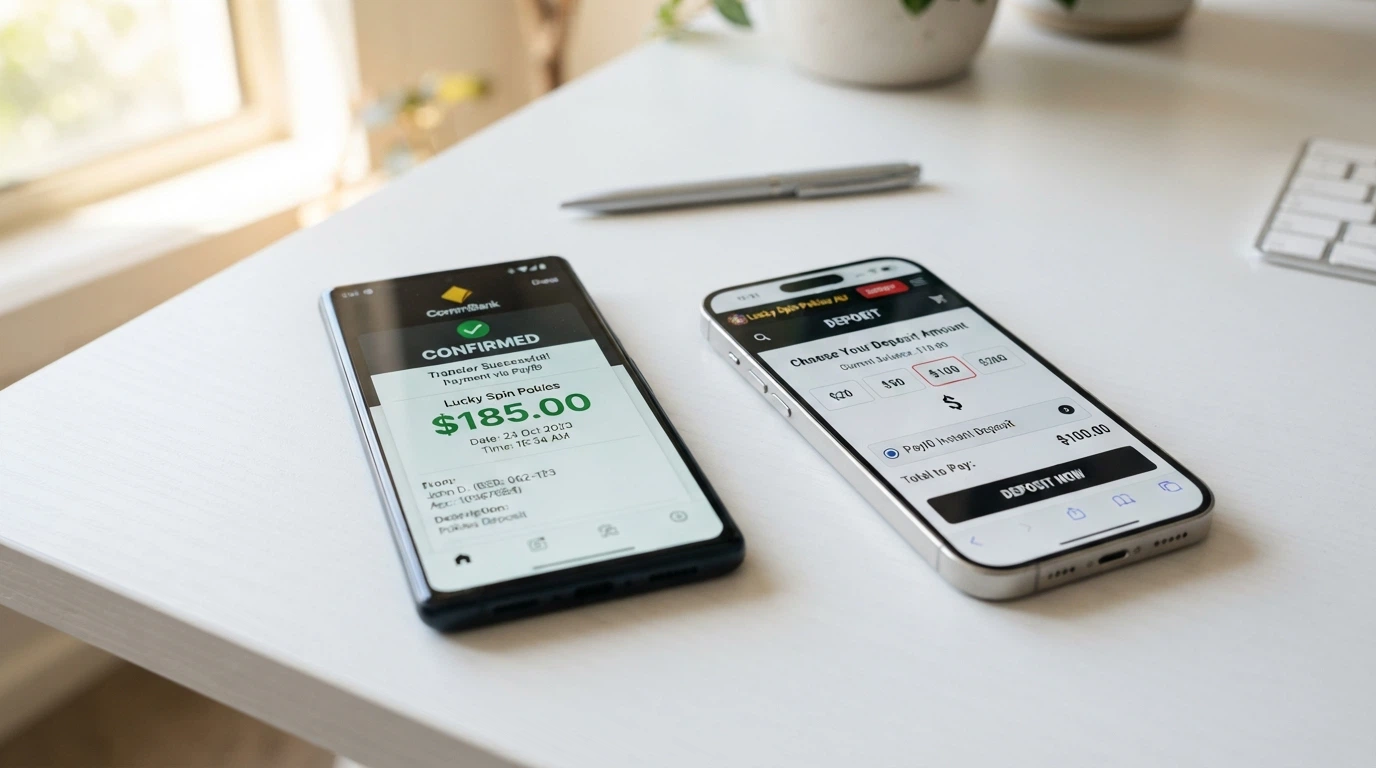
The legal deposit routes for online wagering in Australia are debit card, bank transfer, PayID/Osko and BPAY. Credit cards, credit-related products and digital currency have been banned as payment for online wagering since 11 June 2024, with penalties of up to A$247,500 for operators that fail to enforce the ban. From 1 January 2027, banks and payment providers gain express authority to block transactions to illegal gambling operators.
PayID, bank transfer and the legal deposit routes
PayID and Osko are the fastest domestic routes for an Australian player depositing at a licensed wagering operator. A PayID transfer settles in seconds; an Osko payment arrives in near-real time; BPAY clears overnight. The licensed Australian bookmakers all accept at least one of these methods, and the deposit experience at a licensed operator is fast, audited, and protected by Australian consumer law.
The offshore casino market serving Australian players does not consistently offer any of these routes. PayID and Osko are domestic bank-to-bank rails, and an offshore operator without an Australian banking presence cannot accept them directly. Most offshore casinos in this market route through debit cards, e-wallets (Neteller, Skrill, MiFinity), and cryptocurrency. None of these is illegal for the player to use — the credit and crypto ban targets the operator, not the customer — but the deposit experience at an offshore casino is structurally different from the deposit experience at a licensed Australian bookmaker.
Why a site asking for credit card or crypto is a red flag
Since 11 June 2024, an Australian-licensed wagering operator cannot accept credit cards, credit-related products or digital currency as payment. The penalty for non-compliance is up to A$247,500 per offence. An operator still displaying Visa or Mastercard logos, or still accepting Bitcoin or Ethereum deposits, is operating outside the Australian rules — by definition, since the licensed market has been barred from accepting these methods for nearly two years.
The red flag is not that the player cannot deposit by these methods offshore. The red flag is that the operator is treating the Australian ban as inapplicable, which is consistent with the operator being offshore and offering a product (online pokies) that is itself prohibited under the IGA. A credit-card deposit button on a pokies site is a tell that the operator is not subject to ACMA enforcement.
Withdrawal speeds and what actually shapes them
Withdrawal speed at any casino depends on three variables: the payment method, the operator’s processing queue, and the KYC (know-your-customer) verification check that gates every first withdrawal. A PayID or e-wallet withdrawal at a fast-paying operator can settle in under 24 hours; a bank transfer at the same operator takes two to five days; a first withdrawal pending KYC verification can take a week or more while the player submits identity documents.
Skycrown’s bank-transfer withdrawals clear within three days from a minimum of A$100, which is a useful benchmark for the offshore end of the market. Most offshore operators serving Australian players quote similar windows — one to three business days for e-wallets, three to five for bank transfers — and most add the caveat that the window starts after verification, not after the withdrawal request. A player who has not submitted KYC documents before requesting a first withdrawal can expect the window to extend until verification completes.
At an offshore casino, none of these windows is enforceable by an Australian authority. The licensed Australian bookmaker is bound by the consumer law and the licensing conditions of its jurisdiction; the offshore casino is bound by its own terms page, and the player has no domestic recourse if the operator misses its own stated window.
How We Evaluated Every Operator on This Page
The ranking on this page was built on the assumption that an Australian player reading it is going to weigh two questions before signing up anywhere: what does the no-deposit offer actually deliver after the wagering and the cashout cap are applied, and what does the operator’s offshore status mean for the protections the player gives up by playing there. Every operator in the featured set was measured against the same two axes.
The first axis is offer terms. Where research surfaced a no-deposit free spins offer — Skycrown’s 100 FS, Fair Go’s 100 FS and 70 FS, Royal Reels’ A$10 free cash, the wider-market benchmark at 50 FS with 40× wagering and A$100 max cashout — the offer was evaluated against the cluster norm: 20 to 120 spins at 30× to 60× wagering on winnings, with max cashout caps of A$100 to A$250. Where research did not surface a confirmed no-deposit offer, the gap is stated plainly on the operator’s profile.
The second axis is licence status. Every Australian-facing casino offering online pokies is offshore, because no Australian licence for online casino exists. The featured set ranks operators by the transparency of their offshore licence (WinSpirit’s Curacao 8048/JAZ is the most documented; others have less), by their game-lobby scale (Bizzo’s 8,000+ titles, Skycrown’s 7,200+, WinSpirit’s 6,000+), and by the clarity of their bonus terms. Operators with confirmed data sit above operators with data gaps, but neither group is endorsed over the other for the reader.
The official whitelists checked against the evaluation: the ACMA register of blocked sites, the Interactive Gambling Act 2001 as enforced, and the BetStop National Self-Exclusion Register. None of the operators in the featured set appears on any licensed register, because no register exists for the product they offer. The whitelist check is, by design, a null set.
The limit of this evaluation is the limit of the research it is built on. Where the research pass did not surface a figure — a wagering multiplier for Bizzo, a bonus expiry for WinSpirit, the licence documentation for Rocket Play and Stake — the operator’s profile reflects the gap rather than fabricating a figure to fill it. The audit downstream of this page verifies the figures it carries against the research; it cannot verify what was never there to begin with.
Your Next Move: What This Means for Where You Play
The page has laid out the offers, the fine print and the legal reality. What remains is the decision the page cannot make for the reader.
The trade-off is straightforward. The licensed Australian wagering market does not offer online pokies at all — the product is prohibited under the IGA, and no licence exists for it. The offers this page describes come from operators who exist precisely because they operate outside that prohibition. The free spins are real money. The wagering requirements, the cashout caps and the expiry clocks are real conditions. The absence of BetStop coverage, ACMA recourse and Australian consumer protection is the real cost the player pays for the offer being available at all.

The alternative is the demo mode described earlier. Free-play pokies cost nothing, require no registration, ask for no payment method and pay out nothing. They are not a substitute for a player who wants to play for real money, but they are the genuinely risk-free way to spin, and they exist because the game providers offer them as a marketing tool rather than because any regulator approved them as a product.
The support infrastructure is open to anyone in Australia who plays, regardless of where. The National Gambling Helpline (1800 858 858) is free, confidential, and available 24/7. Gambling Help Online (gamblinghelponline.org.au) provides online chat and counselling around the clock. BetStop is the self-exclusion register for the licensed market. A player who wants help does not have to be playing on a licensed site to ask for it.
The final decision sits with the reader. This page describes the offers, names the operators, explains the fine print, and lays out the legal framework. It does not pick one. The reader’s own appetite for the trade-off — the bonus size against the absence of domestic protection — is the variable the page cannot supply.
Frequently Asked Questions
What are wagering requirements and how do they work on free spins bonuses?
A wagering requirement is the multiplier the casino applies to your winnings before they convert to withdrawable cash. Forty times wagering on A$20 of free-spins winnings means A$800 must be turned over on the pokies before any of it can be withdrawn. The required turnover is calculated on the winnings, not on the original spin count, and every spin along the way carries the house edge. A 40× requirement at a 96.5% RTP pokie produces an expected loss that often exceeds the original win, which is why anything above 50× on no-deposit bonus winnings is considered practically uncle arable for most players.
What is the maximum amount I can cash out from a no-deposit free spins bonus?
Standard max cashout caps in the AU-facing offshore market sit between A$100 and A$250 for no-deposit bonus winnings, with Royal Reels at the low end (A$50) and Fair Go’s Fortunate Buddha spins at the upper end (A$250). The cap applies regardless of how high your bonus balance climbs — clearing the wagering requirement on A$500 of bonus balance still cannot produce more than the stated cap on withdrawal. Any balance above the cap is forfeited at the moment you withdraw.
What happens if an offshore casino refuses to pay my winnings?
There is no domestic recourse. The ACMA does not have jurisdiction over an offshore operator and cannot compel a withdrawal. Australian consumer law does not apply to a transaction with an entity that has no Australian presence. BetStop does not cover offshore sites. The casino’s own terms page is the only contract that governs the dispute, and the player has no leverage beyond the operator’s reputation. This is the trade-off the offshore market asks a player to accept in exchange for the offer being available.
How does BetStop protect me and does it cover offshore casino sites?
BetStop, the National Self-Exclusion Register, launched on 21 August 2023 and binds every Australian-licensed online and phone wagering provider — one registration excludes a person from all of them. As of 31 March 2026, 59,830 people had registered and 37,247 had active exclusions. The minimum exclusion period is three months, the maximum is lifetime. BetStop does not cover offshore casinos, and an offshore site will keep accepting a self-excluded person’s money without intervention.
Do I have to pay tax on my pokies winnings in Australia?
No. Gambling winnings are not assessable income under section 6-5 of the ITAA 1997, and gambling losses are not deductible under section 8-1 — unless the person is carrying on a business of betting or gambling, which an ordinary punter is not. No Australian case has held an ordinary punter’s winnings assessable. The tax treatment is the same whether you play at a licensed Australian bookmaker or at an offshore casino; the difference is in the consumer protection framework, not in the ATO’s treatment of the winnings.