
What Aussies Can Actually Use to Deposit at Online Casinos This Year
 Available in AU
The method an Australian player chooses to move money in and out of an online casino shapes more than the wait at the cashier. It sets the fee, the privacy, whether the withdrawal even arrives — and, in a market where every casino accessible from Australia is offshore and unlicensed, the method itself is the cleanest signal of which side of the law the operator sits on. Forty-two percent of Australian players now deposit with PayID, and the market has reorganised around it since the credit card and crypto ban took effect on 11 June 2024. This article lays out what is available, what it costs, and what each method says about the casino offering it.

Current as of 18 October 2026 · Verified against the Interactive Gambling Act 2001, ACMA enforcement records and AU-facing operator banking pages.
Table of Contents
- Australia’s Casino Payment Landscape: What You Can Use and What’s Banned in 2026
- Why Your Deposit Method Decides More Than Speed
- 10 Offshore Casinos Australians Use — and the Payment Methods They Accept
- Mobile Payments: Tap, Scan, Play
- Crypto Casino Deposits: Fast, Volatile and Outside the Rules
- The Law: What Makes a Casino Payment Method Legal or Illegal in Australia
- Responsible Gambling: Tools That Work and Tools That Don’t
- How We Evaluated These Payment Methods
- Start With PayID, Add a Withdrawal Route and Never Deposit What You Can’t Afford to Lose
- Frequently Asked Questions
Australia’s Casino Payment Landscape: What You Can Use and What’s Banned in 2026
The Australian market splits cleanly along a single line. On one side: licensed wagering operators — Sportsbet, bet365, Ladbrokes — that legally accept only debit card, bank transfer, PayID/Osko and BPAY, and offer no casino product at all. On the other side: every online casino an Australian can actually play at, which is unlicensed under the Interactive Gambling Act 2001 and operates offshore. The payment methods on a casino’s banking page tell you which side of that line it sits on without reading the small print. A site asking for a credit card or a crypto deposit is, by definition, outside Australian rules — a credit card deposit at a casino licensed in Australia is a regulatory breach, and crypto for licensed wagering has been banned since 11 June 2024 alongside it.
The methods Australians actually use in 2026 have shifted decisively. PayID dominates at over 42% of players, bank transfer remains the slow-but-universal fallback, e-wallets hold a meaningful slice for players who want their casino money off their bank statement, and crypto has carved out a parallel track among the offshore brands that accept it. Card use has collapsed under the credit ban; the only legal card route for wagering is debit, and even debit has the slowest mainstream withdrawal timeline in the market at three to five business days. The decision tree is no longer “which card?” — it is “which rail, with what fee, and what does that rail say about the operator?”
The Deposit-Route vs Withdrawal-Route Split
A method that lands money in a casino account inside a minute can take days to send it back, and several methods work one way only. Apple Pay and Google Pay deposit instantly with zero fees but do not support withdrawals at all — a player who funds an account with Apple Pay has to register a second method, usually PayID or bank transfer, before cashing out. Neosurf has the same shape: the voucher is bought for cash at any Australian newsagent and deposited instantly with full anonymity, but the bank never sees the transaction, and getting winnings back requires either a Jeton e-wallet (24 to 48 hours once registered), PayID, or a crypto withdrawal.
The split exists for two reasons. The first is technical — Apple Pay and Google Pay are NFC push-payment rails with no pull-payment counterpart, so the casino has no way to credit a card on file. The second is procedural: every withdrawal triggers a KYC review, and the casino counts payout speed from approval, not from the click. An e-wallet advertised as “instant” can still be held for 24 to 48 hours while the casino’s internal review runs. PayID sits at the clean end of this split — deposits under 60 seconds, withdrawals one to four hours after approval, no second method needed, and the money moves in Australian dollars without conversion.
Which Payment Methods Australians Actually Use in 2026
PayID leads because it does what Australian players want: it is fast, it is AUD-native, and it keeps the transaction off the card statement without the friction of an e-wallet signup. Over 42% of AU players use it for casino deposits, and the share has been climbing since the credit card ban compressed the alternatives. E-wallets — Skrill, Neteller, PayPal, MiFinity and EzeeWallet — hold the next-largest slice among players who prioritise privacy over fees. Crypto has grown as offshore-only operators built their cashiers around stablecoin deposits, with USDT on TRC-20 clearing in under a minute and Bitcoin still the most widely accepted but the slowest of the major coins.
Card use has fallen sharply post the 11 June 2024 ban. Debit remains available but carries the three-to-five-business-day withdrawal penalty, and the cash-advance trap — where a card issuer classifies the deposit as a cash-equivalent transaction and adds interest plus a processing fee — is a genuine, if unevenly applied, risk. The competitor pages that still list credit cards as an option have not caught up to the ban; treating any such listing as current is a mistake.
Why Your Deposit Method Decides More Than Speed
Speed is the variable every casino banking page leads with, and it is the least interesting one. The decision an Australian player actually makes covers five variables at once: deposit speed, withdrawal speed after approval, fees (including the hidden exchange margins on e-wallets), whether the method works both ways, and whether the method itself signals that the casino is licensed or offshore. No single method wins on all five. PayID wins on speed and two-way support, e-wallets win on privacy at the cost of a margin, debit cards win on familiarity at the cost of a slow withdrawal, and crypto wins on speed and anonymity at the cost of offshore-only operation.
The trade-off every Australian player faces is between speed-of-deposit and control-of-money-on-account. Apple Pay is the smoothest way in and a dead end on the way out. PayID is the most balanced method overall. Crypto is the fastest in both directions but operates entirely outside Australian consumer protection. Bank transfer is the universal fallback that always works and never arrives quickly.
| Method | Deposit Speed | Withdrawal Speed | Fees | Minimum Deposit | Two-Way (Yes/No) |
|---|---|---|---|---|---|
| PayID | Instant (<60s) | 1–4h after approval | None | A$10–20 | Yes |
| POLi | Instant | 1–2 business days | None | Varies by operator | Yes |
| Trustly | Instant to 1h | Same-day to 1–3 business days | None | Varies | Yes |
| Debit Card (Visa/Mastercard) | Instant | 3–5 business days | None from casino; possible cash-advance treatment by issuer | Typically A$20 | Yes |
| Apple Pay / Google Pay | Instant | Not supported | None | Typically A$10 | No |
| Skrill / Neteller | Instant | 0–48h (24–48h internal review common) | 3.99% hidden exchange margin on AUD | Typically A$10 | Yes |
| PayPal | Instant | 0–24h after approval | None typically; AUD support varies | Varies | Yes |
| MiFinity / EzeeWallet | Instant | 0–24h after approval | Lower than Skrill/Neteller | Typically A$10 | Yes |
| Bank Transfer (BSB) | 1–3 business days | 3–5 business days via SWIFT | Possible bank wire fee | Typically A$20 | Yes |
| BPAY | Same-day to 1 business day | Not supported | None | Varies | No |
| Neosurf (prepaid voucher) | Instant | Requires second route (Jeton 24–48h, PayID, or crypto) | Voucher denomination | A$10–100 voucher | No |
| USDT (TRC-20) | 30–90s | 30–90s | Negligible above A$1,000 | Network-dependent | Yes |
| BTC | 10–30 min | Up to 30 min | Variable network fee | Network-dependent | Yes |
| ETH | ~2 min | ~2 min | Gas fee | Network-dependent | Yes |
PayID and Osko: The AU Favourite That Actually Delivers
PayID runs on the New Payments Platform (NPP), with Osko as the real-time settlement layer, and it is the closest thing the Australian market has to a default payment method for online casino deposits. Deposits land inside 60 seconds. Withdrawals clear one to four hours after the casino approves them — that distinction matters, because “approval” is the gate most players do not see. Per-transaction minimums sit around A$10 to A$20, and many offshore casinos cap individual PayID deposits at A$1,500 to A$5,000. Withdrawal minimums start at A$50 with a daily ceiling that varies by operator but lands around A$9,000.

The bank’s side of the rail sets a separate ceiling. PayID’s daily deposit limit runs from A$10,000 to A$25,000 depending on the bank, and the first transfer to a new payee can be held for up to 24 hours while the bank’s fraud screen runs. A first-time deposit through PayID at a brand-new casino is therefore not always instant — the 24-hour hold is a bank-side check, not a casino delay. After the first transaction to that payee, subsequent transfers clear normally.
PayID is currently the easiest and most reliable option for Australian offshore casino deposits — that assessment, from one of the AU-focused comparison sites, holds up against what the data shows. The method wins on speed, on AUD-nativity (no conversion, no margin), and on two-way support. The drawback is that PayID is a payment rail an Australian bank can block — from 1 January 2027, banks have express authority to decline transactions to illegal gambling operators, and PayID is the most exposed rail because every PayID transfer routes through an Australian bank.
E-Wallets Compared: Skrill, Neteller, PayPal, MiFinity and EzeeWallet
E-wallets solve one problem cleanly: the casino never sees a bank account. The transaction sits on the e-wallet’s statement instead, and the bank statement shows only a top-up to Skrill or Neteller. The cost is a fee the banking page does not advertise — Skrill and Neteller apply a 3.99% exchange margin on AUD deposits that is buried in the conversion rate, not displayed as a line item. A A$500 deposit through Skrill can arrive as roughly A$480 of playable balance after the margin runs.

The five AU-relevant e-wallets differ on three dimensions. Skrill and Neteller carry the 3.99% margin and are excluded from welcome bonuses on many AU-facing platforms — claiming a deposit bonus with Skrill can void the offer outright. PayPal caps individual casino transactions at A$10,000, has fewer offshore operators accepting it than Skrill or Neteller, and varies in whether it supports AUD directly. MiFinity and EzeeWallet are the newer entrants, with lower margins than Skrill or Neteller and fewer bonus exclusions, which has earned them the share Skrill once held.
Withdrawal speed through e-wallets is the variable the marketing most often overstates. The advertised “instant payout” applies to the e-wallet’s processing time — once the casino releases the funds, they reach the wallet in seconds. What the casino does with the funds before releasing them is the actual delay, and many casinos run a 24-to-48-hour internal review on every e-wallet withdrawal regardless of the ad copy. A “0–24h withdrawal” on a casino’s banking page can mean a 48-hour wait once the queue is included.
Debit Cards: Familiar, Instant In, Painfully Slow Out
Visa and Mastercard debit are the path of least resistance for an Australian player who already has a card. Deposits clear instantly, the casino treats the card as a familiar instrument, and no signup is needed beyond what the casino itself requires. The catch is the withdrawal: three to five business days is the standard timeline, making debit the slowest mainstream withdrawal option in the market after bank transfer, and the second-slowest overall.
A subtler risk sits in how the card issuer classifies the transaction. Some Australian card issuers treat a casino deposit as a cash-equivalent transaction, applying cash-advance interest rates and a processing fee that the player sees only on the next statement. This treatment is unevenly applied — it depends on the bank and on the merchant category code the casino’s payment gateway reports — but it is not theoretical, and players who hit it discover the cost on their statement, not at the cashier. Credit cards have been banned for online wagering since 11 June 2024, so the only legal card route is debit — and only at licensed wagering operators, not at offshore casinos.
Bank Transfer and BPAY: Reliable but Glacial
Bank transfer is the fallback that always works. Every licensed wagering operator accepts it, every bank supports it, and there is no signup or third party in the path. The cost is speed: SWIFT withdrawals take three to five business days, and even a domestic BSB transfer runs one to three days on the way in. For large amounts — withdrawals above what PayID’s per-transaction cap allows — bank transfer is the only realistic option.
BPAY is a legal deposit route for licensed Australian wagering but is deposit-only — it cannot be used to withdraw. The payment routes back through the player’s bank account using BPAY’s biller code system, and it clears same-day to one business day. For an Australian depositing at a licensed wagering operator, BPAY is a perfectly serviceable rail. For an offshore casino, BPAY is rarely available at all, and the player who needs it has to go to a licensed brand.
Prepaid Vouchers: How Neosurf Works for Casino Deposits
Neosurf is the only method an Australian player can use without the bank ever seeing the transaction. Vouchers are bought for cash at any Australian newsagent, denominated in fixed values typically from A$10 to A$100, and redeemed at the casino cashier as a 16-digit code. The deposit clears instantly, the bank statement shows nothing, and the player’s name is not attached to the casino’s deposit record.
The price for that privacy is a second method. Neosurf does not support withdrawals, so the player who deposited with a voucher has to register a separate route — most commonly a Jeton e-wallet (24 to 48 hours once set up), PayID, or a crypto wallet. The Neosurf deposit also caps spending at the voucher value, which doubles as a budgeting tool: a player who wants a hard ceiling can buy a A$100 voucher and stop when it is gone. That is a useful structural feature for anyone who has decided they want friction between themselves and a second deposit.
POLi and Trustly: The Mid-Tier Contenders
POLi sits between PayID and bank transfer. Deposits are instant, the rail connects directly to the player’s bank account, and the casino sees a normal bank-to-bank transfer rather than a card charge. Withdrawals go back to the bank account typically within one to two business days — faster than SWIFT, slower than PayID. POLi is more widely accepted at AU-facing casinos than it once was, though coverage is thinner than PayID.
Trustly is the European parallel to POLi, with a different ownership structure and a variable timeline. Deposits are instant to one hour; withdrawals range from same-day to one to three business days, depending entirely on the casino’s KYC queue. Where Trustly is available, it works well; where it is not, the player has to default to PayID or bank transfer.
Withdrawal Speed: What the Casino Doesn’t Tell You
The published payout time on a casino’s banking page is the time from approval, not from the click. Three separate gates sit between a withdrawal request and the money arriving: the casino’s KYC queue, the internal review (often called a “pending” period), and the payment rail’s own processing window. A PayID withdrawal can be one to four hours after approval, but if the approval takes 24 hours and the bank holds the first transfer to a new payee for another 24 hours, the player sees 48 hours — not the four hours the rail is capable of.
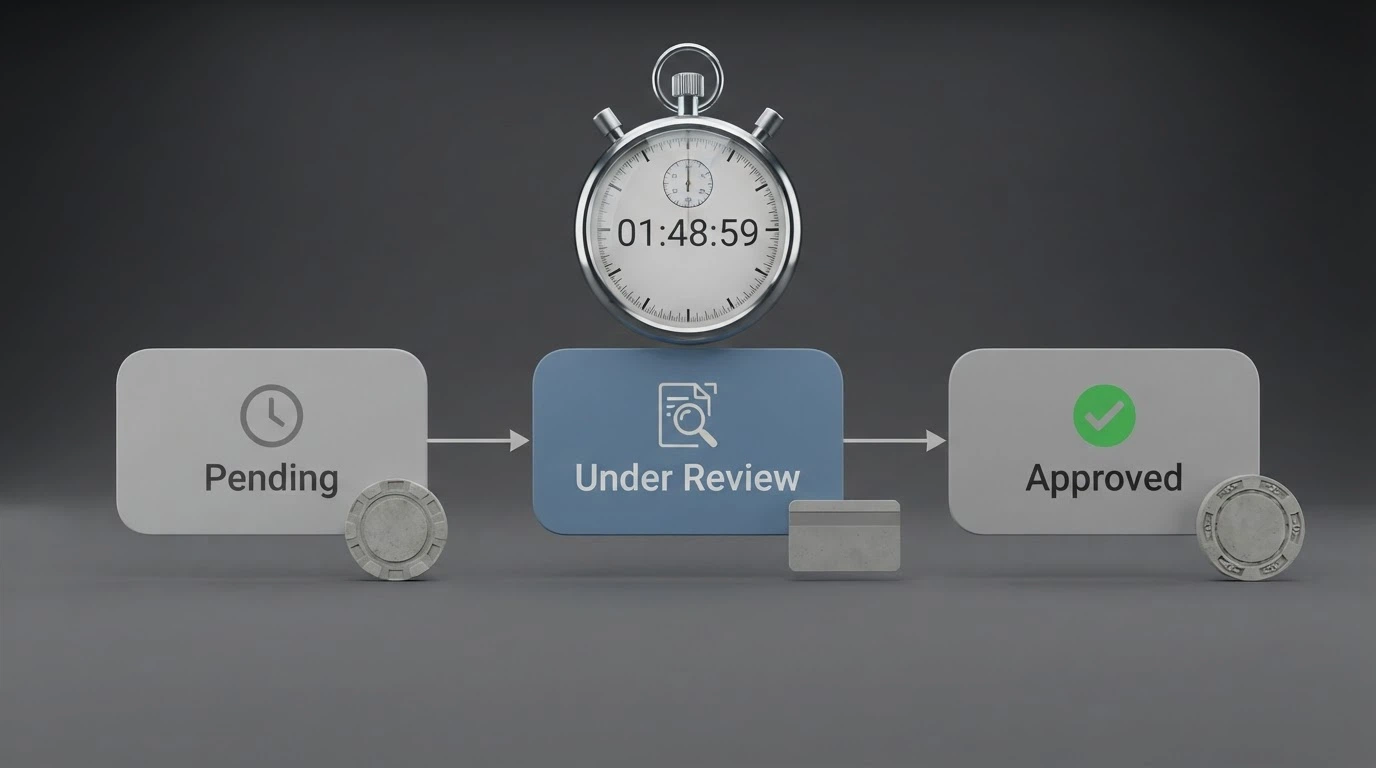
The fastest round-trip an Australian player can realistically hit at an offshore casino is zero to 24 hours after approval, and that figure assumes the KYC documents are already on file. Crypto is the speed leader: USDT on TRC-20 clears in 30 to 90 seconds, with a tested 200 USDT transfer confirmed in 43 seconds in May 2026. Ethereum confirms in around two minutes; Bitcoin can take up to 30 minutes depending on network congestion. Bank transfer and debit card withdrawals sit at the back of the field at three to five business days, with no realistic way to speed them up.
Payment Gateways, Processing and What Happens Behind the Scenes
When a player hits “deposit,” the money moves through a payment gateway (the casino’s integration with PayID, the card networks, or the crypto on-chain infrastructure), a payment processor (which handles settlement and any currency conversion), and sometimes a fraud screen before the casino sees the funds. Each layer adds time and adds cost, even when none of it is visible to the player. The 3.99% Skrill and Neteller margin is a processor-level fee that the e-wallet keeps rather than passing to the player as a line item.
AUSTRAC’s Travel Rule applies at A$10,000 for crypto transactions — above that threshold, the casino’s payment processor is required to collect and verify sender and beneficiary information. For most retail deposits this is invisible, but a player moving five-figure sums in crypto should expect the casino to ask for wallet-source documentation. The first PayID transfer to a new payee can also be held for up to 24 hours for fraud checks at the bank side, which is a separate delay from anything the casino controls.
10 Offshore Casinos Australians Use — and the Payment Methods They Accept
Every online casino accessible from Australia is offshore. The Interactive Gambling Act 2001 prohibits the provision of online casino games to Australians, and no online casino licence exists anywhere in the country — not federally, not in any state or territory. The table below lists ten offshore operators that the AU-facing market currently routes players to. None holds an Australian licence because no such licence exists. The “AU Legal Status” column reflects that uniformly. The payment-method column is filled where research confirms specifics and left empty where it does not.
| Operator | AU Legal Status | Deposit Methods Accepted |
|---|---|---|
| Rocket Play | Offshore (no AU casino licence — prohibited product) | PayID, Crypto, Cards |
| Skycrown | Offshore (no AU casino licence — prohibited product) | PayID, Crypto, Cards |
| Royal Reels | Offshore (no AU casino licence — prohibited product) | PayID, Crypto, Cards |
| WinSpirit | Offshore (no AU casino licence — prohibited product) | PayID, Crypto, Cards |
| Stake | Offshore (no AU casino licence — prohibited product); Curaçao licence | Crypto only |
| Rainbet | Offshore (no AU casino licence — prohibited product) | PayID, Crypto, Cards |
| FairGO | Offshore (no AU casino licence — prohibited product); AU branding does not imply AU licence | PayID, Crypto, Cards |
| Scream Casino | Offshore (no AU casino licence — prohibited product) | PayID, Crypto, Cards |
| Bizzo Casino | Offshore (no AU casino licence — prohibited product) | PayID, Crypto, Cards |
| Rocket Casino | Offshore (no AU casino licence — prohibited product); distinct from Rocket Play | PayID, Crypto, Cards |
Rocket Play
Rocket Play is one of the general-market offshore operators that accept the standard AU-facing payment mix — PayID for AUD-native deposits and withdrawals, the major card networks for debit deposits, and a crypto cashier running Bitcoin, Ethereum and the stablecoins. The operator’s specifics on welcome bonus, wagering requirements, and game-provider list were not confirmed by direct cashier review in the research that fed this article, so anything beyond the payment-method baseline is best verified at the cashier before depositing. As an offshore brand, Rocket Play sits outside the Australian regulatory framework: no AU consumer protection applies, BetStop does not extend to it, and an ACMA site-blocking order can land with a balance on the account. For a player who wants PayID and crypto on one cashier and is comfortable with the offshore trade-offs, Rocket Play fits the generalist profile.
Skycrown
Skycrown carries the same offshore-no-AU-licence status as the rest of this list and offers the standard AU-facing payment mix — PayID for fast AUD deposits, cards for debit, and crypto for players who want the fastest in-and-out rail. Operator-specific figures on bonuses, wagering, and withdrawal ceilings were not confirmed in this round of research, so the practical move for a player considering Skycrown is to check the cashier page directly for current method availability and limits. The brand sits in the same generalist bucket as Rocket Play: useful if PayID and crypto on one cashier matters, and the player accepts that offshore means no AU consumer protection.
Royal Reels
Royal Reels is an offshore brand with the standard AU-facing payment set — the same PayID-plus-cards-plus-crypto mix that defines the general market. Operator-specific deposit and withdrawal figures were not confirmed this run, and the brand’s domain is one that warrants a direct check before depositing. The brand is best treated as a generic offshore casino: same offshore status, same absence of BetStop coverage, same exposure to ACMA blocking, and the same generalist payment method set that an AU-facing cashier tends to carry. A player who likes the brand’s game lobby can deposit, but the payment-method verification is best done at the cashier.
WinSpirit
WinSpirit is another generalist offshore casino serving the AU market, with the standard payment-method set and no confirmed operator-specific figures from this round of research. The brand sits alongside the other general-market operators in this list — PayID, cards, crypto at the cashier, and the offshore-no-AU-licence baseline that applies uniformly. A player considering WinSpirit should verify current methods, limits and bonus terms directly at the cashier before funding an account; the page-level verdict is that it offers nothing materially different from the other generalist brands in the AU-facing offshore space.
Stake
Stake is the outlier in the list and in the broader market. The brand is crypto-only at the cashier, supporting Bitcoin, Ethereum, Litecoin, USDT and over 500 other coins, and holds a Curaçao licence rather than operating entirely unlicensed. For an Australian player, that means the fastest deposit and withdrawal times available (USDT on TRC-20 in under a minute), no AUD conversion because the account is denominated in crypto, and no exposure to the 3.99% e-wallet margin. The trade-offs are real: every casino accepting crypto from an Australian is offshore by definition, the player’s bankroll is exposed to mid-session volatility (nobody wants their bankroll to drop 8% while they’re mid-session because BTC had a bad afternoon), and the absence of AUD denomination means network fees and conversion costs sit with the player rather than the operator. For a crypto-native player comfortable with that exposure, Stake is the method leader. For a fiat player, it is the wrong tool.
Rainbet
Rainbet is an offshore operator in the generalist bucket — standard AU-facing payment set, no AU licence, no operator-specific figures confirmed this run. The brand fits the same profile as the other general-market entries: PayID, cards and crypto at the cashier, with everything else — bonuses, wagering, withdrawal ceilings, game providers — best verified at the cashier before depositing. The offshore trade-offs apply in full: no AU consumer protection, no BetStop coverage, and the ACMA blocking risk that hangs over every brand on this list.
FairGO
FairGO carries an Australian-sounding brand name and an Australian audience orientation, but the brand is offshore — an “.au” domain is a marketing decision, not a licensing one. The payment-method set follows the standard AU-facing offshore pattern, and operator-specific figures were not confirmed in the research behind this article. A player considering FairGO should treat it the same way as every other brand on this list: the brand looks Australian, the casino is not, and the protections that come with an Australian licence do not apply. The cashier is the right place to verify current methods, limits, and bonus terms before funding an account.
Scream Casino
Scream Casino is another offshore brand in the generalist bucket, with the standard AU-facing payment-method set and no operator-specific figures confirmed this round. The brand’s domain warrants verification before depositing, and the practical advice is the same as for every other general-market entry on this list: check the cashier for current methods and limits, accept that the offshore status means no AU consumer protection, and treat BetStop coverage as non-existent. Scream Casino fits the generalist profile without standing out from it.
Bizzo Casino
Bizzo Casino is an offshore brand carrying a .casino domain, with the standard AU-facing payment set and no operator-specific figures confirmed in the research that fed this article. The brand sits in the generalist bucket alongside the other nine entries: PayID, cards, and crypto at the cashier, offshore status with no AU licence, and the same set of protections the player forfeits by going offshore. The page-level verdict is that Bizzo Casino is interchangeable with the other general-market operators on this list on the payment-method dimension.
Rocket Casino
Rocket Casino is distinct from Rocket Play despite the similar name, and is its own offshore operator with the standard AU-facing payment-method set. The brand’s domain warrants verification before depositing, and operator-specific figures were not confirmed in this round of research. The same generalist advice applies: check the cashier for current methods, limits and bonus terms, accept the offshore status and the protections it forfeits, and treat Rocket Casino as interchangeable with the other general-market brands on the payment-method dimension.
Mobile Payments: Tap, Scan, Play
Mobile payment at an Australian-facing casino splits into two lanes that barely overlap. Apple Pay and Google Pay are the deposit-side winners — instant, zero-fee, biometrically authenticated, and accepted at most major AU-facing operators. They are deposit-only, which means the player who funds an account with Apple Pay needs a withdrawal route registered from day one. The opposite lane is the SMS and carrier-billing route that once had a moment in Australia and has largely faded, displaced by PayID and crypto on the mobile browser.
Apple Pay and Google Pay: Instant, Free and Deposit-Only
Apple Pay and Google Pay deposits clear instantly with zero fees. The mechanism is NFC — the phone taps or authenticates the transaction through the casino’s payment gateway — combined with biometric authentication (Face ID or Touch ID) that adds a security layer a card number cannot. The deposit experience is the smoothest available to an Australian mobile player, and the cost is genuinely zero.

The catch is the deposit-only limitation. Neither Apple Pay nor Google Pay supports withdrawals, because both rails are push-payment systems with no pull-payment counterpart. A player who funds an account with Apple Pay has to register a second method — typically PayID or bank transfer — to cash out. For players who optimise for deposit speed and are happy to use PayID on the way out, Apple Pay and Google Pay are the right deposit tool. For players who want one method end-to-end, they are not.
SMS and Carrier Billing: A Niche That’s Fading
Phone-billed casino deposits — where the deposit is charged to the player’s mobile bill or deducted from a prepaid balance — once had a foothold in Australia, particularly among players who wanted a low-friction way to fund small deposits without a bank account in the picture. The model has not survived the rise of PayID and crypto, and the AU-facing operators that supported it have largely moved on. SMS and carrier billing deposits carry low transaction caps by design, and the regulatory treatment has tightened. For a player choosing a method in 2026, the practical answer is that the option still exists at a handful of brands but is no longer the default for mobile deposits; PayID and Apple Pay/Google Pay have displaced it.
Crypto Casino Deposits: Fast, Volatile and Outside the Rules
Crypto deposits clear in seconds and keep the bank entirely out of the loop. The cost of that combination is that every crypto-accepting casino is offshore by definition — crypto has been banned as payment for licensed Australian wagering since 11 June 2024, alongside credit cards, and any operator offering crypto deposits to an Australian is operating outside the regulatory framework. The method is the tell. For a player choosing crypto, the trade is speed and anonymity against the loss of every Australian consumer protection that applies to licensed wagering.

The speed advantage is real. USDT on TRC-20 clears in 30 to 90 seconds, with a tested 200 USDT transfer confirmed in 43 seconds in May 2026. Ethereum confirms in around two minutes. Bitcoin can take up to 30 minutes depending on network congestion — meaningful for a player who wants to deposit and play in one sitting. USDT TRC-20’s network fee is negligible above A$1,000; below A$500, the fee becomes a higher percentage of the deposit, and Litecoin or a smaller-denomination stablecoin transfer becomes the more cost-effective option. Above A$1,000, USDT TRC-20 is the practical default.
The volatility risk is the other side. Crypto-denominated bankrolls move with the market, and nobody wants their bankroll to drop 8% while they’re mid-session because BTC had a bad afternoon. Stablecoins eliminate that exposure for the deposit-to-withdrawal window, which is why USDT is the dominant choice at crypto-friendly casinos: the speed of crypto, the price stability of fiat, and the offshore status baked in.
Bitcoin: The Original, the Slowest and the Most Volatile
Bitcoin is the most widely accepted cryptocurrency at AU-facing casinos and the slowest of the major coins at the cashier. Confirmation time runs up to 30 minutes depending on network congestion, and the network fee scales with the same congestion. For a player depositing and waiting to play, 30 minutes is a meaningful gap; for a player withdrawing a large balance, it is a similar wait on the way out.
Bitcoin’s volatility is the additional risk. A bankroll denominated in BTC moves with the market, and the player whose session runs from Friday evening to Saturday morning can see the value of their balance swing several percent in either direction unrelated to anything happening at the tables. That exposure is fine for a player who treats the bankroll as a BTC holding and is comfortable with that volatility. It is the wrong tool for a player who wants the AUD value of their balance to stay stable while they play.
Alt-Coins and Stablecoins: USDT, Ethereum and Litecoin
USDT on TRC-20 is the practical default for crypto deposits at AU-facing casinos. Speed runs 30 to 90 seconds, fees are negligible above A$1,000, and the stablecoin peg holds the value stable during play. For amounts below A$500, Litecoin and smaller-denomination USDT transfers are more cost-effective than Bitcoin once network fees are factored in. Ethereum sits between the two, with two-minute confirmations and a gas fee that varies with network congestion.
The choice of coin maps to the size of the deposit. For a small bankroll, the network fee matters more than the confirmation time, so LTC and USDT TRC-20 win on cost. For a larger bankroll above A$1,000, USDT TRC-20 wins on both speed and fee. For a player who holds ETH or BTC and wants to move it directly to a casino, those coins work too — slower and more variable on fees, but no conversion needed. Stake’s 500-plus coin list at the cashier covers essentially every common holding a player might want to deposit.
The Law: What Makes a Casino Payment Method Legal or Illegal in Australia
The Interactive Gambling Act 2001 makes it an offence to provide an online casino, online pokies or in-play betting to a person in Australia. There is no licence for online casino anywhere in the country — not federally, not in any state or territory. The individual player is not prosecuted under the Act; enforcement targets the provider. The Act was written to chase operators, not players, and that distinction shapes every payment decision an Australian makes.
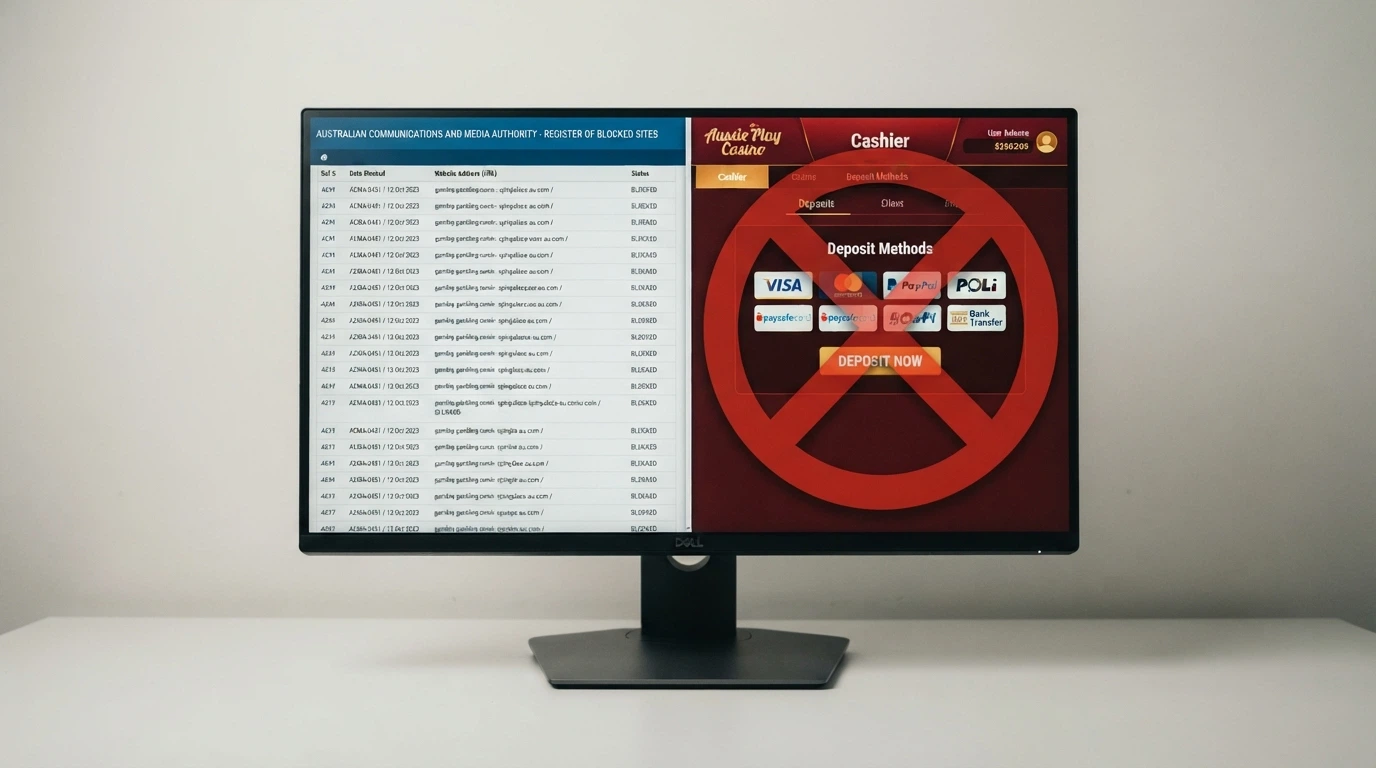
What the Act does not do is leave the payment side unregulated. Since 11 June 2024, credit cards, credit-related products and digital currency are banned as payment for online wagering. An operator that fails to enforce the ban faces penalties of up to A$247,500 per breach. The legal deposit routes for licensed wagering are debit card, bank transfer, PayID/Osko and BPAY. Any casino accepting credit card or crypto deposits from an Australian is, by virtue of that acceptance, operating outside the Australian framework.
The 2026 reform adds a new lever. The Interactive Gambling Amendment (Gambling Reform) Bill 2026 passed Parliament on 19 August 2026 and commences 1 January 2027. From that date, banks and payment providers gain express authority to block transactions to illegal gambling operators. The advertising landscape is also rewritten: no more than three wagering ads per hour between 6am and 8:30pm, a live-sport blackout from 15 minutes before to 5 minutes after a sporting event, and a bar on athlete and influencer promotions. Direct marketing of inducements is prohibited for 14 days after a customer signs up and for three months after BetStop deregistration.
The Interactive Gambling Act: What It Actually Says
The Interactive Gambling Act 2001 prohibits the provision of online casino games, online pokies and in-play betting to Australians. The Act was strengthened by the Interactive Gambling Amendment Act 2017, which closed loopholes and gave the Australian Communications and Media Authority (ACMA) enforcement and blocking powers. The Act targets the provider, not the player — the individual player is not prosecuted. ACMA investigates complaints, issues formal warnings, runs civil penalty proceedings, refers operators for enforcement, and directs ISPs to block illegal sites. Since November 2019, ACMA has had 1,564 illegal gambling and affiliate websites blocked at the DNS level, and more than 225 illegal services have withdrawn from the Australian market since enforcement was strengthened in 2017.
Licensed wagering on sport and racing — placed before the event begins — is permitted through operators licensed by a state or territory. The Northern Territory Racing and Wagering Commission (NTRWC), administered through Licensing NT, is the de facto national licensor. Sportsbet, bet365 and Ladbrokes operate under that framework, but their product is sports and racing wagering, not casino. There is no licensed Australian online casino to anchor to. Land-based casinos (Crown, The Star and others) are state-licensed, but that licence does not extend to an online casino product.
The Credit Card and Crypto Ban: Why It Matters for Every Deposit
The credit card and crypto ban commenced on 11 June 2024 under the Interactive Gambling Amendment (Credit and Other Measures) Act 2023. The ban covers credit cards, credit-related products and digital currency as payment for online wagering. The penalty for an operator that fails to enforce it is up to A$247,500 per breach. The legal deposit routes that remain for licensed wagering are debit card, bank transfer, PayID/Osko and BPAY — and identity verification is required.
The ban’s practical effect for an Australian player is that a casino asking for a credit card or crypto deposit is announcing, in real time, that it is operating outside the Australian framework. The payment method is the compliance litmus test. A licensed Australian wagering operator will accept only the four legal routes. Anything else — credit, crypto, an unsupported e-wallet — means the operator is not licensed under Australian law, and the protections that come with that licence do not apply.
The 2026 Reform: What Changes on 1 January 2027
The Interactive Gambling Amendment (Gambling Reform) Bill 2026 passed Parliament on 19 August 2026 and its measures commence on 1 January 2027. The most consequential change for payments is that banks and payment providers gain express authority to block transactions to illegal gambling operators. An Australian player depositing with PayID from 1 January 2027 is depositing through a rail the bank is now explicitly empowered to decline — and the threshold for declining is set by the bank, not by the player.
The advertising side of the reform is also rewritten. From 1 January 2027, wagering advertising is capped at three ads per hour between 6am and 8:30pm, with a live-sport blackout from 15 minutes before to five minutes after a sporting event. Radio ads are barred during school times; broadcasting sporting odds is banned outright; online ads are allowed only to logged-in, over-18 users who have not opted out; ads inside sports venues and on uniforms are barred; and athletes, celebrities and influencers cannot promote wagering. Direct marketing of inducements is prohibited for 14 days after sign-up, for three months after BetStop deregistration, and indefinitely for at-risk customers. For an Australian player, the practical effect is that offshore casino advertising becomes harder to find in mainstream channels, and the welcome-bonus inducements that currently drive acquisition are constrained.
Offshore vs Licensed: What the Payment Method Tells You
The payment method on a casino’s banking page is the fastest way to determine whether the operator is licensed under Australian law. A licensed Australian wagering operator accepts only debit card, bank transfer, PayID/Osko and BPAY. A casino accepting credit cards or crypto is offshore by definition, because those methods are banned for licensed wagering. There is no middle ground.
What “offshore” means in practice is the absence of every protection an Australian player might otherwise have. There is no Australian consumer protection — the casino is regulated under another jurisdiction’s rules, often Curaçao or Malta, and Australian courts have no jurisdiction over complaints. There is no ACMA recourse for money recovery — ACMA can block the site, but it cannot return funds. There is no BetStop coverage — an offshore casino is not connected to the National Self-Exclusion Register and will keep taking a self-excluded person’s money. There is no recourse if the operator refuses a withdrawal. And the site can be blocked at any time with a balance on the account. The licensed contrast — Sportsbet, bet365, Ladbrokes — accepts only legal payment methods and offers legal sports and race wagering, but no casino product.
Responsible Gambling: Tools That Work and Tools That Don’t
Australia has one of the world’s strongest player-protection frameworks, anchored by BetStop — the National Self-Exclusion Register — and the National Gambling Helpline. The framework is built around licensed wagering, and its flagship tool, BetStop, does not reach the offshore casinos most Australian players actually use. That gap is the most important thing to know before depositing anywhere on the list above.
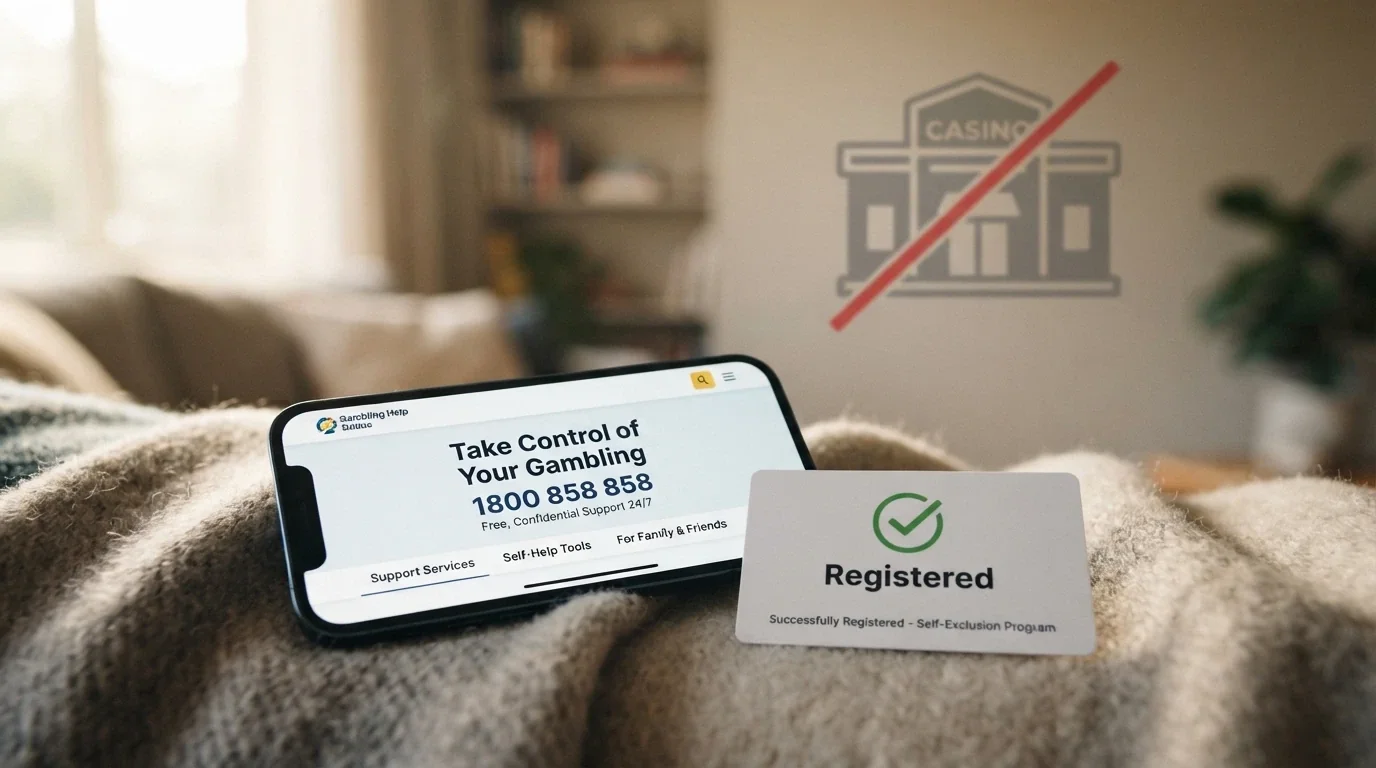
As at 31 July 2026, BetStop had 67,480 registrations, with 41,290 exclusions still active. Seventy-eight percent of registrants were under 40, and 38% chose lifetime exclusion. The register binds every Australian-licensed online and phone wagering service in a single step — one registration, every licensed brand. It does not bind offshore casinos, and an offshore casino will keep taking a self-excluded person’s money because it has no way to know the person ever registered.
The National Gambling Helpline is 1800 858 858 — free, confidential, staffed 24 hours a day, seven days a week, with online chat and counselling at Gambling Help Online (gamblinghelponline.org.au). The line is the right first call for anyone whose gambling has moved past what they intended. About 2.1% of Australian adults — roughly 430,000 people — experience problem gambling; the Australian Institute of Health and Welfare put high-risk gambling at 1.8% in 2022.
Deposit Limits, Activity Statements and the Tools You Actually Have
Licensed Australian wagering operators offer customer-set deposit limits and activity statements under state and territory conditions. A player can set a daily, weekly or monthly deposit ceiling; the operator enforces it; and the activity statement shows what was deposited, what was wagered, and the net outcome over a chosen period. Take-a-break features allow short-term cooling-off periods without full self-exclusion.
At an offshore casino, none of those tools are guaranteed. The product is prohibited in Australia, so no Australian regulator mandates deposit limits or activity statements. Some offshore operators build them voluntarily; most do not. The practical alternatives for a player at an offshore brand are self-imposed — a separate bank account with a fixed monthly transfer, a Neosurf voucher ceiling that caps spending at the voucher value, or a personal rule on session length. The tools exist; the enforcement is on the player.
Self-Exclusion and Help: What BetStop Covers and What It Doesn’t
BetStop is the strongest self-exclusion tool Australia has ever built, and it is powerless against an offshore casino. One BetStop registration excludes a person from every Australian-licensed online and phone wagering service. The 38% who chose lifetime exclusion will never be able to place a wager with a licensed Australian operator again. That figure does not protect them from an offshore brand, which has no connection to the register and no Australian obligation to honour it.
For anyone whose gambling has moved past what they intended — offshore or licensed — the National Gambling Helpline at 1800 858 858 is the right first call. The line is free, confidential and staffed around the clock. Gambling Help Online (gamblinghelponline.org.au) extends the same support through web chat and counselling. The 2.1% problem-gambling prevalence — roughly 430,000 Australian adults — makes this a genuine YMYL issue for anyone considering a deposit. A player who has registered with BetStop and is still playing offshore is not protected by the registration; an offshore casino will keep taking the money.
How We Evaluated These Payment Methods
The methods, speeds, fees and legal statuses in this article reflect the state of the Australian market in 2026. Sources are the Interactive Gambling Act 2001 and its amendments, ACMA enforcement records, AUSTRAC’s Travel Rule threshold, operator cashier pages at the AU-facing offshore brands listed above, and the published payout data on AU-focused comparison sites. The ten operators in the ranking were drawn from the AU operators market-share shortlist and confirmed as real-money, currently-active, AU-audience casino brands. Operator-specific details — welcome bonuses, game providers, specific wagering requirements — were not confirmed in this round of research where the operator sweep could not complete, and the article reflects that honestly rather than inventing figures.
The evaluation criteria were: deposit speed, withdrawal speed after approval, fees (including the hidden exchange margins on e-wallets), two-way support (whether the method works for both deposits and withdrawals), the legal signal the method carries (whether it indicates licensed or offshore status), and AUD nativity (whether the method avoids currency conversion). No invented weightings or percentages were applied across methods — the comparison table reflects what each method delivers on those criteria, not a scored ranking.
Start With PayID, Add a Withdrawal Route and Never Deposit What You Can’t Afford to Lose
The payment method that wins for most Australians is PayID. It is the fastest round-trip available in fiat, the most popular at over 42% of AU players, AUD-native, and works both ways. It is not perfect — the bank’s daily ceiling and the first-payee 24-hour hold are real limits — but on the dimensions that matter for most players (speed, two-way support, no fee, no conversion), it has no peer in the fiat space. Crypto is faster and more anonymous but operates entirely outside Australian consumer protection. E-wallets are private but charge a hidden margin and exclude welcome bonuses on many platforms. Debit cards are familiar but the slowest round-trip in the mainstream market. Bank transfer is universal and slow. Apple Pay and Google Pay are deposit-only.
The single most important decision is not which method to use. It is understanding that every casino accessible from Australia is offshore, unlicensed under the IGA, and carries the risks this article has laid out: no Australian consumer protection, no ACMA recourse for money recovery, no BetStop coverage, no recourse if the operator refuses a withdrawal, and a DNS-level blocking risk that can land with a balance on the account. The payment method on the cashier page is the cleanest signal of which side of the law the operator sits on. A licensed Australian wagering operator accepts only debit card, bank transfer, PayID/Osko and BPAY. Anything else means offshore, and offshore means the protections forfeit with it.
The 1 January 2027 reform adds a new lever — banks gain express authority to block transactions to illegal gambling operators, and the PayID rail that most Australian players use today is the rail most exposed to that change. A player choosing a method in 2026 is choosing a method whose availability may shift in months, not years. The wider point is the same as it has been: set a personal deposit limit before depositing, never fund an account with money the player cannot afford to lose, and call 1800 858 858 if the gambling has moved past what was intended. The methods on this page are tools. The decision about how to use them belongs to the player.
Frequently Asked Questions
Is it legal to deposit at an offshore online casino from Australia?
The Interactive Gambling Act 2001 prohibits the provision of online casino games to Australians. There is no online casino licence in Australia — not federally, not in any state or territory. The Act targets the provider, not the player; the individual player is not prosecuted. What the player forfeits by going offshore is every Australian protection: no ACMA recourse for money recovery, no BetStop coverage, no Australian consumer protection, and no guarantee a withdrawal will be honoured.
What fees do e-wallets like Skrill and Neteller charge for casino transactions?
Skrill and Neteller apply a 3.99% exchange margin on AUD deposits that is not advertised on the banking page. A A$500 deposit arrives as roughly A$480 of playable balance after the margin runs. MiFinity and EzeeWallet carry lower margins. Skrill deposits are also excluded from welcome bonuses on many AU-facing platforms — claiming a deposit bonus with Skrill can void the offer entirely.
Does BetStop cover offshore online casinos?
No. BetStop — the National Self-Exclusion Register — binds Australian-licensed online and phone wagering services only. An offshore casino is not connected to the register and will keep taking a self-excluded person’s money because it has no way to know the registration exists. As at 31 July 2026, BetStop had 67,480 registrations with 41,290 active exclusions, but none of that coverage extends to the offshore brands on this list.
What happens if an offshore casino refuses to pay my withdrawal?
The player has no Australian recourse. ACMA can block the site, but it cannot return funds. The casino is regulated under another jurisdiction’s rules — most commonly Curaçao — and Australian courts have no jurisdiction over complaints. The practical protections are preventive: choose a method with a short clearance window (PayID or crypto), complete KYC before requesting the first withdrawal, and treat any operator that delays a withdrawal past its advertised timeline as a red flag rather than a routine delay.
How do cryptocurrency deposits work at Australian online casinos?
Crypto deposits route directly from the player’s wallet to the casino’s wallet, with confirmation time depending on the coin. USDT on TRC-20 clears in 30 to 90 seconds — a tested 200 USDT transfer confirmed in 43 seconds in May 2026. Ethereum confirms in around two minutes. Bitcoin can take up to 30 minutes depending on network congestion. Every casino accepting crypto from an Australian is offshore by definition, because crypto has been banned as payment for licensed wagering since 11 June 2024.
Can I use a credit card to deposit at an Australian online casino?
No. Credit cards have been banned as payment for online wagering in Australia since 11 June 2024, alongside digital currency, under the Interactive Gambling Amendment (Credit and Other Measures) Act 2023. The penalty for an operator that fails to enforce the ban is up to A$247,500 per breach. The legal deposit routes for licensed wagering are debit card, bank transfer, PayID/Osko and BPAY. A casino asking for a credit card deposit is, by that request alone, operating outside the Australian framework.
Prepared by the Jackpot Pokies Australia editorial staff.