
Best Aussie Online Casinos in 2026: What Actually Pays, and What It Costs You
 Available in AU
Current as of 18 October 2026 — operator terms and licence claims checked against the ACMA register, APH.gov.au legislative record and the Australian Communications and Media Authority’s published enforcement data.

A search for the best Australian online casino leads to a contradiction at the first step. There is no such thing as a licensed Australian online casino, and there never has been. The Interactive Gambling Act 2001 (IGA) makes it an offence to provide online casino games, online pokies and in-play sports betting to a person physically in Australia. No licence exists, not federally, not in any state or territory. A page that promises the best licensed online casinos in Australia is describing something that does not exist. Every site on every list ranking the “top Aussie casinos” is an offshore operator, run from Curaçao, the Tobique Gaming Commission in Canada, or a handful of other jurisdictions the Australian government has no authority over.
This is the page that acknowledges the contradiction, walks the reader through what is actually available offshore, and shows what that choice costs. The Australian player who deposits at one of these casinos is making a calculated trade: access to pokies and live dealer games, but zero Australian regulatory protection, no BetStop coverage, no ACMA complaint body, no statutory withdrawal guarantee, and a real risk that the site is blocked by an ISP with a balance still on it. The math on bonuses tends to be worse than the marketing suggests, and the 2027 reform hands banks and payment providers the power to block transactions to illegal operators outright. The decision is the reader’s. This page exists to make the trade legible, with the numbers, dates and licence claims laid out side by side.
Table of Contents
- No, your Aussie online casino isn’t licensed here — here’s what that means
- The offshore casino sites Australians actually play at in 2026
- The 10 offshore casinos Australian players search for most in 2026
- Why your 2026 casino bonus is harder to cash out than it looks
- New Aussie online casinos worth a look in 2026
- PayID at Aussie casinos: instant in, slow out — here’s the workaround
- Pokies in your pocket: mobile casinos Australian players actually use in 2026
- When the pokies stop being fun: getting real help in Australia
- How we picked the best Aussie online casinos for 2026
- Is an offshore casino worth the risk — what this page actually found
- Frequently asked questions
No, your Aussie online casino isn’t licensed here — here’s what that means
The legal frame matters before any ranking, because the absence of a licence is the frame itself. An Australian who deposits at an offshore casino is not a criminal; the IGA targets the provider, not the player. But the player also has no Australian complaint body to turn to if the operator refuses a withdrawal, voids a bonus win, or simply disappears.

The Interactive Gambling Act: what it actually bans and what it doesn’t
The IGA 2001 prohibits three categories of online product: online casino games, online pokies and in-play sports betting. It permits two: wagering on races and sport placed before the event begins, through operators licensed by an Australian state or territory (the Northern Territory Racing and Wagering Commission, administered through Licensing NT, is the de facto national licensor for online wagering, with terms up to 20 years), and lotteries and keno. The minimum age across all commercial gambling in Australia is 18.
This is why every casino on every Australian-facing list is offshore. The product the reader is searching for — real-money online pokies, blackjack, roulette, live dealer — has no legal supply inside the country. The licensed Australian wagering market covers sports and racing, not casino. Sportsbet, TAB, bet365 and Ladbrokes hold Australian licences for wagering, but none of them offers online casino games to Australian customers.
The 2026 reform that changes everything from 1 January 2027
The Interactive Gambling Amendment (Gambling Reform) Bill 2026 passed Parliament on 19 August 2026, and its measures commence on 1 January 2027. The reform is the most significant tightening of the IGA since the original Act, and it changes the offshore calculus in four specific ways.
First, advertising: from 2027, wagering advertising on television is capped at three ads per hour between 6:00 am and 8:30 pm, with a live-sport ad blackout during play. Second, payments: from 1 January 2027, banks and payment providers gain express authority to block transactions to illegal gambling operators. For a player at an offshore casino, this means a transaction can be declined, reversed or held, and the operator has no Australian legal standing to recover the funds. Third, inducement marketing: direct marketing of wagering offers is banned for 14 days after signup, three months after a person deregisters from BetStop, and indefinitely for customers identified as at risk of gambling harm. Fourth, product: foreign matched lotteries and online keno also become prohibited, alongside further restrictions on trade promotion gambling services.
What this signals for an offshore player is the direction of travel. The Australian government is not legalising online casino. It is narrowing the channels through which illegal operators reach Australian customers, including the payment rails and the marketing that funds them.
ACMA enforcement: 1,564 sites blocked and counting
The Australian Communications and Media Authority (ACMA) has been blocking illegal gambling websites at the ISP level since November 2019. As at March 2026, the count is 1,564 websites blocked, and more than 225 illegal services have withdrawn from the Australian market entirely since enforcement was strengthened in 2017. The blocking works at the network level: when an ACMA request is upheld, Australian ISPs prevent their customers from resolving the domain.
For a player, this means a site that works today may not work tomorrow, and any balance held on it at the moment of blocking is effectively stranded unless the operator chooses to pay it out through an alternative route. The regulator is not going to intervene on a player’s behalf to recover it. The payment ban under the Interactive Gambling Amendment (Credit and Other Measures) Act 2023, in force since 11 June 2024, compounds this: credit cards, credit-related products and cryptocurrency are all banned as payment for online wagering, and an operator that fails to enforce the ban faces penalties of up to A$247,500. The ban is the regulator’s way of telling operators — and players — that the offshore model is structurally outside Australian rules.
The offshore casino sites Australians actually play at in 2026
With no domestic supply, the offshore market is the entire market. The operators serving Australian search traffic today fall into two broad camps: hybrid fiat-and-crypto sites licensed in Curaçao (the dominant jurisdiction) and a smaller cluster licensed by newer regulators, of which the Tobique Gaming Commission in Canada is the most visible. The two groups operate under different rules, offer different payment products and carry different player risks.

The trade-off the reader is making is consistent across both: more game variety and bigger bonus packages than any Australian-licensed operator could legally offer, in exchange for zero Australian regulatory protection. Curaçao sites tend to be the larger, more established names (SkyCrown, RocketPlay, Stake, Royal Reels, FairGO, Bizzo, WinSpirit, Scream, Rainbet) with broad game libraries and Curaçao-Antillephone or Curaçao-Gaming Curacao licences, while Tobique-licensed sites like Wild Fortune are smaller, newer, and sometimes more generous on bonus terms. The Curaçao licence is verifiable through the Antillephone validator; the Tobique licence is verifiable through the Tobique Gaming Commission’s own register, though the regulator itself is only a few years old and is not yet as widely recognised as Curaçao or the Malta Gaming Authority.
Real-money pokies and casino games: what you can actually play
Pokies dominate the Australian offshore market, as they do the domestic one. Game counts at the larger Curaçao sites run from a few thousand to upwards of 3,800 titles (Wild Fortune’s published catalogue), with provider ecosystems built around names Australian players recognise from pubs and clubs: Pragmatic Play (Big Bass Bonanza is the best-known), IGTech (which ports the IGT-style content Australian players grew up on), Booongo, Voltent, BGaming and RealTime Gaming (RTG), the last of which is FairGO’s specialty. Live dealer is the second growth area, with Evolution, Pragmatic Play Live and a handful of smaller studios running the baccarat, blackjack and roulette tables. Table games, jackpot pokies, crash games and “instant win” titles fill out the rest.
Demo or fun-mode play is available at most of these sites without registration, though the catalogue in demo mode is usually smaller than the real-money lobby and progressive jackpots are typically disabled. Research did not surface per-operator demo coverage this run, but the practice is consistent enough across the segment to treat it as standard.
Crypto casinos vs traditional offshore sites: the split in 2026
A meaningful split in the offshore segment is between crypto-native operators and hybrid fiat-and-crypto sites. Crypto-native brands like Stake and Rainbet built their cashier and game catalogue around Bitcoin, Ethereum, USDT and a long tail of altcoins; deposits and withdrawals happen on-chain, often clearing in minutes (research puts the practical range at 2–60 minutes for crypto withdrawals at Australian-facing operators). Hybrid sites accept both fiat (PayID, bank transfer, e-wallets, sometimes Visa/Mastercard debit) and crypto, with fiat on the deposit side and crypto often the faster option for withdrawals.
The split is not just technical. The Australian credit-card and crypto payment ban from 11 June 2024 means that any operator asking an Australian customer for credit card or crypto is operating outside Australian rules by definition. That is not a complaint about the operator’s legitimacy in its home jurisdiction; it is a factual statement about which regulatory framework the transaction is happening in. A player funding a casino account with USDT today is sending funds to an entity the Australian government has formally classified as illegal, and that classification is what gives banks the power to block the transaction from 1 January 2027.
The 10 offshore casinos Australian players search for most in 2026
The table below covers the ten operators that recur most often in Australian search results for “best Aussie online casino” and related terms. Three of them — SkyCrown, RocketPlay and Wild Fortune — were refreshed with full terms this run, and the profiles below carry the specifics. The remaining seven appeared in the market data but their bonus terms, licence numbers and game-provider lists were not confirmed in this research pass; they are listed because they are the names Australian players encounter, not because the page can vouch for their current terms.

| Casino | Licence type | Jurisdiction |
|---|---|---|
| SkyCrown | Curaçao (Antillephone, Hollycorn N.V.) | Curaçao |
| RocketPlay | Curaçao (offshore) | Curaçao |
| Wild Fortune | Tobique Gaming Commission #0000064 (Metlait SRL) | Tobique (Canada) |
| Stake | Curaçao (offshore) | Curaçao |
| Royal Reels | Curaçao (offshore) | Curaçao |
| FairGO | Curaçao (offshore) | Curaçao |
| Bizzo Casino | Curaçao (offshore) | Curaçao |
| WinSpirit | Curaçao (offshore) | Curaçao |
| Scream Casino | Curaçao (offshore) | Curaçao |
| Rainbet | Curaçao (offshore) | Curaçao |
Every entry in this table is offshore, and every entry sits outside the Australian regulatory framework. The distinction that matters in practice is between the three operators with verified, current terms and the seven where the page is reporting market presence rather than audited specifics. The IGA prohibits offering online casino services to Australians — every operator on this list operates on that basis.
SkyCrown: big-package Curaçao casino with 400 free spins across four deposits
SkyCrown’s welcome package is the largest in the featured set by total bonus value: up to A$8,000 plus 400 free spins across four deposits, with a first-deposit offer of 120% up to A$1,200 plus 125 free spins. The headline number is real, but the wagering requirement that comes attached is the part that decides whether the package is worth claiming.
Wagering on the bonus is 40× the bonus amount across all four tiers. Maximum bet during bonus play is A$7.50 on the standard bonus and A$10 on the high-roller bonus. The standard bonus carries 14 days of validity, the high-roller bonus 5 days. Free spin winnings are capped at A$300 per deposit tier, and bank transfer withdrawals start at A$100 with a 3-day clearance window. SkyCrown operates under Hollycorn N.V., registered in Curaçao, with the licence verifiable through the Antillephone validator — it is not licensed in Australia.
The provider mix at SkyCrown is built around IGTech, Booongo and Voltent, which is the IGT-flavoured catalogue Australian players tend to recognise from pub-style content. For a player willing to clear A$48,000 in turnover on a A$1,200 first-deposit bonus, the package pays out at face value. The wagering clause is optional; declining the bonus allows players to access the same games and PayID payment flow without the associated turnover requirement.
RocketPlay: low-deposit Curaçao casino with daily free-spin batches
RocketPlay’s entry point is lower than SkyCrown’s: A$30 minimum deposit for the welcome offer, against a 100% match up to A$500 plus 100 free spins on the first deposit and a 200% match up to A$500 on the second. The 100 free spins are credited in batches of 20 per day over five days rather than all at once, which spreads the playthrough requirement across the validity window. Wagering is 40× on the bonus amount, and the maximum bet during bonus play is A$7.50, consistent with the market norm.
The terms that matter most at RocketPlay are the withdrawal caps: A$2,500 per day, A$7,500 per week and A$15,000 per month. These caps are not unusual for offshore Curaçao operators, but they shape the practical value of a big win. A A$20,000 progressive jackpot, for instance, takes more than a month to clear at the monthly cap. Free spin winnings carry their own A$300 cap with a 5-day validity, which is short. RocketPlay holds a Curaçao offshore licence and is not licensed in Australia.
The lower deposit floor and the daily batched free spins make RocketPlay a reasonable fit for a player who wants to test the waters without committing a large bankroll, provided the withdrawal caps are read before any single-session win.
Wild Fortune: Tobique-licensed casino with 0× wagering free spins and verified 11-minute PayID
Wild Fortune is the operator that breaks the pattern in two specific ways, and the rest of the comparison reads through it. The first is the bonus: 250 welcome free spins with 0× wagering. That is not a typo, and it is not a market-average term. The second is the payout speed: a verified AU$250 PayID withdrawal cleared in 11 minutes in a test conducted between February and May 2026, against a roughly 30-hour average across operators that support PayID withdrawals at all.
The game catalogue backs the bonus up: 3,800+ pokies from 90+ providers, with PayID as a native cashier option rather than a marketing label. Wild Fortune is licensed by the Tobique Gaming Commission under licence number 0000064, operated by Metlait SRL, which is not Australian and not yet as widely recognised as Curaçao or Malta, but is verifiable through the Tobique register. The first-withdrawal KYC delay averages 14 hours, which is the practical cost of the speed: a player will need to clear identity verification once before the fast PayID payouts become available.
The trade-off at Wild Fortune is jurisdiction recognition. A Tobique licence is newer and less tested than Curaçao or Malta, and the regulator does not have the same enforcement history. For a player prioritising payout speed and bonus fairness over jurisdiction prestige, Wild Fortune is the standout. For a player who values the depth of an established regulator’s complaints history, the Curaçao sites are the safer reading.
Stake: crypto-native offshore casino with proprietary games
Stake is the largest crypto-native casino serving Australian search traffic, and it sits at a different end of the offshore segment from the hybrid sites. Deposits and withdrawals are in crypto only: Bitcoin, Ethereum, Litecoin, USDT and a long tail of altcoins, with no fiat cashier and no PayID integration. The game catalogue mixes proprietary Stake titles (Dice, Crash, Plinko, the in-house originals that built the brand) with major third-party providers through standard aggregation deals.
The crypto-only model is the same model the Australian government targeted with the 2024 payment ban. An Australian depositing Bitcoin at Stake is, by the regulator’s own classification, using a payment method prohibited for online wagering, with an operator that is not licensed in Australia and not connected to BetStop. That classification is what underwrites the 2027 reform’s grant of payment-provider blocking authority.
Stake’s bonus terms, game count and provider list were not refreshed this run. The brand is on this list because it dominates crypto-casino search results in Australia, not because the page can verify its current offer. The operator’s own terms page is the source that should be checked before any deposit.
Royal Reels: Curaçao casino with confirmed 30–40× bonus terms
Royal Reels is a Curaçao-licensed offshore casino that appears consistently in Australian search. The bonus terms confirmed this run are 30×–40× wagering on the bonus amount, with a A$200 no-deposit-bonus cashout cap and 7–14 day bonus validity. The wagering range is on the favourable end of the Curaçao market; the A$200 NDB cap is the market norm.
The welcome package structure, the full game-provider list and the payout speeds were not confirmed this run. Royal Reels is on this list for the confirmed terms, not for a complete profile. Treat it as an operator with a licence worth verifying and a wagering multiple worth checking against the current promotions page, rather than a fully audited recommendation.
FairGO: RTG-specialist offshore casino for Australian pokies players
FairGO is the RealTime Gaming (RTG) specialist in the Australian offshore segment. RTG is the studio behind a long tail of pokies titles Australian players have played through the Australian-facing RTG brands that have run for two decades; the catalogue skews toward five-reel video pokies with free-game features and progressive jackpots. For a player who has a specific RTG title in mind, FairGO is the operator most likely to carry it.
FairGO holds a Curaçao offshore licence and is not licensed in Australia. Bonus terms, game count, payout speeds and the licence number were not refreshed this run, and the page reports the operator’s market position rather than its current offer. The terms page on the operator’s own site is the place to verify before depositing.
Bizzo Casino: broad-library Curaçao casino — bonus terms not refreshed this run
Bizzo is a Curaçao-licensed operator that surfaces in Australian search for online casino and pokies terms. The research pass this run did not confirm its current bonus terms, game-provider list, payout speeds or specific differentiators, so the page reports Bizzo’s market presence and licence status only. The Curaçao licence is verifiable through Curaçao Gaming Control Board resources; the specific offer terms need to be checked on the operator’s own promotions page.
WinSpirit: Curaçao casino with social features — data not refreshed this run
WinSpirit is a Curaçao-licensed operator that blends social and casino gaming in its product positioning. Australian-facing search surfaces the brand consistently, but the research pass this run did not refresh its current bonus terms, game count or payout data. The page reports the licence status and the social-gaming positioning; the current offer needs to be checked on the operator’s own site before any deposit decision.
Scream Casino: newer-entrant Curaçao casino — data not refreshed this run
Scream Casino is a newer entrant in the Australian-facing offshore segment, with a Curaçao licence and a market position that is still being established. Bonus terms, game-provider list, payout speeds and specific differentiators were not confirmed this run. Newer entrants are worth checking against two signals: the ACMA blocking list (the regulator has had 1,564 sites blocked since November 2019, and newer sites are faster targets) and the 2027 payment-provider blocking authority, which changes the risk profile of any operator that has not yet established a payment-rail relationship outside the Australian banking system.
Rainbet: crypto-and-sports Curaçao casino — data not refreshed this run
Rainbet operates as a hybrid crypto casino and sportsbook under a Curaçao licence, combining a casino lobby with a sports betting product. The crypto-casino and sports dual focus is the segment that has grown fastest in the past two years at the Australian-facing end of the market, and Rainbet is one of the names Australian players encounter. Bonus terms, game count and payout data were not refreshed this run. As with Stake, the payment side is the regulatory tell: a hybrid crypto operator sits squarely outside the 2024 Australian payment ban framework, and that classification is what shapes the 2027 risk picture.
Why your 2026 casino bonus is harder to cash out than it looks
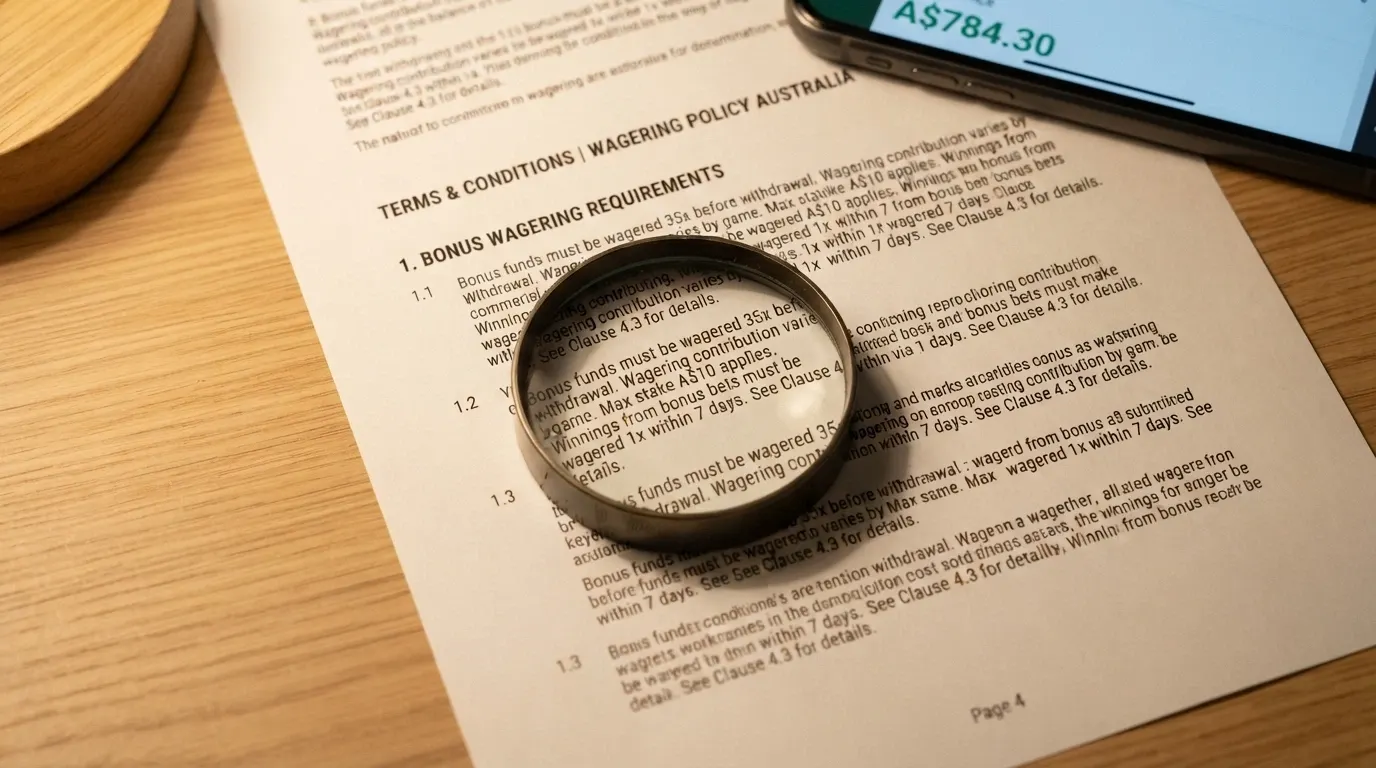
A casino bonus is a turnover commitment dressed up as a gift. The marketing reads “A$1,200 + 400 free spins”; the terms read “wager 40× the bonus amount within 14 days, with a maximum bet of A$7.50 per spin, and any free spin winnings are capped at A$300 per deposit tier.” The first is what the player sees, the second is what the player signs.
No-deposit bonuses and free spins: the real terms behind the headline
No-deposit free spin offers are the most aggressively front-loaded bonus type in the segment, and the one most likely to read as “free” when it is not. The market range at Australian-facing offshore casinos is 30× to 50× wagering on free spin winnings, with a A$50 to A$200 maximum cashout cap. A representative pair of benchmarks: BitStarz no-deposit terms run at 40× wagering on winnings, a A$100 max cashout, and a 7-day expiry; KatsuBet sits at 30× wagering on winnings, the same A$100 cap and the same 7-day window. The 7-day expiry is short; the cashout cap means a lucky A$500 spin is paid as A$100, regardless of what the bonus headline read.
The “no deposit” label refers to the entry requirement, not the cost. The cost is the time it takes to clear 30–50× wagering on winnings that are themselves capped at A$50–A$200, inside a week. For a player who treats no-deposit offers as a way to test a site rather than as a way to make money, the math can be acceptable. Treating the headline as a guarantee of income is a mistake; reading the terms reveals the actual value of the offer.
Welcome packages: what a 120% match actually costs to clear
Deposit-match welcome packages are the larger bonus type and the one the marketing spends the most on. SkyCrown’s first-deposit 120% match up to A$1,200 is the clearest worked example in the featured set. At 40× wagering on the bonus amount, a player who claims the full A$1,200 bonus commits to A$48,000 in turnover before the bonus and any associated winnings become withdrawable. At a A$1 stake per spin on a typical online pokie with a 96.71% return to player (Big Bass Bonanza’s published RTP is 96.71%, which is a representative figure for the segment), the expected loss on that turnover is A$48,000 × (1 − 0.9671) = A$1,579.20. That is the statistical cost of clearing the bonus, on average, across a very large number of spins under the stated assumptions.
The same calculation applied to RocketPlay’s first deposit (100% up to A$500, 40× wagering) gives a A$500 bonus requiring A$20,000 in turnover, and an expected loss of A$658.00 on the same RTP assumption. The turnover mountain is half the size, and so is the expected cost.
The figure that catches players out is whether the wagering applies to the bonus alone or to the bonus plus the deposit. At 40× on the bonus only, a A$500 deposit with a A$500 bonus carries A$20,000 in turnover. At 40× on the bonus plus deposit combined, the same deposit carries A$40,000 in turnover, and the expected loss doubles. The terms page is the place this is set out, and it is the first thing to check.
Wagering requirements, max cashouts and the fine print that kills your win
Three terms void more bonus winnings than any others, and they are worth reading before any deposit.
The first is the maximum bet during bonus play. The market standard is A$5; SkyCrown and RocketPlay both sit at A$7.50. Exceeding the cap voids the bonus and the winnings. For a player used to staking A$10 or A$20 per spin, the bonus effectively forces a lower bet, which extends the time to clear the requirement and reduces the upside of any single spin.
The second is the expiry window. No-deposit offers typically run 7 days; deposit-match bonuses run 3–14 days; some no-deposit free spins are valid for as little as 24 hours. The expiry is measured from the moment the bonus is credited, not from the first spin.
The third is the game-weighting rule. Most casinos apply 100% weighting to pokies but reduce or zero the weighting on table games and live dealer, which means a player who tries to clear a bonus at the blackjack table will see a fraction of the wagering count, or none of it. The exact weighting table is operator-specific, and it is the section of the terms page players most often skip.
Free spin winnings caps sit alongside these three as a fourth common surprise. SkyCrown’s A$300 cap per deposit tier and RocketPlay’s A$300 cap on the welcome free spins are the segment norm, and they apply regardless of how much the free spins actually returned.
New Aussie online casinos worth a look in 2026
A “new” offshore casino in the Australian segment means a fresh Curaçao or Tobique registration that is targeting Australian search traffic, typically with a generous welcome package to compensate for the absence of a payout track record. The seven operators in the second half of the featured list (Bizzo, WinSpirit, Scream Casino, Rainbet, plus the partial-data entries around Royal Reels and FairGO) are the names that fit this description.
What a new offshore casino needs to earn your deposit in 2026
A new operator with no Australian payout history needs to clear four checks before it earns a deposit. The first is licence verifiability: the licence number on the footer of the site should resolve on the regulator’s own register, not just on a badge image. The second is KYC speed, which functions as a payout-proxy signal: a 14-hour first-withdrawal KYC delay (Wild Fortune’s published average) is the benchmark a new operator should be willing to match or beat. The third is the withdrawal cap structure: A$2,500 per day, A$7,500 per week and A$15,000 per month (RocketPlay’s published caps) is one example of a structured set of limits, and the existence of any cap at all is information, because uncapped withdrawals are a market exception, not the norm. The fourth is the bonus terms: a new operator offering 50× wagering with a A$50 max cashout is competing on desperation, not on generosity.
Two further risks sit outside the operator’s own behaviour. The ACMA has had 1,564 sites blocked since November 2019, and newer sites are faster targets because the regulator prioritises active marketing to Australian customers. And from 1 January 2027, banks and payment providers have express authority to block transactions to illegal gambling operators, which means a new operator that has not yet established a payment-rail relationship outside Australian banking is one bank decision away from a frozen cashier.
PayID at Aussie casinos: instant in, slow out — here’s the workaround
PayID is the payment rail that won the deposit side of the Australian offshore market. It is instant (under 60 seconds for confirmation), fee-free, and the minimum deposit at the operators tested sits between A$10 and A$30. The Osko network that runs on top of PayID is what makes the deposit confirm in real time, and the absence of a card statement descriptor is the privacy advantage that drove the operator adoption.
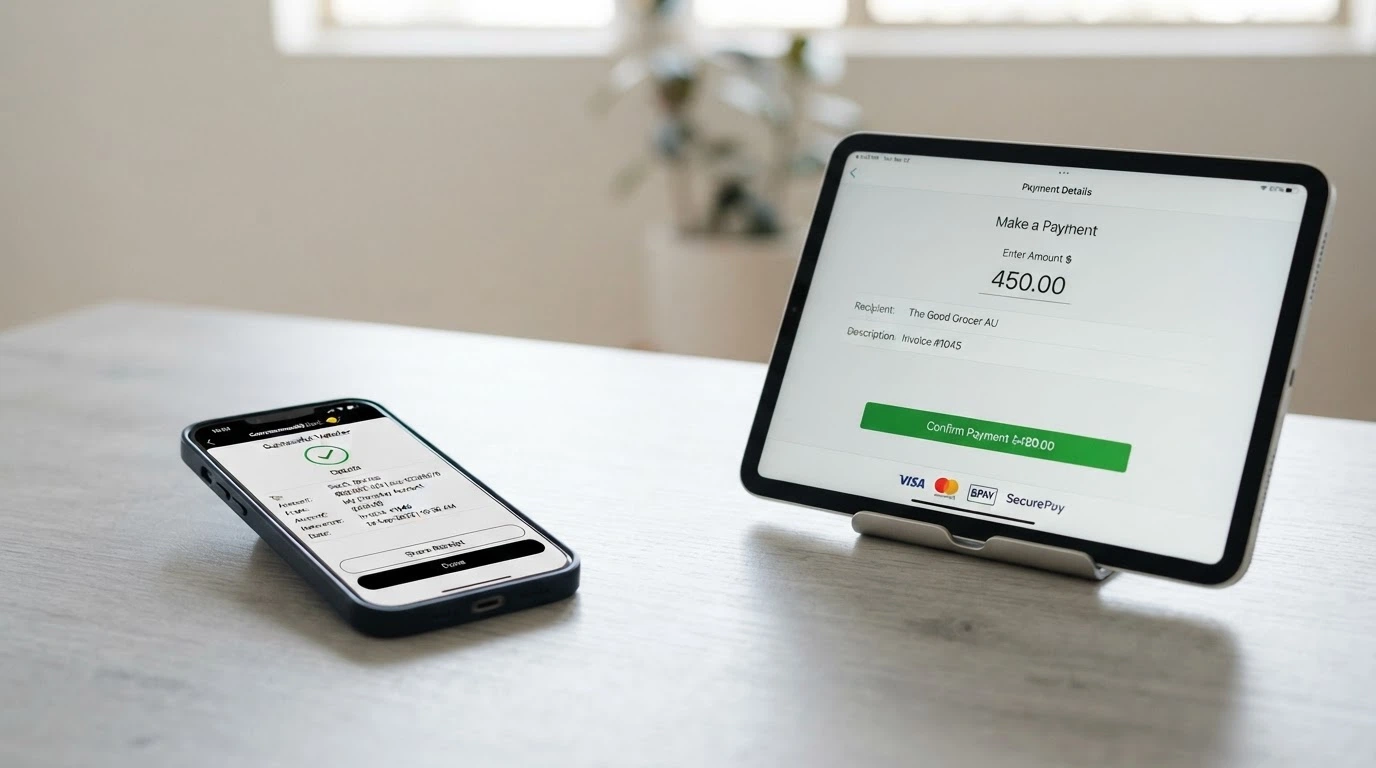
The withdrawal side is where the promise breaks. PayID wins on deposit speed, privacy and cost, but it is the weakest option for getting money back out. Offshore operators that advertise PayID for deposits typically route withdrawals through standard bank-transfer rails rather than native PayID, and the result is a 1–3 day clearance window for the average operator. A NewCasino.ai audit in April 2026 found no verified native PayID integration in the cashier of any featured casino; the operators that market PayID on the deposit button and bank transfer on the withdrawal button are the norm rather than the exception.
| Payment method | Deposit speed | Withdrawal speed | Minimum deposit | Fee |
|---|---|---|---|---|
| PayID (deposit) | Instant (under 60 seconds) | Not typically supported | A$10–A$30 | Fee-free |
| PayID (withdrawal, where offered) | — | ~30 hours average; verified 11-minute outlier at Wild Fortune | — | Fee-free |
| Crypto (Bitcoin, Ethereum, USDT) | ~10–30 minutes (network-dependent) | 2–60 minutes | Varies | Network fee |
| E-wallet (Skrill, Neteller, MiFinity) | Instant | Up to 24 hours | A$10–A$20 | Varies |
| Bank transfer | 1–3 days | 1–3 days (3 days at SkyCrown, A$100 minimum) | A$30+ | Varies |
PayID deposits: instant, fee-free and nearly everywhere
The deposit-side mechanics are what drove PayID adoption across the offshore segment. Osko settles in real time through the New Payments Platform, the player’s bank app confirms the transfer immediately, and the casino credits the account without the standard 1–3 day wait of a card payment or a BPAY transfer. The A$10–A$30 minimum deposit is low enough to test a new operator without committing a large bankroll, and the absence of a card statement descriptor means a transaction on a bank statement does not read as a casino deposit, which is the privacy angle a meaningful share of Australian players cite.
Offshore operators adopted PayID on the deposit side because it works for them, too: the funds clear faster than a card, the chargeback risk that comes with card deposits is absent, and the Australian player’s familiarity with the rail reduces the friction at the cashier. The deposit flow is not the problem. The problem is the withdrawal flow.
Getting your money back: why PayID withdrawals are rare and what to use instead
Wild Fortune cleared a A$250 PayID withdrawal test in 11 minutes in the February–May 2026 testing window, which is the standout result in the segment. The average across operators that support PayID withdrawals at all was around 30 hours in the same test set. The 11-minute result is the outlier, not the norm, and a player expecting every PayID withdrawal to clear in minutes will be disappointed at any other operator in the featured set.
The faster reliable withdrawal paths are crypto (2–60 minutes, depending on the coin and the network) and e-wallets (up to 24 hours for the operators that support Skrill, Neteller or MiFinity). Bank transfer is the slowest of the standard options, with SkyCrown’s published 3-day clearance at A$100 minimum as a representative figure. The practical advice is to fund the account through PayID for the deposit speed, and to plan for a crypto or e-wallet withdrawal if the payout matters on a timeline tighter than three days.
Pokies in your pocket: mobile casinos Australian players actually use in 2026
Every offshore casino in the featured set works in a mobile browser. HTML5 game libraries have replaced the old Flash-and-download architecture, and the modern offshore casino product is designed mobile-first: portrait-orientation pokies, single-hand blackjack, touch-friendly live dealer lobbies. The practical experience of playing at an offshore casino on a phone in Australia today is functionally identical to playing at any mobile-first casino anywhere in the world.

What does not exist is an Australian App Store listing for any of these operators. The IGA’s prohibition on providing online casino services to Australians is what keeps these apps out of the official Apple and Google stores, and the operators have not attempted to list. The result is that the term “casino app” in the Australian offshore context means one of two things: a sideloaded APK downloaded directly from the operator’s site (with the security, update and account-recovery risks that come with installing software outside the official app stores), or a progressive web app that runs through the phone’s browser but offers an app-like interface when saved to the home screen.
Mobile browser vs casino app: what actually works for Australian players
The mobile browser is the default for a reason. It carries the full game library (no mobile-only subset at any of the major operators in the segment), it updates without a manual reinstall, and it leaves the phone’s app permissions untouched. For a player who values simplicity and security, the mobile browser is the better default.
The sideloaded APK offers marginally faster load times and a homescreen icon, at the cost of installing software from outside the official app store, managing updates manually, and accepting the account-recovery risk that comes with an app that is not tied to an Apple ID or Google account. The progressive web app sits in the middle: it is a website optimised to look and feel like an app, added to the home screen with one tap, and it does not require sideloading. For most Australian players, the practical choice is mobile browser for the deposit and the play, and a home-screen bookmark of the casino’s web app if the app-style interface matters.
The one thing worth checking on a phone is the game library: a small number of older operators still maintain a separate mobile-only subset, and the full desktop catalogue is not always available. The newer HTML5-first sites carry the full library on both form factors.
When the pokies stop being fun: getting real help in Australia
The Australian Institute of Health and Welfare puts problem gambling prevalence at 2.1% of adults, roughly 430,000 people, with high-risk gambling prevalence at 1.8% (2022 figures). Australians lost over $32 billion to gambling in 2023–24. The numbers are large enough that the help infrastructure exists whether the gambling happens through a licensed Australian wagering operator, a land-based casino, a pokies venue, or an offshore casino. The reach of that infrastructure is what differs.
BetStop: the self-exclusion register offshore casinos ignore
BetStop — the National Self-Exclusion Register — has been live since August 2023. A single registration excludes a person from every Australian-licensed online and phone wagering service in one step, with exclusion periods ranging from three months to a lifetime. As at 31 July 2026, BetStop had 67,480 registrations across three years of operation, of which 41,290 exclusions were still active (more than 60% of all registrants). 78% of registrants were under 40, and 38% chose a lifetime exclusion.
BetStop binds Australian-licensed wagering services only. An offshore casino is not licensed here, is not connected to the register, and will keep accepting a self-excluded person’s money. For a player who has registered with BetStop and continues to gamble at an offshore casino, the protection that BetStop offers is structurally not in effect. The exclusion still works for the licensed Australian market, but the offshore segment is outside the regime.
Where to get help: 1800 858 858 and the support that works
The National Gambling Helpline is 1800 858 858, free, confidential and staffed 24 hours a day, seven days a week. Online chat and counselling are available through Gambling Help Online at gamblinghelponline.org.au. From April 2026, the government expanded specialised financial counselling services for people experiencing financial difficulty as a result of gambling harm, which is the practical support layer for the debt side of the problem.
The offshore-licensed RG tools that the larger operators offer (deposit limits, time limits, self-exclusion at the account level, activity statements) work at the operator’s discretion, and the page reports their existence qualitatively because research did not carry per-operator RG-feature data this run. The structural fact is that these tools are operator-controlled, not regulator-mandated, and the accountability for enforcing them sits with the operator rather than with an Australian body. For a player whose gambling has stopped being fun, the Australian help infrastructure is the part that does not depend on the operator’s cooperation.
How we picked the best Aussie online casinos for 2026
The source set for this page is publicly available Australian and international material: PayoutVerdict’s payout-speed tests across Australian-facing offshore casinos, Esports.net’s PayID analysis, PokiesAustralia and Gambling Insider’s bonus-term audits, AustralianGamblers and PlayCasino’s operator reviews, the ACMA’s public enforcement register, the AIHW’s gambling-harm data, and the APH.gov.au legislative record for the IGA and the 2026 reform bill. The ACMA register, the Antillephone validator and the Tobique Gaming Commission’s own register are the three licence-verification tools the page relies on; a licence claim that does not resolve on one of those three is a licence claim worth treating as unverified.
Operator selection followed Australian search visibility and relevance to the casino and pokies intent: this is a page about real-money online pokies, live dealer and table games, not a wagering or sports-betting page, and the licensed Australian wagering brands (Sportsbet, TAB, bet365, Ladbrokes) are not in the ranking for that reason. The ten operators in the table are the names Australian players actually encounter when searching for online casino and pokies, regardless of whether their terms were refreshed this run.
The evaluation criteria that ordered the list are: licence verifiability, bonus-term fairness measured by wagering multiple × cashout cap × expiry, payout-speed test results where available, game-provider breadth, and regulatory status under the IGA. No weightings or percentages are applied that the research does not carry, and the verification split is preserved in the page rather than smoothed over: operators 1–3 were refreshed with detailed terms this run, and operators 4–10 were not, and the table reflects that honestly.
Is an offshore casino worth the risk — what this page actually found
The trade the Australian player is making is consistent across the segment. On one side, access to a real-money online casino with thousands of pokies, live dealer tables, bonuses with five-figure headline values, PayID deposits that clear in under a minute, and mobile browser play that works on any phone. On the other side, zero Australian regulatory protection: no AU licence, no BetStop coverage, no ACMA complaint body, no statutory withdrawal guarantee, and a real risk that the site is blocked by an ISP with a balance still held.
The bonus arithmetic reinforces the case for reading the terms. A A$1,200 first-deposit bonus at 40× wagering requires A$48,000 in turnover, and the expected loss on that turnover, at a 96.71% return to player, is A$1,579.20. The “expected loss” is a statistical estimate: an average over many spins under the stated assumptions, not a guaranteed outcome for any single player. It is the best available reading of what the bonus costs the player on average, and the bonus is worth more than that only if the player values the entertainment of the playthrough at more than the expected loss.
The 2027 reform tightens the frame further. From 1 January 2027, banks and payment providers have express authority to block transactions to illegal gambling operators. The same reform caps TV wagering advertising to three ads per hour between 6:00 am and 8:30 pm, blackouts wagering ads during live sport, and bans inducement marketing for 14 days after signup, three months after BetStop deregistration, and indefinitely for at-risk customers. The reform does not legalise online casino. It narrows the channels through which illegal operators reach Australian customers, including the payment rails and the marketing that funds them.
The Australian player who chooses an offshore casino is making a calculated trade, not a protected choice. The page gives the tools to make that calculation honestly: the licence status, the bonus math, the payout speeds, the regulatory frame, the harm data, and the help lines. The judgment belongs to the reader.
Frequently asked questions
Can I get into legal trouble for playing at an online casino in Australia?
No. The Interactive Gambling Act 2001 targets the provider of online casino services, not the individual player. The Act makes it an offence to offer online casino games, online pokies and in-play sports betting to a person in Australia, and the enforcement action is directed at operators and ISPs, not at players who deposit and play. The practical consequence is that the player has no Australian complaint body to turn to if the operator refuses a withdrawal or voids a win, even though the player has not broken the law.
What happens if an offshore casino refuses to pay my withdrawal — do I have any recourse?
The recourse available is whatever the operator’s own terms and the licensing jurisdiction provide. An Australian player has no statutory right to a payout from an offshore casino, no ACMA complaint pathway for a withdrawal dispute, and no Australian court with straightforward jurisdiction over a Curaçao or Tobique entity. The Curaçao and Tobique regulators handle disputes through their own processes, and the operator’s own complaints procedure is the first port of call. This is the structural cost of the offshore model, and the reason payout history and licence verifiability are the two most important signals before any deposit.
Are my winnings taxed if I play at an offshore casino from Australia?
No, not in the typical case. Betting and gambling winnings are not assessable income under section 6-5 of the ITAA 1997, and gambling losses are not deductible under section 8-1, unless the person is carrying on a business of betting or gambling. The ATO treats a recreational player’s casino winnings the same way it treats a recreational punter’s racing win: not taxable, not reportable, and not deductible. Operators pay tax where the customer is — the Northern Territory’s 5% wagering tax plus state point-of-consumption tax in the 10–15% range — but the player has no Australian tax obligation on the win.
Why do some Aussie casino sites ask for crypto when credit cards are banned here?
The Interactive Gambling Amendment (Credit and Other Measures) Act 2023 banned credit cards, credit-related products and cryptocurrency as payment for online wagering from 11 June 2024, and an operator failing to enforce the ban faces penalties of up to A$247,500. An offshore operator that asks an Australian customer for crypto is asking outside the Australian regulatory framework, because the 2024 ban applies to anyone providing wagering services to Australians. The ban is the regulator’s way of marking which payment methods move a transaction outside the licensed system, and crypto is one of those markers. The 2027 reform extends this further by giving banks and payment providers express authority to block transactions to illegal operators.
Is there any way to check if an offshore casino’s pokies are fair?
The two practical checks are the game’s published return-to-player (RTP) and the testing laboratory certificate. Reputable providers publish the RTP on the game info page (Big Bass Bonanza’s published RTP is 96.71%, with alternative settings of 95.67% and 94.5% available to operators, and the setting in play varies by site), and the testing certificate (typically from GLI, iTech Labs or BMM Testlabs) should be visible somewhere in the casino’s footer or terms. The licence jurisdiction provides a third layer, with Curaçao and Tobique both maintaining registers that resolve the licence number on a casino’s footer. None of these is a guarantee of fairness in the same way the ACMA’s oversight of Australian-licensed operators is, but they are the signals the offshore market offers.
Written by the editors at Jackpot Pokies Australia.