
Fast payouts, slow truth: how offshore casinos serve Australian players
Verified as at 3 November 2026 against the official ACMA register of licensed interactive wagering providers and the BetStop statistics published on 31 July 2026.

The fastest-paying online casino an Australian can join is, without exception, an unlicensed offshore one. There is no online casino licence in Australia — federal or state — so every site that pays out inside an hour, every site that accepts a crypto deposit, every site that takes a sign-up from Sydney or Perth is doing so from Curaçao or a similar offshore jurisdiction. That single fact frames the rest of the page. It shapes who can refuse to pay a winning, what happens to a balance when the regulator acts, and which Australian consumer protections the player forfeits on the way through the door.
What follows is a ranked account of the offshore brands Australian players actually use when payout speed matters, the payment methods that decide how fast the money lands, the bonuses that read as generous and the maths they actually cost, and the legal ground Australians stand on when they play at any of them. The reader is taken to be an adult Australian weighing whether — and how — to play at all.
Table of Contents
- What a Fast-Payout Online Casino Actually Delivers in 2026
- The Fastest-Paying Offshore Casinos for Australian Players, Ranked
- Why Your 2026 Casino Payout Speed Depends on How You Cash Out
- Fast-Payout Casino Bonuses That Do Not Trap Your Winnings
- Every Fast-Payout Casino Serving Australians Is Unlicensed — Here Is What That Costs You
- Staying in Control When Playing at Offshore Casinos
- How We Evaluated Fast-Payout Casinos for Australian Players
- What Australian Players Should Actually Decide About Fast Payouts in 2026
- Frequently Asked Questions
What a Fast-Payout Online Casino Actually Delivers in 2026
“Fast payout” is marketing language that papers over a two-stage process the operator controls and the player doesn’t. Every withdrawal is a casino approval followed by a payment-method transfer, and the time the marketing material quotes almost always describes only the second of those two stages. The “instant” payout an affiliate page advertises is the bit the casino can race through; the bit that decides whether the money arrives today or next week is the bit that sits in the casino’s pending queue.
A payout time of “minutes” or “instant” in an affiliate review typically refers to the casino approval stage alone — the time between a player hitting Withdraw and a finance officer hitting Approve. The transfer that follows is governed by the payment rail. The crypto rail can move in minutes; the PayID rail moves in hours; the bank-transfer rail moves in working days. None of these are negotiable with the casino, because none of them are the casino’s to operate. What the casino controls is the time between the request and the approval — and that is the part of the experience the operator can quietly lengthen, often with a mandatory pending period that has nothing to do with the payment method at all.
What “fast payout” means and how the two-stage withdrawal process works
Casino-side approval varies. The fastest operators quote minutes; many take up to 24 hours; some enforce a mandatory 48-hour pending window where the withdrawal sits in the queue and the player can still cancel it. The pending window is where the house edge quietly does its second job: testing across offshore operators shows that more than 40% of players cancel the withdrawal during the wait and gamble the winnings back. Pending periods are not a back-office accident. They are a feature.
Payment-method transfer time varies more sharply. Crypto (USDT TRC20, Solana, Litecoin) clears in seconds to minutes once the casino approves it; Bitcoin adds 30 to 60 minutes for three to six blockchain confirmations; PayID averages 2 hours in business hours and pushes to 48–72 hours on a Friday evening or public holiday because NPP bank-side processing slows outside business hours. E-wallets (Skrill, Neteller, eZeeWallet) sit in the middle at a 6-hour median, with an 18-hour worst case. Card and bank transfer sit at the bottom: 2 to 5 working days for Visa and Mastercard, 3 to 7 for bank transfer. Median numbers are clean; worst cases are what the reader actually meets.
The two stages do not happen in parallel. A casino cannot pre-approve a withdrawal because the verification step has to happen on the actual funds. The fastest combined experience an Australian player can realistically reach at an offshore casino today is in the order of one to two hours, and that requires crypto, a pre-verified account and a casino that processes inside its stated window. The “under one minute” claim some affiliates make is the casino approval stage alone, with the chain transfer still to come.
How online casino play works for Australian punters
The shape of online casino play for Australians is set by what is legal, not by what the operators offer. Online casino games, online pokies and in-play sports betting are prohibited under the Interactive Gambling Act 2001, strengthened by the Interactive Gambling Amendment Act 2017, and there is no Australian licence for online casino anywhere — federal or state. The Australian market is the French case, not the British one: a prohibition the regulator enforces against providers, not players. No Australian has been prosecuted for playing at an offshore casino. The provider is the target.
That is the architecture under which every casino on this page operates. They are offshore services that target Australian sign-ups from Curaçao or similar jurisdictions, accept Australian dollars, and run Australian-friendly payment rails. They are not licensed in Australia and could not be, because the licence does not exist. The Australian Communications and Media Authority enforces the prohibition, investigates complaints, and since November 2019 has directed Australian ISPs to block 1,564 illegal gambling and affiliate websites (as at March 2026); more than 225 illegal services have withdrawn from the Australian market since 2017.
The payment method asked for at sign-up is itself a tell. Since 11 June 2024, credit cards, credit-related products and digital currency (crypto) have been banned as payment for online wagering in Australia, with penalties of up to A$247,500 for non-compliance. Legal deposit routes for AU-licensed wagering operators are debit card, bank transfer, PayID/Osko and BPAY. An Australian who is asked for a credit card or a crypto deposit by a gambling site is being served by someone outside the Australian rules. The payment method is the tell. Every casino on this page accepts crypto — by definition, they are not AU-licensed.
How Australians get money in and out is shaped by the same prohibition. PayID and bank transfer in AUD work, but they go through an offshore entity. Most operators process crypto for speed. Cards work for deposits but are restricted at the Australian end. None of the consumer protections that apply to AU-licensed wagering — dispute resolution, complaints to state regulators, BetStop self-exclusion — apply offshore. That is the practical reality the rest of the page takes as given.
The Fastest-Paying Offshore Casinos for Australian Players, Ranked
The ranking below orders the ten brands by what is known about their tested or claimed withdrawal speed — five operators where tested data surfaced this round, and five where it did not. Every brand listed is offshore/unlicensed in Australia. None holds an Australian online casino licence, because no such licence exists. None is connected to BetStop.
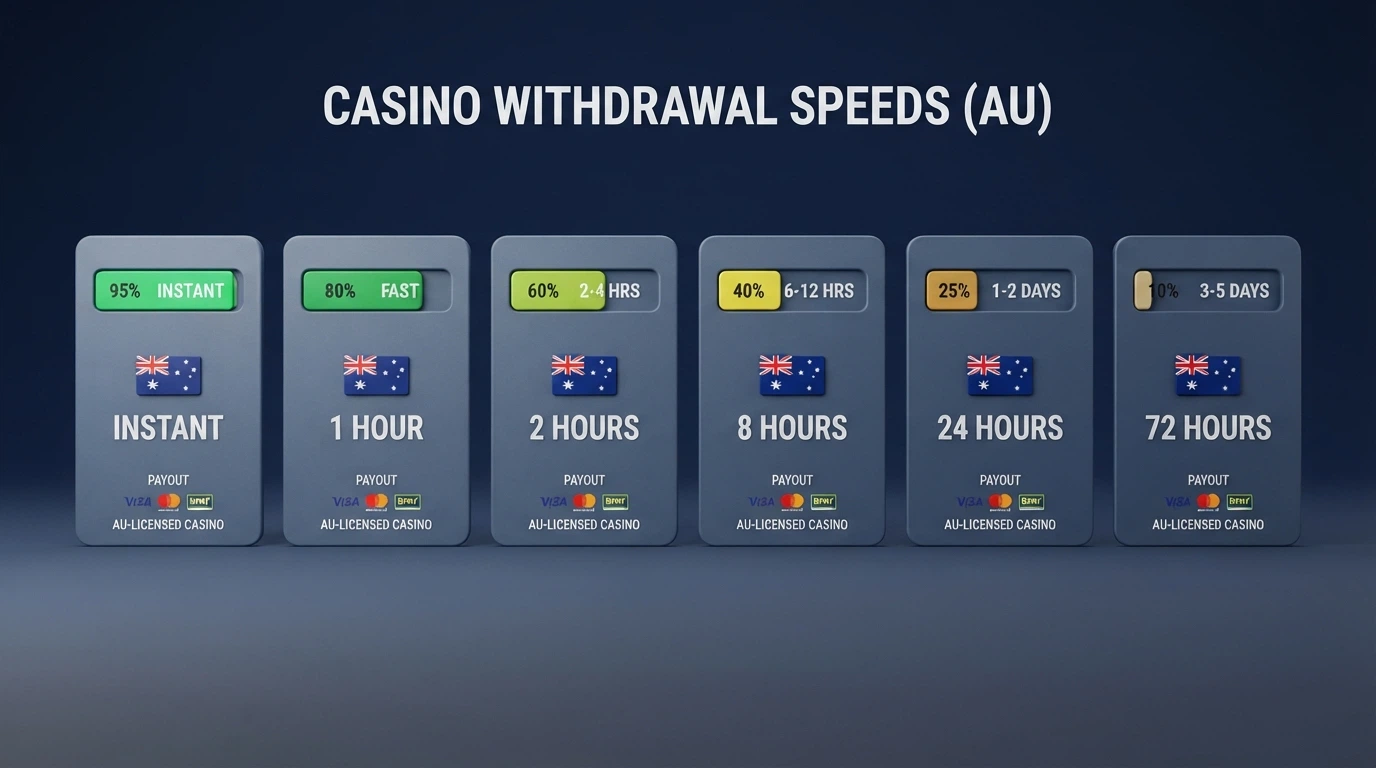
| Casino | Licence | Payout Speed (Tested or Claimed) | BetStop Connected |
|---|---|---|---|
| SkyCrown | Curaçao | ~10 min processing, up to 24h; bank transfer ≤3 days; MiFinity from A$30 | No |
| RocketPlay | Curaçao (Dama N.V.) | 0–24h casino approval; 1–3 days by method | No |
| Royal Reels | Curaçao | Fast withdrawals claimed; daily limit resets | No |
| WinSpirit | Curaçao (inferred) | E-wallet/crypto 1–24h; card/bank 3–5 days | No |
| Stake | Curaçao | Crypto-focused; fast claimed | No |
| Rainbet | Curaçao (inferred) | — | No |
| FairGO | Curaçao (inferred) | — | No |
| Scream Casino | Curaçao (inferred) | — | No |
| Bizzo Casino | Curaçao (inferred) | — | No |
| Rocket Casino | Curaçao (inferred) | — | No |
Em-dash cells indicate payout specifics not confirmed this round. Brand presence in the Australian market is corroborated by independent traffic data; independent test data for brands six to ten was not produced this run, so they sit at the bottom of the speed ranking by default. The ranking is built on payout performance, not market share — Stake and Rainbet each hold roughly 1.28% of the AU-facing offshore market, but neither carries the tested figures the operators above them do.
SkyCrown
SkyCrown is the high-roller fast-payout pick among the operators where independent testing surfaced this round — four tiers of welcome bonus, sub-24-hour processing on average, and a Curaçao licence the operator publishes openly. The bonus is the headline: up to A$8,000 and 400 free spins across four deposits, with 40x wagering on both bonus money and free spin winnings. The offer is not available for cryptocurrency deposits, which is a structural choice that pushes high-volume players toward bank transfer or e-wallet funding.
Payout speed on tested withdrawals averages about 10 minutes of internal processing, with a worst case of 24 hours. Bank transfer starts from A$100 and clears within 3 days; MiFinity withdrawals start from A$30. Withdrawal limits are A$7,500 per week and A$45,000 per month — a non-trivial ceiling that matters for anyone running the bonus through with a serious bankroll.
The verdict: SkyCrown is the right fit for an Australian player who wants the fastest tested withdrawal, can fund with non-crypto methods to claim the bonus, and is comfortable at the A$7,500 weekly ceiling. The marketing name is “instant payout”; the closer-to-true word is “sub-24-hour with limits”. Players banking through crypto should look elsewhere — and accept they cannot claim the welcome offer.
RocketPlay
RocketPlay is the library-first pick in the ranked set — 3,000+ games, a two-tier welcome offer of A$1,000 plus 100 free spins on the first deposit and a 200% match up to A$1,000 on the second, with 30–40x wagering. It runs under a Curaçao licence operated by Dama N.V. Casino-side approval takes 0–24 hours and the payment-method transfer adds 1–3 days on top. E-wallet and crypto routes typically come in under 24 hours combined. Weekly withdrawal limits are tiered by verification level — A$5,000 for basic verification up to A$15,000 at higher tiers, with the higher the verification, the higher the ceiling.
RocketPlay is the operator to pick for game variety rather than headline bonus size, and for a player who plans to verify fully before requesting the first withdrawal. The wagering multiple is the most generous in the ranked set at 30x on parts of the bonus, and the calculation in the wagering section below walks through what that 30x actually costs in expected loss — the headline A$1,000 bonus shrinks considerably once the maths is done.
WinSpirit
WinSpirit is the bonus-heavy pick in the ranked set — a 200% match plus 25 free spins on the welcome offer, with 40x wagering on promotional play. E-wallet and crypto withdrawals land in 1–24 hours; card and bank transfer take 3–5 days. The licence is Curaçao (inferred). A cashback offer and loyalty program sit on top of the welcome package.
The 200% match is the headline number, but the 40x wagering is the number that decides whether the bonus is worth claiming. A 200% match on a A$100 deposit gives A$300 of bonus money, which must be turned over 40 times — A$12,000 of required play — before any withdrawal is possible. The expected-loss calculation later in this page shows what that kind of turnover actually costs. The marketing word is “big bonus”; the closer-to-true word is “big requirement”. Players who want a fast payout without the playthrough attached can skip the bonus and play cash, which is the only path to a payout without a turnover condition.
Stake
Stake is the biggest name in the offshore set for Australian players — 1.28% AU market share, crypto-first rails, and a Curaçao licence. Its payout process is built around the blockchain rather than the bank, which is the structural advantage the brand markets. The library mixes proprietary and third-party titles.
The data gap on Stake this round is wider than for the operators above. Bonus specifics and tested payout times were not confirmed in the operator sweep that produced this page, which is a meaningful note for any reader comparing on tested speed rather than claimed speed. The market-share figure is the most defensible thing on the page about Stake — it tells you the brand has Australian traffic and a working payment pipeline, not that it pays out fastest.
The verdict is structural rather than competitive. Stake suits an Australian player who already holds crypto, prefers to keep play off the bank rails, and is willing to accept that the brand’s Australian market presence is the main signal that the pipeline works. Players who need tested payout times to compare brands should weight the five operators with confirmed data above Stake.
Royal Reels
Royal Reels is the rare offshore operator in this set that lets an Australian test the water without depositing first — an A$10 no-deposit bonus for new sign-ups sits on top of a 100% welcome match up to A$500. Minimum deposit is A$30. Wagering requirements are 30–40x. The library is 2,000+ games from 30+ providers, including Pragmatic Play, Evolution, Yggdrasil and Hacksaw Gaming. The licence is Curaçao.
Royal Reels is the operator to pick for the player who wants to confirm the withdrawal pipeline before committing real money. The no-deposit bonus is not a path to a meaningful payout — its max-cashout ceiling is tight enough to make meaningful winnings effectively unrecoverable — but it is a path to confirming the casino approval stage and the KYC process on a small win before depositing. Tested payout time was not confirmed this round; the operator claims fast withdrawals and runs a daily-limit-reset structure that supports the claim in marketing language. Treat the claim as unverified until a reader’s own withdrawal proves it.
Rainbet
Rainbet holds an inferred Curaçao licence and runs at roughly 1.28% AU market share — on par with Stake for the Australian-facing audience. Bonus terms, game providers and tested payout speed were not confirmed in this round’s operator sweep, which makes Rainbet the kind of brand the reader should treat as present in the AU market without a confirmed speed story to compare against.
The honest read on Rainbet is that it is a real name in the Australian-facing offshore set without a verified payout story. Players weighing brands on tested data will find no number for Rainbet to sort on. It belongs in the reader’s market map; it does not belong in the speed comparison.
FairGO
FairGO carries Australian-facing branding and a Curaçao licence at roughly 0.8% AU market share. The name signals “Australia” to an Australian reader in a way the licence does not support — the only Australian-facing part of FairGO is its marketing. Bonus terms, game providers and tested payout speed were not confirmed in this round.
FairGO is a brand whose market presence is real and whose specific payout performance has not been independently verified for this page. The branding is aimed at Australians; the licence is not. Players who weigh a brand by licensing transparency will weight FairGO the same as the other Curaçao-inferred brands in this ranking.
Scream Casino
Scream Casino fits the same pattern: a real market presence (0.99% AU share), an inferred Curaçao licence, and no independently confirmed payout specifics. The brand’s footprint is mid-tier among AU-facing offshore operators and the data available for this page is the market-share figure plus the licence inference.
Scream Casino is one of four brands the reader can find in the market but cannot rank on tested payout data. That is not a strike against the brand — it is the limit of what the data this round surfaced can support.
Bizzo Casino
Bizzo Casino is one of the longer-running names in the Curaçao set serving Australian players — 0.57% AU market share, Curaçao licence (inferred), and a brand that has been present across multiple reporting cycles. Bonus terms, game providers and tested payout speed were not confirmed this round.
Longevity is a signal — not the same as a payout-speed signal, but a signal. Players who value a brand that has survived multiple reporting cycles will find Bizzo’s presence meaningful; players comparing on tested data will not find a number for Bizzo to sort on.
Rocket Casino
Rocket Casino sits at 0.57% AU market share alongside Bizzo, with an inferred Curaçao licence. Bonus terms, game providers and tested payout specifics were not confirmed this round. The brand shares a name with RocketPlay in this ranking, which is a likely — though unconfirmed — indication that the two share operator infrastructure. Treat that as a guess rather than a fact; this page could not confirm the relationship.
The RocketPlay write-up earlier in this ranking is the closest comparable for any player researching Rocket Casino. Confirm the relationship on the brand’s own published terms before assuming the same operator runs both — this page could not confirm that, but the name overlap is suggestive enough to point a careful reader in the right direction.
Why Your 2026 Casino Payout Speed Depends on How You Cash Out
The brand you pick matters less than the payment method you pick. Tested medians for the same operator can vary from under an hour to several working days depending on the rail. The fastest casino in this ranking is slower than its slowest competitor if the player chooses bank transfer. The slowest casino on the list is faster than its fastest if the player uses crypto. The choice is the player’s, and the cost of getting it wrong is days of waiting on money already approved.
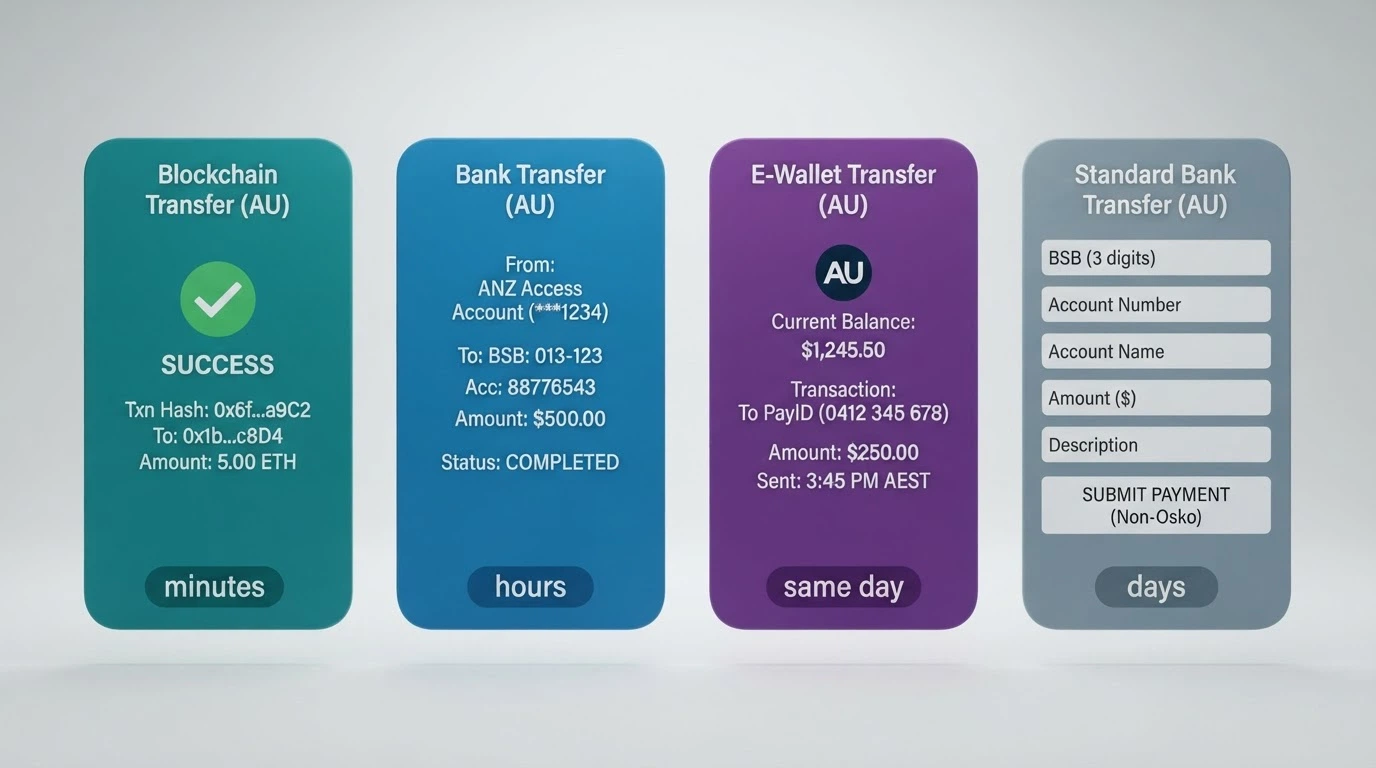
Payment methods ranked by withdrawal speed
| Method | Deposit Speed | Withdrawal Speed (Median) | Withdrawal Speed (Worst Case) | Fees | AU Notes |
|---|---|---|---|---|---|
| Crypto (USDT TRC20, Solana) | Seconds | <1 hour | 4 hours | A$0.02–A$5 network fee | Banned for AU-licensed wagering since 11 June 2024; available at every offshore operator on this page |
| Crypto (Bitcoin, Ethereum) | Seconds–minutes | 42 min (BTC, LTC, USDT) | 4 hours | A$0.02–A$5 network fee | BTC needs 3–6 confirmations adding 30–60 min; ETH 5–15 min |
| PayID | Seconds | 2 hours | 8 hours | Generally nil | Friday-evening or public-holiday requests push to 48–72h |
| E-wallet (Skrill, Neteller, eZeeWallet) | Instant | 6 hours | 18 hours | Operator-dependent | Operator must support the e-wallet for both deposit and withdrawal |
| Visa / Mastercard | Instant | 2 working days | 5 working days | Generally nil for withdrawals | Card-issuing bank may block gambling-related credits |
| Bank transfer | 1–2 working days | 3 working days | 7 working days | A$10–A$50+ | SWIFT fees apply on international wires |
Crypto is the fastest route by a margin, but it is also the route that places the player most clearly outside the AU-licensed wagering perimeter. PayID is the fastest AUD-denominated route for an Australian who wants to stay inside the domestic banking system — though it is only available at operators that support PayID specifically, and the 48–72-hour worst case on a Friday evening is the kind of detail the marketing language does not volunteer. Bank transfer is the slowest by a wide margin and is where the casino’s claimed “instant withdrawal” meets the reality of SWIFT wires and correspondent banking.
PayID vs crypto — which actually clears faster for Australians
Crypto is faster on tested median. The 42-minute median for crypto across AU-facing offshore operators beats the 2-hour median for PayID. USDT on the TRC20 network and Solana both settle within seconds once the casino approves the withdrawal; Bitcoin is the slowest crypto option because of the three to six confirmations adding 30 to 60 minutes; Ethereum sits in the middle at 5 to 15 minutes per confirmation. In every case, the bottleneck is the casino’s internal approval, not the blockchain.
PayID is the faster AUD-denominated route for Australians who do not want to hold crypto. The 2-hour median is reasonable in business hours; the 8-hour worst case is the realistic ceiling. Friday evening and public-holiday requests routinely push to 48–72 hours because NPP bank-side processing slows outside business hours — a structural feature of the rail, not a casino-specific delay.
The Australian-specific complication is the payment-method ban. Since 11 June 2024, crypto is a banned payment method for online wagering under Australian law, with penalties of up to A$247,500 for non-compliance. The ban applies to AU-licensed wagering operators, not to offshore ones. Offshore operators still accept crypto because they operate outside Australian law; an Australian player using crypto at an offshore site is, by definition, outside the AU-licensed perimeter. That is the trade the reader makes for the 42-minute median: speed, in exchange for sitting entirely outside Australian consumer protection.
E-wallets and bank transfers — the slower but widely supported routes
E-wallets sit in the middle of the speed table — 6-hour median, 18-hour worst case across Skrill, Neteller and eZeeWallet in testing. They are the route that most reliably works at every operator on this page, because every offshore casino supports at least one e-wallet, and the e-wallet acts as a buffer between the casino and the player’s bank account. The cost is speed, and the operator must support the e-wallet for both deposit and withdrawal — a deposit via Skrill and a withdrawal to Neteller is a common reason for a refused payout.
Bank transfer is the slowest. The 3-working-day median reflects domestic transfers; international wires add SWIFT fees and 5 to 7 working days. Fees range from A$10 to over A$50 on the bank-transfer side, with the operator often absorbing fees on deposits but passing them through on withdrawals. Bank transfer is the route an Australian player ends up on when the operator does not support e-wallet or crypto, or when the player is moving a sum large enough that the weekly withdrawal cap (A$7,500 at SkyCrown, A$5,000–A$15,000 at RocketPlay) requires multiple weekly requests and a method the casino will accept on each one.
The hidden bottleneck — KYC verification and mandatory pending periods
The casino’s processing speed is only half of the withdrawal story. Identity verification and forced waiting windows delay the first withdrawal more than the payment rail does. The biggest cause of a slow payout at an offshore casino is incomplete KYC — every legitimate operator runs account verification before a first withdrawal, and the documents (passport or driver’s licence, proof of address, sometimes source-of-funds) have to clear before the casino’s finance team will touch the withdrawal queue.
Many offshore casinos enforce a mandatory 48-hour pending period on top of the verification step — a waiting window where the withdrawal sits in the queue and the player can still cancel it. Testing shows that more than 40% of players cancel the withdrawal during the wait and gamble the winnings back. Pending periods are not a back-office accident. They are the feature that lets the house edge do its second job.
The practical mitigation is to verify the account before requesting the first withdrawal. Submit the documents at sign-up, not at cashout. Use a payment method that supports both deposit and withdrawal from the same source. Avoid the temptation to cancel and re-gamble during the pending period — the pending period exists because the operator knows the temptation works.
New fast-payout casinos — what to watch for in 2026
The new-entrant problem in the AU-facing offshore market is asymmetry of information. A brand-new operator’s payout claims are unverified by definition — there is no track record, no third-party testing, no player reports on the withdrawal pipeline. The signals that mean something on a brand that has been around for two years (withdrawal caps, processing time stated in the terms, licence jurisdiction published on the page) are still the right things to check on a brand that has been around for two weeks.
The reform package passed on 19 August 2026 shifts the ground for new entrants. From 1 January 2027, banks and payment providers gain express authority to block transactions to illegal gambling operators. A new offshore casino launching in 2026 is launching into a window where Australian banks can refuse to process its payouts at the request of the regulator. That does not stop a new entrant — it adds a friction point. Operators that survive the transition will be the ones whose banking pipeline already routes around Australian bank scrutiny; operators that have not solved that pipeline will see withdrawal times extend unpredictably.
For a player considering a brand-new fast-payout operator, the signals worth checking are: licence jurisdiction (Curaçao is the standard; Anjouan is the alternative); withdrawal caps published in the terms (A$5,000 per week is common; nothing stated is a red flag); processing time stated in hours, not “instant”; KYC requirements stated on the withdrawal page, not behind a support ticket. If those are not visible before deposit, the payout story the marketing tells is the only story the player has.
What to play — high-RTP pokies at the featured operators
The choice of pokie changes the maths in ways that matter more than the choice of casino. A 99% RTP pokie costs 1% of turnover in expected loss; a 96% RTP pokie costs 4%. Across the A$30,000 of turnover a 30x bonus requirement produces, that is the difference between A$300 and A$1,200 in expected loss — a fourfold difference from a three-percentage-point RTP gap. The table below is the high-RTP end of what the featured operators carry.
A meaningful share of AU-facing offshore sites run reduced-RTP variants of popular pokies without disclosing the configuration in the game panel. The 96.71% on Big Bass Bonanza below is the headline figure; the variant the player actually faces on a given site may be lower — Book of Dead in particular is published at 96.21% but ships at 95%, 92%, 91.2% and 87.2% on different sites.
| Slot Title | Provider | RTP | Volatility | Max Win |
|---|---|---|---|---|
| Mega Joker | NetEnt | 99.00% | Low | 2,000x |
| 1429 Uncharted Seas | Thunderkick | 98.60% | Low | 2,200x |
| Blood Suckers | NetEnt | 98.00% | Low | 900x |
| White Rabbit Megaways | Big Time Gaming | 97.77% | — | — |
| Big Bass Bonanza | Pragmatic Play / Reel Kingdom | 96.71% | Medium-High (4/5) | 2,100x |
| Sugar Rush 1000 | Pragmatic Play | 96.53% | High (5/5) | 25,000x |
| Sweet Bonanza | Pragmatic Play | 96.51% | High | 21,100x |
| Gates of Olympus 1000 | Pragmatic Play | 96.50% | High | 15,000x |
| Lucky 88 | Aristocrat | ~96.3% | Medium | 88x |
| Starburst | NetEnt | 96.09% | Low-Medium | — |
| Book of Dead | Play’n GO | 96.21% | — | — |
Em-dash cells indicate data not surfaced this round. The expected-loss calculation in the wagering section below uses Big Bass Bonanza at 96.71% as its worked example, because it is the most consistent title across the featured set and the RTP is published openly.
Fast-Payout Casino Bonuses That Do Not Trap Your Winnings
A bonus that pays out fast sounds appealing until the wagering requirement is read. The brand names the bonus in dollars; the playthrough multiplies that dollar figure by 30, 40 or more before a withdrawal is possible. The marketing word is “free money”; the closer-to-true word is “money you cannot withdraw until you have turned over 30 or 40 times the dollar value of it”. The expected-loss calculation in this section puts a number on the real cost.
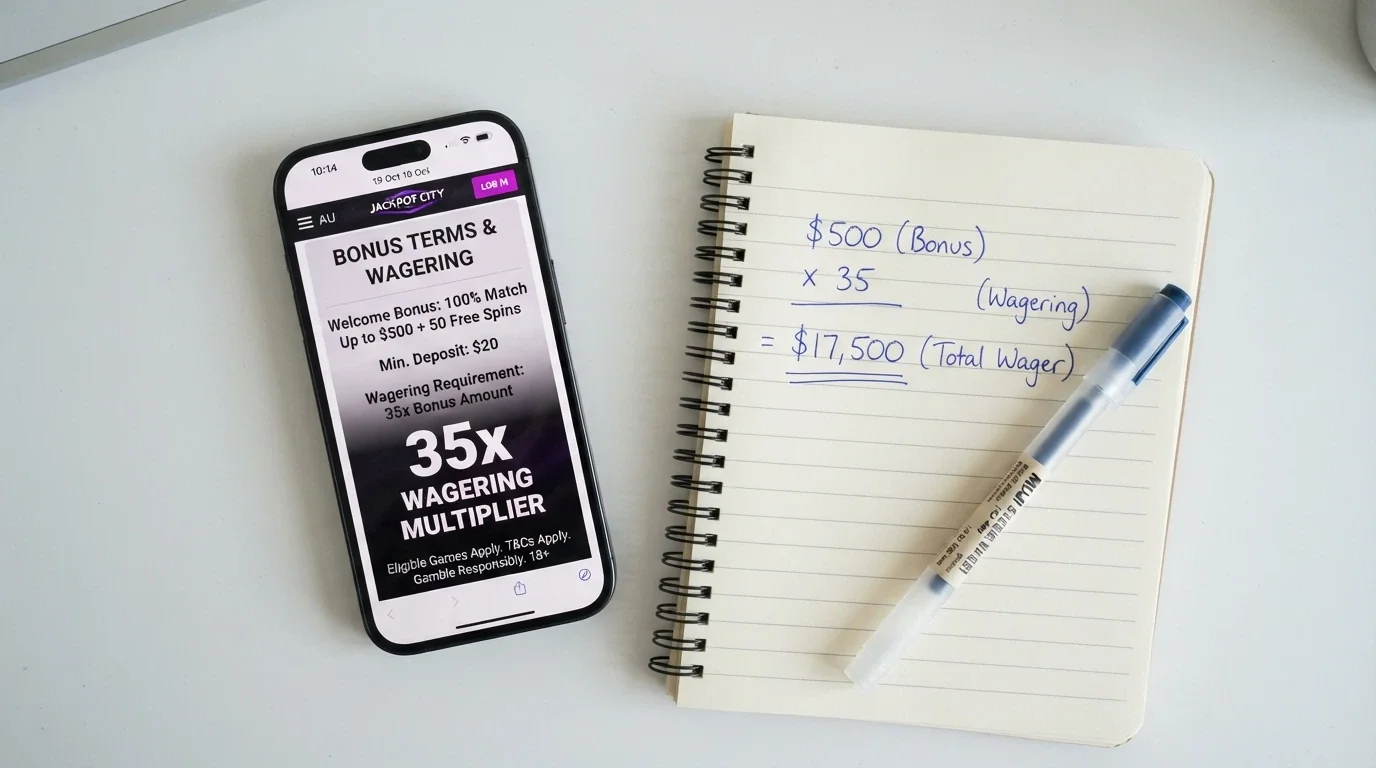
The featured bonuses vary widely in headline size and playthrough. SkyCrown’s 4-tier welcome package runs up to A$8,000 and 400 free spins at 40x wagering — a large headline figure attached to a large playthrough. RocketPlay’s two-deposit welcome runs up to A$2,000 total at 30–40x. WinSpirit’s 200% match plus 25 free spins carries 40x. Royal Reels’ 100% match up to A$500 plus a A$10 no-deposit bonus carries 30–40x. The brand names are different; the wagering math is similar.
No-deposit bonuses at fast-payout casinos — what they are worth
The no-deposit bonus at Royal Reels — A$10 credited at sign-up — is the only no-deposit offer identified in the featured set this round. For other operators, no no-deposit bonus was found. A no-deposit bonus is not a path to a meaningful payout: it carries a tight max-cashout ceiling and a 30–40x playthrough attached to a small starting credit. The A$10 at Royal Reels must be turned over A$300–A$400 before any withdrawal is possible, and the winnings the player can actually cash out are capped well below what the playthrough would suggest.
The honest function of a no-deposit bonus is to test the withdrawal pipeline. The casino approval stage, the KYC friction, the pending period — all of these can be confirmed on a small no-deposit win before the player commits real money. That is what the bonus is worth. It is not what the marketing says it is worth.
Wagering requirements — how they delay your actual payout
A 30x wagering requirement on a A$1,000 bonus means A$30,000 must be turned over before a withdrawal is possible. That figure is the input to the real-cost calculation. Assuming the player wagers only the bonus amount (no additional deposits), and plays Big Bass Bonanza at the featured operators at an RTP of 96.71%, the expected loss on that A$30,000 of turnover is approximately A$987 — calculated as turnover multiplied by the house edge of 3.29%.
So the “A$1,000 bonus” is, statistically, an A$13 net gain to the player — A$1,000 in bonus money, less A$987 in expected loss. The fast payout the marketing promises is gated behind A$30,000 of play. The reader who wants the payout needs to clear the wagering first, and the wagering costs nearly the full bonus value in expected loss before a cent is withdrawable.
The number worth holding onto: across a 30x wagering requirement on Big Bass Bonanza, the player statistically keeps about 1.3% of the bonus value. A 40x requirement, on the same game, leaves the player statistically worse off than not taking the bonus at all — the expected loss exceeds the bonus value. The reader who wants a payout should weight the wagering multiple over the bonus headline every time.
Every Fast-Payout Casino Serving Australians Is Unlicensed — Here Is What That Costs You
The legality section is the one the affiliate pages tend to bury. It belongs alongside payout speed because the protections a player forfeits at an offshore casino are the same protections that would, in a licensed market, govern the payout the player is being promised. The casino is faster because the casino is unlicensed. The two facts are connected.

The Interactive Gambling Act — why no online casino licence exists in Australia
The Interactive Gambling Act 2001, strengthened by the Interactive Gambling Amendment Act 2017, makes it an offence to provide an online casino, online pokies or in-play sports betting to a person in Australia. There is no licence for online casino anywhere in the country — not federally, not in any state or territory. Wagering on races and sport placed before the event begins, lotteries and keno — these are the products that can be licensed, and they are licensed by state and territory regulators. In practice, the Northern Territory Racing and Wagering Commission is the de facto national licensor for online wagering. Online casino is not licensed anywhere in Australia because the IGA prohibits it.
The Australian Communications and Media Authority enforces the prohibition. It investigates complaints, issues formal warnings, refers operators for civil penalty proceedings, and directs ISPs to block illegal sites. The enforcement target is the provider, not the player — no Australian has been prosecuted for playing at an offshore casino. The provider is the target.
ACMA’s enforcement — 1,564 sites blocked and the risk to your balance
Since November 2019, ACMA has directed Australian ISPs to block 1,564 illegal gambling and affiliate websites (as at March 2026). More than 225 illegal services have withdrawn from the Australian market since the 2017 amendments strengthened enforcement. The blocking is the visible enforcement; the withdrawals are the quieter one — operators that decide an AU-facing business is not worth the regulatory friction leave the market of their own accord.
The risk to a player holding a balance at a blocked site is straightforward and unresolved. A balance on an ACMA-blocked site may be unrecoverable. No Australian authority can compel an offshore operator to return funds the operator does not choose to return. The site may continue to operate in other jurisdictions, but the Australian player cannot reach it through an Australian ISP and has no Australian regulator to escalate to. This is the cost of “fast payout” at an unlicensed operator — the operator can refuse to pay with no domestic consequence, and the player has no domestic recourse.
The payment method as a tell — credit cards and crypto were banned in 2024
Since 11 June 2024, credit cards, credit-related products and digital currency (crypto) have been banned as payment for online wagering in Australia, with penalties of up to A$247,500 for non-compliance. Legal deposit routes for AU-licensed wagering operators are debit card, bank transfer, PayID/Osko and BPAY; identity verification is required to open an account.
An Australian who is asked for a credit card or a crypto deposit by a gambling site is being served by someone outside the Australian rules. The payment method is itself a tell. Every casino on this page accepts crypto, which means every casino on this page is operating outside the AU-licensed wagering perimeter. The reader who values being inside that perimeter cannot play at any of the operators on this page.
The 2026 gambling reform — what changes on 1 January 2027
The Interactive Gambling Amendment (Gambling Reform) Bill 2026 passed Parliament on 19 August 2026. Its measures commence 1 January 2027. The reform reshapes the AU-facing gambling landscape in ways that affect offshore operators and AU-licensed wagering differently.
For AU-licensed wagering: a ban on wagering advertising during live sport (15 minutes before to 5 minutes after), a cap of three wagering ads per hour on TV between 5:00 am and 8:30 pm, a ban on athletes, celebrities and influencers promoting wagering products, and the establishment of AdStop — a national wagering advertising opt-out register administered by ACMA. Inducement marketing is prohibited for 14 days after a customer signs up, for three months after a person deregisters from BetStop, and indefinitely for customers identified as at risk of gambling-related harm. Online keno (“pocket pokies”) and foreign-matched lotteries are banned.
For offshore operators: from 1 January 2027, banks and payment providers gain express authority to block transactions to illegal gambling operators. An offshore casino’s Australian customer can find that the bank refuses to process the deposit or the withdrawal at the request of the regulator. The transition will not stop offshore operators, but it will introduce a friction point that affects payout pipelines directly — operators whose banking already routes around Australian bank scrutiny will keep their pipeline; operators that have not solved it will see withdrawal times extend unpredictably.
Staying in Control When Playing at Offshore Casinos
The player-protection systems Australians rely on — BetStop, state-based complaints mechanisms, AU-licensed dispute resolution — do not reach offshore casinos. What does work is the helpline infrastructure, the bank-level blocking tools, and the player-level decisions about how much to leave on an offshore site at any time. None of these are substitutes for the licensed-market protections the offshore player has forfeited. They are what is left.
BetStop does not cover offshore casinos — here is what does
BetStop — the National Self-Exclusion Register — has recorded 67,480 registrations since going live in August 2023, with 41,290 exclusions still active as at 31 July 2026. Seventy-eight per cent of registrants were under 40 and 38% chose lifetime exclusion. The demand for self-exclusion is real. The coverage is narrow: BetStop binds only Australian-licensed wagering services. An offshore casino is not connected to the register and will keep taking a self-excluded person’s money.
What remains for the offshore-casino player is the operator’s own self-exclusion tools, where they exist. Most offshore casinos offer account-level cooling-off periods and self-exclusion by request; none of it is backed by Australian law, and a player who has self-excluded from one Curaçao-licensed casino can still sign up at another. The structural protection is the player-level decision — how much to deposit, how much to keep in the account, how often to withdraw winnings rather than leave them on the site.
Recognising problem play and where Australians get help
About 2.1% of Australian adults — roughly 430,000 people — experience problem gambling. The Australian Institute of Health and Welfare put high-risk gambling at 1.8% in 2022. The numbers are not large in percentage terms but they are large in absolute terms, and they refer to people whose gambling has moved past entertainment.
Help is free, confidential and available 24 hours a day. The National Gambling Helpline is 1800 858 858, with online chat and counselling through Gambling Help Online at gamblinghelponline.org.au. TIS National — 131 450 — can contact Gambling Help Online on the caller’s behalf for non-English speakers. None of these services care whether the gambling happened at an Australian-licensed or offshore operator. The help is the same either way.
The warning signs that gambling has moved past entertainment are behavioural: chasing losses, borrowing to play, hiding play from family, letting work or relationships slide. None of these is a moral judgement. They are signals to call the number.
Practical tools — CommBank gambling lock and deposit limits
Beyond the helpline, Australian banks offer transaction-level blocking tools that work regardless of where the gambling happens. CommBank’s self-service digital gambling lock on credit and debit cards carries a 48-hour cooling-off period before it can be turned off — long enough to interrupt impulsive behaviour, short enough to keep the tool useful. The specialist support team is on 1800 222 387, Monday to Friday 9 am to 6 pm AEST.
AU-licensed wagering operators offer customer-set deposit limits and activity statements under state and territory conditions — the limits differ between jurisdictions, but they exist, and they are enforceable. Offshore casinos may offer account-level deposit limits, but they are not enforceable under Australian law. A player who wants enforceable limits is, by definition, a player who needs to be at an AU-licensed wagering operator rather than an offshore casino.
How We Evaluated Fast-Payout Casinos for Australian Players
The selection and ranking on this page are based on four criteria, in order: tested or confirmed withdrawal speed, licence transparency, bonus fairness measured by wagering multiples, and AU-specific payment-method availability. The order of the ranking reflects these criteria, not a weighted score — no such score was constructed this round.
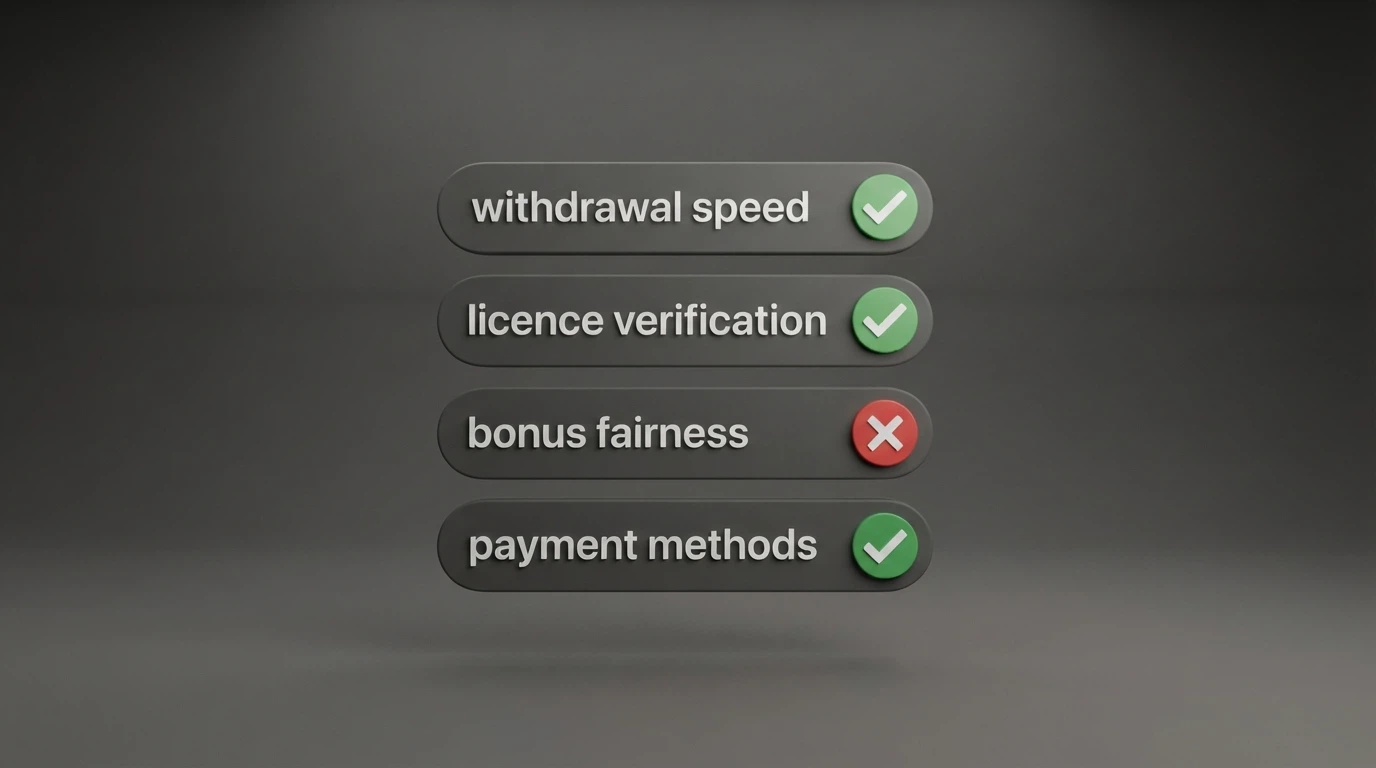
Tested payout data was drawn from independent casino-review sources where available. Licence status was verified against the official ACMA register of licensed interactive wagering providers — the check confirmed that no operator in this ranking holds an Australian online casino licence, because no such licence exists. Bonus data was taken from the operator’s own published terms, not from affiliate pages that may quote outdated figures. AU-specific payment availability was checked against the deposit and withdrawal pages on each operator’s site, with the credit/crypto ban flagged where relevant.
For the five brands where independent testing did not surface this round — Rainbet, FairGO, Scream Casino, Bizzo Casino and Rocket Casino — the operator sweep query failed due to a transport error in this run. Licence status is inferred from the AU market pattern (Curaçao is the standard offshore licence for AU-facing casinos); bonus terms, game providers and payout specifics are not confirmed. Every brand is confirmed real and active via the operators’ market-share data; the missing data is per-operator specifics, not brand presence.
No operator is recommended on this page. The ranking describes what each operator offers and what it costs the player; the judgement on whether to use any of them is the reader’s to make.
What Australian Players Should Actually Decide About Fast Payouts in 2026
The single biggest controllable factor in payout speed is KYC. Complete the verification before requesting the first withdrawal. Submit the documents at sign-up, not at cashout. The casino cannot shorten the verification step on a withdrawal the player has already requested, and the verification step is the largest single cause of a slow payout across the offshore set.
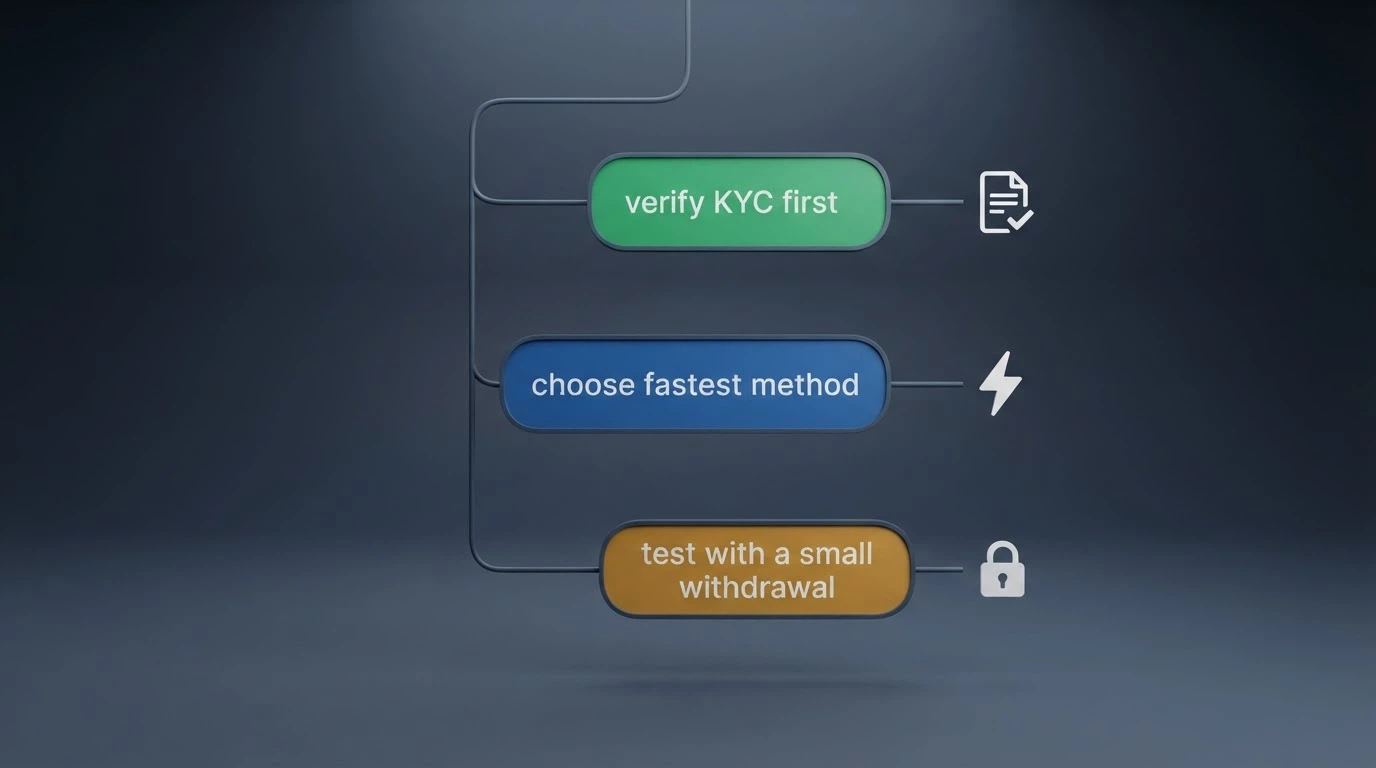
The method choice cuts a payout from days to minutes. Crypto’s 42-minute median beats PayID’s 2-hour median beats e-wallet’s 6-hour median beats bank transfer’s 3-working-day median. Each step up the speed table is also a step further outside the AU-licensed perimeter, because crypto is the fastest route and crypto is the route that places the player most clearly outside Australian consumer protection. The reader who wants both speed and the AU-licensed perimeter cannot have both at any casino on this page.
Bonus terms make a fast payout mathematically irrelevant until wagering clears. The 30x requirement on a A$1,000 bonus is A$30,000 of turnover, which costs roughly A$987 in expected loss on Big Bass Bonanza. The “fast payout” is real; it is just gated behind an arithmetic that gives most of the bonus back to the house. Players who want a payout without that arithmetic should play cash, not bonus.
The legal gap no operator can close is the offshore status itself. ACMA has blocked 1,564 sites since 2019 and the 2026 reform gives banks authority to block transactions to illegal operators from 1 January 2027. The player holding a balance at an offshore site has no Australian regulator to escalate to if the operator refuses to pay. The concrete steps that minimise risk: verify the licence on the operator’s own page; read the withdrawal terms before depositing; test with a small amount first; never leave a large balance on an offshore site. The helpline — 1800 858 858 — is the right number if the gambling has stopped being entertainment.
Frequently Asked Questions
What is the fastest withdrawal method at Australian online casinos?
Crypto leads the speed table: a 42-minute median across USDT, LTC and BTC, with a worst case of about 4 hours. USDT on TRC20 and Solana settle within seconds; Bitcoin adds 30–60 minutes for blockchain confirmations. PayID is the fastest AUD option at 2 hours. The bottleneck is the casino’s internal approval, not the network.
What is the minimum withdrawal amount at fast payout casinos in Australia?
Minimums vary by operator and method. At SkyCrown, bank transfer withdrawals start at A$100 and MiFinity from A$30. At Royal Reels, the deposit minimum is A$30. Other operators in the ranking did not publish minimums in the data this page confirmed. A$30 at MiFinity is the lowest floor across the tested set.
Why is my casino withdrawal taking so long?
Incomplete KYC is the biggest cause. Every legitimate operator runs verification before the first withdrawal — passport or driver’s licence, proof of address, sometimes source-of-funds. Many offshore casinos also enforce a 48-hour pending period, during which testing shows more than 40% of players cancel and gamble winnings back. The payment method is the third leg, not the first.
Can I use crypto to withdraw from an Australian online casino?
Yes at offshore casinos, no at AU-licensed ones. Since 11 June 2024, crypto has been banned for online wagering in Australia, with penalties up to A$247,500. The ban covers AU-licensed operators; offshore ones are not covered and still accept crypto. SkyCrown’s welcome bonus excludes crypto deposits, pushing funded players toward bank transfer or e-wallet.
Are casino winnings taxed in Australia?
No, for an ordinary punter. Betting and gambling winnings are not assessable income under section 6-5 of the ITAA 1997, and losses are not deductible under section 8-1 — unless betting or gambling is the person’s business. No Australian case has held ordinary punter winnings assessable. The tax point sits with the operator, not the player.