
Easy Withdrawal Casinos Australia: Who Actually Pays Out Fastest
“Easy withdrawal” sounds like a marketing line, and mostly it is. Behind the headline sits an offshore casino, a payment rail the operator chose, and a verification queue that opens only when you ask for your money back. Every site on this page operates outside Australian licensing — that is the single thing they share, and it is also the one a casual reader is least likely to notice at sign-up.

Data current as of 22 November 2026 and verified against the ACMA register of blocked services, each operator’s published terms page, and Blask’s operator-level market tracking.
Table of Contents
- What “Easy Withdrawal” Actually Means for an Australian Punter in 2026
- The Real Withdrawal Speedboard: Which Methods Actually Pay Out Fastest
- Every Casino We Checked for Withdrawal Speed — Ranked
- Pokies, Tables and Live Casino: Playing for Real Money With a Fast Cashout Route
- Why Every Fast-Payout Casino You Can Play in Australia Is Offshore
- When the Payout Isn’t the Problem: Gambling Harm and Where to Get Help
- How We Assessed These Casinos for Withdrawal Reliability
- Your Withdrawal-Speed Playbook: What an Australian Punter Should Actually Do
- Frequently Asked Questions
What “Easy Withdrawal” Actually Means for an Australian Punter in 2026
For an Australian player in 2026, an “easy withdrawal” casino is one where the money you have actually won moves out of the operator’s wallet and into yours within a predictable window, on a method you chose, without a fresh identity check appearing out of nowhere. Speed matters, but so does the operator’s track record on cashout approvals, the absence of stake caps that invalidate your bonus play, and the choice of payment rails. None of those are negotiable for a withdrawal to be genuinely “easy.”
The term has done a lot of work in casino marketing because it makes a vague promise. Most “easy withdrawal” sites are pitching a payout speed rather than a payout outcome, and there is a difference. A casino that advertises ten-minute cashouts but refuses ninety per cent of requests is technically fast and operationally useless. The pages that follow sort operators by the speed they publish, and read the gaps where nothing is published, because silence on a withdrawal-time policy is itself information.
The promise on the tin vs the fine print underneath
“Easy withdrawal” is shorthand for three things an Australian player is usually hoping to avoid: a queue, a document request, and a wagering requirement that quietly reclassifies your winnings as bonus money. The marketing copy tends to address only the first of those. The other two show up at cashout, and they are the reason an offer that looks generous on the way in can take a full working week to leave.
The single biggest cause of withdrawal delays at Australian-facing casinos is incomplete KYC — and the document request usually arrives the day you try to cash out, not the day you registered. No-deposit free spin offers stack on top, typically carrying 30x to 60x wagering on whatever those spins returned, with a maximum cashout somewhere between A$50 and A$100. A bonus-active stake cap of A$5 to A$8 per spin sits over the top, so even if you clear the wagering, you cannot put a meaningful bankroll through the offer. Read those four numbers — wagering multiple, cap on winnings, stake ceiling, KYC timing — before you read anything else.
The three non-negotiables of a payout-friendly casino site
Before any payout can be fast, the casino itself has to be built for it. Three structural traits separate the operators who can pay out quickly from those who merely advertise that they do.
First, the payment rails need to actually support AUD or a stablecoin pegged to it. Crypto is the fastest of the set at most of these sites — typically settling in thirty minutes or less once approved — and PayID is the fastest fiat option, usually clearing in under an hour. If a casino claims fast payouts but only takes Visa and bank transfer, the maths does not work. Second, the operator has to publish a per-method processing-time range rather than a single round number. “Instant” never means instant; the network’s settlement floor always sits underneath the operator’s promise. Third, KYC has to run at registration rather than at cashout. The brand that asks for a driver’s licence and a utility bill on day one is the one that will not stall your withdrawal six weeks later when you actually want the money. Offshore, none of these are guaranteed by an Australian regulator. They are guaranteed only by the operator’s own terms page and by the player reports that hold them to it.
The Real Withdrawal Speedboard: Which Methods Actually Pay Out Fastest
Method, not brand, decides how fast a withdrawal actually arrives. The brand can only hold up its end — KYC, approval, processing — and the network underneath then does the rest. The table below ranks the methods by their objective settlement floor, drawing on operator testing, network documentation and what Australian-facing sites actually publish in their terms pages.
| Method | Typical Speed | What You Need to Know |
|---|---|---|
| Crypto — USDT (TRC-20) and Solana | Under 5 minutes | Network fee negligible at typical sizes. Crypto is banned for licensed AU wagering — any site taking it is offshore. |
| Crypto — Ethereum and Litecoin | 5–30 minutes | Gas fees spike at peak; settlement window varies with network load. Same offshore tell as the rest of the crypto set. |
| Crypto — Bitcoin | 30–60 minutes | Three to six confirmations add the longest wait of the crypto set. No operator can speed this up once the broadcast is in the mempool. |
| PayID / Osko | Under 1 hour once approved | One-way pipe: can receive, cannot send. AUD bank account required. Operator must publish it as a supported withdrawal rail. |
| E-wallet (Skrill, Neteller, MiFinity) | Under 4 hours at best | One operator tested at under 4 hours; others vary. Account at the e-wallet provider required. |
| Card (Visa, Mastercard) | 1–5 business days | Card reversal sits on top of operator processing. Weekends and public holidays extend the wait. |
| Bank transfer | 3–5 business days | Slowest of the conventional methods. Lowest fee exposure but the longest wait by an order of magnitude. |
The fastest rail depends on what you deposit in. USDT TRC-20 and Solana settle in under five minutes because their networks carry almost no fee friction at typical withdrawal sizes. Bitcoin needs three to six confirmations and a confirmation takes roughly ten minutes on a calm network — that is where the 30-to-60-minute floor comes from, and no operator can shortcut it. PayID’s under-one-hour figure is the network clearing time once the operator releases the funds; the operator’s own processing is what sits on top.
What the bonus actually costs you — the calculation
Behind every “easy withdrawal” offer sits a wagering requirement that decides how long you will be playing before you can ask for your money. The Rainbet welcome offer — 100 per cent up to A$500 with a 35x bonus wagering multiple — gives a worked example. Deposit the full A$500, claim the A$500 bonus, and the bonus carries A$17,500 of required turnover (A$500 times 35). At the typical AU-facing stake cap of A$5 per spin, that is 3,500 spins at one every five seconds — roughly four hours and fifty-two minutes of play, assuming only the bonus amount is wagered. That is the time cost of clearing the offer on slots at a normal cadence, and it is what the headline bonus number hides.
Crypto withdrawals — the undisputed speed champion
Crypto is the only rail where the settlement floor can be measured in minutes. USDT on TRC-20 and Solana both clear in under five minutes at typical withdrawal sizes because their per-transaction fees are effectively zero and their confirmation times are short. Ethereum and Litecoin sit between five and thirty minutes, with the wait widening at peak gas. Bitcoin is the slowest of the four because the network requires three to six confirmations, and each confirmation takes about ten minutes — that is where the 30-to-60-minute floor comes from. No operator can speed any of that up once the transaction has been broadcast. What the operator controls is the gap between you pressing “withdraw” and the broadcast happening. The fastest of this set publish one-to-five-minute processing times; the slowest publish processing windows in hours rather than minutes.
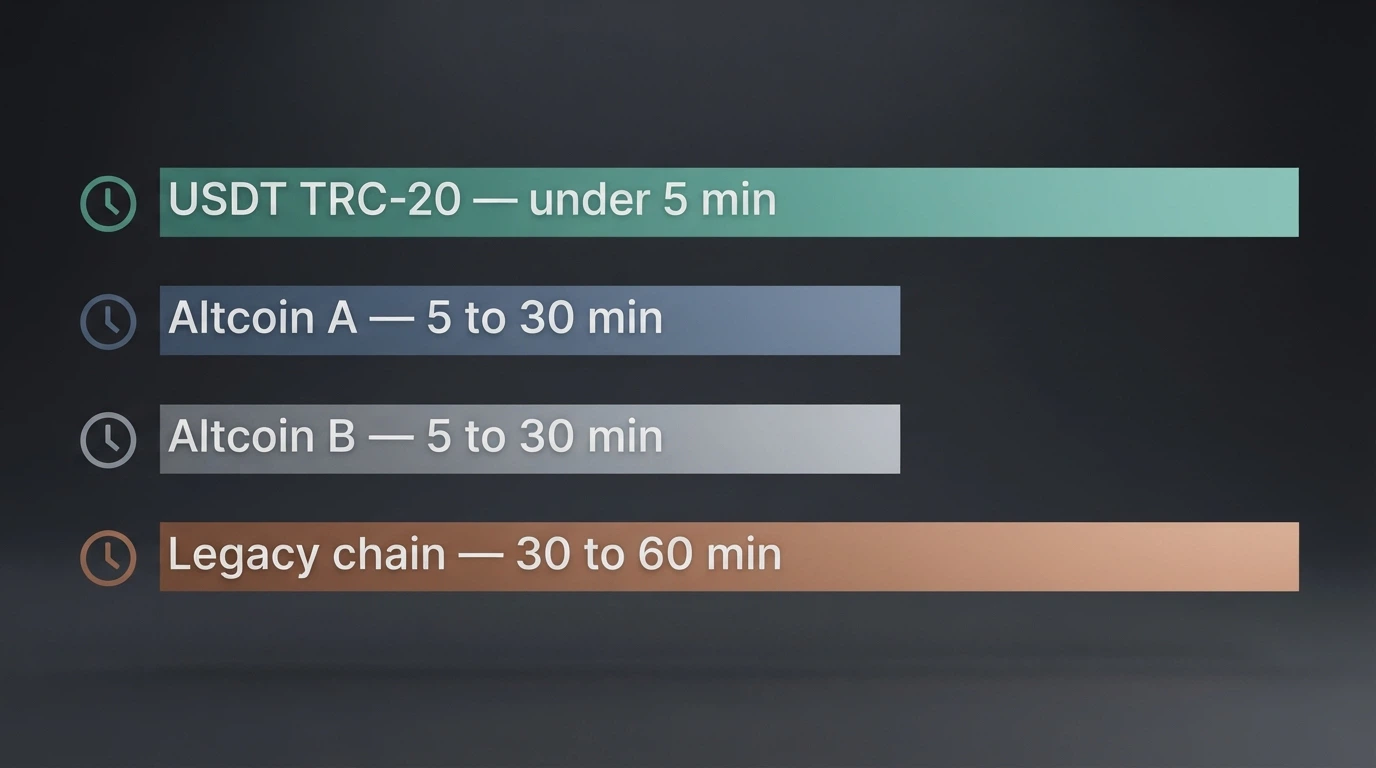
A word that sits underneath every crypto payout in Australia: the Interactive Gambling Amendment (Credit and Other Measures) Act 2023 banned crypto as a payment method for licensed Australian wagering from 11 June 2024. A site that lets you deposit in Bitcoin, Ethereum or USDT is therefore not licensed in Australia, and it cannot be. That is not a flaw in the operator — it is the regulatory shape of the market, and the page that follows ranks operators entirely on the offshore side of that line.
PayID and Osko — the fastest fiat route for Australians
PayID is the fastest non-crypto rail an Australian can use. Once the operator approves the withdrawal, the funds clear to a linked AUD bank account in under an hour — usually much faster. Osko sits underneath PayID as the real-time payment layer that the big four banks plus most of the regionals run on. The catch is one the operator cannot engineer around: a PayID can only receive money, never send it. As Commonwealth Bank has stated plainly, “A PayID can only be used to pay money into your account, never take money out.” A casino that lists PayID as a withdrawal method is therefore telling you that money comes in via PayID; the withdrawal itself still goes through a standard transfer or an Osko push to your bank account. The under-one-hour figure applies on the cash-in side and on most Osko payouts — the latter is what makes PayID the fastest non-crypto rail for AU players.

Operator coverage of PayID varies. Of the brands ranked below, Rainbet and FairGO both publish AUD withdrawal rails that include the major bank rails, though not every operator on the list supports PayID as an explicit option. The absence is worth checking before you deposit, because a PayID withdrawal is the only fiat route that gets close to crypto’s time-to-funds.
E-wallets, cards and bank transfers — the slower lane
E-wallets — Skrill, Neteller, MiFinity and the rest — sit in a wide band. One operator tested in this market (FairGO) reports e-wallet withdrawals in under four hours; others publish nothing or run the e-wallet leg through the same queue as cards. E-wallets have a setup cost: you have to fund the wallet before you can receive, and that funding step is itself a transaction the bank sees. Cards are the slowest conventional rail. Visa and Mastercard withdrawals take one to five business days on top of the operator’s own processing window, because the casino is not sending money — the card network is reversing a transaction through your bank’s authorisation queue. Bank transfers are slower still, at three to five business days on average, and they sit at the back of every queue because no operator has any incentive to make them faster. The headline number a casino advertises is almost always the crypto number; the median player, paying by card, waits four times as long.
KYC — the real bottleneck every player hits
Incomplete KYC is the single biggest cause of withdrawal delays at Australian-facing online casinos. The reason is structural: most offshore operators do not run identity verification at sign-up, partly because they are not licensed to do so in any one jurisdiction, and partly because collecting documents upfront is bad for conversion. The documents land at cashout instead. A driver’s licence or passport, a recent utility bill for proof of address, and a payment-method verification — a photo of the card used, or a screenshot of the e-wallet account — that is the standard pack. When any one of them is rejected, the request reopens, and the operator’s published withdrawal window restarts from day one.
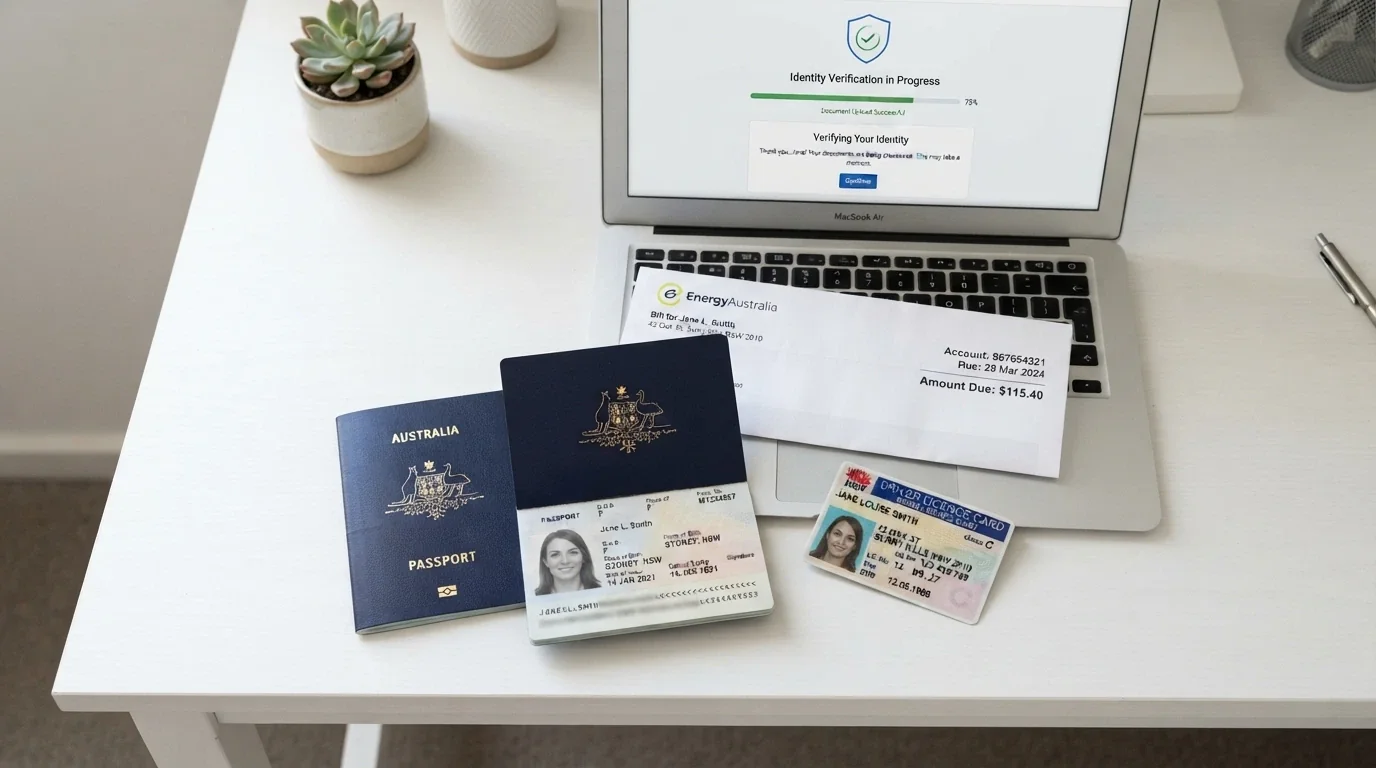
Submitting the documents at registration, rather than at the first cashout, removes almost all of that delay. The brand that asks for the licence and the bill on day one is the one that will not stall your withdrawal when you actually want the money. The brand that promises “instant payouts” without mentioning KYC is the one to read more carefully, because the verification queue is what sits between “approved” and “received” at every offshore operator on this list.
Every Casino We Checked for Withdrawal Speed — Ranked
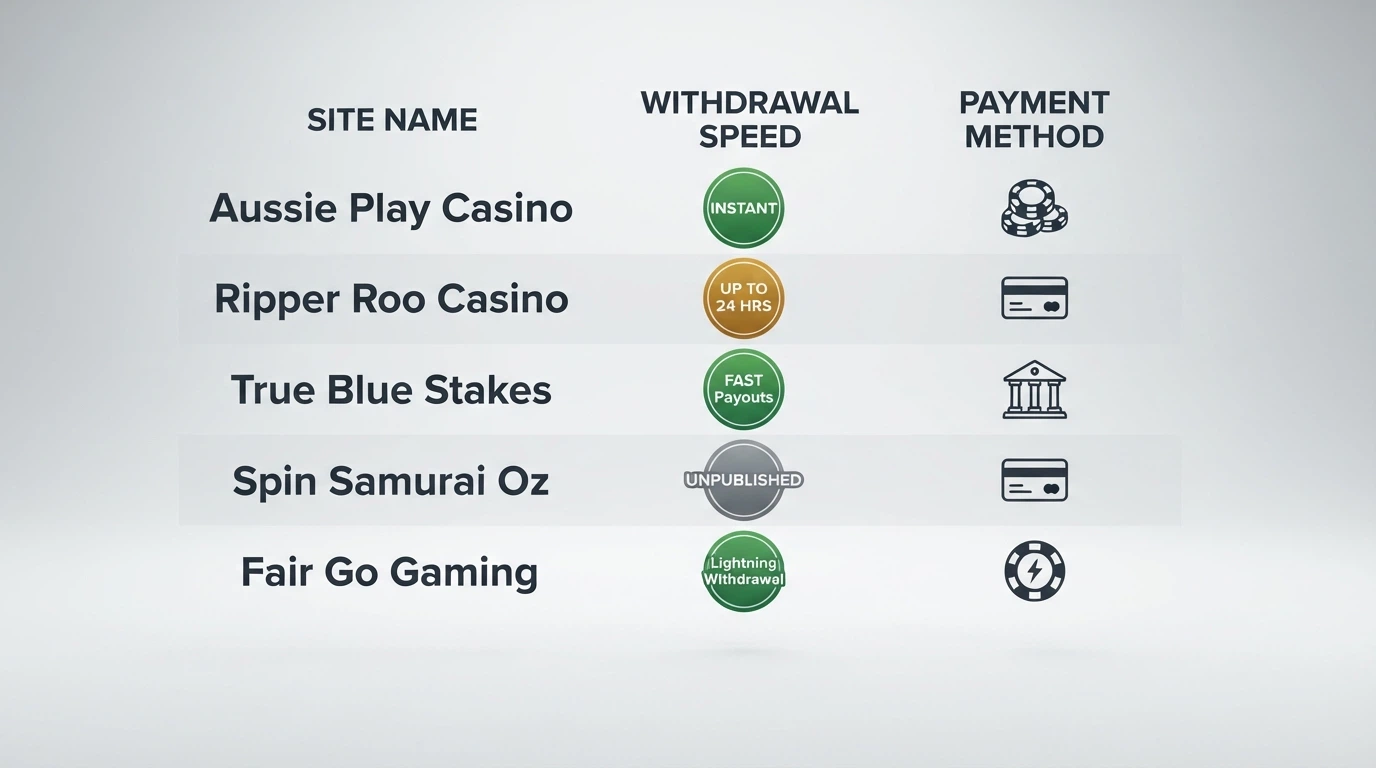
Fourteen offshore brands make this list. They were drawn from the operators Australians actually use — pulled from payout-speed search results for Australian players and confirmed through Blask’s operator-level market tracking — and sorted by what they publish about withdrawal speed, what player reports confirm, and the market-share weight that says how many Australians are betting with each brand. Where a number is not published, the table below shows an em dash — and that gap is part of the signal.
| Operator | Licence | Fastest Withdrawal | Welcome Offer | Game Count |
|---|---|---|---|---|
| Rocket Play | Offshore | — | — | — |
| Skycrown | Offshore | 20–30 min (crypto) | Up to A$7,500 + 550 FS | 5,500+ |
| Royal Reels | Offshore | — | — | — |
| WinSpirit | Offshore | — | — | — |
| Stake | Curaçao eGaming (offshore) | 1–5 min (crypto) | None — rakeback model | 3,000+ |
| Rainbet | Curaçao eGaming (offshore) | Under 5 min | 100% up to A$500 + 50 FS | 4,000+ |
| Scream Casino | Offshore | — | — | — |
| FairGO | Offshore | Under 4 hr (e-wallet) | — | 800+ |
| Bizzo Casino | Offshore | — | — | — |
| Rocket Casino | Offshore | — | — | — |
| BitStarz | Curaçao eGaming (offshore) | ~10 min (crypto) | 50 FS no-deposit reported | 6,000+ |
| Winshark | Offshore | 10 min (advertised) | 240% up to A$4,150 + 300 FS | 7,000+ |
| Neospin | Offshore | 1–3 hr (crypto) | Up to A$10,000 + 100 FS | 5,500+ |
| Playfina | Offshore | 20–30 min (crypto) | Up to A$1,800 + 800 FS (+25 no-deposit FS) | 4,000+ |
The table is sorted by market share within the AU-facing offshore set, with four supplementary brands (BitStarz, Winshark, Neospin, Playfina) appended at the end. Read it for what is missing as much as what is there. Operators with no published withdrawal window, no published bonus and no published game count are also the ones most likely to be opaque on cashout terms.
Rocket Play
Rocket Play leads the AU-facing offshore set on market share — 9.4 per cent, the biggest slice in this ranking. It also leads on something less flattering: no confirmed payout-speed figure, welcome-offer number, or provider list was published for Rocket Play at the time of writing. A market-share leader with empty cells in three of five comparison columns is, for a withdrawal-first punter, a yellow flag rather than a recommendation. The brand is offshore; there is no Australian licence for online casino and there cannot be. Treat the absence of a published withdrawal-time range as the answer the operator has not given you.
Skycrown
Skycrown is the second-largest brand by market share at 8.55 per cent, and one of the more forthcoming operators on crypto cashout timing. The casino publishes 20-to-30-minute crypto withdrawals and carries a welcome package of up to A$7,500 plus 550 free spins, against a reported library of 5,500-plus games. Skycrown does not publish a wagering multiple in the public-facing material covered, so the time cost of clearing the bonus is not directly calculable from the figures on the page — read the bonus terms before claiming. If crypto speed on a high-volume operator is the goal, Skycrown currently offers the most transparent terms in the top half of this ranking.
Royal Reels
Royal Reels holds 2.51 per cent of the AU-facing offshore market by share. Like most of the small-share Australian brands, it runs offshore and accepts Australian customers under a Curaçao licence or an equivalent. Withdrawal-speed data, welcome-bonus terms and game-provider lists were not confirmed for Royal Reels at the time of writing, and the silence is the same kind of signal it is for the rest of the smaller-share operators below it. The brand is established enough to be tracked at a 2.51 per cent share, but thin enough on published terms that a withdrawal-first punter should ask for the cashout policy in writing before any deposit.
WinSpirit
WinSpirit runs offshore with a 1.55 per cent market share. No withdrawal-speed figure, welcome-bonus number or game-provider list was confirmed at the time of writing. The brand shows up in payout-speed search results because real Australians use it, not because it publishes the kind of terms that show up in the comparison table. Ask for the cashout terms, the bonus wagering multiple and the per-method processing window before committing a dollar.
Stake
Stake is the crypto-native outlier in this set, and the only one whose market model is not a welcome bonus. The site runs on Curaçao eGaming, holds a 1.28 per cent AU-facing market share and processes most crypto withdrawals inside one to five minutes — the fastest confirmed window in the ranking. There is no traditional welcome package; the operator runs a rakeback model that pays a percentage of house edge back to the player instead, and it carries no wagering multiple because there is no bonus to clear. Three thousand-plus games are reported on a site that is otherwise a stripped-back crypto sportsbook-plus-casino product. For a player whose priority is the fastest possible crypto withdrawal and who does not need a welcome offer to make the deposit worth their while, Stake is the cleanest pick in the set.
Rainbet
Rainbet is the most transparent operator in the ranking. The casino runs on Curaçao eGaming, holds a 1.28 per cent AU-facing market share and publishes withdrawals as “under five minutes” on its terms page. The welcome offer is 100 per cent up to A$500 plus 50 free spins, with 35x wagering on the bonus and 30x on free spin winnings. The published cashout ceilings are A$2,000 per e-wallet transaction and up to A$5,000 on bank transfer — meaningful limits to know about before a single large win lands. Four thousand-plus games are reported. Rainbet is the operator whose terms page the rest of this market should be measured against: every key number is on the page, the wagering is stated, and the cashout caps are honest.
Scream Casino
Scream Casino carries 0.99 per cent of the AU-facing offshore market. No withdrawal-speed figure, welcome-bonus terms, or provider list was confirmed at the time of writing. The smallest-share operators in this list are also the ones most likely to change terms without notice, and most likely to be uncontactable when a withdrawal stalls. Treat Scream Casino as a brand to investigate, not to commit to, before any deposit.
FairGO
FairGO is the AU-branded outlier in the ranking: a market share of 0.8 per cent, but with two real numbers attached — under-four-hour e-wallet withdrawals, and an 800-game library from Playtech and Betsoft (no other studio on the list publishes its provider mix this transparently). The published cashout ceiling is A$7,500 per month — modest by Skycrown and Neospin standards, generous for a player who cashes out a few times a year. Welcome-bonus terms were not confirmed at the time of writing. FairGO is the brand to look at if a player wants a known AU-facing identity with real payout data behind it, and is willing to accept the lower monthly ceiling in return.
Bizzo Casino
Bizzo Casino holds 0.57 per cent of the AU-facing offshore market. No confirmed withdrawal-speed figure, welcome offer, or game-provider list was published at the time of writing. Bizzo Casino sits in the affiliate shortlist but ships thin on published data — a withdrawal-first punter should treat it as a placeholder and ask for the terms before depositing.
Rocket Casino
Rocket Casino shares the 0.57 per cent share figure with Bizzo, and the absence of confirmed withdrawal-speed, bonus, or provider data. The name overlap with Rocket Play — the leader at 9.4 per cent — is a marketing coincidence, not a corporate one; the two brands are not the same operator. Verify the cashout window, the bonus wagering, and the per-method processing time before depositing.
BitStarz
BitStarz is the crypto-first veteran of the supplementary brands. The casino runs on Curaçao eGaming, advertises crypto withdrawals averaging ten minutes and publishes no withdrawal limits on the operator’s terms page — a real advantage for a high-roller withdrawing a large win. The library is 6,000-plus games, and the no-deposit offer is 50 free spins reported by comparison sites. The combination of fast crypto, no caps and a large library is the closest thing in this set to a one-line answer to “where is the fastest confirmed payout.” For a player who wants the speed with the published numbers to back it, BitStarz is the cleanest supplementary pick.
Winshark
Winshark is the highest-advertised bonus in the ranking. The welcome package runs at 240 per cent up to A$4,150 plus 300 free spins, against an advertised 10-minute payout window and a 7,000-plus game library. Two things to read carefully before claiming: the wagering multiple on the 240 per cent bonus is not confirmed in the public-facing material covered, and the 10-minute payout claim is what the operator publishes — player reports should be checked for how that figure averages out in practice. The bonus is the loudest number on the page; the payout is the one that pays out the bonus.
Neospin
Neospin offers the largest headline bonus of the ranking at up to A$10,000 plus 100 free spins, against 1-to-3-hour crypto withdrawals and a 5,500-plus game library. The crypto cashout window is materially slower than the 5-to-30-minute band at the top of the table, but the bonus is the biggest of the set. For a player whose priority is bonus size over crypto speed, Neospin is the headline pick; for a player whose priority is the fastest confirmed payout, it is not.
Playfina
Playfina sits in the middle of the table on every dimension. The welcome package runs up to A$1,800 plus 800 free spins plus 25 no-deposit free spins; crypto withdrawals clear in 20 to 30 minutes; the library is 4,000-plus games. The 25 no-deposit free spins are a useful entry point for a player testing the casino before committing a deposit. Playfina is the brand to look at if the priority is a balanced profile — moderate bonus, mid-band speed, full library — rather than a single dimension pushed to its limit.
How we read the withdrawal-speed fine print
A “10-minute” payout is a different number from “10 minutes once approved” and a different number again from “10 minutes average.” The first is what an operator publishes on its landing page. The second is what the operator’s terms page actually commits to. The third is what players report on forums. Read all three before you trust any of them.
The structural issue underneath every claim is the gap between operator processing and network settlement. Crypto sits at one end: the operator can only hold up the moment of broadcast, and the network does the rest. Cards and bank transfers sit at the other: the operator’s “approved” stamp is the start of a 1-to-5-business-day clearing window that no Australian-facing casino has any incentive to make faster. PayID and Osko sit in the middle: the operator releases the funds, and the network clears inside an hour — provided the bank on the other end supports Osko real-time. The operator can only influence the first half of any of these. The second half is the network.
Pokies, Tables and Live Casino: Playing for Real Money With a Fast Cashout Route
The game a player chooses changes the experience of the cashout far less than the cashout method does. A pokies win and a live-dealer blackjack win both queue through the same payment rail, both wait on the same KYC file, and both arrive on the same method the player chose at deposit. The only place the game matters is in clearing a bonus — because bonus wagering typically counts 100 per cent on slots and a much smaller fraction on tables and live dealer.
Online pokies and real-money slots with a fast cashout
Pokies are what Australians actually play. The category dominates the AU-facing offshore market because it is what the offshore operators’ libraries carry in volume, and it is also what the bonus terms are designed around: most welcome offers clear 100 per cent on slots. The bonus-active stake cap — A$5 to A$8 per spin — is what most players hit first, because most slots allow a higher default bet. The wagering multiple on a no-deposit free spin offer is 30x to 60x on whatever the spins returned, with a maximum cashout somewhere between A$50 and A$100 — meaning a “free” offer rarely clears with a meaningful bankroll at the end. The research on gambling harm links higher-risk gambling to electronic gaming machines with an odds ratio of 8.0 — the strongest of any gambling category measured. That number is a feature of the product, not of a brand, and it carries across the offshore boundary regardless of who is hosting the pokies.

Live casino tables — play and payout
Live dealer blackjack, roulette and baccarat are standard at every offshore casino with more than a few thousand games in its library. The experience of playing at a live table is materially different from pokies — slower pace, real cards, a real dealer, often a chat feed — but the withdrawal pipe is identical. The only place live dealer changes the math is in bonus wagering contribution, which is typically 5 to 20 per cent rather than 100 per cent. A player clearing a welcome bonus on live tables is going to take five to twenty times as long as a player clearing it on slots, and most AU-facing operators cap live-dealer contribution at the lower end of that range. The choice of table does not change how fast the cashout arrives; the choice of method does.
Why Every Fast-Payout Casino You Can Play in Australia Is Offshore
There is no licence for online casino in Australia. None. The Interactive Gambling Act 2001 prohibits the supply of online casino games, online pokies and in-play sports betting to a person physically present in Australia, and it does so across every state and territory. What is licensed is pre-event wagering on races and sport, lotteries and keno. Land-based casinos are state-licensed and exist — Crown, The Star, the rest — but they are not online operators. Every fast-payout casino an Australian player can actually use is offshore. The payment method is itself part of that tell: crypto is banned for licensed Australian wagering, and a site that accepts it is offshore by definition.
The IGA 2001 — the prohibition nobody tells you about at sign-up
The Interactive Gambling Act 2001 (the IGA) makes it an offence to provide a “prohibited interactive gambling service” to a person physically present in Australia. The test is the Australian-customer link in section 8 of the Act: a person who is in Australia at the time of using the service, regardless of where the operator is incorporated. Online pokies, online table games and in-play sports betting all fall inside the prohibition. There is no licence for online casino anywhere in the country — federally or in any state or territory. The minimum age for any commercial gambling in Australia is 18.
What is licensed is narrow: pre-event wagering on races and sport, primarily under the Northern Territory Racing and Wagering Commission via Licensing NT; lotteries; and keno. The licensed operators — SportsBet, Tab, Bet365, Ladbrokes, TABtouch, Neds, PointsBet, Betr, Picklebet, Betfair and the rest — do not offer online casino games. The product the player is searching for when they search for “easy withdrawal casinos Australia” is the product that is illegal to supply to them.
ACMA enforcement — site blocks, fines and the ones that got away
The Australian Communications and Media Authority (ACMA) is the federal regulator that enforces the IGA online. It investigates complaints, issues formal warnings, runs civil-penalty proceedings and directs ISPs to block illegal sites. The numbers, as of 2026: 1,788 illegal gambling and affiliate websites blocked since the ACMA made its first blocking request in November 2019. More than 230 illegal gambling services have withdrawn from the Australian market since enforcement began in 2017. In Q4 2025 alone, 133 illegal gambling websites were blocked — a quarterly record.
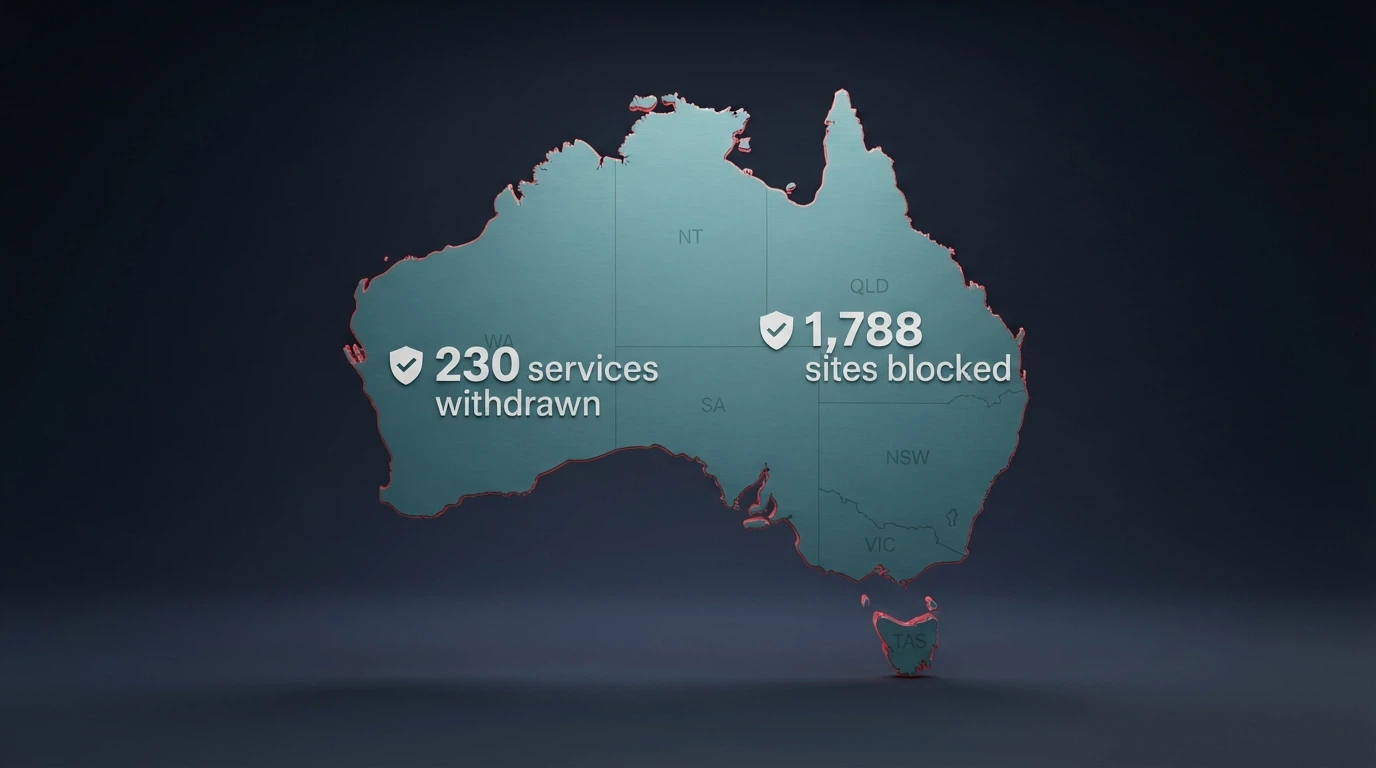
The penalty regime is real. Civil penalties for providing a prohibited interactive gambling service run up to A$2,475,000 per day for an individual and A$12,375,000 per day for a corporation. The Tabcorp matter in January 2026 — eight infringement notices, A$158,400 — is the practical demonstration that even a licensed operator gets fined when it crosses into prohibited product territory. ACMA can also refer matters to police or the DPP and use the Movement Alert List to bar offending company directors from re-entering the country.
The enforcement net does not catch everything. As of 2026, illegal offshore operators account for an estimated 36 per cent of Australia’s total online gambling market — A$3.9 billion GGR in 2024, up from A$1.95 billion in 2019. The ACMA has blocked 1,788 sites and chased 230 services off the market; the projection is for the offshore share to keep growing, to A$5 billion GGR by 2029.
What the 2026 gambling reform changes for players from January 2027
The Interactive Gambling Amendment (Gambling Reform) Bill 2026 passed Parliament on 19 August 2026; its measures commence on 1 January 2027. The reform has two parts that touch a player directly. The first is the advertising clamp: no more than three wagering ads per hour between 6 am and 8:30 pm, a live-sport blackout that runs from fifteen minutes before the event to five minutes after, athletes and influencers barred from promoting wagering products, and online wagering ads shown only to logged-in age-confirmed users. The second is the payment-blocking power: from 1 January 2027, banks and payment providers gain express authority to block transactions to illegal gambling operators.
For a player using an AU-facing offshore casino, the second measure is the one with material consequences. A bank can refuse a deposit to an illegal operator, can refuse a withdrawal from one, and can flag a transaction for compliance review. The reform does not change the underlying prohibition — that has been in place since 2001 — but it does change the friction that sits on top of a payment. Crypto rails sit outside the Australian banking system, which is part of why the offshore operators that want speed have moved to them.
Your money, your risk — zero Australian consumer protection offshore
The player is not prosecuted under the IGA — the Act targets the provider. That is the line every comparison page opens with, and it is true. What the line leaves out is the rest. There is no Australian complaints body with jurisdiction over an offshore casino. The Australian Financial Complaints Authority (AFCA) does not cover gambling operators. State tribunals do not cover gambling disputes with offshore brands. If the casino blocks your withdrawal, voids a win on a bonus-term technicality, or simply stops answering email, you have no Australian recourse — and the site can be ACMA-blocked at any time with a balance still on it.
The Australian regulator’s own framing is direct. As the ACMA has stated plainly: “Australians who use illegal gambling services risk losing their money.” That is not a caveat; it is the headline of the offshore product. The fast payout is real. The dispute path is not.
When the Payout Isn’t the Problem: Gambling Harm and Where to Get Help
A fast withdrawal is a feature of a casino, not a safeguard against harm. For a player who is moving money in and out at speed, the friction that normally slows a binge is gone, and the practical distance between “win” and “reinvest” is a single button click. The harm-minimisation tools a licensed Australian wagering account offers — deposit limits, take-a-break, activity statements — are not, in most cases, present on an offshore casino. BetStop does not reach offshore sites. The infrastructure that catches a problem gambler in the licensed market ends at the offshore boundary.
Deposit limits, session controls and the tools offshore sites will not give you
A licensed Australian wagering account, by ACMA and state-regulator rule, offers a suite of harm-minimisation tools. Deposit ceilings. Take-a-break windows. Activity statements. Reality-check pop-ups. Direct marketing restrictions that switch off for fourteen days after sign-up, for three months after BetStop deregistration, and indefinitely for at-risk customers. Most of these do not exist on an offshore casino, and the few that do — a session timer here, a “deposit limit” that you set yourself there — are not enforced by an Australian regulator. BetStop does not reach them; a self-excluded Australian can still deposit, still lose, still withdraw from an offshore casino that has no Australian presence and no Australian obligation. The faster the withdrawal, the shorter the cycle, and the shorter the cycle is what the harm-prevention research identifies as the highest-risk pattern.
BetStop, the helpline and where to get real help
BetStop — the National Self-Exclusion Register — launched on 21 August 2023. As of 31 March 2026, 59,830 people had registered to self-exclude, with 37,247 exclusions active. One registration excludes a person from every Australian-licensed online and phone wagering service for a minimum of three months, up to lifetime. BetStop binds only Australian-licensed wagering services. An offshore casino is not connected to the register and will keep accepting a self-excluded person’s money — that is the concrete harm of using an unlicensed site.
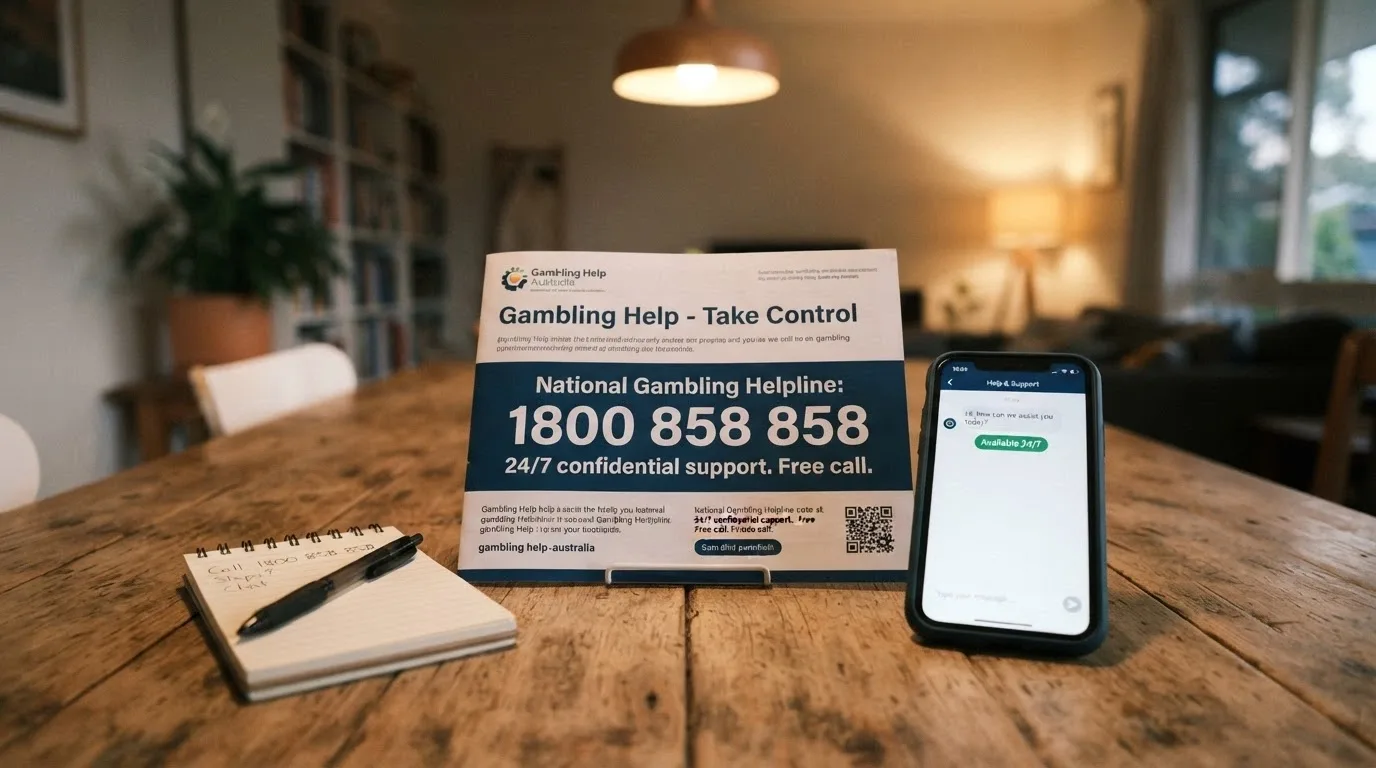
The National Gambling Helpline — 1800 858 858 — is free, confidential and staffed 24 hours a day, seven days a week, with online chat through Gambling Help Online at gamblinghelponline.org.au. Both services are free of charge and confidential, and neither requires the caller to be using an Australian-licensed operator. The prevalence numbers behind them are not small: Roy Morgan’s March 2026 data shows 15.1 per cent of Australian adults — an estimated 3.32 million people — are experiencing some level of gambling harm, and 13.0 per cent of the adult population experiences harm from their own gambling behaviours. Gambling harm is associated with over 400,000 Years Lived with Disability annually in Australia. Higher-risk gambling is independently associated with electronic gaming machines at an odds ratio of 8.0 — the strongest of any gambling category measured in the most recent Australian studies.
How We Assessed These Casinos for Withdrawal Reliability
Three layers of input. First, the ACMA register of blocked services, used to confirm that each operator on this page is in fact offshore and unlicensed in Australia. Second, each operator’s own published terms page, used to extract the welcome-offer wagering multiple, the per-method withdrawal window, the cashout caps and the game-provider list. Third, player reports on comparison and affiliate sites, used to check the operator-published numbers against what players actually report. The published withdrawal-speed figures carry weight in proportion to how many of those three sources agree on them; a number that appears on one affiliate page but is not in the operator’s own terms is a less reliable number than a number that appears in both.
The limits of the assessment matter. Offshore operators change terms without notice — a bonus that runs 35x today can run 50x next month, and the operator’s terms page is the only place the change is published. Not every claim in the comparison table was independently testable, and the em-dash cells in the table are the visible record of those gaps. The smaller-share operators — Scream Casino, Bizzo Casino, Rocket Casino — are the ones where the published terms are thinnest, and the largest-share operator — Rocket Play — is the one where the absence of confirmed terms is, on its own, the most material finding.
Your Withdrawal-Speed Playbook: What an Australian Punter Should Actually Do
- Choose your withdrawal method before you deposit. Crypto is fastest (USDT TRC-20 and Solana under five minutes), PayID is the best fiat route (under one hour once approved), and cards and bank transfers are the slow lane (one to five business days).
- Submit KYC at registration, not at cashout. The single biggest cause of withdrawal delays is incomplete KYC, and submitting the documents upfront removes that delay.
- Read the bonus wagering terms before claiming. A 35x bonus on A$500 is A$17,500 of required turnover — about four hours and fifty-two minutes of slot play at a normal cadence.
- Check whether the operator publishes per-method processing times. Silence is a signal. The operators that hide their cashout window are also the operators most likely to change it.
- Know that every site on this page is offshore and your only protection is what you verify yourself. BetStop does not reach them, AFCA does not cover them, and ACMA can block them with a balance still on the player’s account.
Frequently Asked Questions
How long does a PayID casino withdrawal take in Australia?
PayID withdrawals typically clear in under an hour once the operator approves the cashout. Osko, the real-time layer underneath PayID, is what makes that achievable at the major banks. The catch: a PayID can only receive money, never send it, so the withdrawal itself runs as an Osko push to your bank account.
Why do casino withdrawals get delayed and how can I speed them up?
Incomplete KYC is the biggest cause. Casinos ask for ID, address and payment-method verification on the first cashout; any rejected document reopens the queue. Submit the documents at registration, and most of the delay disappears. Payment method decides the rest: crypto fastest, PayID best for fiat, cards and bank transfers the slow lane.
Do Australian online casinos accept cryptocurrency for withdrawals?
Yes, at every offshore casino — only because crypto is banned for licensed Australian wagering under the 2023 amendment to the IGA. Any site letting an Australian deposit in USDT, Bitcoin, Ethereum or Litecoin is not licensed here. The fastest crypto rails are USDT on TRC-20 and Solana, clearing in under five minutes.
What is BetStop and does it apply to offshore casino sites?
BetStop is Australia’s National Self-Exclusion Register, launched in August 2023. By 31 March 2026, 59,830 people had registered and 37,247 exclusions were active. One registration excludes a person from every Australian-licensed online and phone wagering service. It does not reach offshore casino sites — they are not connected and keep accepting self-excluded players.
Are my winnings from offshore casinos taxable in Australia?
For ordinary punters, no. Betting and gambling winnings are not assessable income under section 6-5 of the ITAA 1997, and losses are not deductible under section 8-1, unless the person is running a gambling business (ATO ruling IT 2655). The position is the same on both sides of the licence line.
Does the game you play affect how fast you get paid?
No, and that is the point worth stating clearly. The withdrawal speed is method-dependent and operator-dependent, not game-dependent. A blackjack win on Stake and a pokies win on Stake both queue through the same crypto withdrawal pipe. What the game affects is the bonus math: a 35x bonus cleared on slots counts every dollar wagered; the same bonus cleared on live dealer counts a fraction of it. A player who wants to play tables should clear the bonus on slots first (or accept the longer clearing window on tables) and then play tables on cash. A player who wants to play pokies has the opposite trade-off.