
Online Pokies Instant Withdrawal in Australia: What the Speed Promise Leaves Unsaid
“Instant withdrawal” is a phrase the marketing writes before the operator has had to explain it. In Australia, the promise runs straight into a wall: no licensed online casino exists in the country, every online pokies site reaching an Australian player is an offshore operation, and the fastest the payments system can actually move money between an operator’s bank and yours is under sixty seconds, only when both institutions support Osko fast settlement through PayID on the New Payments Platform. Everything else — bank transfers, BPAY, debit cards — is measured in business days. The gap between the headline and the wait is not a marketing accident. It is the structure of the product.

This page walks through that structure. It explains which payment methods can clear quickly and which cannot, sets out what offshore operators an Australian can actually reach (drawn from Australian traffic data, not endorsement), names the legal frame the Interactive Gambling Act draws around online pokies, and surfaces the protections an Australian gives up by stepping outside it. The legal status of every operator on this list is the same, because the law leaves no other status for online pokies: offshore, unlicensed, and outside BetStop.
Currency and data current as of 22 November 2026, verified against the Interactive Gambling Act 2001, ACMA enforcement records, and Australian traffic-share data.
Table of Contents
- Why Your 2026 Payout Speed Comes Down to the Withdrawal Method
- The Offshore Operators Accepting Australian Players in 2026
- What Instant Withdrawal Actually Means for an Australian Punter
- Where the Law Stands — and What It Leaves Unprotected
- The Bonus Offers That Come With a Catch
- Staying in Control: The Tools Australia Has Built
- How We Evaluated and Ranked These Operators
- Weighing the Promise of Fast Payouts Against the Reality of Offshore Play
- Frequently Asked Questions
Why Your 2026 Payout Speed Comes Down to the Withdrawal Method
The operator you pick matters less than the payment method you use — and almost everything that makes the difference sits inside Australia’s own payments infrastructure rather than inside any casino’s terms. The fastest a withdrawal can travel is the speed of the slowest leg of the chain, and for an Australian punter, that leg is usually the bank-to-bank settlement at the end.
The legal deposit routes for licensed wagering in Australia are debit card, bank transfer, PayID/Osko, and BPAY. None of those four is faster than the underlying rail that carries it. PayID on Osko can land in under a minute when both institutions support it. BPAY, by contrast, processes in batches and clears over one to two business days for gambling-related deposits. The operator cannot speed any of this up. What the operator can do, and what its advertised payout time usually refers to, is the approval step in the middle: the moment its finance team releases the funds. The marketing calls that step “instant.” The wait that follows it is governed by something else entirely.
PayID and Osko: The Near-Instant Option Australia Built
PayID and Osko are not casino products. They are part of Australia’s New Payments Platform (NPP), the real-time settlement infrastructure the Reserve Bank of Australia and the major banks built between 2018 and 2020. When both the sending and receiving institutions support Osko fast settlement, a PayID transfer can clear in under sixty seconds, seven days a week, including weekends and public holidays. No operator-side processing changes that ceiling, because the ceiling is not set by the operator.
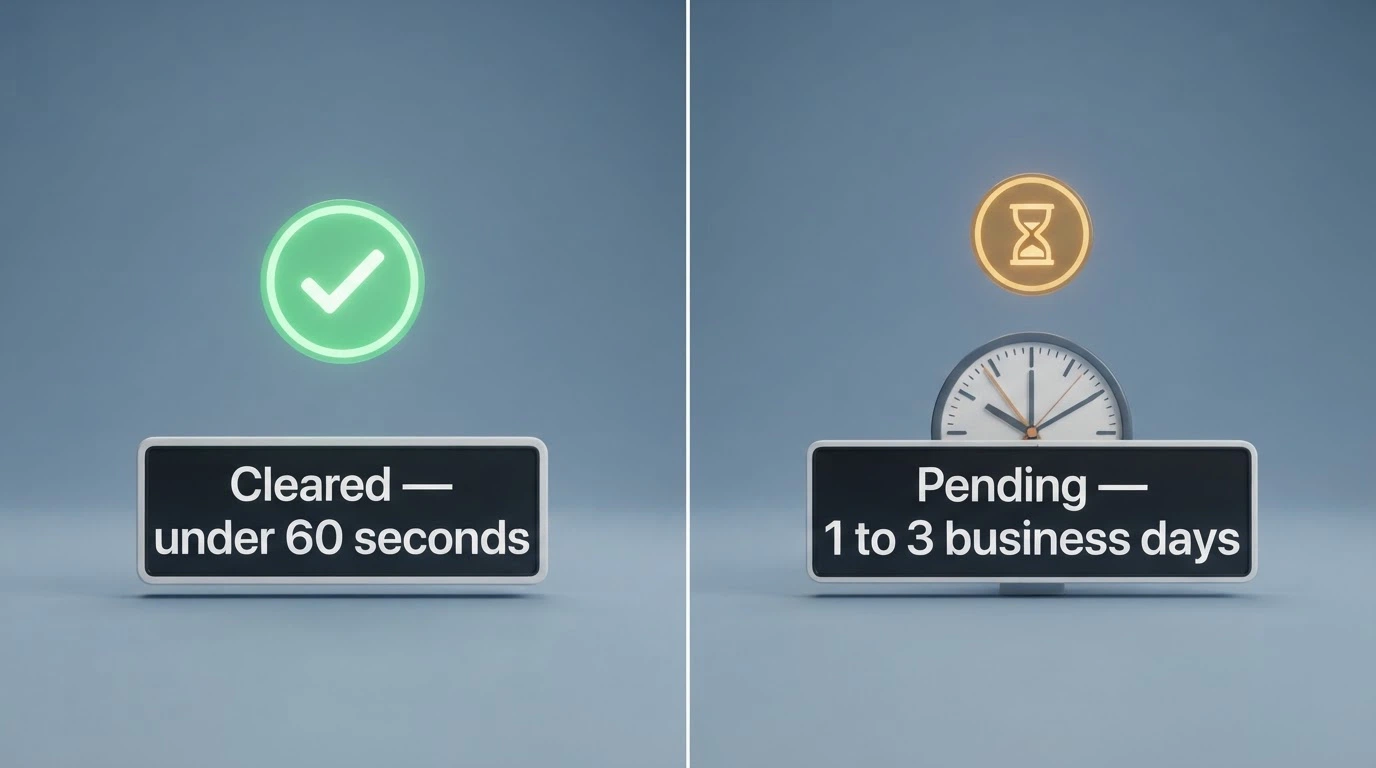
For an Australian punter choosing a withdrawal method, PayID beats a card on speed for a structural reason: a card payout requires the acquiring bank to push funds through a card network, which runs on batch processing, while PayID settles directly between the two banks. The result is that a PayID payout can be in a player’s account during a single ad break, and a card payout is more likely to be in it by tomorrow morning. PayID is also one of the legal deposit routes the ACMA recognises for licensed wagering, which means it sits inside the payments infrastructure the regulator has cleared.
| Withdrawal Method | How It Works | Typical Speed | Available Through |
|---|---|---|---|
| PayID / Osko | Direct bank-to-bank via the NPP, identified by PayID (email, phone, ABN) | Under 60 seconds when both banks support Osko | Most major Australian banks; supported by select offshore operators |
| Bank Transfer (direct) | Standard BECS transfer to a nominated account | Processing time varies by bank and cut-off times | Universally available |
| BPAY | Bill-payment system processing in scheduled batches | 1–2 business days for gambling-related deposits | Most Australian banks |
| Debit Card | Visa or Mastercard direct payout | Processing time varies by card issuer and operator | Operators supporting card withdrawals |
The table reads as it does because the speed ceiling is set by the rail, not the operator. PayID sits at the top because the NPP was built to settle in real time. The rest of the list runs in business days because they all depend on batch clearing or card-network processing.
Bank Transfer and BPAY: Why They Take Days, Not Minutes
Bank transfers and BPAY are secure and widely supported, but the mechanics that make them reliable are the same mechanics that make them slow. A standard direct bank transfer runs through the Bulk Electronic Clearing System (BECS), which processes in scheduled batches three times a business day and never on weekends or public holidays. A transfer lodged late Friday may not clear until Tuesday. BPAY runs on a similar batch timetable: one to two business days for gambling-related deposits, by the system’s own published clearance windows. Neither time is negotiable. The casino cannot press a button to make BECS settle faster, and the casino’s finance team cannot speed BPAY’s batch.
These methods still make sense for players who do not need the funds immediately, who are withdrawing a larger balance that would be awkward to push through a PayID limit, or who prefer a paper trail. They are also the methods every Australian bank supports without exception, which matters for an offshore operator whose PayID support may come and go. A punters should expect to wait one to five business days for a bank transfer and one to two for BPAY, and no advertised payout speed changes either window.
Real-Money vs Demo Mode: Why the Withdrawal Question Only Bites One Way
Demo mode and real-money play are two different products wearing the same game on top. In demo mode, the pokie runs on play-money credits the operator hands out for free, and there is nothing to withdraw because nothing was deposited in the first place. The speed question, the KYC question, the pending-window question — none of them apply, because the operator has no money to hold and no reason to verify an identity against a balance of zero.
Real money changes everything. The moment your own funds sit on the platform, the operator has a financial relationship with you and a regulatory reason to know who you are. The withdrawal question becomes a multi-step process with a real wait, and the protections and obligations on both sides multiply. The same offshore site that spins freely in demo becomes a financial counterparty the moment the deposit clears. That is why every section that follows is about real-money play. There is no withdrawal story for a product that does not hold your money.
What to Expect: Verification, Pending Windows and the Actual Wait
The operator’s advertised payout speed covers one step. The total wait stacks several more on top. A typical first-time withdrawal at an offshore online pokies site runs through this sequence, and each stage adds time the headline number does not include:
- Identity verification (KYC): before a first withdrawal, the operator asks for documents proving who you are — typically a government photo ID, a proof of address, and sometimes a screenshot of the payment method used to deposit. The review can take hours or several business days depending on the operator’s workload and how clean the documents are.
- Pending review window: most operators impose a hold between the withdrawal request and the approval, partly to allow reverse-of-deposit cancellation and partly as a fraud check.
- Operator approval and release: the finance team signs off and pushes the funds. This is the step the “instant” label usually describes.
- Bank-side processing: once the operator has released the funds, the receiving bank applies its own clearing time. PayID/Osko can land in under sixty seconds. Bank transfer and BPAY run in business days.
Per-operator processing times were not confirmed this run, so the steps above describe the typical pattern rather than any single brand’s policy. The operator’s own withdrawal policy page is where the actual figures live, and a player should read it before requesting the first payout.
The Offshore Operators Accepting Australian Players in 2026
Every operator an Australian can reach for online pokies in 2026 is offshore. That is not a feature of this ranking; it is the structural fact the Interactive Gambling Act produces. There is no licensed online casino in Australia — not federally, not in any state or territory. The online pokies product is prohibited outright, so the operator set that reaches Australian players is, by definition, the set that operates without an Australian licence. The table below reflects what exists in practice. It does not endorse any entry on it, and it cannot, because the entry it does not list does not exist.

Per-operator withdrawal methods, payout speeds, welcome offers, and wagering requirements were not confirmed this run. Where a cell has no researched figure, the table carries an em dash, and the prose beside it says so plainly. A reader comparing operators deserves to know where the data stops.
| Operator | AU Legal Status | Est. AU Market Share | Connected to BetStop |
|---|---|---|---|
| Rocket Play | Offshore — no AU licence | ~9.4% (est. A$632.69M revenue) | No |
| Skycrown | Offshore — no AU licence | ~8.55% (est. A$436.07M revenue) | No |
| Royal Reels | Offshore — no AU licence | ~2.51% (est. A$243.99M revenue) | No |
| WinSpirit | Offshore — no AU licence | — | No |
| Stake | Offshore — no AU licence | ~1.28% (est. A$115.67M revenue) | No |
| Rainbet | Offshore — no AU licence | — | No |
| Scream Casino | Offshore — no AU licence | — | No |
| FairGO | Offshore — no AU licence | ~0.8% (est. A$69.11M revenue) | No |
| Bizzo Casino | Offshore — no AU licence | — | No |
| Rocket Casino | Offshore — no AU licence | — | No |
Market share figures are drawn from Australian traffic-share data; they describe who reaches Australian players, not who is licensed to. The five operators without a market-share figure carry em dashes because no figure was available for them this run. Every operator on this list, without exception, sits outside BetStop, outside the ACMA’s complaints process, and outside any Australian authority that could compel a payout.
Rocket Play
Rocket Play is the largest offshore brand reaching Australian players by traffic share, with an estimated 9.4% of Australian online gambling traffic and estimated revenue around A$632.69M. It operates as an unlicensed offshore entity. It is not connected to BetStop. If Rocket Play refuses a withdrawal, the ACMA cannot recover the funds, because the ACMA’s enforcement reach stops at the border. These are not Rocket Play-specific facts; they are facts about every operator on this list, and Rocket Play is the biggest instance of them.
The structural risks of the offshore route scale with the size of the operator only in the sense that a larger operator processes more Australian transactions. The protection gap does not shrink. Withdrawal methods, payout speed, welcome offer, and wagering requirements were not confirmed for Rocket Play this run, and the player should treat its advertised payout times as the start of a conversation, not the end of one. The actual wait depends on the payment method and the KYC queue, both of which the marketing page does not describe.
Skycrown
Skycrown sits second in Australian traffic share, with an estimated 8.55% and estimated revenue around A$436.07M. Its legal profile is identical to Rocket Play’s: offshore, no Australian licence, no BetStop connection, no ACMA recourse. The size of the Australian-facing operation makes it one of the more visible brands for a punter searching from an Australian IP, but visibility is not the same as accountability. The protections an Australian might assume a large brand carries do not apply here, because the regime that would attach them — the Interactive Gambling Act plus the state and territory wagering licensing system — does not licence the product Skycrown sells to Australians.
Specific withdrawal terms, bonus structures, and payout speed were not confirmed this run. The traffic position tells a reader that Skycrown reaches Australian players at scale; it does not tell the reader how fast a withdrawal will land, what the wagering requirement on a bonus looks like, or which payment methods are supported. Those numbers live on the operator’s own page and should be checked before any deposit.
Royal Reels
Royal Reels is a smaller but significant Australian-facing offshore brand, with an estimated 2.51% of Australian traffic and estimated revenue around A$243.99M. It carries the same offshore legal status as every other operator on this list, with no connection to BetStop. The smaller traffic share does not change the protection gap; it only changes the volume of Australians likely to be using the platform at any one time.
Withdrawal methods, payout speed, welcome offer, and wagering terms were not confirmed for Royal Reels this run. A reader interested in the brand should treat the traffic figure as evidence of an established Australian customer base and not as a quality signal about how fast the operator pays out.
WinSpirit
WinSpirit is present in Australian traffic data as an offshore operator reaching Australian players. It has no Australian licence, because none is available for the product it offers. It is not connected to BetStop, and it carries the same protection gap as every other entry on this ranking. Market share, withdrawal methods, payout speed, and welcome offer were not confirmed this run. A reader looking for verified figures on WinSpirit should treat the operator’s own site as the only available source, with the caveat that an offshore operator’s own terms page is also the only place disputes get heard.
Stake
Stake is a globally recognised brand with a modest Australian traffic share — an estimated 1.28% and estimated revenue around A$115.67M. Its global profile does not translate into an Australian licence, because the product Australian players would access (online pokies) is prohibited under the IGA. Stake’s Australian-facing operation runs offshore, outside BetStop, outside ACMA complaints recourse, and outside any Australian consumer-protection regime. The brand recognition Stake carries internationally does not extend the protections an Australian punter might assume come with it.
Per-operator withdrawal methods, payout speed, welcome offer, and wagering requirements were not confirmed this run. The traffic figure tells a reader that Stake reaches a slice of the Australian market; it does not tell the reader whether a withdrawal will clear in minutes or days, or what conditions attach to any bonus.
Rainbet
Rainbet is present in Australian traffic data as an offshore operator. No Australian licence is possible for the product it offers. Rainbet is not connected to BetStop, and the ACMA cannot compel a payout from it. Market share and per-operator specifics — withdrawal methods, payout speed, welcome offer, wagering terms — were not confirmed this run. A reader considering the brand should approach it the way the law treats it: as an offshore entity serving a market the IGA has closed to licensed providers.
Scream Casino
Scream Casino reaches Australian players as an offshore operator. There is no Australian licence for the product it sells to Australians, so it operates without one. It is not connected to BetStop. If the operator refuses a withdrawal, the punter has no Australian complaints body to call. Market share and per-operator specifics were not confirmed this run, and the same caveats that apply to every entry on this list apply here: the operator’s own terms page is the only published source, and it is also the only forum a dispute has.
FairGO
FairGO is an offshore brand pitched at Australian punters, with an estimated 0.8% of Australian traffic and estimated revenue around A$69.11M — the smallest confirmed share on this ranking. The name sounds local. The legal status is not. FairGO has no Australian licence, because no such licence exists for online pokies, and the branding-to-law gap is the one thing the name cannot paper over. It is not connected to BetStop, and an Australian who self-excludes through BetStop will still be able to deposit and play at FairGO without the operator ever seeing the registration.
Per-operator withdrawal methods, payout speed, and bonus terms were not confirmed this run. The traffic position tells a reader FairGO reaches a small slice of the Australian market; the legal position tells the reader the slice is not protected by Australian law.
Bizzo Casino
Bizzo Casino is present in Australian traffic data as an offshore operator. No Australian licence is possible for the product it offers, so it operates without one. It is not connected to BetStop. Market share and per-operator specifics were not confirmed this run, and the protection gap is the same one that runs through every other operator on this list: no Australian consumer protection, no ACMA complaints recourse, no guarantee the operator will pay out.
Rocket Casino
Rocket Casino is an offshore operator reaching Australian players and is distinct from Rocket Play, despite the similar name. It has no Australian licence, because none is available for the product it offers. It is not connected to BetStop. Market share and per-operator specifics — withdrawal methods, payout speed, welcome offer, wagering — were not confirmed this run. A reader who confuses the two brands would find two different sets of terms and two different operator policies, both sitting outside Australian jurisdiction.
What Instant Withdrawal Actually Means for an Australian Punter
“Instant withdrawal” means different things at different points in the chain. An operator calling its payouts instant is usually describing the time between the withdrawal request and the operator’s approval to release funds — a step the operator controls and can compress to minutes. The KYC check that runs before a first withdrawal is not part of the instant claim. The pending-review window the operator imposes is not part of it either. And the bank’s own processing time after the operator has released the funds sits outside the operator’s control and outside the marketing language entirely. The fastest the Australian leg can run is PayID/Osko, which can settle in under sixty seconds when both banks support it.
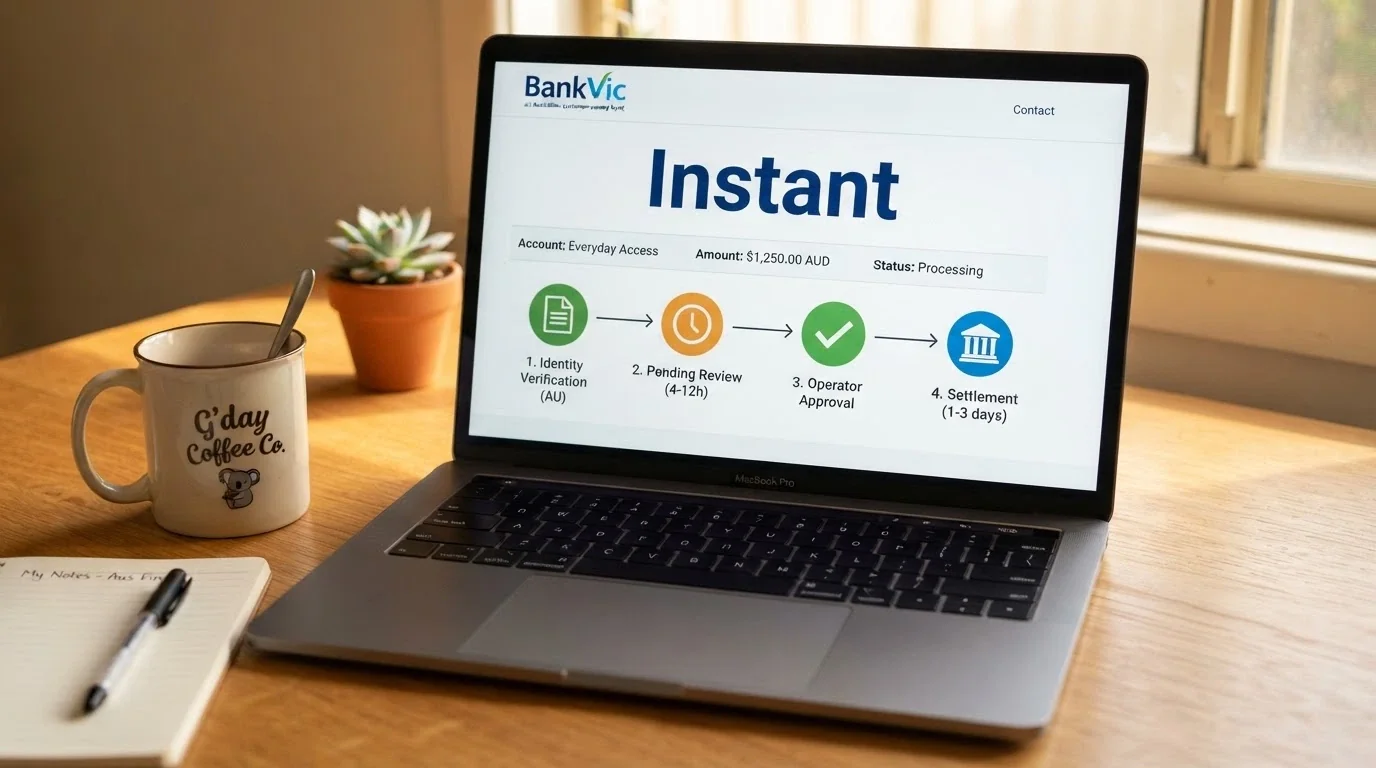
For an Australian punter, the “instant” label is a partial truth the marketing chooses to highlight and a multi-step process the marketing chooses not to. The wait is always longer than the headline, and the gap is not a service failure. It is the structure of the product.
The Marketing Promise vs the Processing Reality
An “instant” label on a withdrawal page usually refers to the operator’s own approval step — the moment the finance team signs off on a payout. That step is genuinely fast at some operators. It is not the only step. Before approval runs, the operator may be running a KYC check on a first-time withdrawal, which can take hours or days depending on the document quality and the operator’s queue. Between request and approval, most operators impose a pending window — a hold designed partly for fraud checks, partly to allow the player to cancel — that can stretch from a few hours to several days. After approval, the funds enter the payments system and travel at the speed of the rail: PayID/Osko under a minute, bank transfer one to five business days, BPAY one to two.
The total wait is the sum of those legs, not the speed of the fastest one. A player who sees “instant” on the withdrawal page should read it as “the operator’s approval step is fast,” and then ask about the KYC requirement for first withdrawals, the length of the pending window, and the payment methods the operator supports. Those three answers determine the actual wait.
What Is Actually on Offer: Fast-Payout Pokies in Australia
The category of “fast-payout pokies” exists in practice, but the speed ceiling is set by the payment method, not the casino brand. An Australian who wants the fastest possible payout chooses an operator that supports PayID or Osko withdrawals, then waits for the operator’s approval step to release the funds. The bank’s settlement takes under sixty seconds once the operator has pushed. That sequence delivers the closest thing to instant this market can offer, and it depends on three things lining up: the operator must support the method, the operator’s approval must be fast, and both the operator’s bank and the player’s bank must support Osko fast settlement.
For an Australian without PayID support at the receiving bank, the fastest realistic option drops to a card payout (typically one to three business days) or a same-day bank transfer if the operator supports it and the cut-off times align. The product on offer is the same — online pokies, prohibited under the IGA, served by an offshore operator — but the payout speed varies by method, not by operator.
Where Australia Sits in the Global Online Pokies Market
Australia is one of the world’s highest per-capita gambling markets sitting inside one of its strictest online casino bans. The country spends more per adult on gambling than almost any other jurisdiction, and the Interactive Gambling Act has made online pokies provision a criminal offence since 2001, strengthened in 2017. The result is a market the law has closed and the demand has not: the ACMA has had 1,564 illegal gambling and affiliate websites blocked by Australian ISPs as of March 2026, and more than 225 illegal services have withdrawn from the Australian market since 2017. Both numbers are evidence of enforcement, and both are evidence of the supply that enforcement is working against.
The offshore market fills the gap the ban creates. Every operator an Australian can reach for online pokies is an offshore entity, because no Australian entity can lawfully offer the product. That is the structural parameter for every withdrawal conversation on this page: the speed of PayID/Osko is real, and the operator that offers it is unlicensed, and both are true at the same time.
Where the Law Stands — and What It Leaves Unprotected
The Interactive Gambling Act draws a bright line. Providing online pokies, online casino games, or in-play sports betting to a person in Australia is an offence. The line does not move for branding, for licence held in another jurisdiction, or for the volume of Australian customers. What the line does not do is protect the player who walks through it. The Act targets the provider, not the punter, which is why offshore online pokies sites exist at the scale they do — and why the punter using them has no Australian authority to call when something goes wrong.

The 2026 reform package tightens the screws further. From 1 January 2027, banks and payment providers gain express authority to block transactions to illegal gambling operators. The change does not ban offshore play; it makes it harder for an Australian bank account to fund one. For a player who has been treating the offshore route as a workaround, that workaround narrows.
The Interactive Gambling Act: What It Bans and What It Does Not
The IGA 2001, strengthened by the 2017 amendments, prohibits the provision of online casino games (including online pokies) and in-play sports betting to people in Australia. It does not prohibit pre-event wagering on racing or sport — that product is licensed, through state and territory regimes, with the Northern Territory Racing and Wagering Commission as the de facto national licensor for the large online bookmakers. Lotteries and keno are licensed too. The line between licensed and prohibited runs along the event clock: pre-event wagering is licensed, in-play is prohibited, and online casino games are prohibited regardless of timing.
The 2017 amendments gave the ACMA its modern enforcement toolkit and the 2026 reform package, which passed Parliament on 19 August 2026 and commences 1 January 2027, adds payment-blocking authority, advertising restrictions, and inducement-marketing bans. From 11 June 2024, credit cards, credit-related products, and crypto have been banned as payment for online wagering, with penalties of up to A$247,500 for an operator that fails to enforce the ban. The legal deposit routes for licensed wagering remain debit card, bank transfer, PayID/Osko, and BPAY — and an Australian who is asked for a credit card or crypto deposit by a gambling site is being served by someone outside the Australian rules.
The ACMA: Australia’s Online Gambling Enforcer — and Its Limits
The ACMA is the federal regulator enforcing the online prohibition. It investigates complaints, issues formal warnings, brings civil penalty proceedings, and directs Australian ISPs to block illegal sites. The numbers tell the story of the enforcement effort: 1,564 sites blocked as of March 2026, and more than 225 illegal services withdrawn from the Australian market since 2017. Those are real outcomes of real investigations, and they have reshaped the supply side of the offshore market over the last decade.
The ACMA’s limits matter as much as its reach. It cannot recover a player’s money from an offshore operator that refuses to pay. It cannot compel an offshore casino to honour its terms. It can block the site, and it has blocked 1,564 of them, but it cannot put withdrawn funds back into an Australian bank account. That is the boundary an Australian walks past when choosing to play offshore, and no ACMA enforcement action changes it.
What You Give Up When You Play Offshore
The IGA does not punish the player. It also does not protect one. An Australian punter at an offshore online pokies site is outside the regime the IGA built and outside the protections that regime carries. The give-up list is concrete:
- No Australian consumer protection. State and territory fair-trading and consumer-credit regimes do not reach an offshore casino operating outside Australian jurisdiction.
- No BetStop coverage. The National Self-Exclusion Register binds Australian-licensed wagering services only. An offshore casino will never see a BetStop registration and will keep accepting the self-excluded person’s money.
- No ACMA complaints recourse. The ACMA can investigate the operator; it cannot order a payout to a specific player.
- No guarantee of withdrawal. The operator’s own terms govern, and the dispute resolution is whatever the operator’s own process is.
- Risk of site blocking. The ACMA has had 1,564 sites blocked; the operator a player is using could be next, with a balance on account.
- Payment disruption from 1 January 2027. Banks gain express authority to block transactions to illegal gambling operators. An Australian whose bank chooses to exercise that authority will find deposits and withdrawals stopped at the bank’s discretion.
- No credit card or crypto deposit route. Those payment methods have been banned since 11 June 2024; an operator offering them is operating outside Australian rules.
The give-up list is the reason the page describes these operators rather than recommends them. A faster payout is a real benefit. So is the absence of every protection Australia has built around online gambling. The reader has to weigh both.
The Bonus Offers That Come With a Catch
Offshore operators use welcome offers and free spins to pull Australian players through the door. The wagering requirement attached to those offers can turn a headline bonus into a multi-step obligation that most players never clear. The bonus is not the gift the marketing makes it look like. It is a credit the operator hands out under conditions the player has to satisfy before any of it becomes withdrawable cash.

From 1 January 2027, the inducement rules tighten. Direct marketing of inducements is prohibited for fourteen days after a customer signs up, for three months after a person deregisters from BetStop, and indefinitely for customers identified as at risk of gambling-related harm. For an Australian-facing offshore operator, those restrictions are Australian rules applied to Australian customers and have the same enforcement profile as every other Australian rule on an offshore operator: the rule exists, the offshore operator is unlikely to be bound by it, and the ACMA can take action against the provider but cannot recover a player’s losses.
Welcome Offers and Free Spins: What Operators Promise
Welcome offers at offshore online pokies sites usually take one of two shapes: a matched-deposit bonus (the operator matches a percentage of the player’s first deposit with bonus funds) or a free-spin bundle (a fixed number of spins on a named pokie or set of pokies). No-deposit offers — a small bonus paid for the act of signing up — exist but are rarer and smaller. The headline number on the welcome page is the figure the marketing puts first. The cashable value of the offer depends on the terms beneath it.
The gap between advertised and cashable is the wagering requirement, the game-weighting rules, the maximum-bet cap while the bonus is active, and the expiry window. A “100% match up to A$500” headline can become a bonus whose cashable value is a small fraction of A$500 once those terms are applied. Per-operator offer terms were not confirmed for the operators on this ranking this run, and the patterns above describe the shape of the product rather than any single brand’s offer.
Wagering Requirements: Why the Bonus Is Harder to Collect Than It Looks
A wagering (turnover) requirement is a multiple the player must bet through before bonus funds become withdrawable. A A$100 bonus with a 40x wagering requirement means A$4,000 of bets before the bonus is cashable. Most players never reach that volume on a single pokie session; the requirement stretches across many sessions, many games, and a clock that counts down to the bonus’s expiry. The interaction with withdrawal speed is direct: until the wagering requirement is met, the bonus balance (and often the deposit it was matched against) cannot be withdrawn at all.
A wager-free bonus is rare and, where it exists, more valuable than a larger bonus with a high multiple. The headline figure is not the figure to compare. The comparison is offer size against wagering multiple against expiry window against game weighting, and the answer that matters is what the player actually walks away with. Per-operator wagering requirements for the featured brands were not confirmed this run; the description above is the shape of the mechanic, not a ranking of the operators on it.
Staying in Control: The Tools Australia Has Built
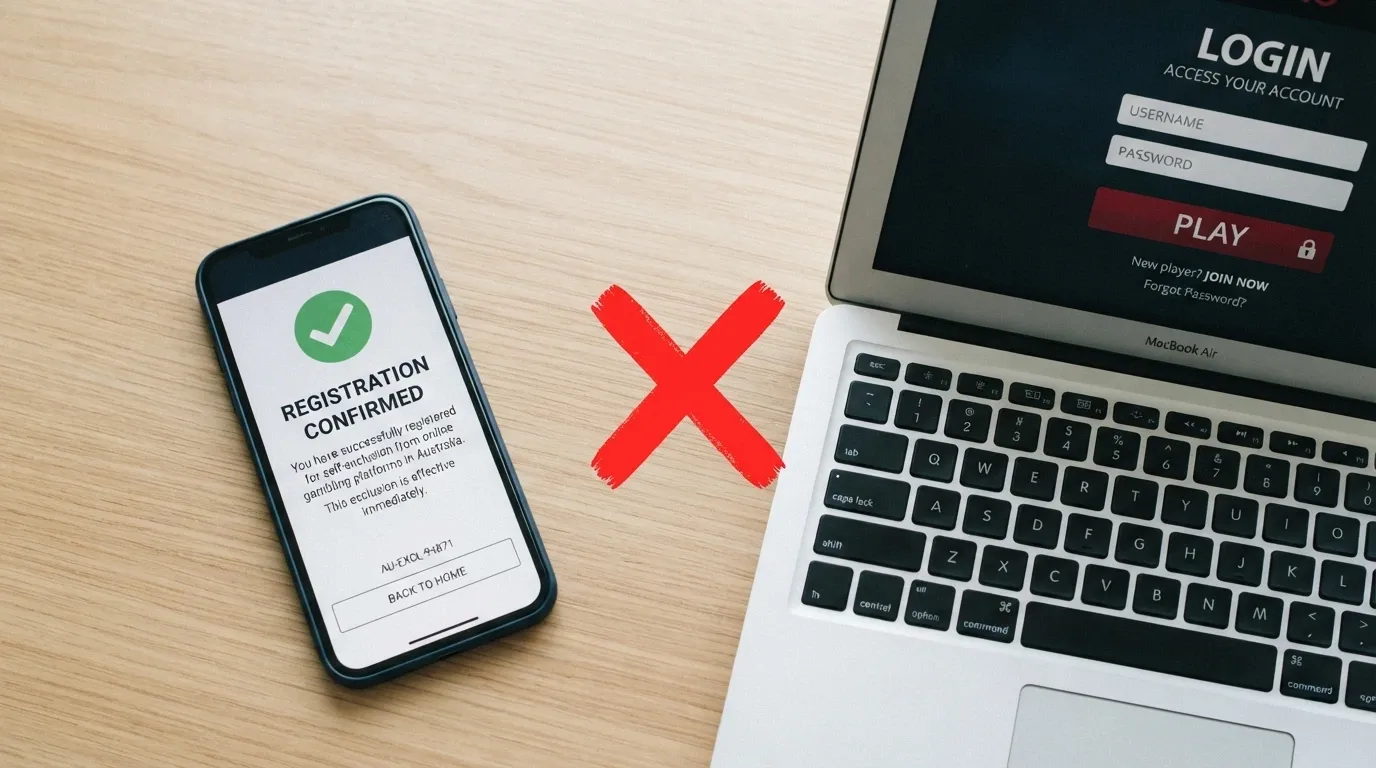
Australia has built a serious player-protection infrastructure. BetStop, the National Gambling Helpline, mandatory deposit limits, and activity statements are real tools with real reach — but the reach stops at the Australian-licensed side of the market. An offshore online pokies site sits outside every one of those tools. A player who self-excludes through BetStop is still able to deposit and play at an offshore casino without the casino ever seeing the registration. The harm-minimisation machinery exists; the offshore route sits next to it, not inside it.
For an Australian who is worried about their own gambling or someone else’s, the help resources work regardless of where the gambling happens. The National Gambling Helpline is free, confidential, and available 24/7. The scale of the problem it answers is large: about 2.1% of Australian adults — roughly 430,000 people — experience problem gambling, with the Australian Institute of Health and Welfare putting high-risk gambling at 1.8% in 2022.
BetStop: Australia’s Self-Exclusion Register — and the Offshore Gap
BetStop, the National Self-Exclusion Register, went live in August 2023. A single registration excludes a person from every Australian-licensed online and phone wagering service. As at 31 July 2026, BetStop had recorded 67,480 registrations, of which 41,290 exclusions were still active — more than sixty per cent of everyone who has ever registered. The demographic skew is sharp: 78% of registrants are under 40, and 38% chose lifetime exclusion. BetStop is a working tool, and the people using it are using it seriously.
The offshore gap is the most concrete harm of the offshore route. BetStop binds Australian-licensed wagering services only. An offshore casino is not connected to the register, will never see a BetStop registration, and will continue to accept a self-excluded person’s deposits and bets. The protection an Australian gets from registering is real on the licensed side and absent on the offshore side. A player who has registered for BetStop and is still being served by an offshore casino is seeing the boundary between the two regimes in real time.
Where to Get Help: The National Gambling Helpline and Beyond
The National Gambling Helpline (1800 858 858) is free, confidential, and staffed 24 hours a day, seven days a week. Online chat and counselling are available through Gambling Help Online at gamblinghelponline.org.au. Both services work for any Australian, regardless of whether the gambling happened on a licensed platform or an offshore one — the help infrastructure does not require the gambling to have happened inside the regime that built it.
On the licensed side, Australian wagering operators offer customer-set deposit limits and activity statements under their state or territory conditions, which differ between jurisdictions. On the offshore side, none of those tools is required, and none of them is reliably offered. A player who has used deposit limits and activity statements on a licensed platform will find them absent at most offshore casinos. The harm-minimisation gap is the same gap that runs through every other protection on this page.
How We Evaluated and Ranked These Operators
This ranking is built from two sources. The operator identities and Australian traffic share come from Australian traffic-share data, which describes which brands reach Australian players and at what volume. The legal and regulatory framework comes from the Interactive Gambling Act 2001, the ACMA’s enforcement record, and the state and territory wagering licensing system. The two sources combine to produce the ranking the table above shows: ten operators ordered by estimated Australian traffic share, each carrying the same legal status because the law leaves no other status for the product they offer.
No operator on this list holds an Australian licence, because no such licence exists for online pokies. The ranking does not endorse any operator on it. It describes what an Australian player can reach in practice, ordered by traffic position, with the legal status and the BetStop connection stated for every entry. Per-operator withdrawal methods, payout speeds, welcome offers, and wagering requirements were not confirmed this run, and the cells without a researched figure carry an em dash. A reader who wants those numbers for a specific brand should read the operator’s own terms page, with the awareness that an offshore operator’s own terms page is also the only forum a dispute will have.
Weighing the Promise of Fast Payouts Against the Reality of Offshore Play
The fastest an Australian withdrawal can travel is PayID/Osko at under sixty seconds, when both banks support it. That is a real ceiling, and it is faster than any operator-side processing can promise. It is also the ceiling on a product the Interactive Gambling Act prohibits, served by operators that hold no Australian licence and sit outside BetStop, the ACMA’s complaints process, and any Australian consumer-protection regime. The speed and the legal status are both true at the same time, and the trade-off between them is the trade-off an Australian punter is making every time they sign up.

From 1 January 2027, the trade-off narrows further. Banks gain express authority to block transactions to illegal gambling operators. An Australian bank exercising that authority will stop a deposit or a withdrawal at its discretion, regardless of the operator’s advertised payout speed. The 1,564 sites the ACMA has already blocked are evidence the enforcement effort is active, and the 225 services withdrawn since 2017 are evidence it has reshaped the supply. Neither enforcement action changes the offshore casino’s terms; both make it harder for an Australian to reach the offshore casino at all.
The choice the page puts on the table is not between operators. Every operator on the list carries the same legal status, sits outside the same protections, and benefits from the same payments ceiling. The choice is between staying inside the Australian regime — with its deposit limits, its BetStop coverage, its ACMA complaints recourse, and its prohibition on the online pokies product — and stepping outside it for faster payout, knowing the protections do not follow. PayID under sixty seconds is fast. It is also the speed available on a product Australia has made illegal to provide and has built an enforcement architecture to suppress. A player weighing one against the other is weighing the only two things that actually differ.
Frequently Asked Questions
How long does PayID withdrawal take from an online casino?
PayID/Osko settles in under sixty seconds when both the sending and receiving banks support Osko fast settlement through Australia’s New Payments Platform. The PayID leg is the fastest the Australian payments system can deliver, but it covers only the bank’s settlement — the operator’s KYC check and pending-review window run before the PayID transfer is initiated.
What is the difference between instant and same-day withdrawal at online pokies?
“Instant” usually describes the operator’s approval step, not the total wait. A same-day withdrawal typically means the funds reach the player’s bank account within the same business day, which depends on cut-off times and the payment method. PayID/Osko can land in under sixty seconds once the operator releases the funds; a card or bank transfer is more likely to clear by the next business day.
Do I need to verify my identity before withdrawing from an online pokies site?
Yes. Offshore operators run KYC checks before a first withdrawal, typically asking for a government photo ID, a proof of address, and sometimes a screenshot of the deposit method. The review can take hours or several business days. The operator’s approval is the “instant” step; the KYC check runs before it and is not part of the instant claim.
What happens if an offshore casino refuses to pay out my winnings in Australia?
The ACMA can investigate the operator and can direct Australian ISPs to block the site, but it cannot compel an offshore casino to pay a specific player. There is no Australian complaints body with that authority over an offshore operator. The dispute resolution is whatever the operator’s own process is, and the only leverage a player has is the operator’s own interest in its reputation.
Is BetStop connected to offshore pokies sites?
No. BetStop binds Australian-licensed wagering services only. An offshore online pokies site is not connected to the National Self-Exclusion Register and will never see a BetStop registration. A self-excluded Australian can still deposit and play at an offshore casino; the registration does not extend to the offshore side of the market.
Can I use a credit card to deposit at Australian online pokies sites?
Credit cards, credit-related products, and crypto have been banned as payment for online wagering since 11 June 2024, with penalties of up to A$247,500 for non-compliance. An Australian-facing gambling site asking for a credit card or crypto deposit is operating outside the Australian rules. Legal deposit routes for licensed wagering are debit card, bank transfer, PayID/Osko, and BPAY.