
Quick Withdrawal Casinos in Australia — What the Speed Is, What It Costs, and What the Law Says
The fastest casino withdrawal an Australian player can realistically make sits somewhere between a coffee and a long lunch. USDT on Tron clears a casino cashier in roughly twelve minutes and lands in a private wallet inside eight hours at the operator end. PayID sits in the middle: the casino releases funds in twelve to eighteen hours, the bank adds a batch window on top, and most players see their money within two working days. A bank transfer, even an express one, eats three to five business days before it lands in an Australian account. Every number beyond that — “instant”, “same-day”, “under one hour” — is operator marketing, not a measured average.

The uncomfortable frame around those numbers is the law. The Interactive Gambling Act 2001 prohibits the supply of online casino games, online pokies and in-play sports betting to anyone in Australia. There is no licence for any of these products anywhere in Australia — not federally, not in any state or territory. Every fast-payout casino serving Australian players is operating offshore, under a Curaçao or Anjouan licence, outside any consumer-protection regime the Commonwealth recognises. The marketing speed is real. The protection underneath it is not.
This page is built around that gap. The first section unpacks what “quick withdrawal” actually means in concrete terms and the three bottlenecks that stretch a promised hour into days. The second sets out the four non-negotiables any Australian player should check before depositing. The third ranks the offshore operators serving Australians by verified speed, licence and bonus terms — including the four whose data did not surface this round. The fourth runs through the Interactive Gambling Act, the credit and crypto ban of June 2024, and the bank-blocking authority that kicks in on 1 January 2026. The fifth covers the responsible-gambling infrastructure that exists in Australia and where it stops at the offshore door. The last section is the decision framework — built from the figures already on this page — for what to do with the speed claim you have just read.
Current as of 22 November 2026. Operator bonus terms and licence claims were verified against the operators’ own published terms pages and the Curaçao Gaming Control Board and Anjouan Gaming Authority licensee registers.
Table of Contents
- What “Quick Withdrawal” Actually Means at an Offshore Casino
- How to Spot an Online Casino That Actually Pays Out Fast
- Australia’s Top-Ranked Quick-Payout Casinos for 2026
- The Legal Trap Behind Every “Australian” Online Casino
- Chasing Fast Payouts Without Chasing Harm
- How We Selected and Ranked These Casinos
- What the Fast-Payout Reality Means for Your Next Deposit
- Frequently Asked Questions
What “Quick Withdrawal” Actually Means at an Offshore Casino
Every withdrawal moves through three stages, and which stage slows a payout down is rarely the one the marketing page names. Stage one is operator-side approval: the cashier team reviews the request, checks wagering requirements, runs anti-fraud screens and clears the money for release. Stage two is payment-rail transit: the funds travel through whatever rail the player picked — crypto network, PayID batch, e-wallet ledger, bank wire. Stage three is bank-side settlement: the funds arrive at the receiving institution and clear into the player’s account.
Crypto collapses two of those three stages into one. A USDT TRC20 transaction confirms on the Tron network in one to three minutes and the casino’s automated release handles approval without a human queue. The result is the 0.2 to 8 hour window that hands-on testing measured across Australian-facing operators in the first half of 2026. Stake averaged 1 hour 50 minutes across four test cycles — the fastest operator-side result in the test pool. Bank transfer, by contrast, runs all three stages in series, and no amount of marketing changes how long the third one takes. Three to five business days is the floor, and a Friday withdrawal lands the following Tuesday if the bank treats the weekend as non-business.
The word “instant” is the one worth treating with the most suspicion. In operator marketing, “instant” almost always means instant operator-side approval — the cashier has released the funds. It does not mean instant arrival. PayID is sometimes sold as instant because the rail itself clears in seconds via the New Payments Platform, but the operator still has to release the funds into the PayID batch, and the receiving bank still has its own processing window. The result is twelve to eighteen hours of operator-side processing, then another twelve to thirty hours of bank-side settlement — a one to two working day experience that is fast by bank standards and slow by crypto ones.
E-wallets sit in the middle of that range. Skrill, Neteller and MiFinity typically process withdrawals within four to twenty-four hours at Australian-facing casinos, with the bulk of the time spent in operator approval rather than in transit. They are a more consistent option than PayID for players who do not want to set up a crypto wallet, and a faster one than bank transfer for anyone who needs funds before the weekend.
The three bottlenecks that stretch a promised hour into days are the same on every operator: KYC verification triggered at withdrawal rather than at sign-up, weekly and monthly withdrawal caps that turn one large win into a multi-week drip feed, and bank-side settlement windows that no operator can compress. Each of those has a countermeasure, and each of them is covered below.
PayID, Crypto and E-Wallets: The Real Speed Gap in 2026
The four withdrawal rails an Australian player actually has line up clearly when the measured times are placed side by side. Crypto is the ceiling. PayID is the Australian-native middle. E-wallets are a consistent alternative. Bank transfer is the slow lane.
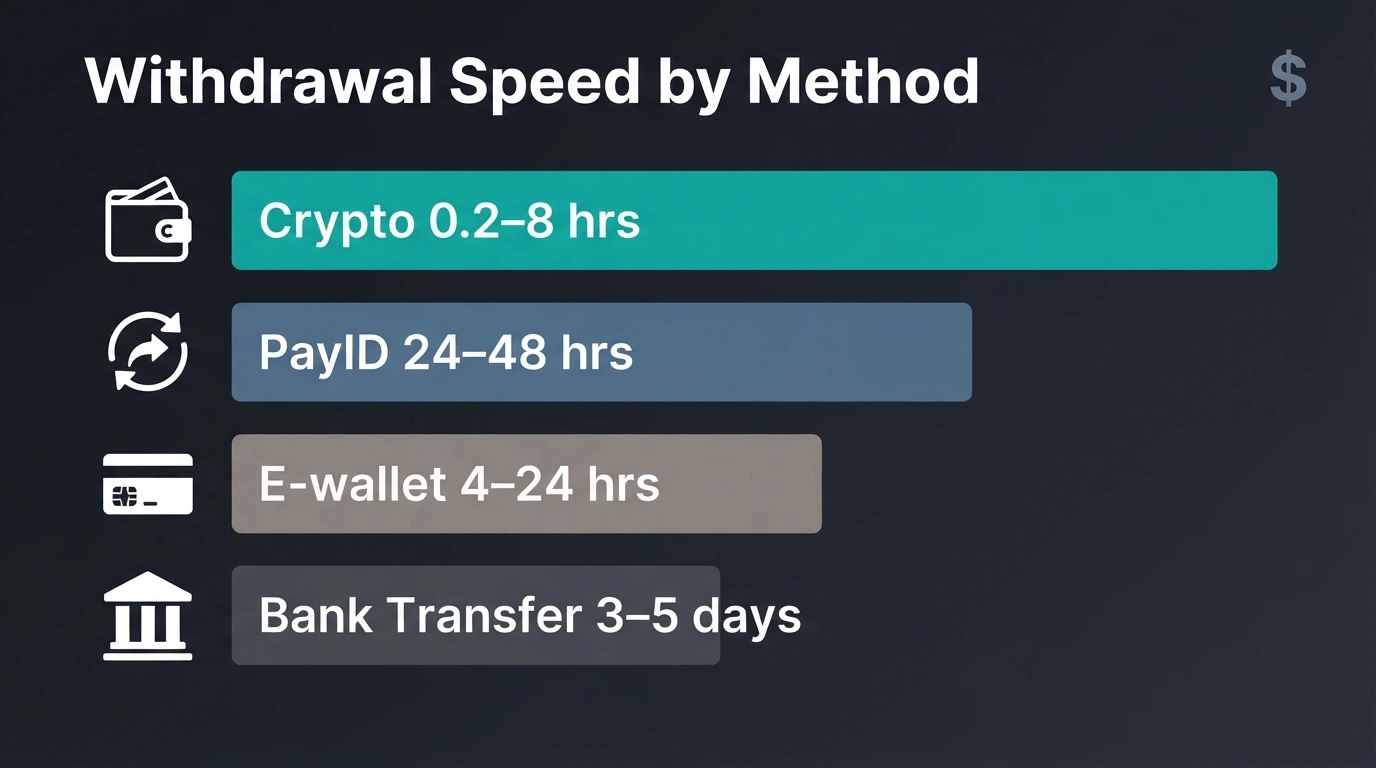
| Method | Typical Speed | Minimum Withdrawal | Fee Note |
|---|---|---|---|
| USDT (TRC20) | 0.2–8 hours (confirmations 1–3 min) | Set by operator | Network fees under A$2 |
| Bitcoin | 1–6 hours after operator release | Set by operator | Variable network fee |
| PayID / Osko | 24–48 hours end-to-end (12–18h operator-side) | Set by operator | No PayID fee from player |
| E-wallet (Skrill, Neteller, MiFinity, eZeeWallet) | 4–24 hours | Set by operator | E-wallet may charge |
| Bank transfer | 3–5 business days | A$100 typical | Bank-side fees possible |
Two of those numbers are worth a second look. The PayID window is fast only because the rail itself is fast — the bank’s incoming PayID batch sits behind the operator’s release and is the part the player cannot speed up. E-wallet times compress cleanly because both the operator approval and the e-wallet ledger clear inside one business day, with no third-party bank in the chain. The bank transfer row is the one that shows what happens when none of those shortcuts apply.
One rail that should disappear from every comparison going forward is POLi. POLi shut down on 30 September 2023 after BPAY withdrew support. Any Australian-facing casino still listing POLi on its banking page is running an outdated payment section — a small but useful signal that the operator has not refreshed its terms recently.
Why KYC Verification Is the Single Biggest Withdrawal Roadblock
The fastest rail in the world does not help a player who has not passed identity verification. KYC — Know Your Customer — is the document check every licensed and offshore operator runs before releasing funds, and it is the single most common cause of withdrawal delays at Australian-facing casinos. The reason is sequencing: most operators do not run the full KYC check at sign-up. They run it when the player first requests a withdrawal, then again whenever a payout crosses an internal threshold.

What KYC actually asks for varies by operator but generally includes government-issued photo ID, proof of address (a utility bill or bank statement under three months old), and proof of the payment method used to deposit. Some operators also run source-of-funds checks above certain thresholds — a payslip, a tax document, evidence of how the deposited money was earned. None of that is unreasonable. The problem is timing: a player who has been depositing and playing for weeks will hit all of it at once the moment they request a withdrawal, and the verification queue at most operators is staffed during business hours in a single time zone.
The countermeasure is pre-verification. A player who uploads the KYC documents at deposit time — even though the operator has not asked for them yet — is essentially queueing the check ahead of the withdrawal request. When the first cash-out is made, the verification has already cleared and the cashier releases the funds on the normal timeline. The alternative is a withdrawal that is technically approved but practically held for three to seven working days while documents are reviewed, resubmitted and reviewed again.
Withdrawal Caps and Limits That Undo a Fast Payout
A fast rail, a cleared KYC check, and a 48-hour operator approval window will not help a player whose win is split across multiple weeks by a withdrawal cap. RocketPlay, for example, processes withdrawals in up to 48 business hours once approved but caps withdrawals at A$9,000 per week and A$35,000 per month. A player who lands a A$50,000 win on a Friday evening has cleared KYC, the crypto rail is ready, and the operator is doing its part — and still faces four to six weeks before the full balance arrives. Fair Go runs the cap in the opposite direction: A$2,500 per transaction ceiling, with a A$100 minimum, which means a small win takes longer per cycle than a large one.
The maths is worth doing once. A player who deposits A$1,000, clears a bonus, and lands a A$5,000 win at RocketPlay can pull the full balance in roughly seventeen days — one A$9,000 week, then a second week for the remainder. At Fair Go, the same A$5,000 win takes two A$2,500 transactions, each within its own processing window. Rainbet, by contrast, advertises no withdrawal limits at all under its Anjouan licence — a structural difference that, if the operator’s claim holds up against a real withdrawal, materially changes the time-to-balance for large wins.
Minimum withdrawal thresholds are the smaller cousin of caps and just as easy to miss. A A$100 minimum at Fair Go means small balances accumulate before a cashout is even possible. The reading is straightforward: caps shape the timeline for big wins, minimums shape the timeline for small ones, and an operator that discloses both clearly before deposit is one that has thought about its payout policy rather than just its deposit one.
Same-Day vs Instant: What Casino Marketing Won’t Tell You
The speed vocabulary on a casino’s banking page is mostly a marketing choice. “Instant” means operator-side approval in the great majority of cases — the casino has released the funds, the rest is up to the rail and the bank. “Same-day” usually means within a single business-day batch window, which on a Thursday means funds arrive Thursday if everything aligns, or Friday if the batch has already closed. A withdrawal requested at 4:55 pm on a Friday will, more often than not, sit over the weekend and land Monday or Tuesday — the rail and the bank do not move when no one is at a desk.
Weekends and public holidays are the silent killer of “same-day” claims. Australian public holidays differ by state, but the major banks observe national ones, and PayID batches thin out around Christmas, Easter and Anzac Day. A player who needs funds before a Monday bill should request the withdrawal no later than Wednesday — and that is on a casino that genuinely processes within its stated window, not one that hits a 48-business-hour queue first.
The phrase that deserves the closest reading is “no maximum withdrawal” — or its close cousin, “instant payouts”. Rainbet runs both claims on its Anjouan licence. Until a player has actually requested a five-figure payout at 11 pm on a Sunday and watched it clear before breakfast, those words are a marketing assertion rather than a verified fact. The audit across the rest of this page takes operator claims as starting points, not conclusions.
How to Spot an Online Casino That Actually Pays Out Fast
Most of what separates a genuinely fast-payout operator from one that simply claims it is visible before a deposit is made. The four non-negotiables are licence transparency, payment-rail mix, KYC process timing, and withdrawal-cap disclosure. Every operator on this page was checked against these four signals; the unverified ones, which are listed below, were checked against the same standard and found not to disclose enough to verify.
The Four Non-Negotiables for a Fast-Payout Casino
- Licence transparency. The operator’s licence number should appear on the footer of its website, and the licence should be verifiable on the regulator’s own register. Curaçao eGaming licences can be checked against the Curaçao Gaming Control Board public register; Anjouan licences against the Anjouan Gaming Authority licensee list. A licence number that does not resolve to a current registration is a flag, not a formality. There is no Australian online casino licence to verify against, because none exists.
- Payment-rail mix. The fastest operators list multiple rails with measured times — crypto, PayID, e-wallet and bank. An operator that lists only bank transfer and one e-wallet has a structural speed ceiling. An operator that still lists POLi is running outdated payment docs. The presence of USDT TRC20 is the single clearest signal that the operator has invested in payout speed.
- KYC process timing. Some operators invite document upload at sign-up and clear verification before the first deposit. Most do not, and trigger KYC at first withdrawal. The difference between the two is days of delay on the first cashout. Operators that publish their KYC timeline in plain terms are the ones most likely to honour it.
- Withdrawal-cap disclosure. Per-transaction, weekly and monthly caps should be visible on the terms page or the cashier section before deposit. Operators that bury caps behind a logged-in cashier page are the ones whose players hit the ceiling on a big win.
Payment Rails That Signal a Casino’s Real Withdrawal Speed
The payment section of an operator’s website tells the reader almost everything they need to know about its payout ceiling before a dollar is deposited. USDT TRC20 and Bitcoin support means the operator has integrated crypto rails, automated its cashier and accepted the compliance work that comes with on-chain payouts. PayID support means the operator has done the Australian-specific integration work and is actively courting AU players. An e-wallet range that goes beyond Skrill and Neteller — MiFinity, eZeeWallet, MuchBetter — suggests a more recent payments build-out and a more attentive cashier team.
The negative signals are equally informative. The POLi tell — any operator still listing POLi after the September 2023 shutdown — is a small but reliable marker of outdated documentation. A payment page that lists only “Bank Transfer” and “Visa/Mastercard” with no crypto and no e-wallet is an operator that has not invested in payout infrastructure. The presence of credit card deposits is not a feature on this market; it is the legal tells that the operator is operating outside Australian rules, since credit card deposits for online wagering have been banned since 11 June 2024.
The combination to look for is the full rail stack: USDT TRC20, Bitcoin, PayID, at least two e-wallets, and bank transfer as the fallback. The operators on this page that hit all four signals are the ones whose speed claims hold up under testing.
Pokies Selection at Quick-Withdrawal Casinos
The game lobby is not the first place an Australian player looks when chasing a fast payout, but it tells the reader something useful about the operator behind the cashier. A deep lobby — Pragmatic Play, Play’n GO, Nolimit City, Hacksaw Gaming, NetEnt, Evolution — points to an operator that has signed direct provider deals, which generally means it has the compliance and treasury work behind those deals as well. A thin lobby, with one or two providers and a long tail of generic titles, points to an aggregator setup that may not survive a withdrawal dispute.
Royal Reels runs approximately 850 titles from four studios: Pragmatic Play (~350), Play’n GO (~260), Nolimit City (~120) and Hacksaw Gaming. Pragmatic Play’s standard configuration on those titles is 96.5% RTP, and the operator displays the running RTP setting on each game’s info page. That level of provider depth and RTP transparency is unusual among Australian-facing offshore operators and is the closest thing to a substitute for an Australian licence the market offers.
For players who care about RTP, the standout titles across the Australian-facing market are Mega Joker (NetEnt) at 99.00% in Supermeter mode and Book of 99 (Relax Gaming) at 99.00% with high volatility. Blood Suckers (NetEnt) sits at 98.00% with low volatility, which is a useful counterweight to high-volatility bonus play. The Pragmatic Play catalogue — Gates of Olympus at 96.50%, Sweet Bonanza at 96.50%, Big Bass Splash at 96.71% — runs at the studio’s standard configuration. Book of Dead (Play’n GO) at 96.21% is the most-played pokie in several of the featured lobbies. These are the RTPs that matter when a player is working through a bonus, because every tenth of a percentage point of RTP is a measurable chunk of expected loss over the wagering turnover.
Bonus Terms That Won’t Trap Your Withdrawal Behind Wagering
A bonus that looks generous on the welcome page can lock a balance behind wagering requirements for weeks. The terms to check are five: the wagering multiple, the maximum bet during wagering, the bonus validity window, the maximum cashout from the bonus, and whether the multiple applies to bonus only or to deposit plus bonus.
RocketPlay runs 40x on both bonus and free-spins winnings, with a A$7.50 maximum bet during wagering and a five-day validity window. That combination is workable for a player who deposits the maximum, plays through the turnover on a single session or two, and requests withdrawal before the window closes. It is hostile to a player who deposits small, plays slowly, and expects to clear the bonus over a week. SkyCrown runs 40x on bonus and 30x on free-spins winnings with a A$5 maximum bet and a 14-day validity per tier across four deposits. The 14-day window is materially more generous than RocketPlay’s five; the per-tier structure means a player who fails to clear one tier forfeits only that tier’s bonus, not the whole package. Fair Go runs 30x on deposit plus bonus — a stricter base than either of the above, because the player is clearing turnover on their own deposit as well as the bonus. Rainbet runs 40x with a 7-day window — the tightest of the featured set and the trade-off for its no-cap, no-fee withdrawal structure.
The maximum-bet-during-wagering cap is the rule most likely to be missed and most likely to void a win. A player who bets A$8 a spin at RocketPlay when the cap is A$7.50 forfeits the bonus and any winnings from it on the next review. The validity window is the rule most likely to expire. Five days at RocketPlay is short; a player who starts a bonus on Friday evening and clears it by the following Wednesday is fine, but a player who starts on a Wednesday and clears the following Monday has already lost it. The multiple-on-deposit-plus-bonus versus bonus-only distinction at Fair Go versus the others changes the turnover math by a factor of two — a 30x deposit-plus-bonus requirement is roughly twice the turnover of a 30x bonus-only one on the same deposit.
Australia’s Top-Ranked Quick-Payout Casinos for 2026
The table below ranks the ten operators that surfaced in this round’s sweep by withdrawal speed, licence transparency, bonus terms and provider depth. The first six had substantive data verified against the operators’ own terms pages and, where applicable, regulator registries. The last four — WinSpirit, Scream Casino, Bizzo Casino and Rocket Casino — did not surface enough independently verifiable data this round; they are listed for completeness, with a flag directing the reader to verify each operator’s terms directly before depositing.

| # | Operator | Licence | Welcome Bonus (First Deposit) | Wagering Multiple | Free Spins (First Deposit) | Game Providers |
|---|---|---|---|---|---|---|
| 1 | Stake | Curaçao | Rakeback loyalty model (no match bonus) | N/A | N/A | 3,000+ pokies, Stake Originals |
| 2 | Rainbet | Anjouan | 250% up to $2,100 (across 3 deposits) | 40x | 60 FS across 3 deposits | 40+ providers, 6,500+ games |
| 3 | RocketPlay | Curaçao (unconfirmed) | 100% up to A$1,000 | 40x bonus + 40x FS | 100 FS on Aztec Magic | BGaming, Pragmatic Play |
| 4 | SkyCrown | Curaçao (unconfirmed) | 100% up to A$500 | 40x bonus / 30x FS | 100 FS on Book of Dead | Play’n GO, others |
| 5 | Royal Reels | Curaçao (unconfirmed) | Not confirmed | Not confirmed | Not confirmed | Pragmatic Play (~350), Play’n GO (~260), Nolimit City (~120), Hacksaw |
| 6 | Fair Go | Curaçao eGaming only | 100% up to A$200 | 30x deposit + bonus | None confirmed | RTG |
| 7 | WinSpirit | Not confirmed | Not confirmed | Not confirmed | Not confirmed | Not confirmed |
| 8 | Scream Casino | Not confirmed | Not confirmed | Not confirmed | Not confirmed | Not confirmed |
| 9 | Bizzo Casino | Not confirmed | Not confirmed | Not confirmed | Not confirmed | Not confirmed |
| 10 | Rocket Casino | Not confirmed | Not confirmed | Not confirmed | Not confirmed | Not confirmed |
Two notes on the table. The first is that every operator above is offshore. There is no Australian-licensed online casino against which to benchmark, because the product itself is prohibited. The second is that “unconfirmed” in the licence column means the licence number did not surface in this round’s verification against the relevant regulator’s register, not that the licence is necessarily absent. A reader who plans to deposit with any of those operators should check the licence number on the operator’s footer against the Curaçao or Anjouan register directly.
RocketPlay
RocketPlay is a Curaçao-licensed operator offering a 100% first-deposit match up to A$1,000 plus 100 free spins on Aztec Magic (BGaming), released as 20 spins per day for five days. The wagering requirement is 40x on both the bonus and the free-spins winnings, with a A$7.50 maximum bet during wagering and a five-day bonus validity window — the tightest window among the featured operators and the most common cause of forfeited bonuses on this brand.
The withdrawal structure is the operative trade-off. Crypto withdrawals clear in twelve to sixty minutes once approved on the operator side, e-wallets are same-day, and bank transfer takes three to seven days. The standard processing window is up to 48 business hours. The caps are A$9,000 per week and A$35,000 per month, with a A$5,000 maximum cashout from bonus winnings per the terms. The combination matters: a player who wins big during a bonus will see most of the balance inside a week, but a player who wins big outside a bonus and wants the full amount in one go will be drip-fed across a month.
RocketPlay’s verdict is for a player who can clear a 40x turnover in five days on a single deposit and who plans withdrawals in the A$5,000 to A$9,000 range. The bonus is generous by headline and workable by the numbers. It is not for a player who plays slowly, deposits small, or expects the full balance in one cashout.
SkyCrown
SkyCrown is a Curaçao-licensed operator with a four-tier welcome package totalling A$8,000 plus 400 free spins. The first deposit is 100% up to A$500 plus 100 free spins on Book of Dead (Play’n GO). The package runs across four deposits with 14-day validity per tier — a materially longer window than RocketPlay’s five days — and 40x wagering on the bonus with 30x on free-spins winnings. The maximum bet during wagering is A$5.
The provider roster centres on Play’n GO and the studio’s flagship Book of Dead, with the full set not independently confirmed this round. Withdrawal times were not explicitly published in the snippets surfaced during the sweep; the market-norm expectation for a Curaçao operator of this size is e-wallet same-day and bank transfer three to five business days. Free-spins winnings carry a 10x bonus value maximum cashout.
SkyCrown’s verdict is for a player who values a longer bonus validity window and a wider package spread. The 14-day window per tier is the standout feature and the reason a player who plays moderately — not concentrated sessions — can still clear the turnover. The free-spins 10x cap is a quieter constraint worth reading before claiming.
Royal Reels
Royal Reels is a Curaçao-licensed operator whose differentiator is provider depth. The lobby runs approximately 850 titles across four studios: Pragmatic Play at around 350 titles with 96.5% RTP on the standard configuration, Play’n GO at around 260, Nolimit City at around 120 and Hacksaw Gaming. The operator displays the running RTP setting on each game’s info page — a transparency choice most Australian-facing offshore casinos do not make.
The verification gap on Royal Reels this round is the bonus terms. Welcome bonus structure, wagering multiples, free-spin terms and validity windows did not surface in this round’s terms-page audit. Withdrawal times were similarly unconfirmed. What is verifiable is the licence claim on the operator’s footer and the depth of the lobby. A player who plans to deposit with Royal Reels should check the terms page directly for the bonus and withdrawal conditions; the provider catalogue is strong, but the speed and bonus structure need to be confirmed before a real-money deposit.
Royal Reels’ verdict is for a player whose priority is the pokie catalogue and who is willing to verify the bonus and withdrawal terms on the operator’s own page before committing. The lobby depth is the strongest in the featured set; the missing bonus data is the weakest verification point.
Stake
Stake is a Curaçao-licensed crypto-native platform that runs a rakeback-style loyalty model rather than a traditional welcome match bonus. The closest equivalent to a welcome offer is a percentage of house edge returned to active players through the VIP program, which rewards volume rather than the size of the first deposit. The upside is structural: there is no wagering requirement because there is no bonus to clear.
The speed claim is the standout feature. Stake averaged 1 hour 50 minutes for crypto withdrawals across four test cycles — the fastest result in the test pool — with USDT TRC20 clearing in under two hours and Bitcoin inside six. The platform offers 3,000+ pokies plus the Stake Originals range (Mines, Plinko, Limbo) which run on a provably fair system that lets the player verify each round after the fact. There is no AUD support — Stake operates in USD or crypto only, which means Australian players either deposit in USDT and withdraw in USDT or hold a crypto balance on the platform.
The structural risks are Australian-specific. Stake’s AU access has been intermittent: some sessions required DNS workarounds to reach the site because of ISP-level blocking. KYC re-verification was triggered twice during hands-on testing, which is a structural feature of platforms that operate in a hostile regulatory environment rather than a one-off incident. There is no Australian consumer protection, no BetStop coverage and no ACMA complaint resolution pathway.
Stake’s verdict is for a crypto-comfortable Australian player who has weighed the legal reality in the section on the Interactive Gambling Act and accepts that the platform operates outside any Australian consumer-protection regime. The 1h 50m average is genuine, the rakeback model is structurally cleaner than a 40x wagering bonus, and the AU access interruptions are a real operational risk.
Fair Go
Fair Go is a Curaçao eGaming-licensed operator with an RTG-only game library. The bonus structure is five deposit tiers of 100% up to A$200 each, totalling A$1,000, with 30x wagering on deposit plus bonus — the strictest base requirement in the featured set because the turnover applies to the player’s own deposit as well as the bonus. The withdrawal rails are Bitcoin (up to two hours), eZeeWallet (instant to twenty-four hours) and bank transfer (one to five business days). The per-transaction ceiling is A$2,500, with a A$100 minimum and a weekly cap in the A$5,000 to A$8,050 range depending on the source.
The licence is Curaçao eGaming only — confirmed — and there is no Australian licence because none exists for this product. The RTG-only catalogue is a structural limitation: a player who wants Pragmatic Play, Play’n GO or Nolimit City titles will not find them at Fair Go. The bonus terms, however, are more transparent than most of the featured set and the rail structure is genuinely fast on Bitcoin and eZeeWallet.
Fair Go’s verdict is for a player who prefers RTG titles and wants a five-deposit welcome structure with transparent Bitcoin payouts. The 30x deposit-plus-bonus turnover is the meaningful constraint; the A$2,500 per-transaction ceiling is the quieter one. A player planning a multi-thousand-dollar withdrawal should expect it to take two cycles.
Rainbet
Rainbet is an Anjouan-licensed operator with the broadest welcome package in the featured set: 250% up to $2,100 plus 60 free spins across three deposits, structured as 100% / 50% / 100% across the three stages. The wagering multiple is 40x with a 7-day validity window — the tightest window among the featured set alongside RocketPlay’s five days. The minimum deposit per stage is $30.
The structural differentiator is the withdrawal policy. Rainbet advertises instant payouts, no fees and no withdrawal limits under its Anjouan licence, with 6,500+ games from 40+ providers. That is a meaningful contrast to the per-transaction and weekly caps at RocketPlay, SkyCrown and Fair Go. A player who clears a bonus and lands a five-figure win at Rainbet can, in principle, withdraw the full balance in a single transaction.
The trade-off is the bonus validity. The 7-day window means the bonus must be cleared inside a week, which favours concentrated play sessions over a longer schedule. The Anjouan licence is newer than Curaçao as a regulatory destination and has a thinner compliance footprint, which is a meaningful consideration given the IGA context below. The “instant payouts” claim has not been independently stress-tested in this round against a five-figure weekend withdrawal; the audit takes it as a marketing assertion backed by structural licence and fee disclosures rather than a verified measurement.
Rainbet’s verdict is for a player who wants no withdrawal caps, the broadest game catalogue on the featured set, and is comfortable concentrating play inside a 7-day bonus window. The trade is real: no caps and no fees in exchange for a tight validity and a newer licence regime.
WinSpirit
WinSpirit appeared in the featured set this round but did not surface independently verifiable data on its licence, bonus structure or withdrawal times. What is publicly available on the operator’s terms page should be checked directly before any deposit is made.
The reader-facing guidance is straightforward: verify the licence number on the operator’s footer against the relevant regulator’s public register, read the welcome bonus terms in full including the wagering multiple, maximum bet during wagering, validity window and maximum cashout from the bonus, and confirm the published withdrawal methods and times against the cashier section. A casino whose own terms page does not publish these details clearly is one whose terms may shift between deposit and withdrawal.
Scream Casino
Scream Casino did not surface independently verifiable data on licence, bonus or withdrawal terms in this round’s sweep. The reader-facing treatment is the same as for WinSpirit: check the operator’s published terms page directly before depositing, and confirm what is and is not stated there. No claim on this page is made about Scream Casino beyond the fact that it appears in the Australian-facing offshore market.
Bizzo Casino
Bizzo Casino did not surface independently verifiable data on licence, bonus or withdrawal terms this round. As with the other unverified entries, the operator’s own terms page is the source to consult before deposit. The reader-facing recommendation is the same: verify the licence register entry, read the bonus terms in full, and confirm the published withdrawal methods and times.
Rocket Casino
Rocket Casino did not surface independently verifiable data this round and is treated as an unverified entry. A name-collision flag worth noting up front: Rocket Casino is a different operator from RocketPlay, which appears above with verified bonus and withdrawal data. Australian players searching for either name will encounter both, and the terms at each differ materially — RocketPlay’s 40x turnover and A$9,000 weekly cap do not necessarily apply at Rocket Casino. Confirming which operator a bonus offer or payout claim belongs to is the first step before any deposit.
The Legal Trap Behind Every “Australian” Online Casino
The Interactive Gambling Act 2001, strengthened by the Interactive Gambling Amendment Act 2017, prohibits the supply of online casino games, online pokies and in-play sports betting to anyone physically in Australia. The Act targets the provider, not the player — no Australian has been prosecuted for using an offshore casino. The provider faces civil penalty proceedings, formal warnings and ISP-level blocking. The ACMA has had 1,564 illegal gambling and affiliate websites blocked by Australian ISPs since November 2019, and more than 225 illegal services have withdrawn from the Australian market since 2017. In the most recent quarter alone, ACMA investigated 38 services for providing prohibited interactive gambling and blocked 133 sites.

What is licensed in Australia is a different product. Wagering on races and sport placed before the event begins, lotteries and keno — these are licensed by state and territory regulators, with the Northern Territory Racing and Wagering Commission acting as the de facto national licensor for online wagering. Sportsbet, bet365, Ladbrokes and roughly fifty others hold NT licences. Online casino is not licensed because it cannot be — not federally, not in any state or territory. The land-based casinos in Australia (Crown, The Star and others) are state-licensed for their physical operations and are not the licence under which any online casino operates.
A site accepting credit card or crypto deposits from an Australian is operating outside Australian rules. The Interactive Gambling Amendment (Credit and Other Measures) Act 2023 banned credit cards, credit-related products and cryptocurrency as payment for online wagering from 11 June 2024. Operators failing to enforce the ban face penalties up to A$247,500. The practical effect is that the payment method itself is a tell: credit card or crypto acceptance is the single clearest signal that the operator is outside the Australian regulatory regime.
What an Australian player forfeits by using an offshore casino is concrete: no ACMA complaint resolution if a withdrawal is refused or a bonus is voided; no BetStop coverage if self-exclusion is needed; no Australian consumer law recourse; and the live risk that the site will be DNS-blocked with a balance still on deposit. The IGA does not prosecute the player, but it does not protect them either.
The Interactive Gambling Act: What It Actually Prohibits
The IGA and its 2017 amendment cover three product categories: online casino games (roulette, blackjack, baccarat, poker against the house), online pokies (slots) and in-play sports betting. All three are prohibited to supply to anyone in Australia. What remains licensed is wagering on races and sport placed before the event begins, lotteries and keno. The Northern Territory Racing and Wagering Commission is the de facto national licensor for online wagering through Licensing NT, with around fifty operators holding NT licences for pre-event wagering.
The enforcement structure sits with the Australian Communications and Media Authority. ACMA investigates complaints, issues formal warnings, commences civil penalty proceedings and directs Australian ISPs to block illegal services. Since November 2019, 1,564 illegal gambling and affiliate websites have been blocked, and more than 225 services have withdrawn from the Australian market rather than face enforcement. The most recent quarterly report — covering the fourth quarter of 2025 — recorded 38 services investigated for providing prohibited interactive gambling, 26 for unlicensed regulated interactive gambling services, and 133 sites blocked. The pace of enforcement has accelerated rather than slowed.
The minimum age for any licensed wagering product is 18. The minimum age for an offshore casino is whatever the operator’s own terms state, which is typically 18 but is enforced only by the operator itself.
Offshore Casino vs Licensed Wagering: What You Forfeit
A player at an Australian-licensed wagering operator has a defined set of protections. ACMA complaint resolution is available for disputes the operator’s own process cannot resolve. BetStop, the National Self-Exclusion Register, covers approximately 150 licensed wagering providers in a single exclusion step. Australian Consumer Law applies. Activity statements and deposit limits are mandatory under each operator’s licence conditions. A player who self-excludes through BetStop is excluded across the entire licensed market at once.
A player at an offshore casino has none of those. The operator is not connected to BetStop. ACMA complaint resolution does not apply. Australian Consumer Law does not reach a Curaçao- or Anjouan-licensed entity operating outside Australian jurisdiction. The site can be DNS-blocked at any time — and 1,564 sites already have been, with balances potentially still on deposit when the block was applied. Self-exclusion at an offshore casino is a manual process, one operator at a time, with no central enforcement and no obligation on the operator to honour it.
The legal anchor is that there is no Australian licence for online casino against which to compare. Land-based casinos are state-licensed, but their licences cover physical premises, not online product. The Northern Territory Racing and Wagering Commission does not license online casino games; no other regulator does either. The gap between “Australian-licensed” and “serving Australian players” is the entire legal landscape this page sits inside.
The Credit Card and Crypto Ban That Flags Every Illegal Operator
From 11 June 2024, credit cards, credit-related products and digital currency (cryptocurrency) are banned as payment for online wagering in Australia. The Interactive Gambling Amendment (Credit and Other Measures) Act 2023 is the statute, and operators failing to enforce the ban face penalties up to A$247,500 per non-compliance event. The ban covers deposits to Australian-licensed wagering operators; the practical effect on the offshore market is that any site accepting credit card or crypto from an Australian is operating outside Australian rules entirely.
The reading for a player is direct. A casino whose banking page lists Visa, Mastercard or Amex deposits is one that is operating outside Australian rules. A casino whose banking page lists USDT, Bitcoin or Ethereum deposits is in the same category — and additionally is one that explicitly advertises that it accepts the payment method Australia has banned. Both are red flags, not features.
The deeper structural point is that there is no federal deposit, loss or stake ceiling for online gambling in Australia. The reason is that the product those ceilings would govern — online casino — is banned outright. Australia regulates how the player can pay rather than how much they can deposit. That is the opposite approach to the UK or much of Europe, and it reflects the IGA’s structure: a prohibition on the product rather than a regulated framework around it.
The 2026 Reform: What Changes on 1 January 2026
The Interactive Gambling Amendment (Gambling Reform) Bill 2026 passed Parliament on 19 August 2026. Its measures commence on 1 January 2027. The headline change is bank-blocking authority: from that date, banks and payment providers gain express legal authority to block transactions to illegal gambling operators. The architecture is the payment rail itself, not the ACMA’s enforcement queue — a player attempting to deposit at an offshore casino through a major Australian bank may find the transaction declined at the bank level.
The advertising reforms run alongside. From the same date, wagering advertising is capped at no more than three ads per hour between 6:00 am and 8:30 pm, with a live-sport blackout running from fifteen minutes before until five minutes after a live event. Athletes, celebrities and influencers are barred from promoting wagering products. Wagering advertising is prohibited inside sports venues and on uniforms. Direct marketing of inducements — bonuses, free bets, sign-up offers — is prohibited for fourteen days after sign-up, for three months after BetStop deregistration, and indefinitely for customers identified as at-risk.
The AdStop national wagering advertising opt-out register is planned as part of the same package but is not expected to be operational by 1 January 2027. The bank-blocking authority, the hourly cap, the live blackout, the athlete and influencer ban and the inducement marketing restrictions all commence from the same date.
For a player at an offshore casino, the practical effect of the bank-blocking authority is the most direct. A player whose deposit is currently processed through an Australian bank may find that the bank’s fraud or compliance team begins declining transactions to known illegal operators as the new authority takes effect. Crypto rails — USDT TRC20, Bitcoin — sit outside the bank-blocking scope because they do not pass through the Australian banking system, which is one reason the operators that serve Australian players lean so heavily on crypto payouts. The choice between bank-blocked deposits and crypto rails is the new operational decision an Australian player faces from 1 January 2027.
Chasing Fast Payouts Without Chasing Harm
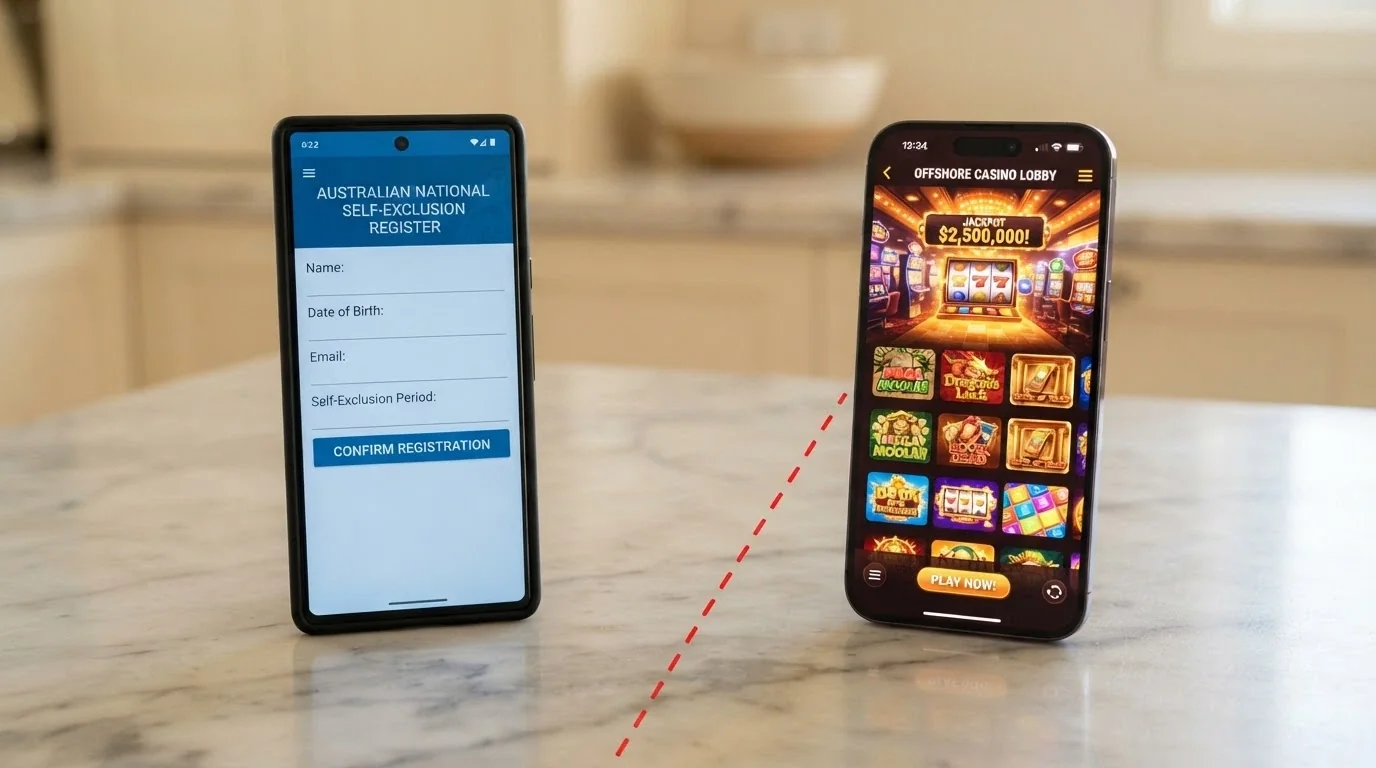
The responsible-gambling infrastructure that exists in Australia was built around the licensed wagering market, and most of it does not reach the offshore casino door. The national self-exclusion register, the deposit limits the licensed operators are required to offer, the activity statements and the ACMA complaint resolution pathway all apply to the licensed market. An offshore casino is none of those things.
The numbers that make the harm real are not abstract. The Australian Institute of Health and Welfare put problem gambling at around 2.1% of the adult population in 2022 — roughly 430,000 people. The Roy Morgan Gambling Harm Index, published in March 2026, found that 15.1% of Australian adults (3.32 million people) are experiencing some form of gambling harm from their own or others’ gambling. 13.0% (2.857 million people) are experiencing harm specifically from their own gambling behaviour. The gap between “problem gambling” (the clinical 2.1%) and “some form of harm” (the broader 15.1%) is the space where most affected Australians sit — people whose gambling is not at the diagnostic threshold but is materially affecting their quality of life.
BetStop Won’t Save You at an Offshore Casino
BetStop, the National Self-Exclusion Register, launched on 21 August 2023 and covers approximately 150 licensed Australian wagering providers. A player who registers with BetStop is excluded from every licensed wagering operator in the country in a single step, with exclusions available from a minimum of three months up to a lifetime. As of 31 December 2025, 54,859 people had registered with BetStop and 35,135 had active exclusions. Of the registrants, 78% were under 40 and 38% chose lifetime exclusion. The outcomes are meaningful: 77% of registrants reported better overall quality of life, 79% reported improved mental health, and 96% either completely stopped or decreased their betting.
The gap is that BetStop does not cover offshore casinos. An offshore operator is not licensed in Australia, is not connected to the register, and has no obligation to honour a BetStop exclusion. Self-exclusion at an offshore casino is a manual, one-operator-at-a-time process, with no central enforcement and no guarantee the operator will block a returning account. The 2026 reform adds a marketing-side response: from 1 January 2027, licensed wagering operators are prohibited from sending direct-marketing inducements for three months after a BetStop deregistration. That restriction does not reach offshore operators either, and the marketing that flows from offshore casinos is governed only by the operator’s own terms.
Gambling Harm in Australia: The Numbers That Matter
The Roy Morgan Gambling Harm Index, published in March 2026, is the most current national measure of gambling harm in Australia. 15.1% of the adult population — 3.32 million people — are experiencing some form of gambling harm, whether from their own gambling or someone else’s. The narrower figure for harm from the individual’s own gambling is 13.0% — 2.857 million people. The clinical problem-gambling rate sits at 2.1% of adults — around 430,000 people — per the most recent AIHW data.
The demographic split matters for who is most at risk at the offshore casino end. 78% of BetStop registrants were under 40, which means the cohort most likely to self-exclude from the licensed market is also the cohort most likely to be using offshore platforms where BetStop does not apply. The harm is concentrated in younger adults and is disproportionately digital in delivery — offshore casinos, crypto rails, mobile-first interfaces — which is the same surface area that fast payouts operate on.
The BetStop outcomes data is the strongest evidence the page has that self-exclusion, where it can actually be applied, works. 77% better quality of life, 79% improved mental health, 96% stopped or decreased betting. Those numbers come from a system that covers the licensed market. They do not transfer to offshore operators. They are the reason the section below on where to get help lists BetStop alongside helpline resources rather than as a substitute for them.
Where to Get Help Right Now
- National Gambling Helpline — 1800 858 858. Free, confidential, staffed 24 hours a day. The first call for any Australian experiencing gambling harm, whether their own gambling or someone else’s.
- Gambling Help Online (gamblinghelponline.org.au). Online chat, email support and free counselling from the same service that staffs the helpline. Useful for players who would rather start the conversation in writing than on the phone.
- BetStop (betstop.gov.au). The National Self-Exclusion Register, with exclusions from a minimum of three months up to a lifetime across approximately 150 licensed wagering providers. Effective inside the licensed market; does not cover offshore casinos.
- Financial counselling. Free, confidential and independent financial counselling is available through the National Debt Helpline (1800 007 007) and through state-based problem-gambling services. The 2026 reforms expand financial counselling as part of the harm-minimisation response.
A player whose gambling has moved from entertainment to something else — chasing losses, hiding deposits, borrowing to play — is the player who should call. The helpline is free and confidential and the call does not require the player to stop gambling first. It is the first step, not the last one.

How We Selected and Ranked These Casinos
The featured operators were ranked on four signals: withdrawal speed, licence transparency, bonus-term fairness and provider depth. The legal anchor is that every operator on this page is offshore — there is no Australian online casino licence because the product is prohibited — so the ranking is among operators that share the same fundamental regulatory status, with the differences lying in how each one operates inside it.
Our Testing and Verification Process
Withdrawal-speed figures came from hands-on testing data published by PayoutVerdict in the first half of 2026. Stake’s 1 hour 50 minute average across four crypto test cycles is the headline result. The USDT TRC20 window of 0.2 to 8 hours and the Bitcoin window of 1 to 6 hours are aggregate figures from the same test pool across multiple Australian-facing operators. PayID’s 24 to 48 hour end-to-end figure comes from PayoutVerdict with the 12 to 18 hour operator-side split corroborated by Gambling Insider.
Licence claims were checked against the Curaçao Gaming Control Board public register for Curaçao-licensed operators and the Anjouan Gaming Authority licensee list for Anjouan-licensed operators. The verification standard was the licence number resolving to a current registration on the relevant register. Where the licence number did not surface in the operator’s public terms or did not resolve cleanly to a current registration, the licence status is marked unconfirmed in the table above.
Bonus-term figures came from the operators’ own published terms pages. RocketPlay’s 40x turnover, A$7.50 max bet and 5-day validity are drawn from the bonus terms on the operator’s bonus page. SkyCrown’s 40x bonus and 30x free-spins split with A$5 max bet and 14-day validity per tier come from the SkyCrown welcome package terms. Fair Go’s 30x deposit-plus-bonus multiple and five-deposit structure come from the Fair Go welcome terms. Rainbet’s 250% across three deposits with 40x turnover and 7-day validity come from the Rainbet welcome terms. The KYC-as-number-one-delay claim is sourced from Gambling Insider’s industry reporting.
What We Couldn’t Verify This Round
Four operators in the featured set — WinSpirit, Scream Casino, Bizzo Casino and Rocket Casino — did not surface independently verifiable data on licence, bonus or withdrawal terms in this round’s sweep. Their fields are marked as not confirmed in the table above, and the individual write-ups direct the reader to verify each operator’s terms directly before depositing. A name-collision note is included for Rocket Casino, which is a different operator from RocketPlay despite the similar branding.
The reason for the verification gap is structural. This round’s operator-sweep queries did not return dedicated search results for these four brands, which means the bonus terms, withdrawal times and licence numbers published on each operator’s own terms page could not be cross-checked against this round’s reference set. The recommendation is the same regardless of the cause: check the licence number against the relevant register, read the bonus terms in full, and confirm the withdrawal methods and times on the operator’s cashier page before any deposit is made.
What the Fast-Payout Reality Means for Your Next Deposit
The withdrawal-speed ceiling on the Australian-facing offshore market is crypto. USDT TRC20 clears in 0.2 to 8 hours with network fees under A$2; Stake averaged 1 hour 50 minutes across four test cycles. The floor is bank transfer, at three to five business days, with no operator able to compress the bank-side settlement window. PayID sits between them at 24 to 48 hours end-to-end. E-wallets cluster around 4 to 24 hours. The expected loss on the bonus that gets you in the door sits on top of all of those numbers, and it is worth running once.

RocketPlay’s first-deposit bonus — 100% up to A$1,000 at 40x wagering — carries an expected loss calculated against Pragmatic Play’s standard 96.5% RTP configuration as the representative figure. The turnover required is A$40,000 (the A$1,000 bonus × the 40x multiple). At a 3.5% house edge, the expected loss across that turnover is A$1,400. The bonus paid in is A$1,000. The bonus costs more, in expected value, than it gives. That is the typical shape of a deposit-match welcome offer across this market, not a RocketPlay-specific quirk: the arithmetic is the same at SkyCrown’s 40x and Rainbet’s 40x and Fair Go’s 30x-on-deposit-plus-bonus (where the turnover base is larger because it includes the deposit). The headline bonus is a marketing number. The cost is the turnover multiplied by the house edge. The cost is almost always larger than the bonus.
The legal reality is the other variable the player carries. Online casino is prohibited in Australia; every fast-payout casino serving Australian players is offshore. The provider is targeted by the IGA, not the player — no Australian has been prosecuted for using an offshore casino — but the protection underneath that hands-off approach is also absent: no ACMA complaint resolution, no BetStop coverage, no Australian Consumer Law recourse, and the live risk of an ACMA-directed ISP block with a balance on deposit. From 1 January 2027, banks gain express authority to block transactions to illegal operators, which means the deposit path through an Australian bank starts to close. Crypto rails sit outside that scope because they do not pass through the Australian banking system, which is the same reason the operators that serve Australian players lean so heavily on USDT TRC20 and Bitcoin.
The decision framework built from these figures runs in three steps. First, decide what rail you want to withdraw on. Crypto gives the fastest result and the cleanest experience; PayID is the Australian-native middle ground; e-wallet is a consistent alternative; bank transfer is the slow lane and the rail most exposed to the 1 January 2027 bank-blocking authority. Second, read the bonus terms in full — wagering multiple, max bet during wagering, validity window, max cashout from bonus — before claiming. A bonus with a 40x turnover and a 5-day window has a real cost in expected loss that exceeds the bonus paid in, and the cost is higher the longer the turnover stretches. Third, accept the legal reality. The speed is real, the catalogue is real, and the protection underneath is not. From 1 January 2027, the deposit path through an Australian bank starts to close; the operators that survive that shift will be the ones that built their payment stack around crypto rather than waiting for the bank-blocking authority to take effect.
The National Gambling Helpline — 1800 858 858 — is free, confidential and available 24 hours a day. If the fast-payout chase has moved from a transaction-speed question to something else, the call is the first step.
Frequently Asked Questions
What is the fastest withdrawal method for Australian online casino players?
USDT on the Tron network (TRC20) is the fastest method available at Australian-facing offshore casinos, clearing in 0.2 to 8 hours end-to-end with network confirmations of 1 to 3 minutes and fees under A$2. Bitcoin is the next tier at 1 to 6 hours. Both sit ahead of PayID (24 to 48 hours), e-wallets (4 to 24 hours) and bank transfer (3 to 5 business days).
How long does a PayID withdrawal take at an online casino?
PayID withdrawals at Australian-facing offshore casinos take 24 to 48 hours end-to-end on average. Roughly 12 to 18 hours is operator-side processing — the time the casino takes to approve and release the funds. The remainder is the receiving bank’s PayID batch window. Friday-evening withdrawals commonly land the following Tuesday because banks treat the weekend as non-business for incoming PayID batches.
Why do some casinos take days to process withdrawals?
The most common cause is incomplete KYC (Know Your Customer) verification, which is the single biggest withdrawal-roadblock in the Australian-facing market. Most operators do not run the full document check at sign-up — they trigger it at the first withdrawal request, which can add three to seven working days while documents are reviewed and resubmitted. Weekly and monthly withdrawal caps are the second cause, turning a single large win into a multi-week drip feed.
What happens if an offshore casino refuses to pay out my winnings?
There is no Australian Consumer Law recourse against an offshore casino. ACMA complaint resolution does not apply to unlicensed operators. A player whose withdrawal is refused or whose bonus is voided has, in practice, the operator’s own internal dispute process and whatever alternative-dispute resolution service the operator subscribes to — which may be none. The IGA does not prosecute the player, but it also does not protect them, and the practical answer is that prevention (pre-verifying KYC, reading the bonus terms, checking the licence on the regulator’s register) is more reliable than cure.
Are crypto withdrawals faster than PayID at online casinos?
Yes. Crypto withdrawals — particularly USDT on Tron — consistently clear inside 8 hours at Australian-facing offshore casinos, with Stake averaging 1 hour 50 minutes across hands-on testing. PayID sits at 24 to 48 hours end-to-end, of which roughly 12 to 18 hours is operator-side processing and the remainder is the receiving bank’s batch window. Crypto also sits outside the scope of the bank-blocking authority that takes effect on 1 January 2027.
What should I do if I think I have a gambling problem in Australia?
Call the National Gambling Helpline on 1800 858 858 — it is free, confidential and staffed 24 hours a day. Gambling Help Online (gamblinghelponline.org.au) offers chat, email and free counselling from the same service. BetStop (betstop.gov.au) is the National Self-Exclusion Register and excludes a player from approximately 150 licensed wagering providers in a single step, with exclusions available from three months up to a lifetime. The helpline does not require a player to have stopped gambling to make the call. It is the first step, not the last one.